Showing posts with label winter waterfowl. Show all posts

Wednesday, 9 January 2019

St. Clair NWA record breaking 2019 Christmas Bird Count

The results are in and the count week is over. Officially this 39th Christmas Bird Count, centred around St. Clair National Wildlife Area along the east side of Lake St. Clair, ended up with 93 species, one better than the previous high of 92 in 2014. And one could make the argument that since Thayer's Gull, which was one of the 92 species that year, has now been dropped from full species status, the 2019 count is two higher than our previous high.

The weather was quite decent for a change, at least compared to the bitter cold and snow of the previous count, which tallied a mere 62 species. Our most recent ten year average is 78 species, so hitting 93 was major indeed. In fact I believe there were only three counts across the entire province that exceeded this total. Considering that an estimated 75% or more of this count's circle is active agricultural land, or Lake St. Clair itself, or private wetlands that were inaccessible, the total of 93 is even more impressive.

Waterbirds, and especially waterfowl, are critically important for the species diversity and overall numbers for this count. All the water was open this year, making it attractive to the myriad ducks, geese and swans. While the cold snap of November and early December caused many ducks to move on, we were fortunate that some environmental conditions caused a major influx of ducks, especially Mallards into the area just a few days before our count. At times the skies seemed full of winged waterfowl. The NWA had lots of open water patches and almost every one had many ducks and geese.
(Note: I did not have my camera with me for most of the day, so most of these photos are from a bit earlier time.)

 We achieved new high totals for several species, including over 46000 Mallards.
 American Black Ducks set a new record with 7560 being recorded.
 Our record for Tundra Swan is almost 11000; we had about half that many, which is still quite a few!
We set a new high for Ring-necked Duck at 215.
Both scaup were represented.
 Only 6 Hooded Mergansers were recorded.
 We had 71 Snow Geese, so our record of 87 was not in jeopardy. We also had two Ross's Geese, which doubled our previous high.
Snow Goose
There were eagles aplenty. Our previous high number for this count was a pretty impressive total of 27 birds achieved in 2016. The 50 birds recorded this year blew that number out of the water. What helped, I am sure, is that because there was no ice on the lake, all the eagles were limited to perching in trees along the shoreline as they waited for a crippled duck or dead fish to come into sight.
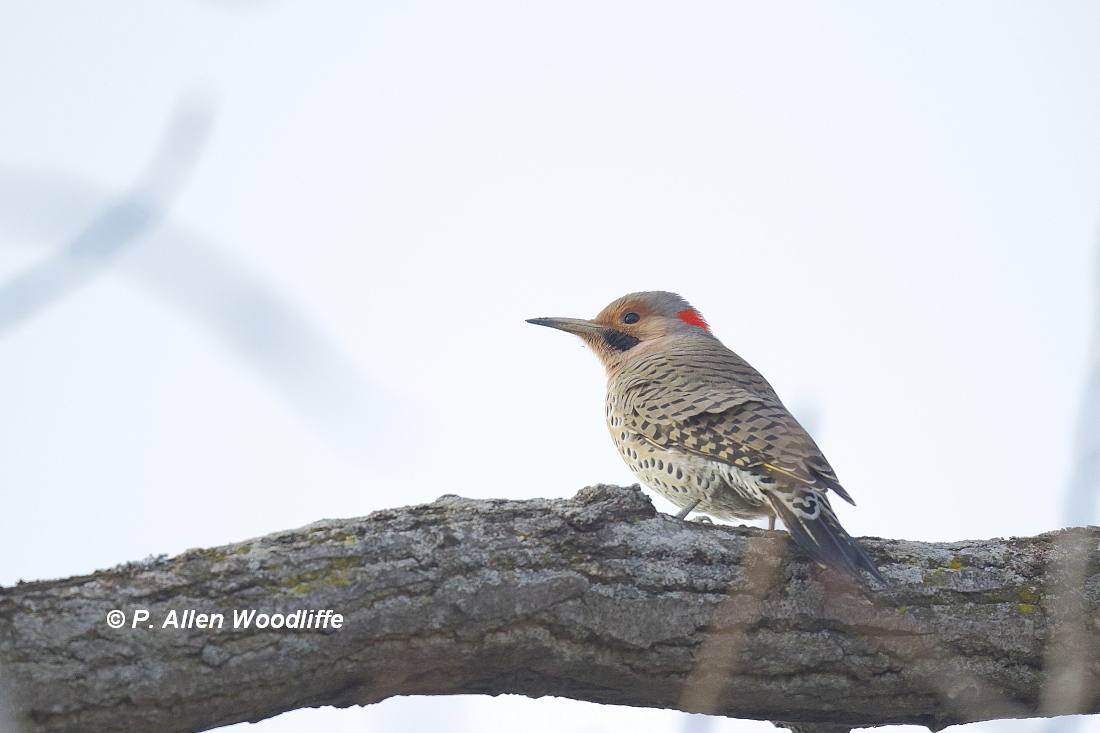
We set a new record for Northern Flicker, with 11 being seen.
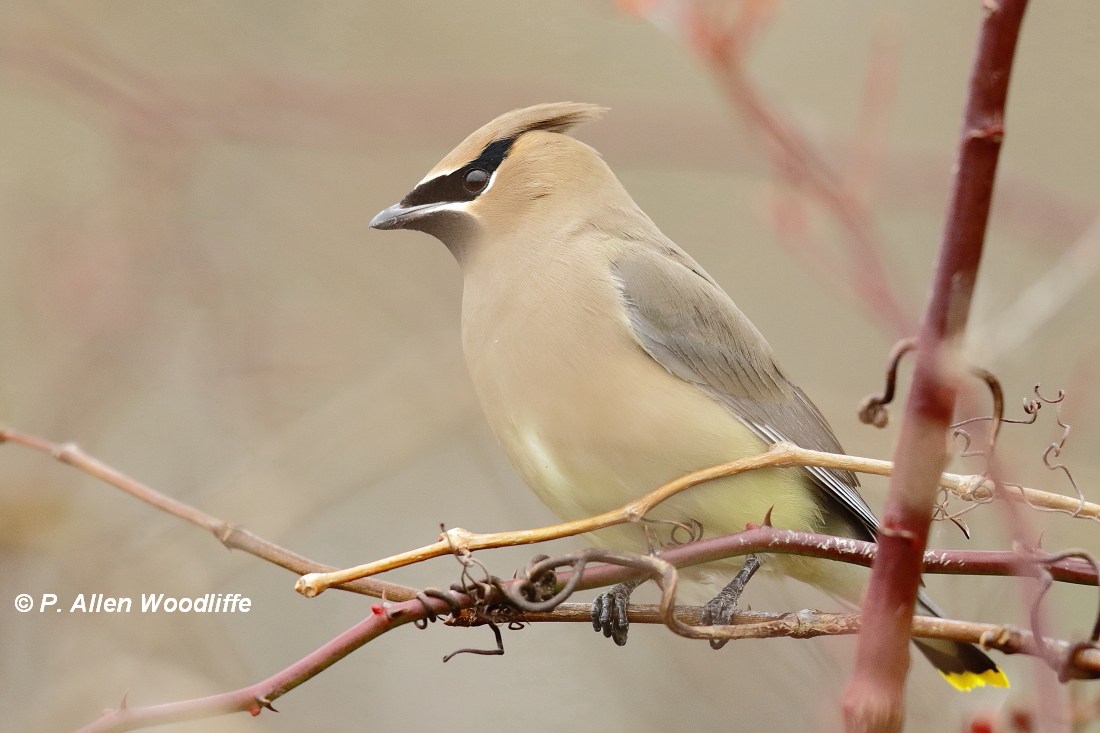
Cedar Waxwings are pretty uncommon on this count, so we were pleased that 17 were seen.
Not quite as infrequently seen as the waxwings, but still pretty hit and miss, is Common Redpoll. With the eruption of winter type finches into southern Ontario lately we were happy to count 32 of this species. Our record of 607 redpolls of 2008 will likely be intact for quite awhile yet!
It used to be that getting even one Snowy Owl was an achievement, and for the first couple of decades of this count we missed them more often than we got them. But something is happening to this arctic breeder, as we have had them for 8 straight years, and got 6 this year. It is a far cry from the 18 we had in 2016, but it is nice to consider it a regular species nowadays.

The waterfowl hunting period is now over for another season. There still are lots of ducks, geese and swans in the area, and as long as much of the lake and wetland area is open water, lots of them will remain. They won't be disturbed from being hunted, and will continue to travel between the wetlands and the fields nearby in relative safety. If a cool-down settles in over the next few weeks, with a bit of snow cover as being forecast, some will likely move on to points south so there won't be as many to see. But the St. Clair NWA is worth a visit at any time of year.


Friday, 3 February 2017

Bald Eagle nesting and winter waterfowl

Now that it is a little more winter like rather than the tease of spring we had not that long ago, I thought it was time to check on some of the wintering waterfowl hanging out in an accessible place. For me, one of the better spots is Erieau, where the vehicle can be used as a blind and birds more or less carry on with their struggle to survive.

With the ice on the lake entirely gone, and even with Rondeau Bay quite open, many of the birds are a little farther away than I would like. But some swam by on occasion.

Bufflehead weren't numerous, but there were a few. Sometimes called 'Butterballs', they are one of the smaller ducks, and not often hunted due to their small size.
Bufflehead
This female Greater Scaup is in fresh plumage. One can tell because the whitish feathers at the 'ears' are not showing, as that typically appears after the feathers are a bit more worn. There were a few males a ways off, but this one seems to hang around close to the channel and harbour area.
Greater Scaup
There were several female Redhead close to the harbour, but the brighter coloured males were well out.
Redhead
The male Harlequin Duck was playing in the surf again. Seeing it is a hit and miss proposition. Even when it is there, it seems to spend more time under water than on the water, and one never knows where it will pop up so you have to be fast to get a good look, and even faster (and luckier) to get an identifiable photo.

A small number of American Coot are hanging on.
Normally they would feed at the water's edge and pick things up without diving. However there is comparatively little sustenance of that sort these days, so they do dive under, bringing up bits of aquatic vegetation. Their dive is anything but graceful, however.....it is closer to a belly-flop at times.

Gulls seem to be almost non-existent in January, but there are a few starting to show up. Actually there were several hundred of them a couple of days ago...mostly Herring Gulls out along the edge of the ice, but a few Ring-billed Gulls like the ones shown below were hanging around the harbour. Anytime a duck came up with a fish, the Ring-bills were ready to pounce....usually unsuccessfully, fortunately for the duck. This first photo shows an adult Ring-bill in pretty good breeding plumage.
This next photo is of a Ring-bill which is still showing some grayish speckles on its upper chest and around the head, indicating its plumage development isn't quite as far along as the bird in the previous photo.

While in the Erieau-Shrewsbury area, I stopped to check a raptor nest along the south end of Fargo Road. I had heard that a couple of Bald Eagles were seen there recently, and sure enough, two of them were there. The one bird on the left is working away at something at the bottom of the nest bowl.
The nest is on private property, but quite visible from the road with a decent pair of binoculars. The property owner is a friend of our family, and he phoned me to let me know about this. He is quite pleased to have a pair of eagles nesting in his woodlot, of course.

Afternoon lighting is the best time for viewing, especially on a sunny day. It is interesting to note that in 2016 this nest appeared, and a couple of eagles were there. But as the season progressed, the eagles went elsewhere, and the nest was taken over by a pair of Red-tailed Hawks. Only time will tell if they decide to stay for the complete nesting season in 2017!


Saturday, 28 January 2017

Goose, Goose, Swan

Any readers who have kids may suspect I adapted the title from the Duck, Duck, Goose, game. It's true...but since this post doesn't really deal with ducks, but lots of geese and swans, hopefully you will pardon the writer's licence here.

Waterfowl are present in southern Ontario in increasing numbers these last couple of weeks, as mentioned in some of my previous posts. Since the Lake St. Clair area, including local marshes, have always held an attraction for migrating waterfowl, it is definitely worthwhile checking things out when hints of spring appear. The fields of harvested corn, beans, carrots or whatever, are an added attraction. And as far as waterfowl are concerned even though it is still January, if the snow and ice disappear, it gives them reason to gradually move north with these conditions, so that eventually when they make that bigger push to their arctic or sub-arctic breeding grounds, it is less distance to travel.

Greater White-fronted Geese had been reported in the Blenheim area a few days ago, and so last Monday I headed for the sewage lagoons there. Sure enough, there were 6 in the far pond, along with several dozen Canada Geese.


A couple of days later, Jeremy Hatt reported good numbers of various goose species near St. Clair NWA. I couldn't get out for a day or so, but yesterday I put it on my schedule. And just east of SCNWA, between Heron Line and Rivard Line, a good number of ducks, geese and swans had congregated, with more arriving all the time. The best views were from Rivard Line.

Some of the most obvious birds were Tundra Swans, their white bodies showing up against the dark landscape and their melodious kloo, kloo calls filling the air.


There were a couple of larger swans somewhat by themselves, so I grabbed a couple of shots of them just because they were relatively close at hand. But since I was really trying to check all the geese, which were smaller, more numerous and blended in against the snow-free landscape, I didn't pay close attention to these swans. My mistake.....at least fortunately when I got the images transferred to my computer and I started looking through them, I realized these were Trumpeter Swans!


Their larger size, the larger and longer bill, the lack of any yellow in the lores, the wider and less pinched black area in front of the eyes, the straighter line of feathering along the base of the bill and the pointed feathering at the top of the bill (the pointed feathering is most obvious on the bird on the left in the lower photo) all are characteristic of Trumpeters. I vaguely recalled hearing an odd swan call, lower and more nasal than a Tundra while I was there, but it wasn't heard often.

Trumpeters used to be a regular breeding species in the Great Lakes region, but were extirpated from Ontario more than a century ago. It was re-introduced in Ontario in the early 1980s primarily in central Ontario, and it has been gradually expanding ever since. Records in Chatham-Kent are very few and far between in the last few decades. However almost a year ago, there were 2-3 birds that showed up in Rondeau Bay at Shrewsbury and were around for several weeks. Once the ice broke up entirely and all the waterfowl dispersed, the Trumpeters were rarely seen, although Blake and Steve had three flying through as late as April 23. Interestingly, a Trumpeter was observed just outside of Rondeau, along Cty Rd 15, on June 7. There is habitat around Rondeau Bay, but no one that I have come across ever saw any evidence of breeding, although they could have done so unnoticed.

Regardless, there were two Trumpeters here near SCNWA. Maybe a few will be the norm again.


As mentioned, geese were the original target of my search on this day. And I was fortunate to see several kinds, including some of the rarer species.


Snow Geese are not all that rare in Chatham-Kent, but certainly are not in the numbers that they occur in in eastern Ontario, where at the peak of their migration, it is not uncommon to see 50,000 -100,000 in a day. But seeing at least 50 in one field here was a nice treat. In this first photo there are about 23 birds. Not all are the white phase, of course.

 This next photo show two of the blue phase Snows, with their dark bodies and white head.
 And here is a first year blue phase Snow, told by the dark head.

There were more Greater White-fronted Geese....at least 8 by my count. Three of them are in this next photo, standing quite close together. They are slightly smaller than the more abundant Canada Geese, but their browner body, pinkish-orange bill and white feathering at the base of the bill are all diagnostic. The second photo shows one in flight, and a closer look might explain why one of the other names for this species is 'Speckle-belly".

Greater White-front in flight
There were some Cackling Geese as well. They are diminutive versions of the typical Canada Geese, but their shorter legs, smaller body size, shorter neck and stubbier bill are characteristic. I didn't get any photos on this day, but this next photo is one I took less than a year ago in a field close to SCNWA.
Cackling Goose in the centre

There were other white geese in the field. They are smaller versions of the Snow Geese, called Ross's Geese, and there were at least 6 in the field. They are not much larger than a Mallard. Some of the key features, besides their size, is the lack of the 'grin' patch on their bill, the straighter drop to the white feathering at the base of the bill, and the smudgy bluish-gray colour at the base of their bill. They also have a shorter, stubbier bill and a more rounded head. These next two photos are of different birds. The first one is quite probably a hybrid between a good Ross's and a Snow, which happens regularly. The subsequent off spring typically show a mix of the diagnostic characteristics. The bird in the first photo is small, but not quite as small as a Mallard. The grin patch is lacking, and the base of the bill shows the bluish-gray colour, but the bill looks a bit longer than a pure Ross's. Conclusion: a probable hybrid.
This next photo is probably a better example of a good Ross's Goose, showing all of the typical characteristics.


While out and about, I did wander some of the roads in the former Dover Township to see what Snowy Owls I could find. Without trying too hard, I came across 7 birds. Most were a long way from the road, and some were not visible except with binoculars. Typically they were standing beside a clump of grass, or a post of some sort. This next photo is of the closest Snowy I found, and it was taken and subsequently cropped to the equivalent of about a 30X 'scope view.


Sunday, 22 January 2017

Waterfowl are the order of the day...hints of spring?

A few days ago it was time to check the St. Clair River. I hadn't been there since the Wallaceburg Christmas Bird Count (CBC) on Dec 27, and the river at that time had very few ducks compared to what it can look like. On that day, I had to resort to some of the creeks entering into the river to find much....even Mallards!


The sky was quite brightly overcast that CBC day, making this shot of an immature Bald Eagle flying overhead challenging.
There were a few Long-tailed Ducks...always a highlight in my opinion.

Gulls were almost non-existent. There was the occasional lake freighter moving up and down. I always get a kick out of seeing how much the bow of the ship raises the water level as it plies its way through.

On this more recent trip, things had improved a bit. There were some quite large rafts of ducks, almost entirely Redhead. There were probably in excess of 5000 birds altogether.
Raft of Redheads
There were a few other species mixed in, including Canvasback as well as one of my favourite ducks, the Ring-necked Duck.
A couple of male Ring-necks mixed in

Common Goldeneye were plentiful in small numbers, as were some of the other typical diving ducks such as Bufflehead and scaup.
Common Goldeneye
A bonus bird was this Common Loon in its winter plumage. There is often one somewhere along the river, but since so much of the river is not in view due to residential areas, there is no guarantee one can find it. This one was fairly close to my side of the river, and no housing was nearby to obscure the view.

On the way to and from the river, I checked out out the area along Meadowvale Line, just south of Wallaceburg. It has been one of the more reliable spots to find Snowy Owls this winter again, and today was no exception. There was one right close to the road, but it didn't like that the car was slowing down, so it headed farther into the field.


A bit of a surprise on this particular visit was the large number of Tundra Swans already in the field, and while I was there, more kept pouring in. There had to be more than 500 swans spread out across the field, and certainly more than I had seen in several weeks. Perhaps the recent mild weather had encouraged them to return, and they were spring migrants???


At one point a large falcon came through, flying low and fast and hugging the ground before landing briefly in a tree. I didn't get a definitive look at it, but the way the swans reacted, it was something they were concerned about, and about a third of them got up and left in a hurry.
Given the arctic flavour of the day, with Snowy Owl and Tundra Swans the only birds in view, I considered it might have been another arctic species...a Gyrfalcon. I'm not sure a Peregrine would have elicited the same response by several hundred swans. Nonetheless, I just entered it on ebird as a large falcon.

Yesterday I took a trip to Erieau. There was still lots of fog around!
Upper part of turbines rising through the fog

I noted the male Harlequin Duck at the far east end of the rocks across the channel.....too far away for anything more than a record shot. At least the water was fairly calm, allowing the auto-focus to hold on the bird. This bird has been in the area for more than a month, although not always visible.
Harlequin Duck on the far right

Today I headed over to St. Clair NWA, hoping that the warmer weather would have brought in some waterfowl. It has been fairly quiet there in the last couple of weeks, due to most of the visible area of the NWA being frozen pretty solid. And it was mostly frozen today as well, but there were lots of Canada Geese in the adjacent fields, feeding on what looked to be left over carrots from last year's harvest. There were at least 1000 Canada Geese, with some white ones in the mix. I noted them first from Balmoral Line, on the south side of the NWA, but later headed over to Bradley Line, the next road south. Of course the geese were about half way in between, in a slightly lower part of the field, so a scope was necessary to examine the flock and photography was challenging.

There were also 18 Snow Geese mixed in, including at least 4 blue phase Snows.
Six Snows on the right, and at least one blue phase on the far left
There had been some Greater White-fronted Geese seen in the vicinity of the Blenheim Sewage Lagoons earlier today, and I scanned this scattered flock carefully to see if any were here. I didn't see any but off by themselves were two small white geese, about half the size of the Snows. I was not able to see their heads, as they were tucked under their wing, so I couldn't check for the 'grin' patch which if present, would indicate they were Snows. But the very small size was pretty characteristic of Ross's Geese! Definitely an unexpected highlight, but no photos to be had.

With all the mild weather, will Snowy Owls stick around or be heading back north?