There are a few rare to uncommon bird species around, mixed in with the expected species. One of the highlights of recent days is the arrival of Dickcissel. It used to be a rather extreme rarity up until a few years ago, and any reports of them immediately created a rush of birders anxious to get them on their life or year lists. While there is still a quick response by birders when one is reported, the occurrence of Dickcissels in southwestern Ontario is not quite the novelty it once was. The beginning of their fairly regular occurrence began in 2017, and I wrote about it for the April, 2018 edition of Ontario Birds, which you can read about here.

Dickcissels have appeared in several places in the south and mid western parts of Chatham-Kent so far in recent days, and I went to a spot where a sizeable grassy/prairie type field had been established a few years ago. I had a couple of the birds there last year, and sure enough, almost as soon as I pulled up to the edge of the road, there was a male singing away. Fortunately this species sings at a pitch that even my ears can easily detect, and this bird came and went several times, giving me lots of photo ops right from the vehicle.
I had been out to another site, privately owned, where I had them last year, but so far, they had not shown up. I will check in another few days. It was not a lost cause, as I was treated to a male Bobolink intent on feeding young at a nest......
....and lots of Savannah Sparrows.

The real bird rarity of the area was even rarer than a Dickcissel. It was a Cassin's Kingbird that showed up in southern Essex County. Its rarity status was clearly demonstrated by the dozens of birders that descended on the site as quickly as they could get there, giving variable views. I am sure it was an Ontario lifer for many. I did not venture there to see it however. It was in late November of 2013 when I found one of this species at Rondeau! Unfortunately it was dead, but still identifiable. It was resting in the sand dunes of the southeast beach of the park. It quite likely had been hanging out along the edge of the dunes and oak savanna, and had gone unnoticed by birders in the area, not all that surprising since it was in late November when birders do not frequent that area very often. With a cold spell of several days earlier, the amount of insects available to it had likely diminished, causing it to perish. It had deteriorated by the time I found it, but it was salvaged and eventually ended up at the ROM.


Far less rare, but still nice to see and even get a few photos of, were several bird species at the local sewage lagoons. About 5 White-rumped Sandpipers were using the sprinkler cells.
The White-rump is easily told by being larger than similar looking Semipalmated Sandpiper, with that latter species shown on the left side of the next photo, and also by the greater black markings extending farther along the flanks. It also has a reddish base to the underside of the beak and longer wings that extend beyond the tail when at rest. And of course the white rump, which shows in flight.
It is uncertain whether these White-rumps are just late in going north, given the vagaries of weather patterns over the last month or so, or early in returning. I had been told by someone much more expert than I, several years ago, that White-rumps go north fairly quickly and even overshoot southern Ontario for the most part, to get a good start on nesting in their arctic territories. But if the weather conditions there are not favourable and nests fail, then the birds will abandon further nesting attempts and slowly move south, appearing here in southern Ontario by mid-June. With that in mind, I suspect these birds are ones that are on the return.

A common shorebird species is the aptly named Spotted Sandpiper, and there are always a few at the sewage lagoons.
Not a shorebird, but a Song Sparrow, next, which occurs in a wide variety of habitats. This one was scurrying around amongst the vegetation at the edge of the sprinkler cells, often just out of sight.
A quick trip to Rondeau was not terribly birdy in the area I explored, but there is always something to see, and even get photos of. Gray Catbirds are not always so cooperative, but this one was advertising its territory and less concerned than usual about me.
Mourning Doves are often well beyond photo range.
The Common Five-lined Skink is anything but common, and is in fact endangered, but can be seen occasionally on a sunny log.
And in sunny spots along the woodland trails, the Six-spotted Tiger Beetle can be found quite regularly. Just so you know, it doesn't always have six spots, however.
One of my outdoor forays involved heading to Clear Creek Forest Provincial Park, a favourite destination at various times of the year. On the way there, I stopped to see how a very large Black Gum tree was faring, given the sometimes extreme wind, snow and ice conditions over the winter. It was doing fine. The flowers are not very impressive, and this next photo shows some deteriorating flowers as well as some early developing drupes, or berries, which will be much larger and blue at maturity.
It is a large, impressive tree, and the only location in Chatham-Kent that I am aware of. The next photo shows it just a bit past the peak of autumn colour, when the leaves are a deep red. This was taken in the mid-autumn of 2022. Maybe this coming autumn I will get it at its peak!
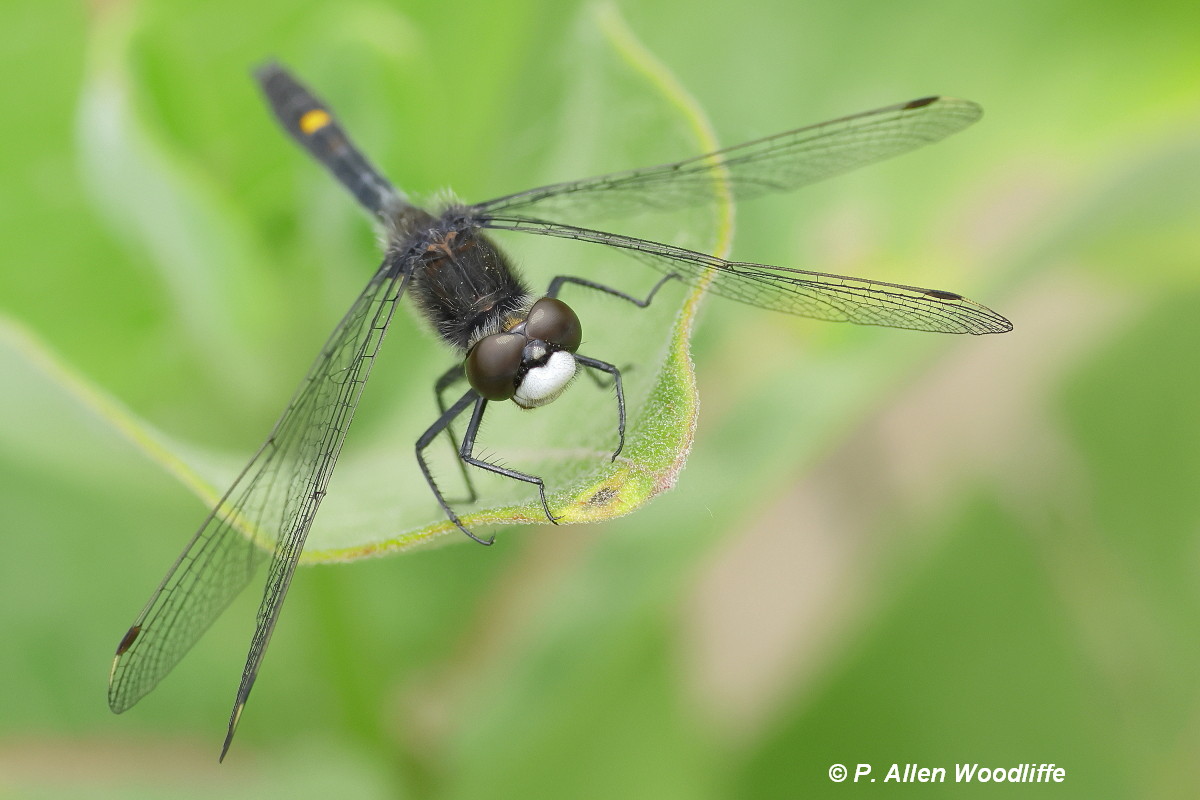
Any visit to Clear Creek Forest PP entails being on the lookout for anything and everything. A walk around the former gravel pit on the north side, can be good for dragonflies, and on this occasion I got these next two species:
 |
Calico Pennant
|
 |
Dot-tailed White Face
|
It was a coolish day, and I anticipate an increase in ode diversity over the next few weeks.
My main purpose was to check up on a very rare orchid: Purple, or Lily-leaved, Twayblade (Liparis liliifolia). En route to that spot, I came across this Northern Crescent butterfly.....
...as well as a Virginia Ctenucha moth.
I was successful in finding the orchid, in spite of it being partially hidden under other, more profuse vegetation, and overall it was in fine shape for photographing.
It is an endangered species, with very few locations for it in Ontario, and only one in Quebec.
Given its subtle appearance, and growing amongst other vegetation, it would not surprise me if it occurs in a few other places, but just hard to find!
If you would like to subscribe, or unsubscribe, to Nature Nuggets, send an email to: prairietramper@gmail.com