Showing posts with label Little Wood-Satyr. Show all posts

Saturday, 21 June 2025

Lots of colours and diversity!

 First of all, I need to apologize for not responding to the many comments readers have shared with me over the past few months. I used to get immediate notifications when a comment was made, but something changed, and so comments that were made since the beginning of 2025 seemed to be tucked away in a different manner, and I only came across them today. I have tried to respond to all of those that were made since then!

June is the prime month for Tulip Trees to show off their impressive flowers. 


 The Tulip Tree Trail is one of my favourite trails at Rondeau for various reasons that I might explain in my other post. At any rate, there are lots of Tulip Trees, but unfortunately for the normal hiker, the flowers are hard to see as the flowers like lots of sunlight so are most abundant near the uppermost parts of the tree. A telephoto lens was necessary to get this next photo.

At ground level, fortunately, there are lots to see at this stage of the season. It is always nice to lock eyes on a butterfly!

Northern Crescent
Wildflowers are more apt to stay put for the camera. This next flower is a Narrow-leaved Blue-eyed Grass.

Another critter came into view: it is a Morbid Owlet, a moth, which was not very active and preferred the shadier parts along the trail. Not sure who comes up with these names, as I don't see anything morbid about it.
Butterflies are fairly active especially on sunnier days. If it doesn't get too hot, I expect they will really like the next few days as it becomes the warmest of the year so far!
Little Wood-satyr
A colourful wildflower that likes open grassy areas, such as at the edge of a prairie/savannah with lots of sun is this next one: Hairy Beardtongue, a native species.


 Purple-flowered Raspberry is starting to be more noticeable at the woodlot edges, as the deep red flower appear. Although it is a member of the raspberry family, the fruits are not edible.

And in a few places, one might encounter the Endangered, Red Mulberry. There are a few places scattered around Rondeau where this species can be found, and it is in flower right now.

 In some of the wetter areas, one will come across this next wildflower, Tufted Loosestrife.

Also along trail edges, but not a native species, is Common Mouse-ear Chickweed, named because the 5 petals are partially split, looking like a pair of ears.

And then another moth comes into view. It is known as a Black-bit Moth.

 An even smaller creature resting on a leaf was this Basal Click Beetle, barely a centimetre in total length.

Not a flower in the normal sense of what one might expect, is this next one: American Cancer-root, formerly known as Squawroot. It is parasitic on the roots of various trees, mainly oaks and beech trees, although this particular one was part of a clump at the base of a White Pine. But since the roots of trees intermingle underground, it could easily have been connected to an oak, which was nearby. It doesn't have leaves and flowers like most flowering plants, and what is seen above ground is really just the flowering/fruiting body.

One can come across Ontario's only lizard at Rondeau, the Common Five-line Skink. I know I have featured them in recent posts, but I thought this one was worth showing. I refer to these particular ones  as 'Love Skinks'. The male has the orange facial area. I have never seen a pair of them this close, and with the male having his right front arm over the back of the female!


While we were watching this pair, we had what we determined was likely a Short-tailed Weasel pop up on the boardwalk less than two metres of my feet, grab something and disappear. I suspect that as we had slowly walked along the boardwalk approaching this spot, the weasel dropped what it had in its mouth, and scampered away, but was reluctant to give up its meal and so returned. It all happened so fast I was unable to get a photo of the weasel. I didn't get a solid look at what it came back for, but the person I was with said it looked like a small skink, perhaps part of the extended family of the pair we were watching. I had seen young skinks in this immediate vicinity on previous visits, so it was entirely likely. Certainly an interesting time watching nature in action, much to the chagrin of the little skink.
 

Visitors to Rondeau earlier this season likely would have noticed where the park's prescribed burn efforts were this year. Several areas looked like this:


In only a short period of time, the grasses responded well, and even now, several weeks later, the growth has been quite lush, as expected. The burn keeps the numerous shrubs, some of which are not native and aggressive, in check, so that the native grasses and wildflowers continue to represent an important part of the park's vegetation mix.
I was going to feature some more early season orchids, but that may be in the next blog. And check out my new-themed blog, Life Is A Journey, at this link. I plan to post my next one on this blog very soon.

If you would like to subscribe, or unsubscribe, to Nature Nuggets, send an email to: prairietramper@gmail.com
 

Wednesday, 12 July 2023

Rondeau Butterfly Count

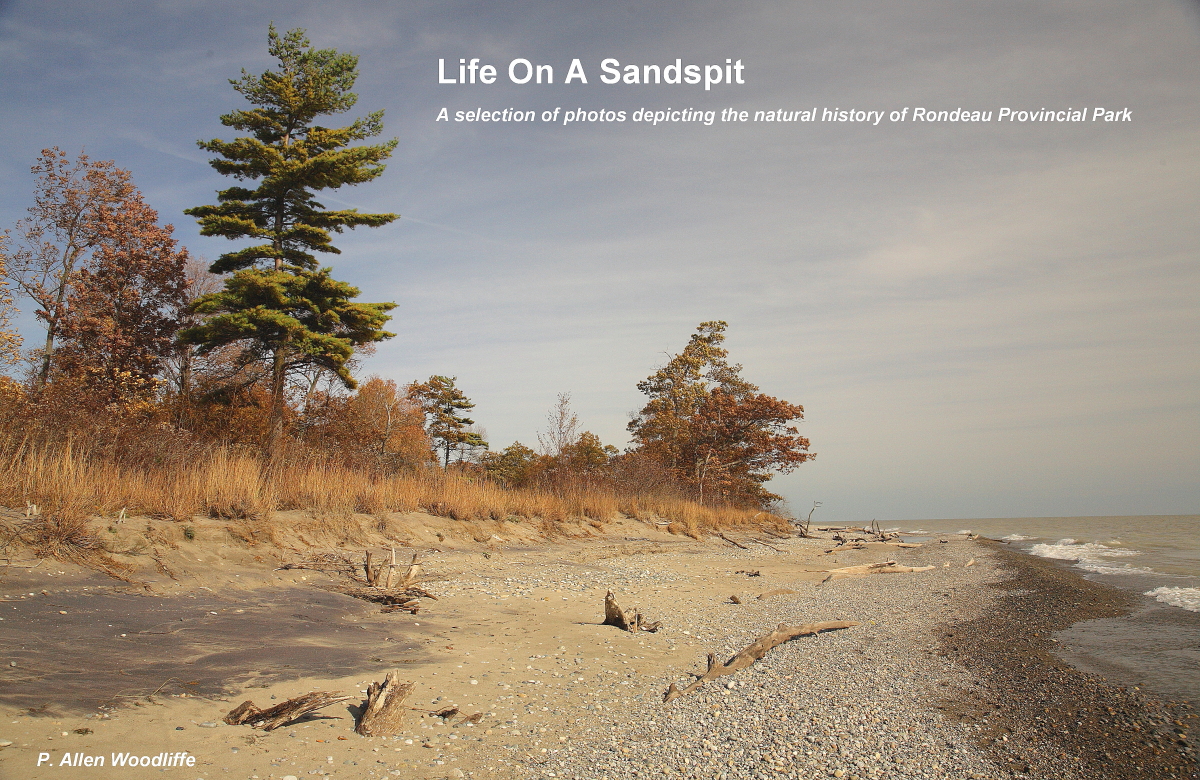
Just a brief note regarding Life on a Sandspit: it seems to have garnered a lot of interest and is doing well.

It is currently available at the Friends of Rondeau store (inside the Rondeau Visitor Centre), as well as the Bayview Market, just outside the Rondeau PP gates. It is also available via the Sydenham Field Naturalists, and you can see it, along with other nature publications on their web site here. I am slowly finding other local sites where it may be available, and will provide updates on those as they occur.

On to the butterfly count post.

Just a few days ago, on July 9, was the annual butterfly count, for the Rondeau area. Over the past 22 years, it has ranged from 35 to 47 species, averaging about 41 species. I don't have the final tally for this year, but based on the area that I and my colleagues did for this one, I think we will definitely be below average both for total species and individuals. I usually get about 18 species, but this year I got only 15. Of course weather is always a factor, and the cool, cloudy, misty weather this year did not bode well. And a downpour of heavy precipitation in the afternoon for some, did not help at all. Nonetheless, it can always be worthwhile to get out and see what is around. The following photos are ones I took while meandering through the several spots I normally cover. I didn't get photos of all the species I recorded, and the results vary.

This first one is the only swallowtail species I encountered, and just one individual!

Black Swallowtail
Bronze Coppers, next, are not a guarantee, and I only saw this one. Fortunately it cooperated to get the kind of photos that allowed me to separate it from the American Copper.

If this count was taken a few years ago, I would have no problem identifying this next one as a Summer Azure. However the lepidopterist taxonomists have examined the Celastrina genus a little differently, and it apparently is not quite so easy, so this one could be as Summer Azure, but I left it as Celastrina sp.

Common Wood-nymph

Eastern Comma

Eastern-tailed Blue

Little Wood-satyr
Monarchs, shown next, got off to a slow start in the count, but as the day wore on, I came across several areas where Common Milkweed was present in the hundreds of plants. One area could have even had more than a thousand plants, so getting several dozen Monarchs was not hard. If I had been able to carefully survey this largest milkweed site, I could have easily doubled the number of Monarchs, but by that time I was losing energy so I did most of my surveying via scanning the large field with binoculars.
Crescent butterflies are normally fairly common, but for some reason, that wasn't the case on this day. I had just this one Northern Crescent.
Although the ? on this next butterfly isn't all that visible, it was indeed a Question Mark.
Red Admirals, at 57 individuals, were by far the most common of the butterflies, other than Cabbage Whites at about 70.

Of course anytime one is out in such habitat, there are always other things to see, so I took advantage of the photo ops I was given. This Eastern Gartersnake was quietly sitting along the edge of one of the first trails I took. I presume it was trying to soak up some of the non-existent sunshine, as it never moved even a bit, although I got quite close.


Along the Erieau Marsh Trail there were the usual things like Great Blue Heron.....
...and even a Trumpeter Swan.
Song Sparrows were common in most areas.....
...as were Red-winged Blackbirds.
Along one area, which follows an old Railway Track, I saw three Wild Turkeys, but true to their character, did not allow me to get very close. This next photo is highly cropped.
Along this same part of the area I covered, I noted several clusters of a Species At Risk, known as Prairie Rose.
And I even saw the occasional day-flying moth that enabled me to shoot it: the Eight-spotted Forester.

Once all the results are tabulated, I will update the results for this count, but as far as I can tell in talking with several other counters, it will not be one of the better ones. Every year is different! Update: there was a total of 1777 individuals of 36 species recorded on this day, so definitely on the low end of average.


If you would like to subscribe, or unsubscribe, to Nature Nuggets, send an email to: prairietramper@gmail.com


Thursday, 11 July 2019

Butterfly Count Scouting

Tis the season for butterfly counts. While there are a number in the area, the only one I participate in is the Rondeau area one, coming up this weekend. So in order to get in the mood, I spent a bit of time last Monday at Rondeau checking out one of the most prolific patches for butterflies in the park. It is actually an old dump site, known as the Dillon Dump. With the high water this year, and a tree that had come down across the entrance to the trail leading to the dump, I don't believe anyone had been in there for weeks, possibly not for months. I talked with some of the park staff ahead of time, and one or more of the maintenance crew cleared a pathway at the entrance through the fallen tree limbs making access possible (thanks, Jon!).

One of the things that this site has going for it is that it is an opening of about one hectare, completely surrounded by deciduous woodland and swamp, and the main plant there right now is Common Milkweed. Fortunately it is in peak flowering condition right now. There must be upwards of 2000 plants, and with each of them having several flower heads and each head having at least several dozen individual flowers, there may be 10,000 or more individual flowers for pollinating insects to feast on. Butterflies were fairly abundant, not surprisingly. I spent about an hour there in the sweltering heat and came up with 14 species of butterfly. I'm sure there were others. There wasn't anything unexpected, but with the butterfly season to date seeming to be a little behind time, it was nice to see this diversity in one location.

I managed to get photos of the following species. There were Monarchs a-plenty, not surprisingly.
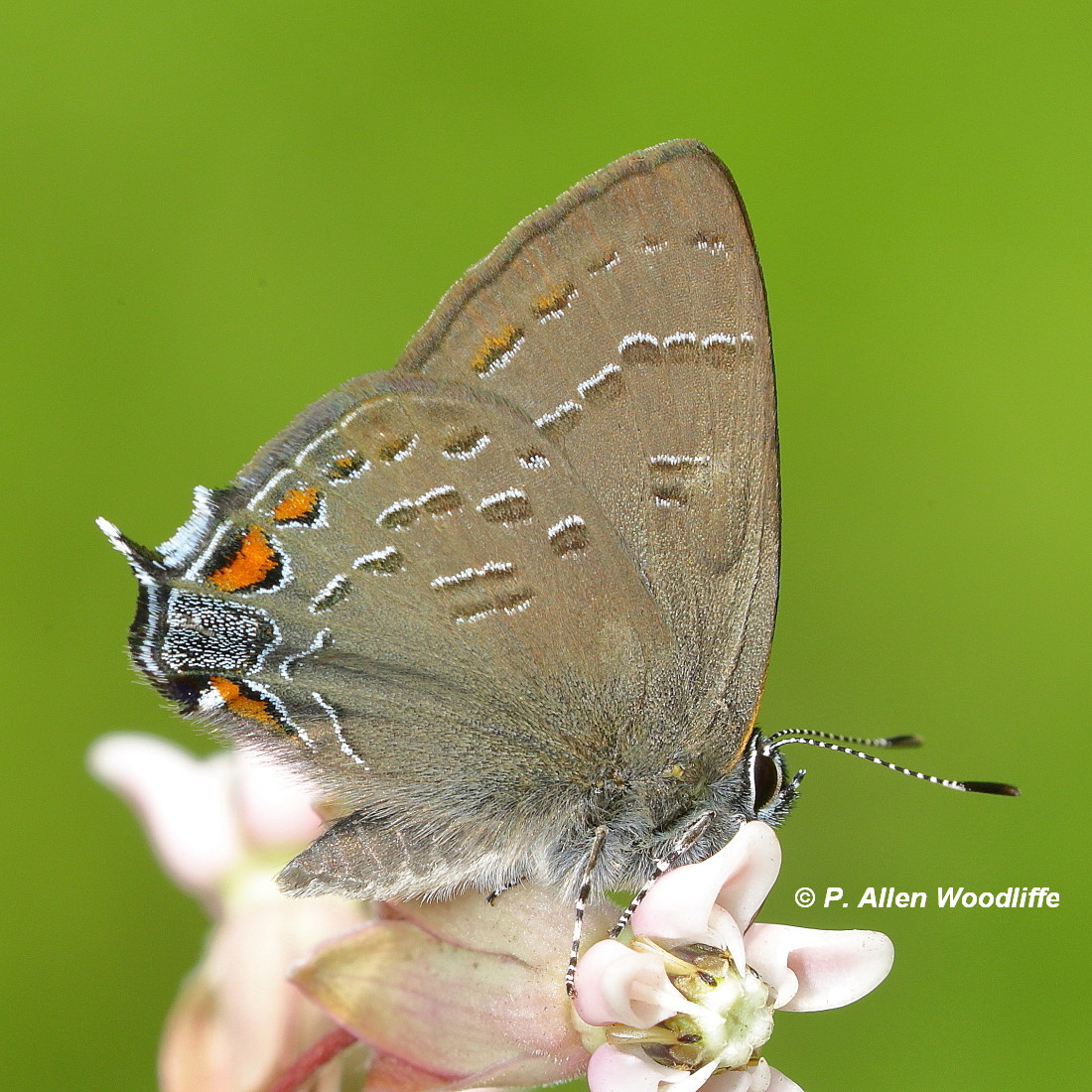
A couple of Banded Hairstreaks were nice.

Eastern Comma
Eastern Tiger Swallowtail
Hobomok Skipper
Pearl Crescent
Question Mark

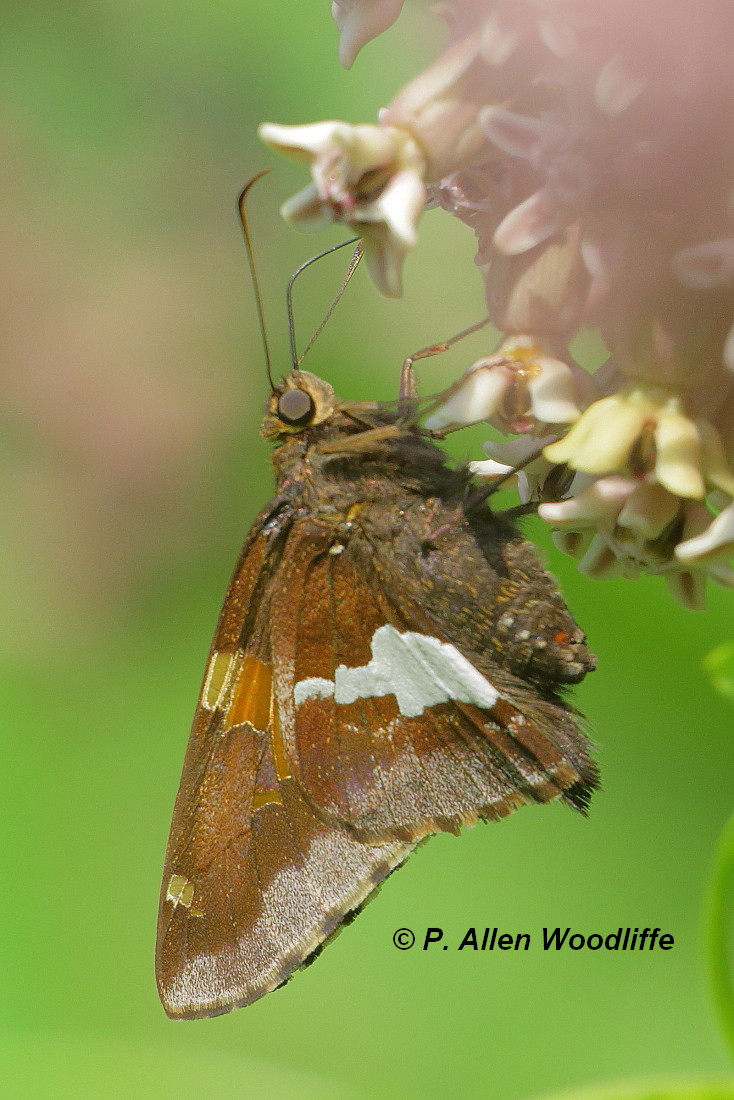
Silver-spotted Skipper
Little Wood-Satyr
There were a few that I didn't get photos of, including Summer Azure, Red Admiral, Tawny-edged Skipper and Northern Broken Dash, as well as a couple of skippers that skipped away too fast to get any kind of decent look at. And there were likely others that I didn't see, but might have if I stuck around long enough. I did get a Viceroy a bit later on.
There were lots of dragonflies as well, although almost all of them were of the Meadowhawk type. I just wasn't sure which one, as the three possible ones are often difficult to distinguish in the field.

 There were lots of damselflies as well, but I only tried to get photos of this one, a type of Spreadwing in the Lestes genus.
Hopefully the upcoming butterfly count will have a decent result, but time will tell. However unless someone wants to venture out the officially closed Marsh Trail, a significant part of the count area will not be covered. This next photo shows the north end of the trail, at a location where hundreds of birders stood patiently last September and October waiting for the famous Great Kiskadee to show itself. Things have changed considerably, due to the record high water levels of the lakes; hence the closure of the trail.

I also had some things to do in the vicinity of Clear Creek Forest Provincial Park, so I took a bit of time to look for butterflies and dragonflies around the open area and ponds at the north side of the park. The butterflies were much the same as what I got at Rondeau earlier, but with less diversity. The dragonflies were plentiful though. Again, nothing really unexpected but it was nice to have so many to choose from in such a small area.
Blue Dasher
Calico Pennant
Common Whitetail
Twelve-spotted Skimmer
Widow Skimmer
 There were quite a few Eastern Pondhawks, including young males with their thorax still transitioning from green to pale blue.

With all of the dragonflies around, it was no surprise to see the exuviae still clinging to the tops of dead stems, where the nymphs had climbed out of the water to subsequently emerge as adults.
Whilst on the watch for dragonflies, I noticed this Bronzed Tiger Beetle scurrying across the sandy edge of one of the ponds.
There were a couple of dragonfly types that just wouldn't land and so I never got a chance to identify them let alone photograph them. Maybe next time.