Showing posts with label Peck's Skipper. Show all posts

Tuesday, 20 September 2016

Prairie patch action, #1

Prairies are great places to explore, for all kinds of reasons. Unfortunately there aren't many left! So sometimes small patches of vegetation that appear somewhat like prairie have to do instead.

I've been to a few of those lately. One place is a narrow strip along an active railway line just east of Thamesville. A few posts ago I highlighted some of my findings. As I was in the area recently, I decided to check it out again. Not surprisingly, the Ironweed that was dominant and highly attractive to butterflies at my previous visit, was just about finished. But as often happens in the natural world, another species takes its place. This time it was Prairie Thistle (Cirsium discolor).

Prairie Thistle is quite uncommon in Ontario, being ranked as S2. It is a much paler purple than the abundant, and not native, Bull Thistle (Cirsium arvense).
Prairie Thistle
And the butterflies loved it! This first image is of a very tattered Giant Swallowtail visiting an equally tattered Ironweed. I was impress by how easily this worn individual could still fly. I am sure that it must have been much more taxing given the lack of lift these wings could provide.
This is another Giant Swallowtail, not quite as tattered as the previous one. During my previous visit I had as many as eight Giants, but there were only about three this time.
 There were at least a couple of Great Spangled Fritillaries around.
Great Spangled Fritillary
And several Monarchs....it was hard to keep track of their numbers as they moved around constantly.

This next image shows not a butterfly, but a day-flying moth known as a Hummingbird Clearwing. In flight it very much resembled a hummer.

Other winged invertebrates included a few damselflies, such as this Eastern Forktail.

But butterflies were the main attraction, and there were the usual common species, such as Viceroy, Black Swallowtail, Eastern Tiger Swallowtail and this Peck's Skipper on the much darker Bull Thistle.

I also visited a friend's family farm north of Thamesville, where several hectares have been planted into various mixes of prairie grasses and forbs. There was much the same mix of butterflies, but I lucked out and got a couple of rarer ones, such as the not-so-common Common Buckeye....
Common Buckeye
.....and the even less common Common Checkered Skipper. It has been an excellent year for this species. I have seen more this year than in all my previous years of looking for butterflies!
Common Checkered Skipper
Where there are wide grassy roadsides in rural areas, there are often a few Groundhogs....at least until the predators get wind of them!

Even more recently I have explored some prairie patches and restoration areas in Lambton. I will be highlighting them in a future post.


Tuesday, 22 September 2015

Summer ends.......autumn begins

Summer is ending, but it is still a magical time of year with so much to see. The weather is more pleasant for getting out to explore, in my opinion.

The brisk winds ranging mostly from the northeast to southeast these last few days made it enticing to get to the east beach of Rondeau, hoping that some of those rare waterbirds show up, such as jaegers or Sabine's Gull. So I spent a bit of time hanging out at the Dog Beach Access at Rondeau scanning the lake. With all of the wind and wave action, even the gulls weren't spending much time on the water. There were at least 3000 gulls within view, mostly Ring-bills and Bonaparte's with a handful of Herring and Great Black-backed mixed in. A few Common Terns and Caspian Terns were there as well.

A small portion of the mass of gulls
 One gull, the one in the centre of the next image, looked a bit out of place here, and it was surprisingly aggressive towards the nearby Bonaparte's Gulls from time to time.
 After scratching my head for awhile, I am convinced it is a Bonaparte's Gull in a plumage that I don't often see here at this time of year. It appears to be a bird passing from the juvenile to first winter plumage.....the black nape was particularly noticeable, but the size, shape, black wing bar, pink legs and dark bill all point to a young Bony. The bill is actually a bit lighter towards the base, but isn't all that evident in this photo due to back lighting. In looking at the other Bonies in the group and elsewhere, I did not see another one quite like this.

It is quite possible that there was a rarity or two tucked away in the mass of gulls, but they were so jam-packed together and the light was a bit harsh, I just couldn't pick out anything rare in the group.

Late summer wildflowers are always a good place to find some action. New England Asters don't get a lot of respect by us humans, since they are so abundant, even weedy at times. But they are a bonanza for many insects. Pollinators love them!
New England Aster
Peck's Skippers are still around in good numbers.

Goldenrods also are favourites with many pollinators. This member of the Paper Wasp group is large and easy to photograph. When they are nectaring on flowers, I find they are more interested in the flower than they are with a camera, macro lens and flash right up close.....but I try and remember to move slowly.
Paper Wasp (Polites sp)
 Along woodland edges and opening, one can find Rattlesnake Root, a.k.a. Smooth White Lettuce (Prenanthes alba), another member of the Compositae family.

 In the grassy areas, one can find a fragrant orchid, the Great Plain's Ladies'-tresses (Spiranthes magnicamporum). It is one of the last orchids to bloom each year, and some are just starting to peak.
They have a scent somewhere between vanilla and hot plastic! The arrangement of flowers, as shown in this next image from the top, is distinctive.
Plants show individual characteristics, as this next Great Plain's Ladies'-tresses was taken just a few metres away on the same day, but it is clearly about a week farther ahead in its blooming as the lowest flowers are already brown and even the upper most ones are showing signs of being past their best.

Milkweeds are always worthwhile to check for invertebrate activity. There are still Monarch caterpillars munching away. I hope this one has a chance to make it to Mexico!

And this looks like a Red-banded Leafhopper convention....or is it an example of the three-on-three rules the NHL is going to use in games that go into overtime beginning in 2015?


These developing pods of Purple Milkweed below are prime spots for a gathering of the Large Milkweed Bug clan. There are various ages represented here, and on the lower left of the left side pod, one can see a few of the remaining exoskeletons of bugs that have recently shed. On cool mornings, one can see tightly grouped critters all trying to take advantage of the morning sun.

Berries are always important sources of food for migrating birds, especially thrushes, thrashers, catbirds and warblers. These brightly coloured berries of the Winterberry (Ilex verticillata) stand out against the dark greenery...no doubt they will soon be consumed. It is an uncommon plant at Rondeau.
Winterberry

While investigating a small patch of trees and shrubs to find out what bird was making some chip notes, I got side-tracked by this brightly coloured Eastern Gray Treefrog resting on a leaf of a Green Ash.
 As you can see, it really isn't gray at all in this case. This species has the ability to change its colour to blend in with its surroundings, although it usually takes several hours to change completely.
Eastern Gray Treefrog
Nearby, in a puddle along the parking area, was this Green Frog. Note the partial tire track right in front of it.....I guess he likes to live dangerously! Fortunately there isn't a lot of vehicle traffic during the week this time of year.

Green Frog

A day or two before, I was in a large natural area in north Lambton. One of the highlights of the trip was to discover a new location for a rare gentian: Stiff Gentian (Gentiana quinquefolia). It is S2, meaning there are between 6-20 locations known for it in Ontario. However even some of those populations have disappeared, so it is an increasingly rare species, although not legislatively protected yet. I have only seen this in the past on the prairies of Walpole Island First Nation.
Stiff Gentian
Even at known locations, its numbers may vary from year to year, as it is a biennial species.

On the return from northern Lambton, I stopped at a section of the Sydenham River passing through northern Chatham-Kent. Although the sun was low, there were still a few odes moving about, including this beautiful American Rubyspot.
I got a quick glimpse of a Smoky Rubyspot, as well as a large dragonfly cruising along the bank, but the latter never stopped long enough for me to get a good look at it.

And so summer is about over, but a new season begins.
Chenal Ecarte sunset


Monday, 8 June 2015

Do you know where Swamp Cottonwood is?

I've had occasion to check out Bickford Oak Woods Conservation Reserve three times in the last few weeks. It doesn't take all that long to get there, but there aren't any official trails, so one has to be willing to follow some overgrown logging trails, or bushwack their way through once you arrive. At 308 hectares in size (760 acres) and much of it being wetland, it isn't the easiest place to get around, but usually well worth the effort.

Drainage is poor, leading to all sorts of small and large wetland pockets.
Typical forested wetland of Bickford Oak Woods
One of the things that Bickford Oak Woods Conservation Reserve (BOWCR) is known for is the only location in Canada for the tree species called Swamp Cottonwood. It was discovered by Gerry Waldron, John Ambrose and Lindsay Rodger in 2002, while doing some inventory work. It is hard to believe that even in this 21st century, new tree species are being discovered in southern Ontario!
Swamp Cottonwood
Swamp Cottonwood grows to a fairly good size, and occurs in a buttonbush swampy area. There are several dozen trees of various sizes.....the image here is from a very short young plant.

The wetlands are great spots for amphibians, such as this tiny Western Chorus Frog, only about 2-3.5 cm long.

In general, the BOWCR does not have a lot of large trees. It was acquired by business men during a time when industrial expansion of that part of Lambton County was thought to be a good investment. But industrial expansion did not occur in this area, so it sat for decades. It did undergo fairly intensive timber harvest about 50 years ago, as well as some cattle pasturing, so it wasn't in the most pristine shape. But in the late 1990s, the owners called me to see if any government or private conservation agency would be interested in purchasing it, and so a plan of action was put into place. With the extreme generosity of individuals, local field naturalist groups, the Nature Conservancy of Canada as well as Ministry of Natural Resources, it was acquired and eventually designated as a Conservation Reserve. The forest is rebounding from the harvesting and pasturing activity of the past. But hints of such activity remains, if one only looks at the type of tree form that is common to see throughout the drier sections of the forest.

Multi-stemmed tree trunks abound. Oak was a valuable forest product, and so the merchantable timber was taken out. But oaks have a tendency to sucker after harvest, and some of those suckers are now the well established tree trunks. It is quite common to see double and triple stemmed trunks of various oak species.

Triple-stemmed White Oak
 And on occasion, one may find one with as many as five trunks such as this Red Oak below shows.
With this forest being so large at over 750 acres, it has a significant amount of what is known as Interior Forest, which is the forested portion at least 100 metres from the edge. This is the maximum distance at which edge species, such as Brown-headed Cowbirds, will normally venture in, giving a safer area for birds such as Wood Thrush, Ovenbird and other forest interior species to breed without being parasitized by the cowbird which lays its eggs in other species nests.

Ovenbirds, Wood Thrush, Scarlet Tanager, Yellow-throated Vireo, Rose-breasted Grosbeak and others are fairly common here. Less common species include Cerulean Warbler, Tufted Titmouse and even Acadian Flycatcher. I have seen or heard all of these here from time to time, other than the Acadian......that one is pretty infrequent here.

Some of the largest wetland areas in the BOWCR will support Beaver, and a Great Blue Heronry is in the vicinity of these same interior wetlands.
Beaver cutting
I noted this One-spotted Stinkbug along the trail.
And in October, one can easily find Witch-hazel, a shrub that only flowers in the fall.
Some of the property that was formerly in farmland has been left to regenerate, and even had some tallgrass prairie plants and wildlife shrubs established about a decade ago. Right now, these areas are great for butterflies and dragonflies. This first one is a Common Baskettail, but it had me fooled at first because they normally have an obvious dark spot at the base of the wing. It is more noticeable in the second photo.
Common Baskettail
 Also fairly abundant was Common White tail, as in the next photo showing an immature male of the species.
 Twelve-spotted Skimmers were also well represented.
Twelve-spotted Skimmer
Wildlife shrubs, such as this Nannyberry, are coming into good flower these days, which is great for butterflies.
Nannyberry
Eastern Tiger Swallowtail
Giant Swallowtail
American Lady
In the grasses and clover were some smaller lepidoptera:
Common Ringlet
Juvenal's Duskywing
Peck's Skipper
I'm not 100% certain if this is a Peck's Skipper.....those little rascals are sometimes a challenge unless you get just the right angle to show the important characteristics.....if anyone has a better idea, please let me know.

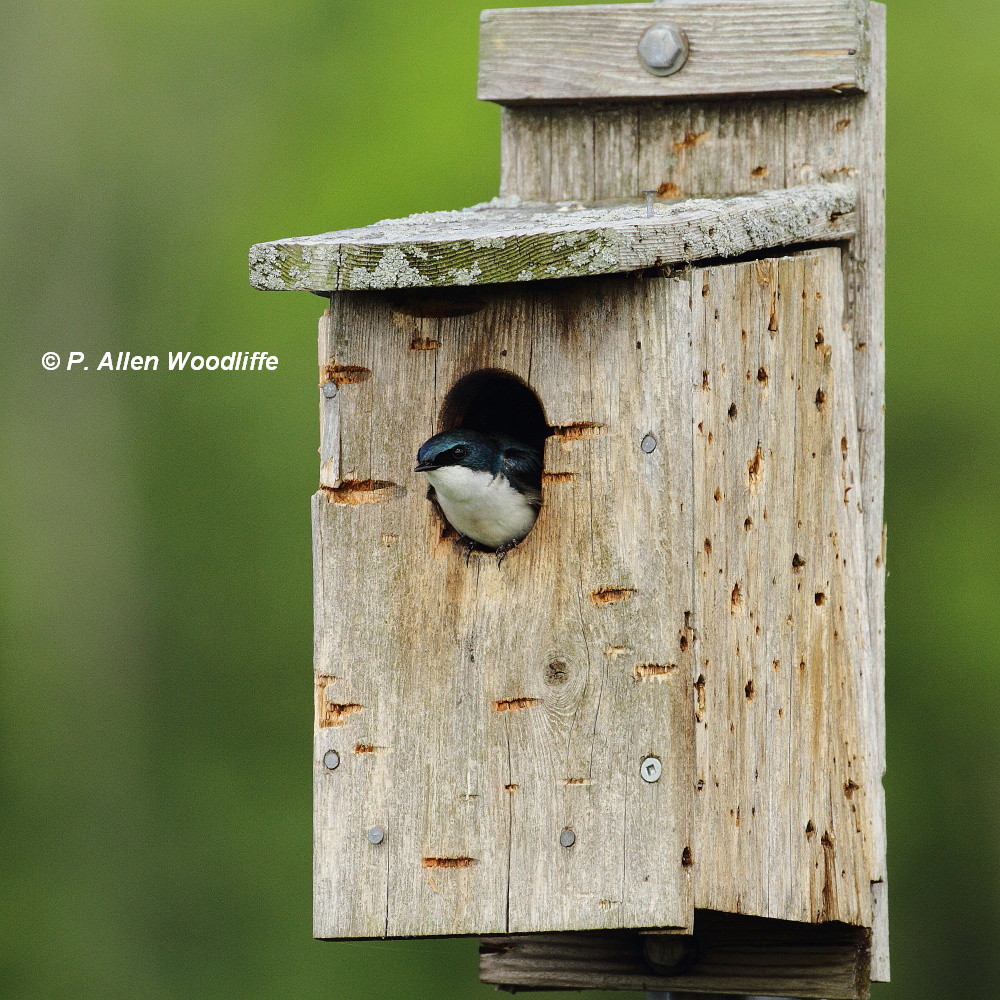
While I was busy photographing butterflies in the open grassy area, this Tree Swallow and its mate were keeping an eye on me.