Showing posts with label Mourning Dove. Show all posts

Thursday, 28 September 2023

A bird with the aerial view decides to nest

 Nesting Mourning Doves in southern Ontario aren't uncommon at all. But the timing for this one, the chance to photograph it from start to finish, and from the comfort of air conditioning over the course of those mostly hot and humid days of August, gave the opportunity to create this post.

 This pair didn't even start to build their nest, as sparse and flimsy as it was, until early August of this year. The vast majority of bird species have finished their nesting cycle weeks earlier, and some have even begun their southward migration. But for a year-round resident species, the lateness of the summer isn't all that much of a problem.

A pair of Mourning Doves (MODO) have attempted to nest at this spot in the past. On one occasion, they were at least partially successful. Building a nest of their style does not lend itself well to this particular location. The branches of the White Pine tree are quite smooth and getting a bit of nesting material to stay long enough to construct the next stages is next to impossible, especially if there is any wind. Nonetheless this pair persisted, and eventually they had what they thought would do the job.

In spite of the visibility of this nest location, photographing it was not without its challenges. If there was any kind of wind from a northerly direction, some pine branches got in the way at just the wrong time. And for any morning photos, which was generally the most active period, the nest was backlit. Overcast days were generally better for morning photos, but that put the ISO of the camera higher than I would have preferred. The mirrorless R7, which I used almost entirely for these photos, handled the increased ISO much better than my other DSLR cameras,

 They were well along at this stage, but still had some finishing touches to complete.

It was interesting to see some aspects of the nest building process. The male comes in with a bit of nesting material.....


...and then typically climbs onto the back of the female, which is sitting in the partially constructed nest, passes the material over and she decides where it is needed.

This next photo was taken on Aug 8 the first day of incubation of what presumably were two eggs, the typical number for this species.

Day 1 of incubation

I took a few photos over the next several days, but there wasn't a whole lot of difference to show. It was on Day 14, that the hatching began. Nothing really to see in this photo, but the adult's general actions indicated something was happening underneath. The adult kept getting up and looking at the eggs it was sitting on....

Day 14 after incubation begins

...and by Day 16, activity increased to the point where it was clear hatching had begun.

It was around this time that I was reminded of a well-known bird observer from many decades ago, who made numerous astute and detailed observations of a common nesting species, the Song Sparrow: it was Margaret Morse Nice, and you can find a bit of information on her at this link. She didn't have high quality optics and camera equipment available, but used her exceptional ability to observe detail, and record that. She was definitely ahead of her time, and contributed observations of bird behaviour for several decades.

I am not putting myself at the same level of observing and interpreting bird behaviour as she was, but I thought at least I had the optical and camera equipment available to document some things that I could. While MODO is a commonly breeding species, they don't often nest in such a location that has an accessible view.

During the first few days after hatching, there wasn't much to observe. I took a few photos, but by Day 21, 5 days after hatching the two young were much more visible. They grow quickly!
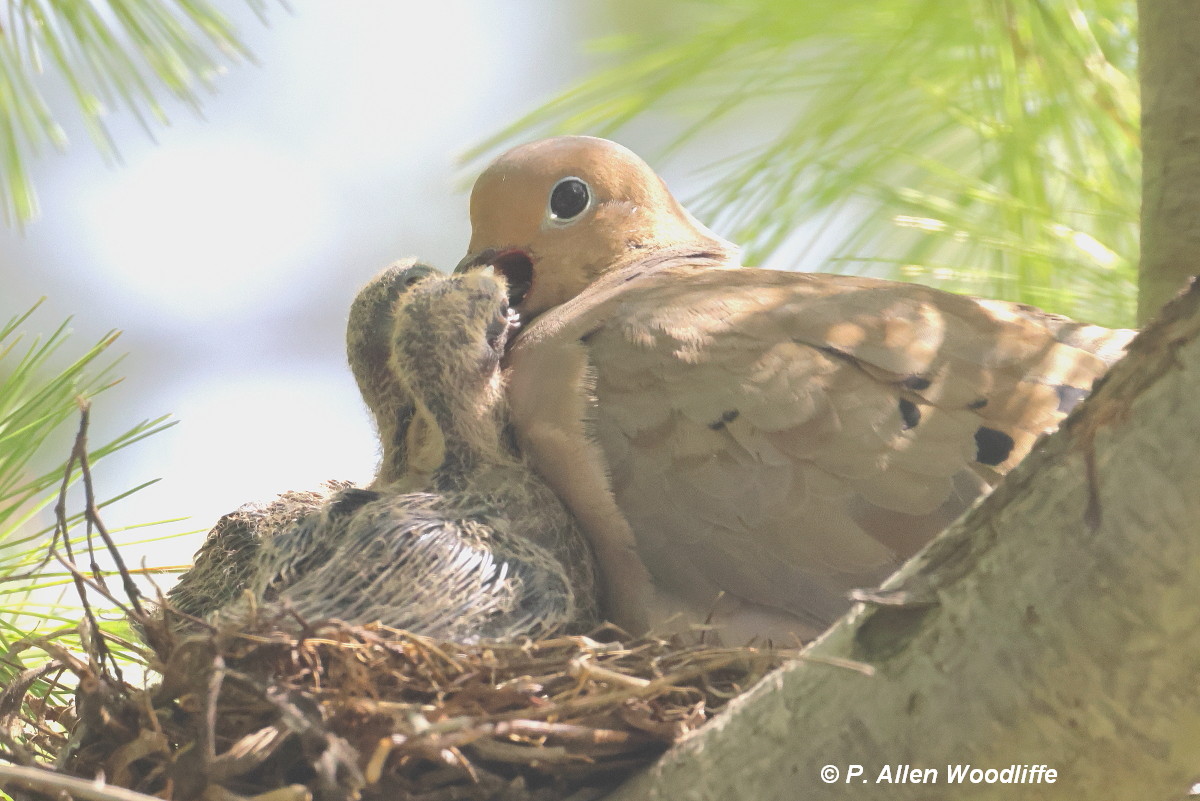
The MODO does not feed its young in quite the same way most other species do. The adults ingest their normal diet of seeds and then proceed to create 'pigeon milk' in their crop. The young, as shown in the photo above, then 'dig in' to the adult's mouth and either get to where the pigeon milk is waiting, or sometimes cause the adult to regurgitate some of the pigeon milk to a more accessible part of its mouth. This goes on during the entirety of the nesting period, and continues for even a couple of weeks after they have left the nest. Then they will eventually switch over to the normal MODO diet of seeds.

Most of the first few days the young, when not feeding, are content to sit low in the nest, barely visible. It seems the adults were getting a bit restless from time to time, probably to stretch to compensate for the long periods of just sitting.

Day 22

By Day 26, when the young were about 11 days old, they were much more visible and active in their own way.


By Day 29, they were getting quite large, and a crowded nest was more and more the case. When one tried to move around at the edge of the nest, it might have even lost its balance a bit. At least this caused it to develop its wing muscles in preparation for future air borne mobility.

I should mention that the vicinity of the nest seemed to have been kept clean. In many songbird groups, the adults remove the white fecal sac from the nest and immediate area so that predators have less to go on when looking for something to prey upon. I never saw the removal of white fecal sacs with the MODO. However I did frequently observe the adult poking around in the nest, and coming up with and even eating small dark things which I expect was what the young had eliminated from their digestive system.

The young were increasingly observed just by themselves at the nest. It was definitely getting more crowded.

Day 30

The next morning, on Day 31 and about 15 days after hatching, there was only one bird in the nest. It seemed a little more restless and it was observed moving around on the supporting branches beyond the nest itself.

Day 31
It spent a lot of time on the edge of the nest, looking for where its sibling had moved on to.....
---and discovered it was sitting at the edge of the garden, all by itself unless an adult came in to feed it.

Later that same day, the presumably younger bird had decided it was time to get out, and by mid-afternoon it too, had vacated its home and re-joined its sibling.

They were seen in or near the garden on a regular basis for several days afterwards, always on the ground, but with decreasing frequency.
By Day 38, they were seldom seen at all, and on occasion clearly had developed their flying capability to get to above ground locations. At this stage, they were looking more and more like the adults.

MODOs are still around the neighbourhood, and will be for the remainder of the year and beyond. But it is next to impossible to determine which are the youngsters that came from this nest.


If you would like to subscribe, or unsubscribe, to Nature Nuggets, send an email to: prairietramper@gmail.com


Friday, 11 August 2023

Waterbirds continue, Fungi and some backyard wildlife

 The autumn migration continues, with a few more northern warblers filtering southward, as well as shorebird numbers and diversity continuing to build. At the local sewage lagoons, the species and numbers vary, but the lagoons are productive, as evidenced by a good number of 'out-of-town' birders checking them out in addition to us locals.

One of the highlights of recent days was the single day sighting of a Red-necked Phalarope. I didn't get to the lagoons that day, but went the following day. There was at least a dozen birders over the course of the next day, all with the hopes of encountering this rare shorebird. Unfortunately there has been no sign of the phalarope by anyone since, but it is relatively early in the autumn migration so another one might show and stay around. A highlight of this outing, however, was to see my first of the year Baird's Sandpiper.

Short-billed Dowitchers, a shorebird with a long bill, but on average shorter than its Long-billed relative, are also appearing as expected.
There are lots of the diminutive Least Sandpiper around....
....as well as Lesser Yellowlegs....
...and Semipalmated Sandpipers, and others.

Sandhill Cranes continue to be around wetlands, as well as recently harvested fields nearby. At this time of year one might expect to see a third or fourth one, as a family group. It is more likely that this pair was unsuccessful raising any young this year, since there were no young accompanying them.

With the amount of precipitation in recent weeks, it will come as no surprise to see a profusion of fruiting fungal bodies around in the leaf litter or emanating from rotting wood, some of which are quite colourful or at least distinctive. These images were all taken during one or more of my quite recent orchid forays at Rondeau.

Coral Fungus
This next one is a member of the Gomphus genus, without a common name. It might be a relative rarity on the North American landscape, but species identification is yet to be determined.

Next is a member of the Waxcaps group.

And this next one is a member of the Deer Mushrooms group.

This last one is known as Dead Moll's Fingers, a member of the Xylaria genus

There are things of interest much closer to home, which is great for my photographic itch when I don't wander too far. Marie spotted this caterpillar busily trying to get through the grasses. It is an American Dagger Moth.

In the pollinator part of our community garden, the Great Black Digger Wasps are busy....
...as are the various species of wasps and wasp-like critters. The one in the photo below is a member of the Umbrella Paper Wasp group.
A young Short-horned Grasshopper posed for a single photo before leaving for parts unknown.
This Tachinid Fly, which is hard to identify to species with a single photo, was keeping an eye on my camera with ring flash and macro lens coming closer and closer.
Much easier to get photos of was this Giant Swallowtail, once considered an uncommon and even a potential species at risk not that long ago.

Nesting season is still ongoing. We have had a pair of Mourning Doves building a nest just a few metres outside our living room window. They didn't start until after the first of August, and the female is now sitting on the nest almost all the time. Presumably there are one or more eggs. In past years, Mourning Doves have attempted to nest in the same location, but without success. Their nests are flimsy structures, and they could never get any nesting material to stay in place. This pair has found a way, and we will be keeping an eye on how it develops over the next few weeks.

As an update regarding my book 'Life on a Sandspit':


 It is now available at more locations, including:

-Friends of Rondeau bookstore in the Rondeau Visitor Centre;

-Bayview Market, just outside the park gates;

-Mindful, an interesting store in Blenheim at the main intersection of Talbot Trail and Marlborough St

-The Book Brothers, on King St E in Chatham

-via the Sydenham Field Naturalist web site, at https://www.sydenhamfieldnaturalists.ca/publications/


If you would like to subscribe, or unsubscribe, to Nature Nuggets, send a request to: prairietramper@gmail.com


Sunday, 10 August 2014

Backyard wildlife......more but different!

Many people have relatively well-manicured, even relatively sterile lawns. Not us! The less grass to cut, the better, and so a lot of it has been put into trees and gardens. The latter may be of the veggie type or the ornamental flower type or even the wildflower/tallgrass prairie type. It is amazing what one can get into a small space!

And that leads to a wonderful diversity of fauna making use of it. Some of the interesting critters you may have already seen on previous blog posts. But there is often something new popping into view.

The Echinacea in particular attracts a wide diversity of insects. Bees are buzzing around like crazy, as are various fly type pollinators that look like bees.


On the dill, we see the larvae of Black Swallowtail.

Black Swallowtail larva

This guy is still pretty tiny....it has a lot of growing to do before it becomes an adult.

Black Swallowtail adult

I came across another immature katydid recently. This appears to be another of the Fork-tailed Bush Katydid type. It spent some of its time on this Echinacea, but was on its way to a nearby tomato plant.

Fork-tailed Bush Katydid female


One morning, tucked up under some raspberry bushes, was this magnificent moth. It is a Pandorus Sphinx, one of the largest moths of the area. It feeds on wild grape among other things. It looks very fresh, so it may have just emerged from its cocoon in the previous few hours, and was spending the day drying its wings and waiting for nightfall to begin the next chapter in its life.

Pandorus Sphinx

Much smaller than this sphinx moth is a planthopper, looking very much like a small leaf with legs on the move. It isn't much larger than your thumb, and usually gets around by walking on the vegetation, but it can both leap and fly at least for short distances.

Acanalonia conica

On the underside of some cucumber leaves were these tiny Lace bugs, just a few millimetres in body length. They get their name because upon a closer look, part of their body has a delicate lace-like pattern. The adult is on the left and the much smaller nymph is on the right and lower down.

Lace bugs

Attached to a stem that had been cast into a future compost pile was this empty case of a Cicada. There are several kinds of cicada in this range....I am not sure exactly what species this one is. Maybe now I will hear the adult singing/buzzing away in the tree tops on a warm day.
Cicada sp nymphal case

Not a true insect, but a member of the Arachnidae family, are spiders. They aren't the favourite critter to warm up to, but they do catch lots of insects! This Garden Cross Spider had its web stretched across some plants, and had already captured several small insects.
Garden Cross Spider
This Orchard Orb Weaver had its web stretched between a couple of milkweed plants, and likewise had had several feeds of insects that became entrapped. It really is an attractive critter when you get up close to it. Go ahead....take a closer look!

Orchard Orb Weaver
Because we use a lot of composted material in our garden, fungi appear from time to time. The parts that we typically see are just the fruiting bodies of the much larger organism below ground. There, the 'roots' of the fungi (called mycorrhizae) are busily devouring dead plant material. The fruiting body above ground lasts just long enough to have the spores disperse, to enable more of them to find a suitable substrate to live on. This one is, I believe, a type of Coprinus or Inky Cap. Many of them are much larger.....this one's cap is only about 1.3 cm in diameter.

Inky Cap
At the opposite end of the size spectrum, we have our resident bunnies......you will be hearing more about their exploits in life and death in a future post.


American Robins have several broods over the season. I think our local ones are on their third brood already. This recently fledged youngster was hanging out along the pathway through our prairie/forest patch.

 It then hopped up to the fence, and seemed to be interested in the nearby house wren nest box. I'm not sure what was going through its mind!

Just below this spot, a fledged young Song Sparrow was resting, waiting for one of its parents to come by with food.

Song Sparrow fledgling

And above the house late today, this adult Mourning Dove had it own 'aerial view' of the property......perhaps it was getting ready to view the super moon tonight.....or not.


No, we don't have cable or satellite tv.....we only graduated from bunny ears a couple of years ago, but with this set of rooftop aerial, we can get all the channels we 'need'. We can spend more time in the garden or elsewhere observing nature, and we provide a good resting place for birds.....what would they use if we had cable or satellite :-).