Showing posts with label Swamp Milkweed. Show all posts

Sunday, 25 October 2020

Black-headed Gull, Autumn colours, and Seeds

The title may seem a bit eclectic, but there is so much to see in nature!

The great fluctuations in the weather at this time of year is perfect for putting birds on the move. And that means species not normally seen can show up, however briefly. Certainly in the last day or so, with the brisk north to north east winds, raptors continue to be on the move. Bald Eagles, shown first, continue to be frequently be passing through, while Red-tailed and Red-shouldered hawks are building in numbers. They are often too high for great photography, at least when I have seen them, so this image of a sub-adult Bald Eagle will have to suffice.

The bonus for watching for raptors along the north shoreline of Lake Erie is that waterbirds are seen as well. Common Loons, the occasional Red-throated Loon, grebes and scoters are seen but often well out from shore. On occasion some unusual gull may be found, such as the adult Black-headed Gull that showed up along the shoreline just north of Rondeau this past Friday. Steve C put the word out that both a Sabine's Gull and Black-headed Gull had been seen there within a 30 minute time frame. As I was already on my way out to the park, it was easy to stop by. The Sabine's Gull had gone from view awhile before (it was reported later in the day, but well away from this location), but the Black-headed was still in the vicinity, although it had moved down the shoreline a bit. Garry S and I struck out down the beach, noting two other birders intently looking through their scope. Kevin G joined us and by the time we got to where the birders were scoping some gulls, the Black-headed Gull flew into view and joined a small group of other gulls already resting at the shoreline. Although it was still a distance away, the light was good and the telephoto lens worked well. This first photo shows the Black-headed at the left, showing its characteristic red bill with a dark tip and red legs, and the black dot behind the eye. Several Ring-billed Gulls and a single Herring Gull in the group made for an easy comparison.
Although we wanted to get closer for better photos, we hesitated since there were other birders on their way to see this quite rare vagrant. But there were non-birders walking along the beach, some with dogs, and it was only a matter of time before the gulls flushed. We went a bit closer and then waited. But a dog was getting too close, and the gulls were getting restless. Then all of a sudden the Black-headed took to flight, and fortunately flew in our direction. With the nice light, it made for some good photo ops. This is only the third Black-headed Gull I have seen in the Rondeau vicinity in over 5 decades of birding!

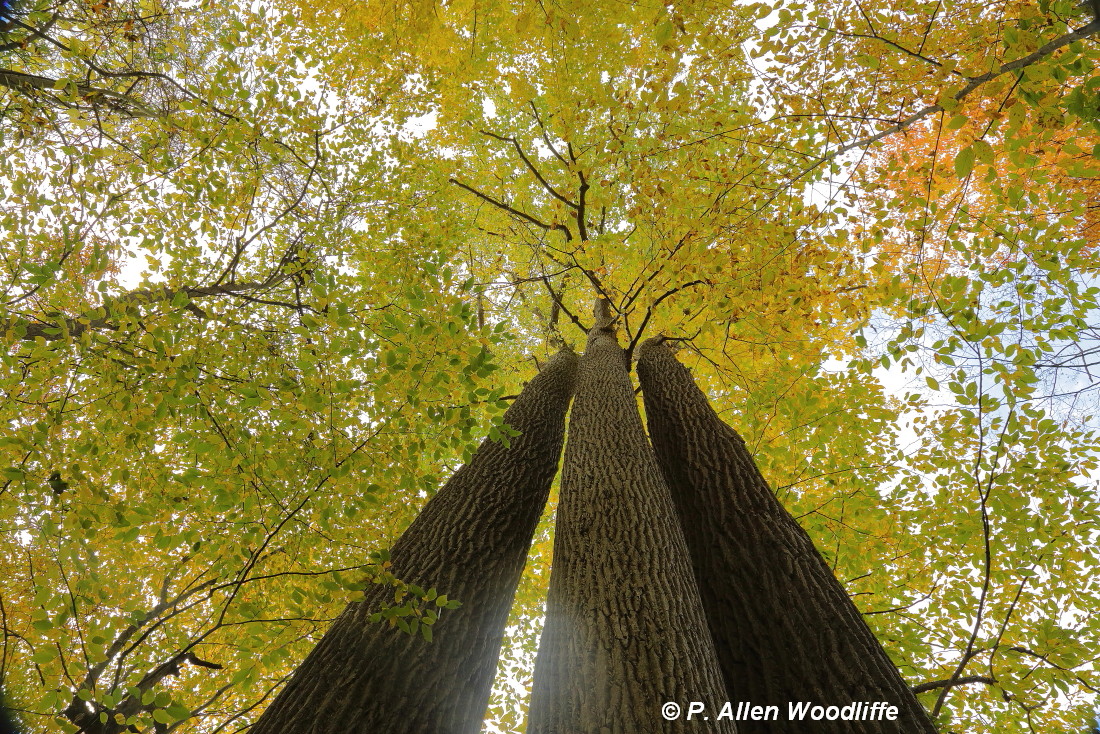
I headed into the park, wanting to photograph some of the golden autumn colours before the forecast wind and rainstorm in a few hours, blew most of the remaining leaves off the trees. Bennett Avenue is one of my favourite places here. The colours aren't as vivid as sometimes, but were still nice to see,

Here are the trio of Tuliptrees along the Tuliptree Trail.

A slug of some sort was crossing the path. At first glance it looked like a species I photographed earlier in the year, which turned out to be an endangered species. I'm not sure about this one, though.

I also like to get to Clear Creek Forest Provincial Park for some autumn colour photography. Here is one of my preferred vantage points, a couple of weeks ago. It was still looking quite green, and the creek itself was totally dry.

  This is from the same vantage point, taken yesterday, two weeks later.
And just to provide a different perspective, this is a lower angle from the stream edge.
A few days ago I got a message from Fred, a retired OMNR colleague, about a white goose associating with the large flock of Canada Geese hanging out at Mud Creek, here in Chatham. Knowing that Snow Geese are arriving in the area these days, Marie and I decided to check it out.
 
This was one that we saw along the creek system.
But it wasn't the one that Fred was referring to. We also saw this one, which turns out to be a hybrid of a Greylag and domestic goose. Who knows where it came from, but hybrid geese involving the Greylag, native to Europe, are widespread.
This is also the time of year when the fruiting bodies of many plants are visible, although maybe not for long as some are highly sought after by wildlife. Big Bluestem is one of the most common grasses in a Tallgrass Prairie. The seeds will be a source of food for songbirds, especially sparrow types.
 
Seed of the Common Milkweed are quite photogenic, and they are often abundant, which bodes well for the species in the future, as well as for the endangered Monarch butterfly which relies heavily on the availability of this plant.


The seeds of the Swamp Milkweed, shown next, are very similar, not surprisingly, and the plant is just as important to the Monarch.
Although this next seed head is not that of a native plant species, it is photogenic just the same. It is that of Green Foxtail.
 The bright red berries of Winterberry will not last long. When they are found, they are consumed quickly by some of the thousands of migrating songbirds.
 
 This next photo shows the fruiting body of another member of the plant kingdom. The part of the fungus we see is just a small part of the extensive living fungus that is growing underground, inside the trunk of a tree, or wherever. I'm not sure what species this is, but thought it was photogenic.


Tuesday, 12 July 2016

Butterflies, birds and a new location for a rare plant

It was an almost perfect day for a butterfly count this past Sunday....sunny, hi temp of about 28C and not much wind. The only thing that was missing was the abundance of butterflies that everyone was hoping for! Of course the very dry conditions over the last couple of months, with the exception of the last week, was undoubtedly a factor.

Regardless, intrepid butterflyers headed out to their respective territories in the Rondeau Provincial Park area. My territory included areas in the Erieau McGeachy Pond/Rail Trail area, as well as various old fields, pastures, etc around Blenheim.

There were lots of flowering plants for nectaring, including:
Common Milkweed
Bird'sfoot Trefoil
Catnip
Common Sow Thistle

Crown Vetch
Wild Bergamot
Swamp Milkweed
Yarrow
Only the milkweeds, Yarrow and Wild Bergamot are native. The rest are not, but butterflies and other pollinators don't seem to know the difference.

Cabbage Whites ruled the day, at least in terms of numbers.
Cabbage White on Sow Thistle
 Sulphurs weren't far behind.

Skippers were not plentiful where I was, but Silver-spotted were the most common.
Silver-spotted Skipper
 A few Northern Broken-dash were recorded.

Where Common Milkweed was common, one would find a few Monarchs. I haven't found them very abundant this year, but more so than last year so far.
Monarch on Common Milkweed
I noted a single Black Swallowtail.

There were lots of Common Wood-Nymphs. Normally their bouncy and erratic flight makes them impossible to photograph, and when they land, they are usually in a heavily shaded or vegetated area so also next to impossible to photograph. Fortunately (for me) these two were busy and let me get a couple of shots.
Common Wood-Nymph

Little Wood-Satyrs were not as abundant as I found them in the past week or two, but still were around in small numbers.
Little Wood-Satyr
 There were a few Great Spangled Fritillaries, but often were rather worn like this one.

I only saw a single Question Mark.


There were a few Eastern Tailed Blues around.


The butterfly highlight of the day for me was Common Buckeye. I saw one while I was walking the road along a railroad corridor and small wooded area along Fargo Road north of Blenheim.

Of course while out looking primarily for butterflies, there were a few other things that caught my eye from time to time. Along this same Fargo Road I came to a soon-to-be-harvested wheat field, and I noted two brown ears sticking out a little higher than the grain.
It got a little nervous with me aiming my camera at it. Undoubtedly the short train that rolled past behind me at this time, increased its nervousness, so off it bounded for cover. The light wasn't the best, but you can see some white spots, indicating it is this year's fawn.


Wild Turkeys are fairly common across the landscape these days, but one doesn't see them as often this time of year with all the vegetation cover. This one scooted across the road fairly quickly, giving me only one shot.

Another highlight for me along Fargo Road was discovering a new population of a Species At Risk plant: Climbing Prairie Rose (Rosa setigera). It is designated as Special Concern in Canada and Ontario. In Canada it is most common in Essex County, but also occurs in good numbers scattered across the western part of Chatham-Kent. There are very few records of it east of Chatham-Kent. I noted at least 30 clusters of plants, most of which were just a bit past their best.

Climbing Prairie Rose
With all of the shrubby, old field type habitat I was walking through, I noted the usual shrubby, old field habitat type birds, including Gray Catbird, Willow Flycatcher, Song Sparrow, Savannah Sparrow, American Goldfinch, etc.

American Goldfinch male

Eastern Pondhawk is one of the more distinctive and striking dragonflies, in my opinion.

While at the Blenheim Sewage Lagoons, keeping an eye open for birds is recommended. The sprinkler cells that were bone dry all spring, have now been repaired and there was lots of water in them. Shorebirds were fairly plentiful too, for the season. I noted a couple of Greater Yellowlegs, probably 30 Lesser Yellowlegs, and several dozen small sandpipers, most of which were either Least or Semipalmated, and the usually abundant Killdeer. The least expected shorebird species were these two Short-billed Dowitchers.
Lesser Yellowlegs (l); 2 Short-billed Dowitcher (r)
So while it wasn't a banner year for butterflies in my territory, it was a good day to be out, and there is always something of interest.




Wednesday, 16 July 2014

Milkweeds (and Monarchs) have a new lease on life!

Probably many of you reading this are aware of recent changes to the Noxious Weed list of Ontario. Up until this spring milkweeds, which includes the entire genus of Asclepias, were on this list and ultimately at risk. Landowners were obligated to remove them from their property, and if they didn't, the weed inspector could authorize someone else to do it for you and send you the bill!

In reality, there was only one species of milkweed that was really any problem, and that species was Common Milkweed (Asclepias syriaca). It could get quite aggressive especially on the farming landscape, as it thrives on disturbed sites. But the list of Noxious Weeds was compiled years before there were chemical controls and other methods of tilling that helped keep it from being too problematic in the agricultural setting.

Asclepias syriaca

The Monarch butterfly is highly dependent on milkweeds, especially Common Milkweed, as the adults lay eggs on the milkweed's leaves and the caterpillars consume the leaves. The milky sap that the caterpillars ingest as they eat the leaves is what makes eating the caterpillars so distasteful to predators. The very distinctive colours of the caterpillar serve as ample warning to caterpillar-eating birds to beware.....they are not a tasty meal!


In recent years, as the Monarch butterfly declined and became legally listed provincially and nationally as a Species At Risk (SAR), there was a conflict with retaining milkweeds on the Noxious Weed list and requiring landowners to destroy the critical plant of a SAR. So it was a major, yet long overdue, event earlier in 2014 when milkweeds were removed from that list.

With that as background, let me introduce you to eight of the other nine milkweeds of Ontario (The 10th species, Four-leaved Milkweed [Asclepias quadrifolia], is extremely rare and in Ontario is currently found only in one or two places in the east. I have yet to see it).

Swamp Milkweed (Asclepias incarnata) is a tall species that is commonly found in wet areas, as its name suggests. Wetlands, roadside ditches and the like are great places to see this one. Its reddish purple flowers and relatively long narrow leaves, as well as the habitat, are useful characteristics.

Asclepias incarnata

Poke Milkweed (Asclepias exaltata) is an uncommon species most often found along woodland edges. It has wide leaves, and pinkish white downward hanging clusters of flowers.
Asclepias exaltata

Butterfly Milkweed (Asclepias tuberosa) is probably the most distinctive milkweed of all! It is found in grassy woodland openings, in prairies and on grassy sandy beaches.

Asclepias tuberosa

Green Milkweed (Asclepias viridiflora) is not a plant that many people would recognize as a milkweed. In fact most people would walk by it and not give it much thought at all. This next photo is of a fairly robust plant along a sandy trail through the southeast beach of Rondeau, with closer views following.


Asclepias viridiflora


Whorled Milkweed (Asclepias verticillata) is generally not common anywhere in Ontario, but where it does occur, can be fairly abundant. The leaves are quite narrow which together with its white flowers, separate it from all other Ontario milkweeds.

Asclepias verticillata

All of the preceding species occur or formerly occurred at Rondeau. Whorled Milkweed has not been seen for at least two decades.

Prairie or Sullivant's Milkweed (Asclepias sullivantii) is restricted in Ontario to the extreme southwest. It grows in some of the better quality tallgrass prairies, and also may be found along some highway road allowances where the vegetation may have some structural characteristics of a prairie. It looks a lot like Common Milkweed, but the underside of the leaves are not hairy, the leaves are more upright and the main leaf veins are more purplish.

Asclepias sullivantii

Purple Milkweed (Asclepias purpurascens) has vivid, deep purple flowers. It is a plant of some of the best quality tallgrass prairie and savanna in southwestern Ontario.

Asclepias purpurascens


One of the rarest milkweeds in Ontario is Tall Green Milkweed (Asclepias hirtella). To date in Ontario it has only been found in the tallgrass prairies of the Ojibway Prairie area in Windsor, and probably totals less than two dozen plants. It is a relatively common species in the mid-western tallgrass prairies, however. The next photo is one I took on a wonderful Missouri prairie in 2007, whereas the second one was taken on film in the 1990s from a small population in the Ojibway area.

Asclepias hirtella


So get out and enjoy some of our native milkweeds....the butterflies sure do!


Here is a bit of additional info: currently there are two stamps for sale via Canadian Postal outlets.....one of a Monarch adult for 22 cents, and a Monarch larva for 2 cents