....at least for now. Yes, the night-time creatures are becoming harder and harder to find. Once the temperature gets down to about 10C, very few are attracted to the black light. There are still a few around, but they will be preparing to overwinter under some bark, or in a pile of leaves. Many adults will just die, with those in the larvae or pupa stage overwintering.
I expect there will be the occasional decent night yet to come along. One year I was still having some success in early November, although with the lake effect keeping temperatures from sliding too low, Rondeau will have some later opportunities than places inland.
With that, I will now feature a few of the more colourful or interestingly patterned ones I got at Rondeau this year. Currently the park's list is a bit over 650 species, which seems like a lot, and it is, but a far cry from what is likely there. There are over 3300 species known from Ontario, and if the diversity of habitats of Rondeau were thoroughly surveyed, would probably have at least 1200 species. So we have our work cut out for us. Some plans are in the works on how to obtain a significant increase next year!
Here are a few. One or more may have been shown in previous year's blogs, but these are all from the 2022 season. Some are quite aptly named, others are not. In fact some don't even have a common name, just a scientific one.
 |
Arched Hooktip
|
This next one is a new species for Chatham-Kent. It is not very common anywhere in southwestern Ontario, where the only records are. It is Atascosa glareosella.
 |
Basswood Leafroller
|
 |
Black-bordered Lemon
|
 |
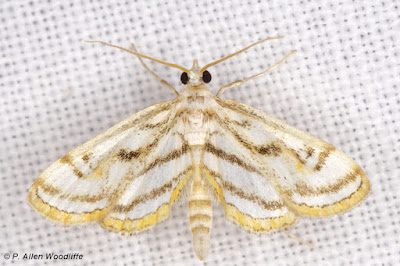
Bog Lygropia
|
 |
Chestnut-marked Pondweed Moth
|
 |
Delicate Cycnia
|
I always am on the lookout for members of the
Caloptilia group, as they are tiny, have interesting patterns, and are propped up due to their quite long front legs. This first one is a Dogwood Caloptilia, only about 7mm long.
Sphinx moths are fairly numerous, but don't often come to lights. This one is on the ground immediately below the lit sheet. It is an Elm Sphinx, the only one I photographed this year.
When one is walking through grasses, there often are little moths that pop out, but then almost immediately go into hiding under a blade of grass. They are tiny and mostly linear. This one is one of the smaller members of the grass-veneer group, called the Gold-striped Grass-veneer.
I come across two or three of this next species each year. It is considered uncommon, and is known as the Harris' Three-spot.
A fairly large and quite distinctive moth that shows up later in the season is this Large Tolype. I have had as many as 8 on the sheet at the same time.
 |
Little White Lichen Moth
|
 |
Lost Owlet
|
This next one is also a first for Chatham-Kent. It is a Mayapple Borer Moth, and although it has not been found very often across southern Ontario, it is a bit surprising since there is a lot of Mayapple in various woodlands across the southwest.
One that is officially rare, and is also quite intricately patterned, is Moonseed Moth, named due to its affiliation with an uncommon plant called Moonseed.
This next one is the Pickeralweed Borer, also uncommon.
Not uncommon, but certainly distinctively patterned, is this Pink-shaded Fern Moth, which I come across a few times each year.
Members of the Silk Moth group are always a highlight to have come to the light. They are some of the largest and most colourful of all of our moths. This first one is a Promethea Moth, which is very closely patterned to a Tuliptree Silkmoth. At first I was thinking and hoping it would be the latter species since I have never photographed one. However the moth experts I consulted agreed it was a Promethea, although some were not 100% certain. Nevertheless, it will be documented as a Promethea.
Another colourful, but slightly smaller, silkmoth is this Rosy Maple Moth. One can usually have a small number come to the lights, but just for a short period. Late June and early July is prime time for this beauty.
 |
Rusty Virbia
|
 |
| Sensitive Fern Borer Moth |
|
|
 |
The Beggar
|
This next one is known as a Variable Narrow-wing. It is a migrant that may show up in late summer/early autumn, and comes from Central America! The late season southwesterly winds bring it northwards, but the ones I have photographed are in surprisingly good condition, such as the one below. I have photographed it a couple of times in the past, but always in September or early October.
And last but not least is this White-headed Prominent, a fairly regular but not common species.
Of course I have photographed hundreds of others over the season, but most are less impressive from a colour and pattern perspective, and some are quite worn having lost many of the scales that give them their diagnostic pattern.
I am already hoping for great things next year!
If you would like to subscribe, or unsubscribe, to Nature Nuggets, send an email to: prairietramper@gmail.com


