Showing posts with label Silver-spotted Skipper. Show all posts

Tuesday, 12 July 2022

Butterfly count--Rondeau

 This past July 10 was the annual Rondeau area butterfly count. It is always something to look forward to, although we went into it with some trepidation this year. The hot, dry weather for most of the last month or so, which followed a cooler and wetter spring prior to that has, I think, played a bit of havoc with invertebrate populations. Certainly pollinating insects in general seem to be less abundant than what we normally expect, and butterflies are not as abundant either. Other parts of Ontario even here in the south seem to have been blessed with a bit more precipitation as of late, so hopefully the dearth of invertebrates in this immediate area is just a localized condition.

At any rate, I began my usual route, at the McGeachy Pond Trail, at about 9 a.m. As I walked and looked, I began to think that my next blog post will have to feature something other than butterflies! I walked to the far end and back over a period of about an hour, and came up with two butterflies, both of which were Cabbage Whites, and even those two were only noted on the return. 

Yikes! This was not going as hoped. It didn't help that the butterfly bush that was located at the residence at the far western end of this trail had died.

But I kept on, and went next to the Erieau Rail Trail. The first part was quite shaded, and there was more bird action than butterflies. I had things like a pair of Carolina Wrens, Downy Woodpecker, and a Warbling Vireo scolding me to get my attention.


At the observation platform, there were Barn Swallows building a nest under neath.

There were a few butterflies to be found, especially where there were patches of Catnip. For some reason, the patches of Common Milkweed or Canada Thistle were not as interesting to the butterflies that were around. Catnip was the plant to check out, as these Red Admirals would attest.


I explored other areas as well, including one that Steve, Keith and Jim and I always check out just west of Blenheim. It didn't disappoint with the usual mix of Wood Nymphs, Little Wood Satyrs, Eastern Tailed Blues and such.

I continued on my way and the other three covered more of their typical territory. We had decided that the local sewage lagoons, sometimes a real hotspot for butterflies, would not be worthwhile this year. The extreme dryness on and adjacent to the berms, and the recent mowing, left very little to attract butterflies, so why bother.

One of the spots that never fails, is along the B-Fit trail at the south side of Blenheim. There are a couple of large cells designed to hold excess water, and a walking trail goes around. At one point a landowner has established a nice garden mix of native and non-native wildflowers that always attract insects. Except for the time I was there this year. There is a mix of Purple Coneflower, Bee-Balm and even Butterfly Bush among others. But there was not a single butterfly to be seen when I was there. I mean, butterfly bush is supposed to be a guarantee! But not this time.

Fortunately it wasn't a complete waste of time, as the one cell had a lot of dogbane and Swamp Milkweed in it, and there were at least 6-7 Monarch butterflies flitting around there.

I also spent some time along a wide road allowance, which has a seldom used railway line along it, and part of it is adjacent to a wet woods. For the size of the area, it was the most productive part of my day. There were of course a multitude of both Orange and Clouded Sulphurs and Cabbage Whites,

There were also a few Azures. One used to be able to call them Summer Azures with a fair bit of confidence at this time of year. However in recent years, at least some expert lepidopterists have decided/discovered that it isn't quite as easy to separate the different azure/Celastrina types as once thought. Even putting them on iNaturalist as a Summer Azure, someone will eventually respond declaring they cannot be separated, and downgrade the observation to Celastrina sp. So they are just Azures for now. Such is the realm of taxonomy.
I was pleased with the number of hairstreaks visiting some of the milkweed patches. I had at least 6 Banded Hairstreaks in just a few minutes.
I had the occasional Delaware Skipper.....
....and I was a bit surprised to see at least 4 Dun Skippers. I think the wet woods adjacent to this site was definitely the reason for them, as they are not generally a common skipper in my experience.
Dun Skipper

Hobomok Skipper

Silver-spotted Skipper, one of the largest of the skipper group, was fairly numerous, with at least 7 at this location.

I had been at Rondeau a couple of days earlier, scouting around even though it wasn't my territory. I thought I was fortunate to have seen and photographed this next one, a Black Dash. I don't think it is commonly seen either, and I haven't heard what the final tally for butterflies was on this count, so maybe it will only be a 'Count Period' record.

I ended up with a mere 17 species of butterfly, a little lower than usual, but not all that surprising given the recent weather, the somewhat limited habitat variation and the way the day began. Monarch numbers were lower than usual, as I only had 16.


If you would like to subscribe, or unsubscribe, to Nature Nuggets, send an email to: prairietramper@gmail.com


Thursday, 28 September 2017

Butterfly Bonanza

One doesn't normally consider September, and late September at that, to be a prime time for finding butterflies. But then the extended mid-summer weather isn't exactly normal, either.

It had been a little more than two weeks since I had last been to the McGeachy Pond trail and checked on the butterfly bush by the west end parking lot, so I decided it was time again. I went out this past Tuesday morning....another hot sunny day.

The butterfly bush still had numerous flower clusters, with lots of butterflies vying for a spot from which to sip the nectar. It was hard to decide which butterfly to photograph first! The west end of the trail also had numerous butterflies, and overall I ended up with well over 150 butterflies of a dozen species! This area had been mine to cover during the butterfly count back in July, a time when butterfly diversity is usually at its peak, but on that occasion I got only half a dozen species and only a few dozen individuals at the most.

The following photos were taken on this visit. I didn't attempt photos of Cabbage White or Red Admiral.

It has been an excellent late season for Painted Lady. On this occasion I saw at least 30, and most looking quite fresh.

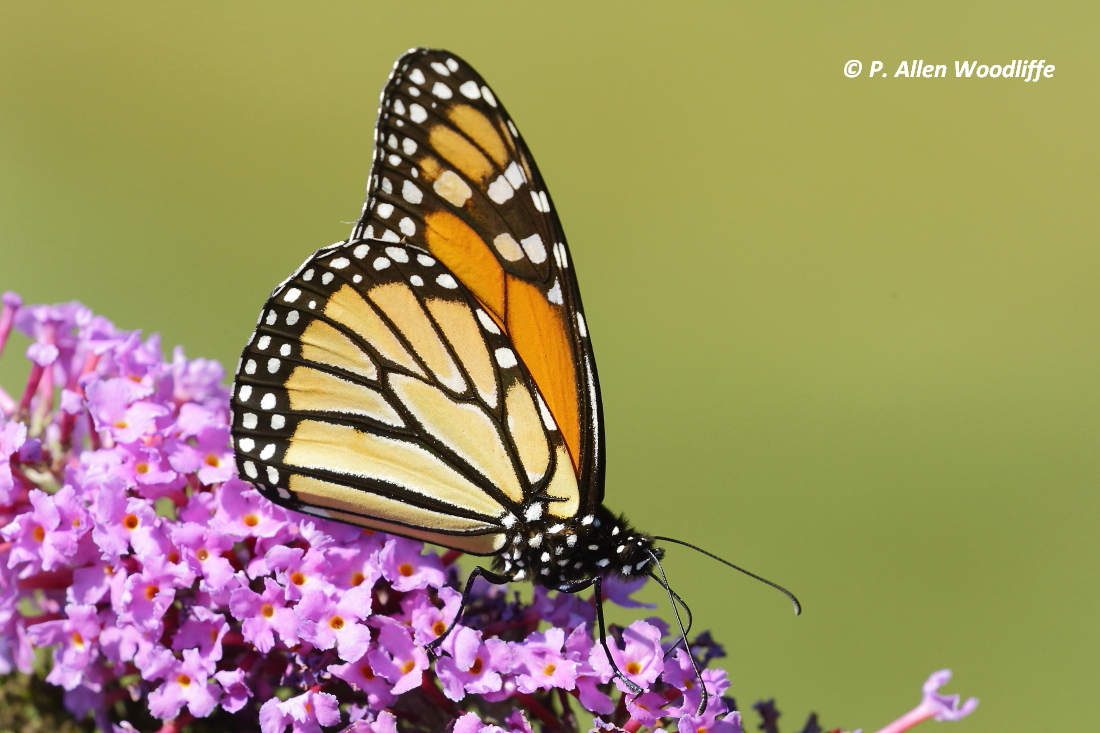
 Monarchs were not surprising at all, as they are well into their southwestern migration. There were at least 22 of them.
 Silver-spotted Skippers were few....no more than 5.
 I didn't bother counting Orange Sulphurs, although there were at least a dozen.
 One which I was hoping for was Fiery Skipper. If it shows up in southwestern Ontario, it is usually late in the season, so not a total surprise but nice to finally see one for the year. There were actually two individuals.
 Gray Hairstreak is also more likely to be seen later in the season, and this single individual was my first of the year, and one of the few I've photographed in recent years.


Along the trail was a profusion of goldenrod and New England Aster, among others, but it was clear that New England Aster was the favoured plant.

There were a few Clouded Sulphurs, another quite expected species.

Common Buckeye is another late season species. The one individual I observed wasn't my first of the year, but I've seen no more than half a dozen so far.
 Certainly one of the highlights was to see a super abundance of Bronze Coppers. I had a couple on the early July Butterfly Count, a little early for them, but only one or two since. It is a species that is often associated with wetlands, so the adjacent McGeachy Pond wetland was undoubtedly a factor. I was quite surprised to count at least 55 individuals along the trail, certainly more than I usually see in an entire season!
 It wasn't uncommon to see three or more in close proximity to each other......
 .....or even 7! There are 6 visible (one only partially) in this tight shot.
 Another first of year for me was this Common Checkered-skipper. It had been reported in other areas, but for some reason has not been common in Chatham-Kent. It is very tiny...about the same as the width of the aster flower head.
While the temperatures are dropping a bit for a few days, getting to be about normal, a slight warming trend early next week will likely continue the butterfly action, so at least one more visit will be attempted then to see what differences there might be. Stay tuned!


Monday, 11 September 2017

Recent Rondeau and Erieau foray

It is amazing how time flies, and I hadn't been to either Rondeau or Erieau for awhile. A recent trip to both made up for that.

At Rondeau, I headed for the South Point Trail, where there is often a buildup of warblers and other passerines at this time of year. That was a good choice. The bushes were loaded. Unfortunately the bright sunlight, caused many shadows in the dense shrub growth, and hawks in the vicinity kept the birds low and partially hidden. So photos weren't all that rewarding. Blackpoll Warblers were by far the most common.
 I got about 15 species in all, including the occasional Black-and-white Warbler. They aren't usually this green, but being in the shade of the greenery will do that.
There were also sightings of things such as Northern Parula and Blue-gray Gnatcatcher, but no photos. No Connecticut Warbler either that I could find, although one or more has been seen by others along this trail in recent days. Seven Bald Eagles were noted overhead, including five of which were flying much higher and drifting with the winds in a southwest direction, so presumably migrants.

It wasn't that many years ago when seeing a Bald Eagle was a real highlight, but due to their rebounding population in the last couple of decades, is an expected sight.

I always keep an eye out for other things of interest, and came across a variety of pollinators on goldenrod. One that particularly caught my attention is this Feather-legged Fly (Trichopoda sp.), named because of the feathery appearance of the lower part of its hind legs. It is a little more obvious in the second photo.

I got lots of photos of other pollinators, but as yet are still working on their identification. Maybe it will be fodder for a future post.

What used to be a rare orchid but is now just considered uncommon with a restricted range, is this Great Plain's Ladies'-tresses.
A later trip to Erieau proved worthwhile. Nothing really unexpected was seen, but it is always nice to see what is around.

There was a flock of at least 50 Sanderling feeding and resting on the beach.


A Ruddy Turnstone was feeding on the pier and area.
Not a Rock Sandpiper
At the west end of McGeachy Pond is a butterfly bush next to the parking area. On this day, it was very busy, with more than a couple of dozen caught up in a feeding frenzy. There were at least 15 Monarchs and 7 Painted Ladies as well as Question Mark, Red Admiral, Silver-spotted Skipper and the usual Orange Sulphur and Cabbage White butterflies, all seen in about 20 minutes.
Monarch

Orange Sulphur

Painted Lady

Question Mark

Question Mark

Silver-spotted Skipper
A brief stop at the Campbell Line pasture on the way home did not have much bird life. Aside from the typical Turkey Vultures passing by overhead, there was a family of Eastern Kingbirds on the fence by the road.
 This immature Brown-headed Cowbird, below, was hanging out with the kingbirds, so I assume it thought it was part of the family due to it likely being raised by them. No doubt it will not make the southward migration with its 'family', but hook up with other cowbirds before long.


Wednesday, 6 July 2016

Preview of a butterfly count

'Tis the season for butterfly counts. Several in southwestern Ontario have already taken place, and the Rondeau one is coming up this weekend. In preparation for it, I have been out scouting around a bit to see what to expect. With the drier than normal weather, early indications are that butterfly diversity and abundance is down from normal.

Patches of Common Milkweed (Asclepias syriaca) are well known for their attractiveness to butterflies. I visited a large patch a couple of days ago. This area is affectionately known as the Dillon Dump, as it was used as a temporary holding place for debris such as brush, branches, stumps, etc before they were burned. It is located along what remains of the former Dillon Trail, which used to be a driveable road across the southern part of the park. The entire route is next to impossible to find now unless one is quite familiar with the layout of it, and one has some good high rubber boots. Regardless, this open area near the beginning and driest part of the Dillon Trail is now dominated by Common Milkweed. If there was one plant, there had to be at least 1000, and many of them were in some stage of flowering.
Partial view of the Dillon Dump area

Needless to say, this is a hotspot for butterflies. By far one of the more common ones on this occasion was Silver-spotted Skipper, the largest skipper we have. There must have been 50 or more.
Silver-spotted Skipper
The next image shows a view of the Silver-spotted Skipper that one doesn't see nearly as often as the one in the previous image.

There were some smaller skippers around...mostly European Skippers, and some other small butterflies such as Summer Azure, which I didn't photograph. But there were larger butterflies on the wing, such as this Eastern Comma.
Eastern Comma
 The comma is more obvious on the underside of the wing.

Great Spangled Fritillaries were there as well, although the handful I saw all seemed to be a bit faded and not very fresh looking. This one is a little battered as well, with its right hind-wing showing some wear and tear.
Great Spangled Fritillary

Eastern Tiger Swallowtails were noticeable due to their size and flashy colours. There were at least 8 of them there.
Eastern Tiger Swallowtail

There were a few Little Wood-Satyrs around.
Little Wood-Satyr

A couple of Appalachian Browns were there, one of which was quite fresh looking as well as being cooperative.
Appalachian Brown
With all of the milkweed, I was hoping for a good number of hairstreaks. Alas, I only saw one....this Banded Hairstreak, below. With all of the oaks in the vicinity, I was sure there would be more, which there likely were. However they can be surprisingly difficult to see if they are on the far side or underside of a flower head, and they don't seem to fly as often as many other species of butterflies, so can go unnoticed. This site is in Blake's territory, so undoubtedly he will find a few and maybe some other hairstreak species as well. (By the way, Blake....be prepared for chiggers).
Banded Hairstreak
There were a few dragonflies zipping around, but not a lot of diversity in them. By far the most common one was this White-faced Meadowhawk.
White-faced Meadowhawk


There were other species of milkweed in the area, including Butterfly Milkweed (Asclepias tuberosa).
Butterfly Milkweed

For some reason there weren't any butterflies on them while I was looking.

Another milkweed nearby in the grassy beach dunes is Green Milkweed (Asclepias viridiflora). It isn't very colourful, and I have not seen butterflies on them....only ants.
Cluster of Green Milkweed


Sunday looks like a decent day for the butterfly count.....mostly sunny, with temperatures ~28C so hopefully there are lots of butterflies.