Warblers, other passerines, and shorebirds continue their seasonal movements, with numbers increasing. Exploring places along the Lake Erie shoreline are great places to encounter them. This includes places like Erieau, Keith McLean Conservation Lands and of course Rondeau. And since due to the higher water levels minimizing these places for shorebirds, the local sewage lagoons are definitely worth checking out from time to time.
The warblers are fairly plentiful, that is until a cold front with its associated northerly wind comes through, and then a lot of them move farther south. But there often seems to be a fair number around. On some days, the number of warblers reported even rivals those days in mid-May! Getting photos of them is another story, however.
The east South Point Trail of Rondeau can have pockets of warblers and vireos to capture ones attention. Here are some warblers that strayed within camera range long enough to get a photo, with some of them sporting a different plumage than they have in spring.
 |
American Redstart
|
 |
Bay-breasted Warbler
|
 |
Black-throated Blue Warbler
|
There are lots of dogwood bushes along the trail, many of which are, or have been, quite laden down with berries. These birds are zipping in and out of the shrubs in their quest for the huge benefits these berries are as they build up their energy levels so they can go on the next leg of their migration. Many clusters of berries are half gone, as this next photo shows.
On my search for birds, I will come across other notable things, such as a few American Ginseng, a species at risk. It was not a great year for berry production, however, as some plants did not produce any berries, and even the ones that had some success, only produced one or two.
I also came across a new-to-me location small Black Ash. Normally Black Ash are found in wet areas, but this one was on a much drier than normal site. Ash trees in general have been hit hard by the Emerald Ash Borer, and Black Ash is now a Critically Endangered species in Canada. It is easily identified by its stemless paired leaves.....
...a brown pointed end bud.....
....and the underside of the leaves being hairy where they join the stem.
At the opposite end of the abundance scale is Great Blue Lobelia, especially common in open and damp forest edges.
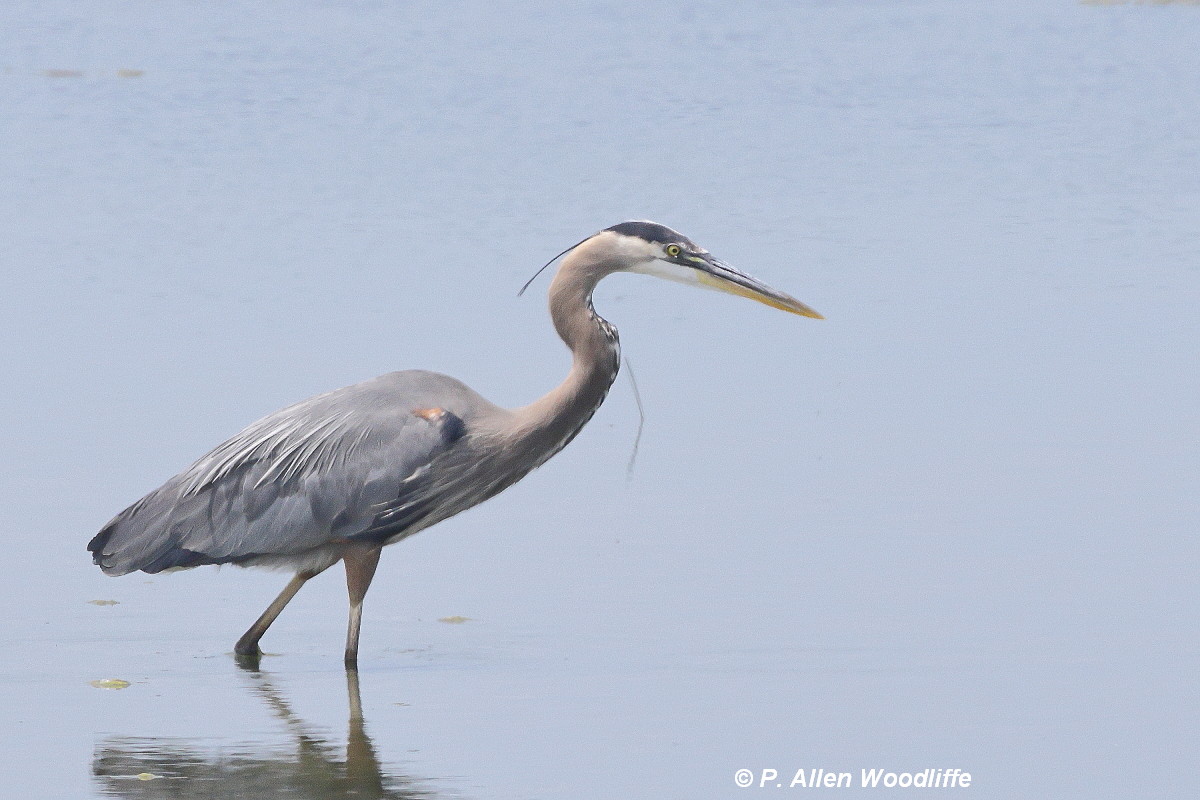
At the Keith McLean Conservation Lands, the mud-flats are almost non-existent, and so it is not good for shorebirds. But Great Egrets and Great Blue Herons make good use of it.
The higher water levels have produced good habitat for Swamp Rose Mallow, and here I found another white variant of this species at risk.
Along the trail, several Cedar Waxwings were flying out from a willow tree going after insects, and occasionally came back and sat on a branch convenient for my photographic interests.
On another occasion I went to Erieau, looking for shorebirds along the beach, and whatever else I could find. With the regular beach hikers and dog walkers, on this occasion there weren't any shorebirds on the beach, but I found a few at the end of the lighthouse pier. There were a few Sanderling.....
...and at least a couple of White-rumped Sandpipers. They can often be separated from similar looking sandpipers by the longer wings, extending beyond the tail. The angle I got this photo of doesn't show it as clearly as I saw it from other angles, but didn't capture it with my camera.
Cormorants are present at Erieau by the dozens, even hundreds at times. This one was swimming and diving quite close by the end of the pier.
I scanned the horde of cormorants and gulls on the break wall across the channel. This large, predominantly gray gull caught my eye, and I managed a couple of shots, and after greatly cropping them, could only come up with this one. I am not quite sure what it is. It seems to be the size of a Herring Gull, but normally young birds of that species have a brownish colour to their plumage. However Herring Gulls vary quite a bit over their huge breeding range, which extends from coast to coast, and it is possible it is just a young Herring Gull but not from a local Ontario population.
As I was pondering the gull, I heard a distinctive call approaching from behind. A large shorebird, with a long, down-curved bill flew quickly by, and by the time I was able to get a photo or two, all I got was its back end. It is a Whimbrel, one of the largest shorebirds to go through the area at any time of year, and much more common in the spring. I don't always see them in the fall.
Shorebirds at the Blenheim sewage lagoons continue to be fairly diverse and in good numbers. I certainly don't try and photograph the diversity each time I go, but try and get a few shots. The light wasn't great, but I did manage to get the following:
 |
Baird's Sandpiper
|
 |
Greater Yellowlegs
|
 |
Short-billed Dowitcher
|
 |
Stilt Sandpiper
|
While the St. Clair NWA isn't all that close to the southerly part of Chatham-Kent and the Lake Erie shoreline, it still can be quite worthwhile to explore and photograph the birds that make themselves visible. Wood Ducks are frequently seen flying over the NWA, and on occasion one will be resting either on some fallen branches.....
....or tucked under the woody vegetation along the shoreline.
A Belted Kingfisher was busily hunting for food....
...and a Sandhill Crane was feeding along the edge of a wet area.....
.....while this trio of cranes flew over and headed for the far corner of the marsh, presumably to find a spot to spend the night.
If you would like to subscribe, or unsubscribe, to Nature Nuggets, send and email to: prairietramper@gmail.com