Showing posts with label Trout Lily. Show all posts

Friday, 16 April 2021

Spring slows, but there are still things to see

 There is no question that the current cooling of the weather has slowed the unfolding of spring, and that is the way it should be. Things, especially plants, were way ahead of themselves, and would risk a severe set back if they continued to develop and got hit with a significant frost in the next few weeks. It happens, as we have had snow even in the second week of May in recent years.

Nonetheless, there are still things to see and enjoy with a little bit of effort. I was at Rondeau earlier in the week, hoping to see the Black Vulture that treated birders on the last weekend. I spent a lot of time checking every vulture I could find, from the north end of the park to the south end. I saw black vultures, but not 'the' Black Vulture.

I also stopped at Mel's place, where the White-winged Dove that has graced the park with its presence over the last several years, is most apt to show up any day now. I didn't see any sign of the target species, but noted this next one on an adjacent lot. Rock Pigeons are not often seen in the park, as they are more often hanging around rural areas, especially farm yards.
Given the bright sunny day, there were a couple of Carolina Wrens advertising their territory.
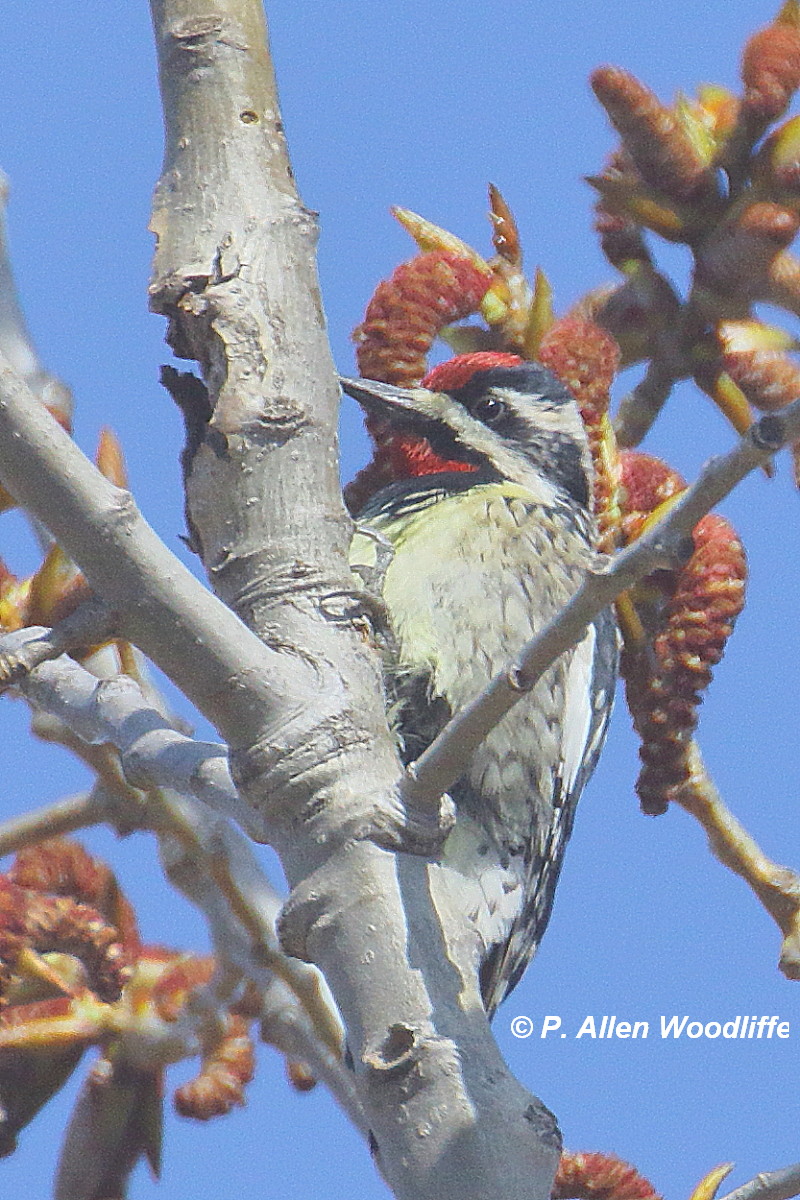
Yellow-bellied Sapsuckers are scattered far and wide in the park, but not always conducive for a good photograph.
Along one of the trails, this Northern Ribbon Snake was slithering by. It is a Species At Risk, and prefers swampy forest habitat, of which there is plenty at Rondeau. I am more likely to see them swimming on the water of a slough rather than through the leaves.
It looks a lot like an Eastern Garter Snake, but has more vivid black and yellow stripes, as well as a rusty brown stripe along the edge of the belly scales. Also it has a white dot right in front of the eye.
Wildflowers continue, such as Bloodroot.....
....and Spicebush, a shrub that is dominant especially in the damper areas of the park. In other words, it is almost everywhere!

This is a great time of year to explore Sinclair's Bush, about half way between Rondeau and Blenheim. Spring wildflowers are fairly diverse and abundant, but certainly are not at their peak quite yet. 

Early Blue Cohosh is one of the earliest, and is out nicely right now.

Yellow Trout Lily is abundant. Their mottled leaves are everywhere, although only a small percentage of plants actually put up a flower.
The petals open up, and curl back, on bright sunny days, but on cloudy days, will almost close right up.
A much less conspicuous wild flower is Wild Ginger. Usually you just see the green leaves poking up through the dead leaves of last year......
....but if you pull away some of those dead leaves, you will see this flower that rests on the ground. It doesn't need to be seen by the flying pollinators that most plants attract, as this species is pollinated by beetles and ants, that spend most of their time at ground level.
Always a pleasant sight to see is Dutchman's Breeches.

Closer to home is the Thamesgrove Conservation area, along the Thames River at the east side of Chatham. The birds were not unusual, but I kept an eye open for flowering plants. I found Common Hackberry, a Carolinian tree species that is abundant along the river.

Several patches of Lesser Celandine, a type of buttercup that is a garden escape but still quite attractive, were here and there.

One of the highlights is to see the White Trout Lily in flower, a close relative to the Yellow one featured above. The white version is relatively uncommon in Chatham-Kent.

In other news, I got a new camera body to add to my equipment. It is the Canon EOS R6, a mirrorless full frame camera, which will also crop to 1.6X. With an adapter, I can use all of my existing lenses. It is a bit different than the two cameras I have had for several years, a Canon 5D3 and 7D2, and will require a bit of experimenting and adjustment to get comfortable with the new layout, features, etc. But so far it has been a relatively smooth adjustment. I haven't ventured into the more challenging photo situations that I do regularly with my other bodies, but have played around with it at home. Here are a few shots I've taken right from the kitchen window.


I'm looking forward to putting it through some more rigorous photography to see what it is really capable of. One of the things I am looking forward to trying out is low level photography. This camera has a tilt screen, so instead of lying on the ground, I can remain somewhat upright and tilt the screen to see the subject and get the right composition. As I become less and less able to kneel at a low level and get back up quickly and easily (a condition that many seniors eventually have to deal with :-), it will make low level photography less problematic, I hope.


Tuesday, 7 May 2019

Paxton's Bush Owls and Owlets

Bird migration seems to be in full swing right now but I will interrupt my posts on that topic just to bring folks up to date on what has been happening at Paxton's Bush, here on the north side of Chatham. I wrote about it in my Natural Areas of Chatham-Kent series about a year ago, and you can read some background on this site here.

As has been the case the last few years, the resident pair of Great Horned Owls have nested, this time quite a bit closer to the residential area. Local birders and photographers have been keeping a close eye on this process, and two young birds have been successfully raised. One of the first photos I took of them this year was this next one, with one of the owlets peeking over the top, and a nice glint of the setting sun in its eye.
 One of the adults was always fairly close by to keep an eye on things.
The adults being watchful has been beneficial, to be sure. One day not long ago when I was watching the owls, I heard a loud, intensive chittering. It turned out that the local Cooper's Hawk was in the area, and swooped down almost to the owl's nest. Immediately one of the adult owls came onto the scene, and got between the hawk and the owlets. The light was very poor for photos, so I didn't get much, but this next photo shows the adult Cooper's Hawk in a nearby tree where it was taking a short break before its next attack.
On several occasions the hawk even swooped quite close to the adult owl, and the owl even seemed to flinch. There was never any direct contact that I could tell. The whole process seemed to last about 5 minutes, until the hawk returned to its side of the woodlot. There is a pair of Cooper's Hawks nesting in this woodlot as usual, and it is my speculation that the owls, being a night predator, may have harassed the hawks to some extent, and now the hawk was returning the favour during the daylight hours when the owls were more sedentary. Just a guess, however.

Meanwhile in spite of the drama, the owlets have continued to grow, and at times have sat up right out in the relative open.

And then one day, the oldest owlet decided it was time to venture out, and left the nest for good. Its flight capability, I think, left a lot to be desired, as for a couple of days it was seen on or very near the ground. I expect its first flight was more of a glide and flap rather than an effective flight, and once it was on the ground, it really couldn't get up into the trees where it would be safer.

This next photo shows where we found it. It is with a wide angle lens, so you have to look hard to see it.
A much closer look........
.....and closer still.

These previous photos were taken across the creek from the north side, just 40 metres or so west of the bridge. These next ones were taken on the south side, before crossing the bridge, with the owlet looking back over its shoulder.


The other owlet was still in the nest, and will likely leave very shortly if it hasn't already. The first one eventually found a way to climb up a leaning tree to a much safer height, and as the leaves continue to open, it will be much more difficult to see.

On one occasion just before I had arrived at the owl nest viewing location, I caught a bit of movement out of the corner of my eye. A furry critter was hunkered down under some developing Mayapple. It was a Groundhog.
 A closer look revealed something in its mouth.
 It retreated a bit until I had moved on down the trail a bit, and then it emerged. The thing in its mouth was a young Groundhog.
 It scooted across the trail and headed for another sheltered spot.
After awhile I noticed a Groundhog running along the creek at the edge of the nearby field. I suspect that with all the rain, its initial burrow was flooded, and the adult was moving its young to a higher and drier location. But the new location is a lot closer to the owls, and it is always possible that the owls may end up dining on Groundhog one of these days.

There is at least one pair of Mallards in the woodlot area.
In the last day or so, people have seen an adult Mallard with as many as eight ducklings trailing behind. Most won't survive, and in fact while they are young, might end up in the talons and tummy of the Cooper's Hawk.

Blue Jays seem to be always present.
Typically there are a few warblers, vireos, tanagers and grosbeaks to be found, but that mix of songbirds changes daily as many are stopping for a rest and a few meals to replenish their energy so they can continue their northerly migration.

A parade of wildflowers is present, and over several weeks there will always be something to see.
Hepatica
Trout Lily
Red Trillium
But although the vegetation is constantly changing, the presence of Great Horned Owls is almost a sure thing any time of the year, although most times they are difficult to see.


Wednesday, 2 May 2018

Natural Areas of Chatham-Kent, Part 13 (Sinclair's Bush)

Sinclair's Bush is one of the few areas in Chatham-Kent where you can drive and have forest on both sides of the road. Not for a long way, mind you, but it is a start, and gives a hint of what driving through southwestern Ontario was like a few decades ago. It is not far from where I grew up, and I remember spending time there many years ago, exploring the natural features. It continues to be an attraction to me and others, partly because it is so accessible. Spring time is the perfect time to visit.

So where is this place? Note this first photo, showing the town of Blenheim. Towards the middle right hand side, is the letter "S", indicating Sinclair's Bush.
A closer view, also complements of Google Earth, shows the configuration of the overall woodland. Most of this almost 40 ha woodland complex is privately owned, but in the centre of the site, shown within the blue line, is the approximate boundary of the Conservation Area owned by the Lower Thames Valley Conservation Authority.
This parcel now owned by LTVCA was slated for development in the mid 1980s. It was going to be the site of a single house surrounded by woodland. In fact along the trail, the pipe where a well was dug, is still visible. However local landowners, who took pride in this larger woodland area and were not in favour of the house, joined together with conservation agencies and the Ministry of Natural Resources which had identified the overall site as part of an Area Of Natural and Scientific Interest to oppose this development. Funding from landowners, conservation groups and others as well as a significant contribution from Union Gas, allowed this site to be purchased and retained in its natural condition. It was turned over to the LTVCA.

This site is a mix of upland and lowland forest typical of southwestern Ontario. The rich, well-developed soils support a lush forest.

As mentioned above, spring is one of the best times to visit, before the leaves of the trees are out which shade the forest floor. The spring wildflower display on the CA property as well as those adjacent properties that are privately owned can be impressive! In the earliest period, the lowland forest can have some wonderful displays of Marsh Marigold.

 Dog-toothed Violet, a.k.a. Trout Lily, is in prime condition on a sunny day in early May. On cloudy days, the flowers close up.

 Cut-leaved Toothwort is plentiful.
 Starry False Solomon's-seal is scattered about.
This next one is seldom noticed, although there are good sized patches of it. Normally all one sees is the mostly round green leaves. However if you take a closer look, and move some of last year's leaves that cover the base of the plant, you may see a purplish/chocolate brown flower. It is known as Wild Ginger.
  The flower is in bloom under the leaves, since it is pollinated by ground beetles, not the flying insects that pollinate many of the other flowers you will see here.
 One of the more interesting discoveries I had here was to find the yellow form of the Red Trillium. It is not commonly seen anywhere. I know of only 4 locations for it in Chatham-Kent, although undoubtedly there are more.
 A woody plant that Sinclair's Bush is known for is Pawpaw. The flowers are fully open just as the leaves are developing. The leaves here with the flowers look like ordinary leaves, but they are still quite small.
 The flowers may develop into a greenish fruit. When it ripens fully, it can be fairly aromatic. Note the size of the leaves here.
 To get a fuller appreciation of the leaf size, see the next photo. The leaves at the top are those of Black Walnut, which are not small themselves. But the huge leaves are Pawpaw.

I found my first American Woodcock nest at Sinclair's Bush many, many years ago. This species returns to southern Ontario in late March or early April, and nesting begins shortly afterwards.
The young are able to leave the nest shortly after hatching, and blend in well with their surroundings. Do you see it in this next photo?
 How about here?
 Okay...here is a much closer view.
Red-bellied Woodpeckers are a regular feature here, as it is in many southern Ontario woodlots these days. However that wasn't always the case. In the early 1970s, it was quite a rarity in Ontario. I remember an experienced Canadian naturalist from another province camping on our lawn, since he wanted to get to Sinclair's Bush to see a Red-bellied Woodpecker which had recently been discovered there.
It is a likely place for lots of other birds in season. There are currently 85 species known for this site.

SInclair's Bush is well worth getting off the nearby paved road known as Talbot Trail (Hwy #3) and quietly driving down this rural, gravel road to experience this small remnant of what much of C-K used to look like.