The next group of a dozen or so species of birds with which to compare their status 3/4 of a century or more ago, continues.
Turkey Vulture

Then: Wood describes it as a common summer resident, with an occasional nest being found, and the species being more common in the eastern part of the county.
Now: I hesitated to include this species in this series, mainly because it is currently a common summer resident although in my opinion, there have been some changes over the decades. The amount of forest cover a century ago was considerably more than there is now, although I don't have any hard facts to back that up. Currently there is less than 4%, and considering how farming has changed to bigger and bigger fields, some of it owned and operated by corporations with large holdings and requiring bigger and bigger equipment, I feel quite confident in stating that woodland is now the lowest than it has ever been. So a century ago, there would have been more woodland, and thicker hedgerows scattered across the municipality. By the 1970s or thereabouts, seeing Turkey Vultures was a much rarer event than today. I expect it was partly due to habitat loss.
In the last 2-3 decades, however, seeing Turkey Vultures during the breeding season has increased, but not because of increased habitat in Chatham-Kent. The population has gradually expanded northwards, as some bird species tend to do. And that was reflected in the results of some of the hawk watches in southwestern Ontario and adjacent Michigan. At the end of 2018, more than 60,000 Turkey Vultures were counted during the September through November period, as they traveled within sight of the Essex/Michigan hawk watch towers. In 2020 there were more than 72,000 vultures counted, and the long-term average of over 51,000 birds. Some days were quite spectacular, with scenes like this next photo, not all that uncommon.

As for nesting birds, actual nests are not easy to find. However comparing the two Breeding Bird Atlases, they were found with some breeding evidence in more squares during the second atlas than the first. And just to illustrate that they don't always require a good quality habitat, this next photo show one that I photographed in 1993 in the former Raleigh Twp, one of the least forested areas of C-K. It was in a hedgerow that had a bit of junk placed on it, including an old bed spring, which the nest was under!
Cooper's Hawk
Then: A common spring and fall transient, but rarely breeds and is occasionally seen in winter.
Now: still common in spring and fall, but is a regular breeding species. It is typically more common in winter than its smaller relative, the Sharp-shinned Hawk, which Wood thought was more common in winter than Cooper's. The second OBBA found it to be much more common than in the first OBBA. While it is not 'fair' to compare the habitat at Rondeau to the rest of CK, there are typically several pairs that nest there annually. Some are in tall coniferous trees, such as this White Pine. Several of us watched the courtship, copulation and nest building of this pair. But more often the nests are found in the hardwoods, which dominate the woodland habitat at Rondeau.
Golden Eagle
Then: considered an accidental visitant.
Now: a fair assessment would consider it an uncommon but regular autumn migrant. For example the Detroit River Hawkwatch has a long-term average (beginning in 1983) of 94 birds per year during the September-November count period.
Bald Eagle

Then: considered a permanent resident, nesting not far from lake shores. Others of the day back then considered it to be rather rare.
Now: certainly times have changed dramatically. While it was a rare, permanent resident in the early part of last century, by the 1970s it was even rarer. In fact in 1969, there was only one known active nesting pair between Long Point and the mouth of the Detroit River, and that was a pair at Rondeau. Even there it had limited nesting success, as although they actively attempted to nest, there were as many years with no success as there was with raising a single eaglet. As the use of certain agricultural chemicals such as DDT was eventually greatly reduced, the numbers of eagles and their nesting success improved. Currently I am aware of at least 26 nesting pairs in CK alone, and I suspect there are a few more in areas where there is limited access to for surveying. So that is a huge change for the better!
Northern Harrier
Then: considered a common summer resident, with a few remaining through the winter. It was noted as breeding sparingly at the St. Clair Flats.
Now: certainly not a common summer resident, but with the persistence of some of the larger wetlands adjacent to Lake St. Clair, it is periodically seen in summer. With some wetland and other open habitats increasing slightly over the past few decades, there was an increased number seen with breeding evidence throughout CK in the second OBBA compared to the first.
American Kestrel
Formerly known as American Sparrow Hawk
Then: formerly considered a common summer resident, but by the 1940s, there were very few nesting in CK, and only an occasional one seen in winter.
Now: A species which has had its ups and downs. It is more of an open habitat nesting species, and with the loss of trees like Elms due to Dutch Elm Disease, there were numerous dead trees in tree and property lines across CK. By the middle to latter part of last century, there was more habitat (dead trees) and a slight up-tick in the abundance of this species. Indeed the records with breeding evidence between the first and second OBBA did not change much, at least in terms of the number of atlas squares reporting breeding evidence. However as those dead trees fell down, and as farm fields were expanded to accommodate a significant increase in the size of farming equipment, habitat in the form of tree lines between farm properties was lost. Currently the abundance of this species across CK is much less than it was even 2-3 decades ago, even in winter. The Blenheim/Rondeau CBC supports this, as the average for the last 20 years is about 11 birds per count, whereas the average for the previous 20 years was about 27 birds per count.
Spruce Grouse
Then: considered a former resident! A specimen was taken near Chatham in the late 1870s!
Now: none have ever been reported since, to my knowledge. CK is way out of its normal range, so this record is likely to be an escaped bird from someone's collection, or possibly mis-identified. It is a conifer specialist, especially Spruce, as its name implies. The closest record for either of the two OBBA was several hundred kilometres away in the Muskokas.
Ruffed Grouse
Then: Ruffed Grouse was considered to be a formerly abundant, permanent resident but now (in the 1940s) probably vanished from the county.
Now: there are probably a few reasons for its decline even back then. Certainly the loss of forested habitat was happening. Also, a likely ever increasing population of Eastern Coyotes, which adapted well to the wider open spaced due to decline in forest, would have been a factor. Also there had been a hunting season, and this game bird was sought out.
That being said, there was likely enough forest habitat scattered here and there to maintain a small population. And since the species is known for an erratic fall flight, it can disperse from more established populations. There has been the occasional record in southern CK over the last decade or so. This next photo shows a nest I came across in a woodlot in central CK back in the late 1970s. That forest was mostly cleared by the mid 1980s, unfortunately.

(Greater) Prairie Chicken
 |
Lesser Prairie Chicken
|
Then: Formerly a common resident, locally. Possibly there are still a few left on St. Anne's Island (technically Walpole Island First Nation, Lambton Co.). They were known from the Raleigh Plains, an extensive stretch of low, marshy prairie along the south side of the Thames River, where as many as 75-100 chickens were reported. They were also known from the greater Mitchell's Bay area in the later 1800s and were hunted by at least a few local hunters who prized their meat. At this time, it was just known as Prairie Chicken, but in recent decades it has been separated to Greater and Lesser Prairie Chicken.
Now: this species has been gone from southwestern Ontario for many decades. While the species is generally considered a mid-western prairie species, there used to be what was known as the 'prairie peninsula' extending into southwestern Ontario. Early surveyors and botanists described the prairie vegetation in the tri-county area of Essex, Kent and Lambton. With the exception of parts of Walpole Island (Lambton) and northwestern Essex and much tinier remnants in CK, the tall grass prairies are long gone. I have seen Greater Prairie Chicken in several places in the mid-west, especially parts of Missouri, but never gotten a photo of one. The photo of the Lesser Prairie Chicken shown above, is a much more restricted species than the Greater. I got access to a blind that overlooked a lek on the Cimarron National Grassland in extreme southwestern Kansas back in 2012.
Gray Partridge
Then: a species introduced in about 1914, and lasted a few years but were apparently gone by the late 1920s.
Now: gone
(Northern) Bob-white
Then: the population was known to fluctuate widely, from being quite plentiful to being almost to the point of extirpation.
Now: the native population is gone, as a result of habitat loss, severe winter weather three years in a row in the mid to late 1970s, and the increasing presence of Eastern Coyote. There have been efforts to re-introduce a few individuals by well-meaning persons. However most of these birds have been pen-raised and are not fit to survive in the wild. This is especially problematic when all meaningful habitat is long gone. The first photo above is one taken in June, 2009, in Missouri, in a natural habitat. The second photo was taken in 2021, in CK, of a released bird, at the edge of a village and farm land.
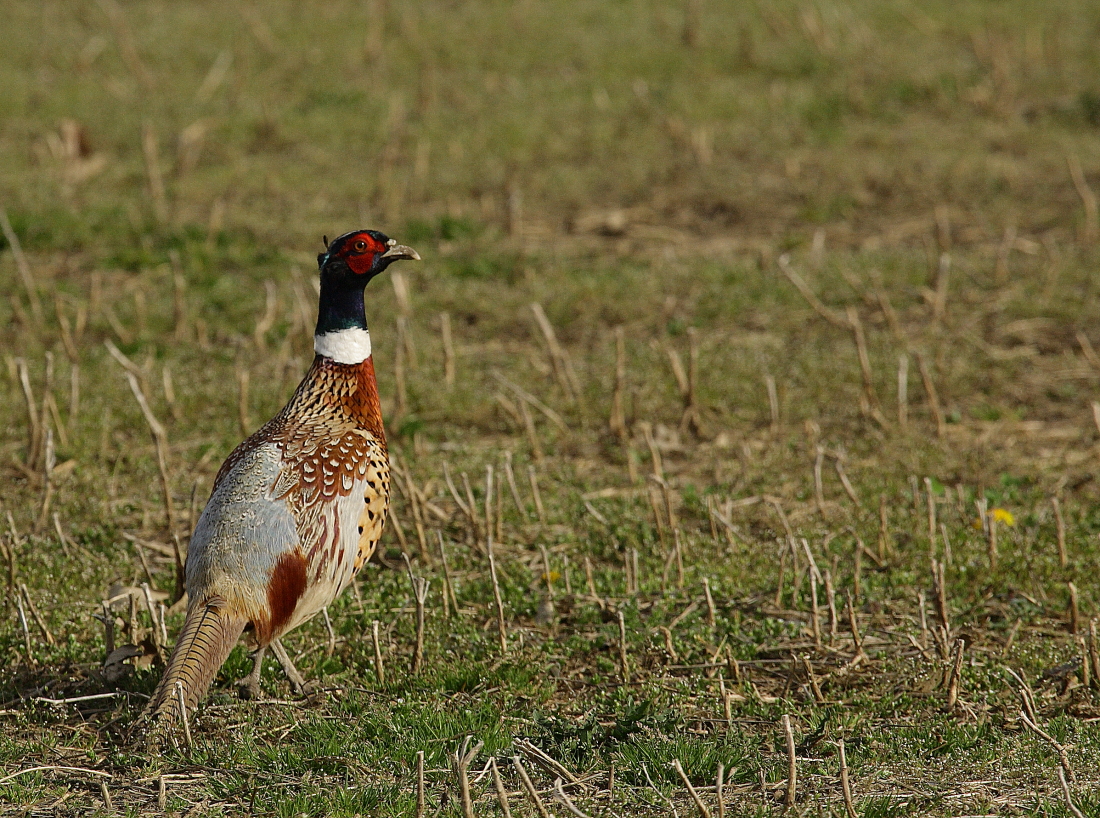
(Common) Ring-necked Pheasant
Then: another introduced species, brought in by the Ontario Department of Game and Fisheries. They became well established. For most of a decade beginning in 1939, there were small groups of pheasants scattered throughout the county. By 1946, they were much fewer.
Now: it is a species which has continued its downward trend. Between about 1981-2000, they were seen regularly on the St. Clair NWA Christmas Bird Count, with sometimes between 20-45 reported. In the last couple of decades we are lucky to get one or two, with none seen in the last 5 years. I don't think hunting pressure has been a factor, but the increase in the Eastern Coyote population undoubtedly has.
Wild Turkey
Then: Formerly a permanent resident in the heavily forested areas, but at the time of Wood's writing in the later 1940s, they had vanished from the county. They were considered plentiful in Rondeau in 1768, and in 1796 they were reported as in great numbers in the Fairfield area. In 1833, they were seen in considerable numbers in Raleigh and Tilbury townships. The numbers fluctuated over the years until the early 1900s when they were very restricted. In 1920, a few birds from more southern parts of their range were introduced in Rondeau where they were known to be present for a few years.
Now: for most of the 1900s, Wild Turkeys were almost non-existent in CK. A southern Ontario wide re-introduction program was undertaken beginning in 1984, and in spite of their usual preference for heavily forested areas, began to do quite well even in such unforested habitat in CK. In examining data from the Blenheim/Rondeau CBC, they were virtually non-existent from 1939-2003, but beginning in 2004 until the present, there is typically anywhere from several dozen to almost 350 birds tallied for that count. In comparing data from the first two OBBAs, the species was virtually unaccounted for in the first atlas (1981-1985) but found in almost every atlas square during the second atlas (2001-2005).
Sandhill Crane
Then: formerly a rare transient, occasionally remaining to breed in places such as the St. Clair Flats in the late 1800s; by the 1940s, it was an accidental transient.
Now: this species has been more successful in recent decades. While in the 1970s and 1980s, it was quite rare to see one other than on migration, beginning in the 1990s, they were a bit more plentiful during spring migration and a few have remained to breed. Larger wetlands such as those along Lake St. Clair as well as at Rondeau seem to be the most likely breeding areas, and numbers on migration have risen substantially. There was a moderate increase between the first two OBBAs, largely restricted to those larger wetland areas. Clearly there has been greater nesting success in places farther north, as up until the early 2000s, it was a species hardly recorded during the CBCs, but for the Blenheim/Rondeau CBC, they have been seen annually beginning in 2009, with more than 100 individuals recorded on two occasions during that time.
Part III of this series will continue in a future post. Stay tuned.
If you want to subscribe, or unsubscribe, to Nature Nuggets, send an email to prairietramper@gmail.com