Showing posts with label Caspian Tern. Show all posts

Saturday, 31 August 2024

The joys of exploring open wetland areas

 I don't recall ever being on a roller coaster in my earlier days, but these last few weeks and months seem like I am on one now. Lots of ups and downs, sometimes with little or no warning, as I wrestle with the passing of Marie. Nonetheless, I have been out roaming around bits of the natural world when the mood and weather seem appropriate. Of course the heat and humidity is always a factor, at least for me. Even though I grew up on a farm in southern Chatham-Kent, I don't seem to have minded the heat and humidity as a youth working on the farm. But as an adult, I never seemed to be able to tolerate it all that well.

One of my favourite go-to places reasonably close by, is the Mitchell's Bay North Shore Trail. It is quite open, with great views of various bird species and usually a bit of a breeze to make the weather more comfortable. It is one of the better spots to see and photograph Great Egrets, which nest at some of the cattail islands just out in the lake. I usually see at least half a dozen on my outings.


They also nest in the marshes of Walpole Island, which is off in the distance from the best vantage point of the trail here. The view point at the end of the gravel trail, where I took this next photo from, is higher than the surrounding wetlands, giving some great views of the marsh as well as Lake St. Clair.

There are some dead trees, which at times can be well-stocked with migrant swallow types, especially Purple Martins. There are lots of martin houses in the area, and as the nesting season is over and their autumn migration is soon to come, they gather in large numbers to feed on the numerous flying insects, but take time to rest on these dead branches.

On one of my recent times along this trail, I got a fair whiff of skunk smell. I didn't think too much of it at first, since skunks are native to the area. But as I got a little further down the trail, I noticed a bird in a tree in the direction the skunk smell was coming from. It was a Great Horned Owl, sometimes called a skunk owl, since they don't seem to be bothered by the smell, and will prey on them from time to time. This owl had undoubtedly had a recent experience with a skunk.

Upon a closer look at the photo on the computer, I noticed this owl did not have any sight in its right eye.

With the openness along this trail, it is great for getting good views, and even some good photos of the creatures hanging out in the area. Another member of the swallow family, is Barn Swallow shown next. There are always a few, but not anywhere near the numbers exhibited by the Purple Martins.

A Belted Kingfisher or two can often be seen, although they are quite reluctant to let anyone get very close.
Out over the lake there may be a few different gulls and terns, especially in spring and fall. Caspian Terns, shown in the next two photos, are becoming more plentiful. They don't breed in the immediate area, but frequent the area as they hunt for small fish to capture from the relatively shallow lake these days.

In the cattails, one will often hear Marsh Wrens. On occasion one will even come into view for the camera!
More likely to be seen are Song Sparrows.
Eastern Kingbirds are scattered around in small numbers...

...and there is usually a Green Heron skulking around the edges.

Another favourite spot to check out is St. Clair NWA, which has a great trail meandering through the ~240 ha wetland. Birds are present in good numbers, but not always within decent camera range. That may change over the next few weeks, as migrant waterfowl will be passing through, and many will take refuge in the NWA from the hunting pressures occurring in nearby marshes. However other things with wings include butterflies, such as this Black Swallowtail.

...and lots of Monarchs and the similar looking Viceroy, shown next.

Wildflowers such as Blue Vervain, next, are plentiful...

...as is the rarer Field Thistle, sometimes called Prairie Thistle, and is a Species At Risk. Since most of what used to be known as Dover Twp, north of the Thames River and adjacent to Lake St. Clair used to be tallgrass prairie prior to settlement, there are pockets of prairie vegetation persisting in places like SCNWA. Prairie Thistle looks very similar to the much more common Swamp Thistle, but is a paler pinkish purple in comparison.
Sandhill Cranes can be seen regularly. One of the best times to see and hear them is in the early evening, as they return from their daytime feeding in fields, and spend the overnight hours in the marsh. I typically see 20 or more, and they will continue in reasonable numbers for the next several months.

  A Northern Harrier, a.k.a. Marsh Hawk, patrols the marsh, followed by an Eastern Kingbird which doesn't approve of its presence.

Another wetland wildflower, and also a Species At Risk is this next one: Swamp Rose Mallow. It can be quite abundant in these marshes along Lake St. Clair.

I did make it to Rondeau on one occasion, hiking along the Marsh Trail. It has always been one of my favourite parts of the park, but in recent years the trail has taken quite a beating with the high water. It is still hike-able. Bald Eagles can be seen fairly regularly, as there is at least one nest out along the edge of the forest and marsh. This eagle, a sub-adult, was perched in a nearby dead tree and was surprisingly tolerant of me along the trail.

Another one was seen flying by, although it was flying away and didn't give me the photo op that I would have liked.
Elsewhere I stopped in at the Blenheim Sewage Lagoons on my way home from Rondeau, in part to see a few shorebirds that are becoming more numerous. But this long-staying male Canvasback got my attention, and although it was well out close to the middle of one of the ponds, enabled me to get a couple of photos. Canvasback are more of a western species, although they pass through in good numbers on migration. Summer records are not unheard of, but quite unusual.

I did see a few shorebirds, but they were a bit skittish. Perhaps it was due to a Peregrine Falcon hanging out in the area, which put the shorebirds to flight periodically. This Lesser Yellowlegs was one of the more numerous species, with at least a dozen seen, and it gave me a good photo op.

Thursday, 13 June 2019

Lake McLean, flooding, orchids and butterflies

There is a new lake in Chatham-Kent. Well not totally new, as part of it has been around due to the high water levels of the last couple of years. But currently it is at likely close to the largest size it has ever been. I'm talking about the flooded fields at Keith McLean Conservation Lands. For those of you who had been there over the last year or so, searching for bird rarities such as Red Knot, Snowy Egret, Glossy Ibis, Black-necked Stilt or Nelson's Sparrow, or even just out enjoying some of the other 208 species of birds now known for the area, or the general landscape, you will know that parts of it have been more than a little wet. But if you haven't been there in the last few weeks, you may be quite surprised.

I was there just last Saturday for the first time in several days. This first photo is taken from Google maps, and shows a good portion of the most accessible part of the KMCL. (Click on the image for a larger version.) The blue line encloses what I have named Lake McLean, where the current water levels have invaded on the agricultural fields. The P is the parking lot, the B is the bridge, the W is the wetland area shown in the second photo which has been under water for well over a year. The M is the wetland along the causeway. I used to live right across from Keith McLean's place, and knew him quite well at the time. He told me that he remembered a time when the water levels were so low that the area I've marked as M was dry enough one year that they actually plowed it and planted a crop! I think the farmer who normally puts a crop in on the McLean property this year will be severely curtailed in his efforts.
 I took this next photo while standing on the bridge that crosses the creek system, marked as B on the map above, and looks onto the area marked as W.
 The creek has always been very close to the field, of course, but as the water in the creek rose, it got perilously close to the top. In the next photo you may be able to see the brownish colour on the vegetation at this very narrow point, as the water spilled over from the creek and flowed into the field. These next photos were taken at a time when the water levels were actually down a slight bit.
 These next two photos were taken from the road.  I am standing with my heels at the edge of the pavement, and the water is only a couple of metres away. These were taken on Saturday, June 8. When I came by on June 12, it was even worse. In fact I couldn't have stood at that same spot, as someone, possibly from the roads dept, had come along and piled mounds of earth all along the side of the road to prevent the water from spilling over across the road. At the beginning of this post, I indicated the current level might be close to having created the largest lake here. However I have 35mm slides of June 1985, when the water was actually spilling over the road at the bridge/causeway.
 The photo above shows the tops of some evergreen trees planted here several years ago, as well as a post. If you take a close look at what it says on the sign in the next photo, it says "No motor vehicles" and specifically shows ATVs, snowmobiles and motor bikes. I think they will have to update their sign to include motorboats!
 Water birds are, naturally, loving it. There have been lots of ducks using it from time to time, including this female Hooded Merganser.
 Great Blue Herons and Great Egrets are regularly seen, especially the former species. With the reports of several Snowy Egrets in various places in southern Ontario lately, I keep checking to see if one will show up here. So far none have, but a couple did show up last year.
 There are sometimes up to a couple of hundred gulls and terns using the lake. Caspian Terns are usually found around large bodies of water. I guess they consider Lake McLean a large enough body of water for now. It probably is a little late for gulls to consider the area as a nesting site, but who knows?
Almost all of the migrating shorebirds have left the area for their more northerly breeding grounds, but from mid May until just a few days ago, flooded fields like this were very attractive to shorebirds. In fact it was not uncommon to see a greater diversity and number of shorebirds in flooded fields than it was at sewage lagoons. In just a few weeks from now some shorebirds will be returning and may find these flooded fields, assuming they are still flooded, to be quite to their liking. Stay tuned.....

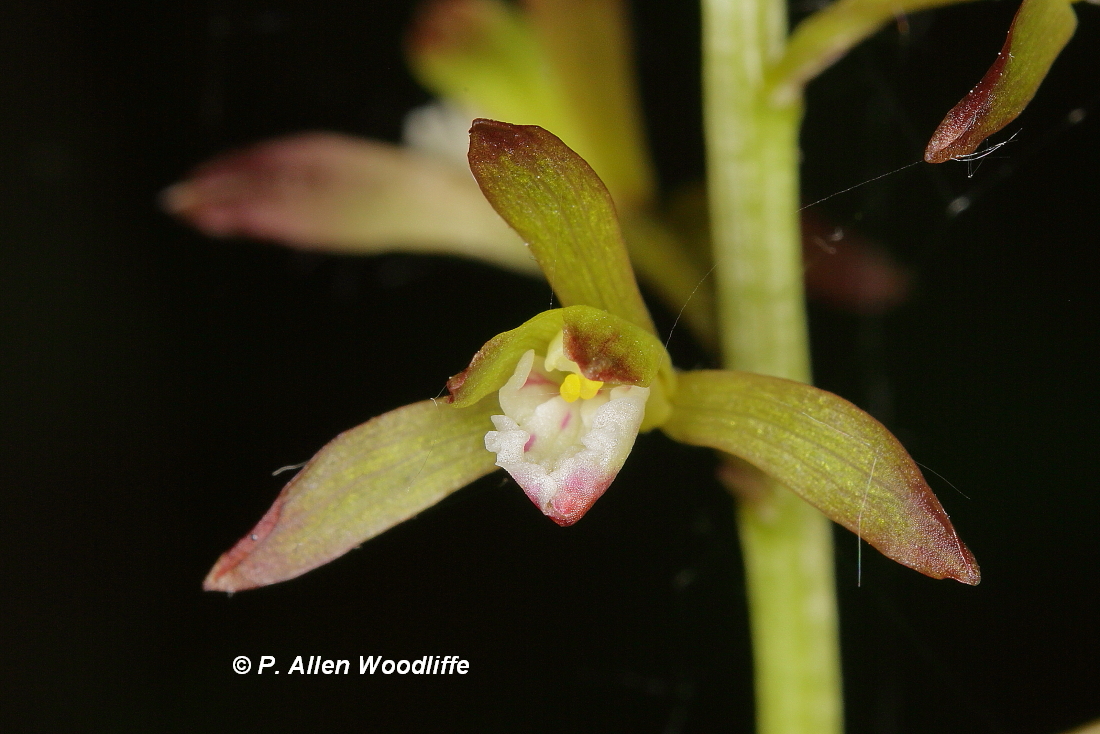
As mentioned, I have been back to Rondeau on a couple of occasions in the last few days. I wanted to do some more orchid photography, and was focusing on Puttyroot. I found 15 plants in flower, four of which are shown here. You can see the single faded leaf at the bottom of the stem.


 Another plant that I have been keeping an eye on is American Gromwell, which up until I re-discovered it at Rondeau in 2017, had not been seen in Chatham-Kent in at least 30 years.
 One of the purposes of my latest foray at Rondeau was to try and locate an Acadian Flycatcher nest that had been reported. It was not in the typical habitat, and in spite of my efforts, was not able to locate it yet. But I did come across lots of other birds including this recently fledged Brown Thrasher scurrying about in a shrubby tangle.
 The adults were very close by, keeping watch over their youngster and 'chucking' their alarm call on a regular basis.

 There were also lots of butterflies out along the trails and forest edges. I must have seen at least 50 Azure types, mostly flitting.
 Little Wood-Satyrs were scattered here and there, with their ditsy-doodling flight in the low vegetation.

 I came across at least a dozen skippers, almost all of which were Hobomok, and the only skipper I was able to photograph. The only other skipper I could tell for sure was my first of the season Silver-spotted Skipper.
Only a few more weeks until the butterfly count!

Monday, 24 April 2017

Weekend wildlife

I know that wildlife is around more than just on weekends, and in semi-retirement one would think I would have lots of time on normal weekdays to get out and explore. However that isn't always the case, and most of this past week had me otherwise occupied.

But the last day or so was a great change of scenery and included several of my 'go-to' places in Chatham-Kent.

Rondeau Prov Park is always worthwhile, for many reasons. It was a relatively quiet, windless morning, so I stopped first at the Spicebush Trail hoping that the Louisiana Waterthrush which has been noted there on occasion would make an appearance. Not today.

The South Point Trail is usually a good place to meander along. Eastern Towhees are regular.
There has been an influx of White-throated Sparrows in the last couple of days. In places, the ground seems to be moving as they shuffle through the leaves searching for food.
A large number of Chipping Sparrows were in the sandy beach dunes at the forest edge. I scanned through as many as I could, hoping that a Lark Sparrow as was found at Point Pelee a couple of days ago, might be mixed in with this group, but it was not to be.

I got my first of year (FOY) Pine Warbler, and one of the two I saw even allowed me to get at least a record shot as it came down to a leafless branch. When they are flitting through the pines, it isn't quite so easy.
Pine Warbler not in a pine
 I was interested in getting a FOY Red-headed Woodpecker. It used to be a common species here and throughout southwestern Ontario. In fact on one occasion, in 1983, we recorded an astounding 114 on the Rondeau/Blenheim Christmas Bird Count! The species has been in serious decline for quite awhile, and that could be the topic for an entire post. In a typical year now, there may only be one or two pairs nesting in the Rondeau area. At any rate, since one had been reported in the previous day or so, I wanted to track it down if possible. Initial efforts were not successful, but Garry S advised me he had seen one going between a willow tree and a feeder at a lot just south of where the White-winged Dove spent most of 2016 and part of its time to date in 2017. It didn't take a long time to find the bird, and it was on the move between various trees in about a 3 cottage lot area.
Woodpecker in the willow


I had tried to get a photo of Northern Flicker from time to time, and I often find that if you move in their direction, they quickly move on. But while waiting near the willow tree that the Red-headed Woodpecker was supposed to come to, I noted this flicker arrive and start feeding on the lawn, apparently not concerned about my presence.


A short while later, I checked up on another red, white and black bird, the reported Rose-breasted Grosbeak, and found it coming to a feeder just north of the Visitor Centre.

The White-winged Dove continues at its alternate site, trying to build a nest on top of a stove pipe. I'm not sure what goes through its head when the material it keeps depositing on this slippery and shiny surface disappears almost as fast as it is deposited.
Another member of the dove family, Mourning Dove is, at this point, having more success than the White-wing. This nest was in a honeysuckle bush along the Tuliptree Trail.

I stopped at the Spicebush Trail again, just in case the Louisiana Waterthrush was in the area. Still no waterthrush, but the highlight was to have a visit with Rob and Pauline, two former MNR colleagues whom I hadn't seen in many years.

Before leaving the park, I checked out the maintenance loop. No new birds for the day, but I got my FOY Question Mark.

The species is not common in April but does occur in very low numbers. The dark upper hind wing indicates it is a summer form, which is apparently typical of spring migrants.

A brief swing by Erieau had distant waterfowl and a few Caspian Terns.

Yesterday afternoon, we went to the Mitchell's Bay area, exploring both the south shore trail and north shore trail. I noted a sub adult Glaucous Gull and a Common Gallinule, both FOY but no photos. There were some cooperative Forster's Terns.

The Purple Martin houses have attracted the target species.


An American Coot was close by the north shore trail......
 ....as was a Ring-necked Duck.
The target species I was hoping for was Yellow-headed Blackbird. I had intended to go out on Friday afternoon, since it had been a few days since my previous visit, but some other projects kept me away. Later that evening I noted that Blake had seen about 7 males, so I figured my chances were good on this day. Sure enough, three were seen foraging on a lawn near the south trail, while at least another four were hanging out with a large mixed flock of blackbird types in the field to the east of the trail. I didn't see any females, but they should arrive soon and let the nesting begin!