Showing posts with label Midland Painted Turtle. Show all posts

Sunday, 12 April 2026

Fair weather brings fair sightings

 The three favourite natural areas I go to, Rondeau PP, St. Clair NWA and Mitchell's Bay North Trail, have all had some better photo opportunities of late, which isn't surprising given the gradual arriving of spring.

At Rondeau, there is an increasing variety of photo ops, although I have missed lots of the first of year migrants. I plan to catch up with more of them very soon!

Eastern Phoebe

Northern Flicker
This next creature is sometimes called a Northern Brown Snake, but more officially it is Dekay's Snake. It is small, not particularly rare but not abundant either.


As the days warm, there is an increasing number of butterflies, including this Red Admiral.
A pair of Yellow-bellied Sapsuckers, relatively recent arrivals, were seen 'fighting' for territory on this tree, and as they were so active, neither one really cooperated for a photo that I was hoping for. Maybe next time.

 At St. Clair NWA, with the wide open skies, it can be good for seeing things and even getting a few photos. However it has been cool and windy, so not ideal, but still worth it.

On one occasion there were several flocks of Bonaparte's Gulls, averaging about 40 in number, passing through fairly quickly on their way to points farther inland. Presumably some field being worked up had attracted their interest. Bonaparte's Gulls have just arrived in large numbers in the last couple of weeks. 

Waterfowl are becoming less numerous, but still are around, like this male Bufflehead; its mate was nearby.
Sandhill Cranes are almost a guarantee these days, with as many as 15 or so typically seen in the immediate area. These next two were right on the trail, and let me get closer than I expected.
There was this third one as part of the group, but it left first, and allowed me to get some good flight shots.

At the Mitchell's Bay North trail, there are almost always 2-3 Bald Eagle's passing by, or landing on a small mud flat at the water's edge. Most of them right now are sub-adults, as the adults are presumably on or near their nest.


With the water level being what it is, there is a lot of mud flat, and I am hoping to see a good variety of shorebirds. On this occasion there were a couple of Greater Yellowlegs out feeding.


...and along one of the sunnier, quieter channels, there were a few Midland Painted Turtles enjoying some sunshine.
Tree Swallows were fairly abundant, but mostly in flight. Once in awhile, one would rest on a wire.

Certainly one of the less expected birds seen in Chatham-Kent these last few days was a Black Vulture. It was just a bit north of Clear Creek Forest Prov Park, in eastern C-K. I didn't get out to see or even look for it as I was busy with some other things. However I have been fortunate to see one in C-K in the past, including this one which I photographed inside the Rondeau Park boundary, back on March 15, 2009, a few years before I started Nature Nuggets.


If you would like to subscribe to Nature Nuggets, send an email to: prairietramper@gmail.com 


Saturday, 29 March 2025

Orchids...spring wildflowers, and birds!

 Okay it isn't really orchid flowering season, nor is there much of anything else flowering for that matter. However the leafless season is one of the best times to find this one:

It is called Puttyroot (Aplectrum hyemale) and is an Endangered Species in Ontario and Canada. Rondeau is fortunate to have had several populations known from various parts of the park over the years, and I have been able to track down 7 different ones. Unfortunately at least two of those populations have disappeared, whether it is due to forest floor changes as a result of canopy cover alteration from the arrival of Emerald Ash Borer, which decimated the ash trees that were dominant in the canopy. Or maybe due to fluctuating water levels. Or something else entirely. 

At this time of year, they are not in flower, but their overwintering leaves are distinctive and if one is concentrating sufficiently on the leaf litter, they can stand out nicely. Each leaf represents an individual plant, but very few will actually flower in a given year. In the main population, which I have been following for more than 3 decades, I have sometimes seen up to about 75 leaves, but never seen any more than about 20 with a flowering stem and in flower and that was in a good year. More typically I only see a dozen or so in flower at the most.

While out looking around a few weeks ago, I cane across a new-to-me population with 7 leaves, a single leaf of this new population is shown next. Given the habitat that this species occurs in, I expect there are more populations as yet unseen. There are hundreds and hundreds of what appears to be suitable habitat. The leaves are starting to dry and they will almost totally disappear before long.
It will be interesting to see how many flowering stems are found this year.

There are other things that are actually in flower. This first one is called Snowdrops. It flowers early, and is not native. It often occurs in fairly abundant little patches. This patch occurred next to a cottage in the park.

One that is native, but not often seen, is called Skunk Cabbage. The green and purple stems emerge from a fairly wet area, sometimes where standing water is present at least in early spring. It doesn't occur at Rondeau. I have been keeping an eye on this small population at Clear Creek Forest Prov Park.
A closer look inside one of the purple leaves, known as a spathe, may show the little cluster of flowers, as seen here.

Over the next few weeks, I am looking forward to finding a lot of other spring wildflowers! In the meantime, there is hopefully an increasing number and variety of birds to look for and try and photograph. American Robins are becoming quite numerous, with sometimes several dozen seen on even a short outing. On one occasion on a cold day and driving through a small town, I drove by what looked to be a type of crabapple tree. Underneath were at least 30 robins groping around in the lawn, looking for crabapple residue.

American Pelicans have appeared in southwestern Ontario in recent days. Of course a birder and photographer always hopes to get views such as this next one, which I photographed flying over Rondeau Bay near Erieau last year. Opportunities such as this do not occur very often.....
....as this next photo illustrates. This photo was taken from the Mitchell's Bay South Nature Trail, where as many as a dozen pelicans were resting on the sheltered edge of a large stand of cattails. In viewing them through binoculars, it was difficult to know for sure that they were in fact pelicans, or some of the many large swans that were also in the area. I know of at least a few birders who ventured out to try and see these birds, but were not successful. However a high powered 'scope confirmed them as pelicans, as every few minutes one would get up, stretch its neck and it large orange bill would be obvious. At other times one would stretch its wings, and the black wing tips and outer primaries would be distinctive. The photo below is the best I could do. Even with my top quality lens, this photo was taken, and subsequently cropped to be at slightly more than 100X.

More predictable are Bald Eagles. At least some of the known nests are being occupied, such as this one at Rondeau, visible from the west South Point Trail.


But lots of eagles are on their migration to nesting areas farther to the north. On one occasion in the last few days, while on the east South Point Trail, I saw about 11 and most were adults.

Brown Creepers are arriving.

Downy Woodpeckers are permanent residents, and are a little more noticeable as they start to establish territories.
Eastern Phoebes are arriving, and there are a few flying insects for this flycatcher to feed on.
Killdeer are fairly widespread in muddy fields and marsh edges.
Northern Flickers are present in increasing numbers, searching for ants on lawns.
Pileated Woodpeckers are also residents, and are more often noted due to their loud drumming to demarcate their territory. When I was out today, I heard three different birds calling from my one vantage point, one was fairly close and the other two were a fair way either north or south of the closest one.
Turkey Vultures are fairly plentiful these days, depending on the wind. On one occasion I saw about 40 circling a wooded area late in the day, presumably looking for an overnight roost.
Wild Turkeys are also permanent residents, and a little more visible now than sometimes. I stopped one day to look for the Wilson's Snipe that sometimes occurs at this wide creek, but only saw this turkey hopping across.
And these two were roaming about a farm field near St. Clair NWA.
I saw my first of the year Yellow-bellied Sapsucker a few days ago, but only got some record shots.

Local Canada Geese are paired up.

I saw my first of the year Great Egret fly over a few days ago, just north of Mitchell's Bay, where during the summer and fall season it is common to see a dozen or more, as they nest in some of the offshore cattail islands.

 Sandhill Cranes continue to be around, although they are starting to pair up and instead of large groups, are often in groups of four or fewer.

Of course Red-winged Blackbirds have arrived in large numbers especially in wetland areas, where they are seen and heard giving their choke-er-ee calls attempting to lure in a female as they arrive.

Not to be left out of the wildlife scene of late, are turtles especially on some of the warmer days. Blanding's Turtles are an Endangered Species. I usually see a few, such as this next one, along the Marsh Trail near Erieau.
On the other hand, Midland Painted Turtles are fairly abundant. On this day I counted at least 40 all sunning on a log or some similar spot.

There is always lots to see!


If you would like to subscribe, or unsubscribe, to Nature Nuggets, send an email to: prairietramper@gmail.com


Saturday, 23 November 2024

Autumn's final warm fling?

 Butterflies in late November? Yes, and a few other warmish season creatures have been out and about. Eastern Comma, first, is a species that will overwinter as an adult, so when the weather is warm, they can be out basking as this one was.

Common Buckeye does not overwinter in southwestern Ontario, but there has been a good number of them this late summer and fall, so it isn't all that surprising to see the occasional one stick around in this unseasonably warm weather.


  There have been a few Autumn Meadowhawks flitting around in sunny, sheltered places.

Next is a Black Blow Fly.

...followed by a Common Drone Fly.

There were a few of this next one around. It is a possibly a Tufted Clusterfly, although the exact type of clusterfly has not yet been determined.
Woolly Bear Caterpillars are often seen, even in winter. It is the larval stage of the Isabella Tiger Moth, and this first image shows the typical coloration.
According to a specialist on iNat, this next one is a Tiger Moth of the Phragmatobia species.

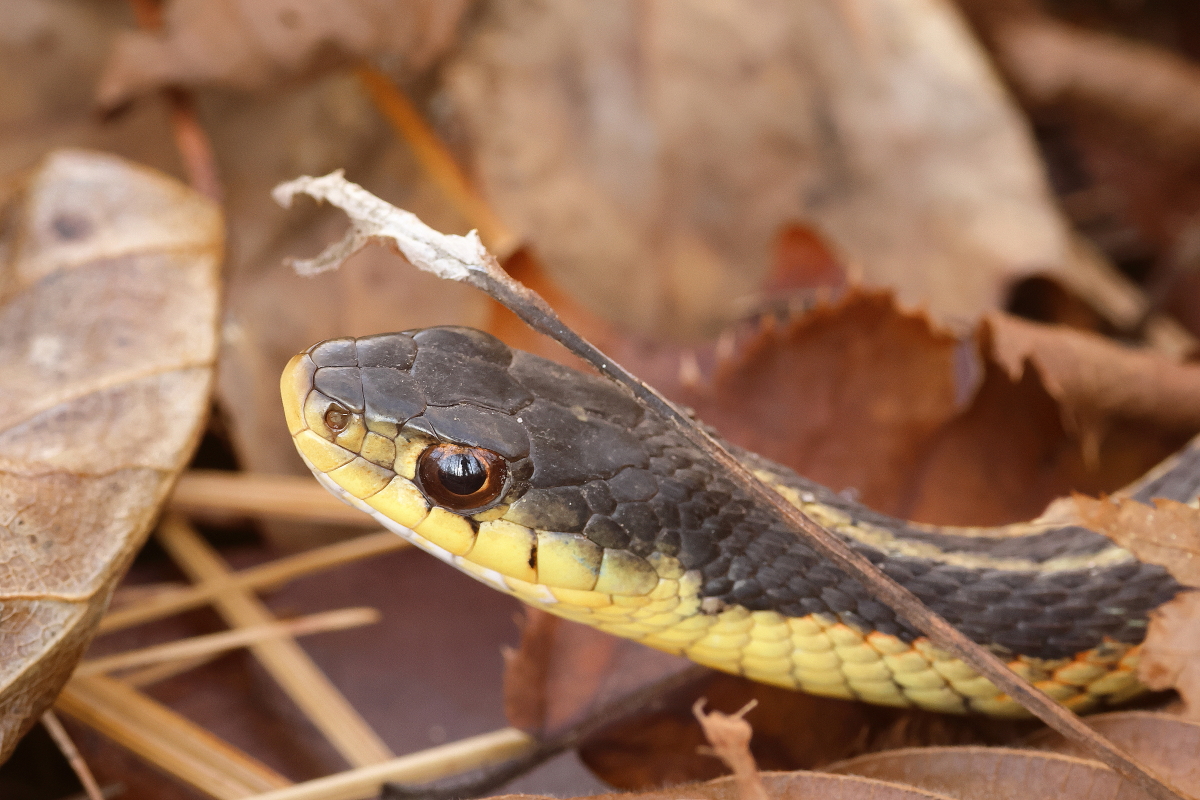
Reptiles are cold-blooded, and are not often seen this late in the season. However due to the warmer than normal temperatures, a few Eastern Garter Snakes were out....

.....as were a few Midland Painted Turtles.

I even heard several Spring Peepers on more than one occasion! I'm sure all these reptiles and amphibians are now safely in their winter quarters!

On one of my outings to Rondeau, I spent a bit of time scanning the lake from the east beach. I was hoping for a few loons, especially a Red-throated Loon or even a Pacific Loon. Both have been seen on occasion in the last week or so. I did see up to a couple of dozen Common Loons.....


....and there was at least one Red-throated Loon mixed in from a distance, but I didn't get any photos of it. As for a Pacific Loon, I struck out on that one so far, but I have seen them in Ontario in the past. When I was involved with some wildlife surveys at Polar Bear Provincial Park in about 1990, we came across a nest, and one of the adults was cooperative enough to allow me this photo. The fall plumage is considerably more drab than this photo, however.
While looking for loons, there was a massive movement of Red-breasted Mergansers flying by. I think they had been stirred up by a passing ship, so there were probably 3-4000 of them in flight that stretched like this photo, for at least a kilometre with smaller groups going by as well.

I spent a bit of time up along the Mitchell's Bay North Lakeshore Trail, and while I didn't see any shorebirds on this occasion in spite of the extensive mud flats, there were some raptors in the area keeping an eye on waterfowl and other things. There were probably three adult Bald Eagles in the area, although they were sometimes on the move for a short distance and maybe there were only two.


This Merlin, next, was initially seen hopping around in some shallow water. Not sure what it was trying to do, maybe wash something before eating? It wasn't clear, but after a few moments it got up and left....
....and this next photo is likely of the same bird, on the top of a pole a short distance away, surveying its domain.

I also spent a bit of time along the Erieau Marsh Trail. There wasn't a huge diversity of birds, but a few things caught my eye and gave me some photo ops. I was a little surprised to see at least a couple of dozen American Pipits flying around in a loose group and landing near the tree tops. I usually see them in much fewer numbers, and typically on the ground, but these were migrating so were behaving a little differently.


American Tree Sparrows are one of the more common sparrows this time of year. This one was busily tearing into some goldenrod seedheads.
A Downy Woodpecker was digging into a tree trunk....
...and this is a Rusty Blackbird, one of a small flock of a dozen or so on the move.
This Great Blue Heron was first noticed when I heard its loud 'croak' that indicated where it was, so enabled me to get this rather distant and cropped photo.


If you want to subscribe, or unsubscribe, to Nature Nuggets, send an email to: prairietramper@gmail.com