Showing posts with label Interrupted Dagger Moth. Show all posts

Thursday, 4 August 2022

Some night-time creatures of Newport Forest that saw the light

 Newport Forest is a wonderful natural treasure, tucked away on the south side of the meandering Thames River in Elgin County. It was a combination of woodland, creek valleys and abandoned farmland when it was acquired more than two decades ago by Kee and Pat Dewdney. The abandoned farmland was planted into various trees, shrubs and native herbaceous plants, and the Dewdney's undertook an ambitious plan to document all living things, plant or animal, to be found on the site. You can read much more about Newport Forest at this link.

A few years ago, the Dewdney's donated it to the Thames Talbot Land Trust, a well-organized and effective organization dedicated to preserving many natural areas within their area of interest.

Virginia Bluebells

I have been there several times, usually upon invitation, and especially with the intent of enjoying the wonderful display of Virginia Bluebells in late April or early May, but even more so, to set up my black lights and survey for the night-time creatures that are drawn to the lit up sheets. Moths, of course, are my main target, although there are many other things that arrive.

It was this past weekend, at the end of National Moth Week, that I met Kee and we proceeded to set up the black lighting equipment in preparation for the arrival of some winged denizens of Newport. There were lots of non-moths, to be expected, and there was no shortage of caddisflies of various shapes, colours and sizes. They are difficult to identify to species, but this one apparently is Potamyia flava. I don't know if it has a common name or not.

But the moths were the main focus, and although we only had the lights on for a bit less than two hours, I photographed a little more than 40 species of moths. Most were to be expected, but some were notable for their provincial rarity. What follows are some of the more significant or colourful ones.

The first one, Currant Fruitworm Moth, is fairly small as you can tell in comparing it to the size of the weave of the sheet. There are very few records for Ontario, although it does not have any official status. It is the first record for Elgin, according to iNaturalist.


Delightful Dagger
This next one is one of the largest moths we saw that night. It lives up to its name, the Drab Prominent, and what makes it a bit notable is that it is officially Endangered according to Nature Serve, and S2/Imperiled according to the Natural Heritage Information Centre. There are fewer than 20 records for Ontario, all in southern Ontario, and this is the first for Elgin.

Flowing Line Snout
Another rarity is Glorious Habrosyne, shown next. It didn't come to the sheet, but hung out on the branch I was using from which to support the light. Fortunately it was not worn and the detailed pattern was nicely visible. There are a few dozen records scattered across Ontario, predominantly in the south, and it is on the list of rare species that the NHIC maintains. I photographed this species a couple of years ago at Newport. It is the third record for Elgin, according to iNat.
On the very smallest scale of the moths was this next one: the Gooseberry Barkminer, a.k.a. White Eye-capped Moth. It is only about 6 mm in length.

Green Leuconycta
This next one is not very common anywhere, but widely scattered, and its distinctive pattern is always a delight to see on the sheet.
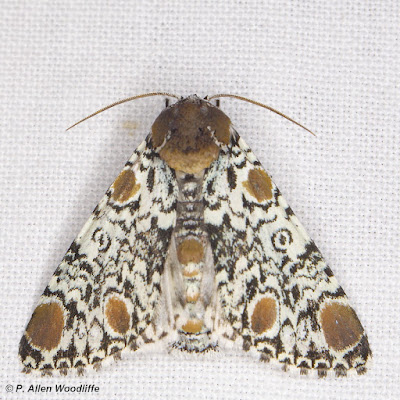
Harris's Three-spot
These next two are quite similar, and if they are not in fairly unworn condition, can be a challenge to identify. They are both in the Acrobasis genus.
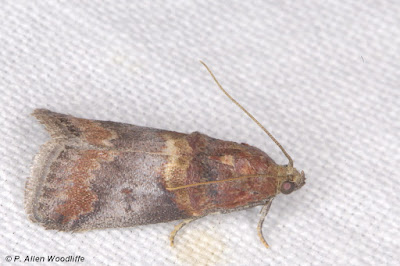
Hickory Leafstem Borer

Hickory Shoot Borer
Next is a fairly large one, known as the Interrupted Dagger Moth.

Johnson's Euchlaena


The American Lappet Moth, next, is not only fairly large and colourful, it has the distinct habit of not folding its forewing against the body and hindwing, but laying it somewhat flattened.

Mantled Acrobasis Moth

Master's Dart

Painted Lichen Moth
As you can see, not all moths come to the sheet. This one, the Ragweed Borer Moth, decided the light itself was more to its liking.
Some moths habitually have their wings folded in an upright position, at least part of the time.
Fortunately they will usually flatten them out, making this Red-fringed Emerald much easier to photograph and identify.

Sharp-angled Carpet
Next is a member of the Slug Moth group, called a Skiff Moth. While it doesn't have an official rarity status, it is on the NHIC's list of Rare Species in Ontario.
The Splendid Palpita is fairly common and widespread.
Unfortunately this next one, which was formerly called Gypsy Moth but now called Spongy Moth, is not native and fairly common. It goes in cycles, and in 2021 it was extremely abundant. The current year is a lot better, and this is just the first one I have photographed this year and the only one we saw on this night. Last year I sometimes would get as many as 20 at a time on the sheet!
The Thin-winged Owlet, next, is quite distinctive in both form and pattern. It is Vulnerable in Canada, and on the NHIC list of rare species. It is widely scattered in mostly southwestern Ontario. This is the first record for Elgin Co., according to iNat.

Variegated Midget
Next is the Verbena Bud Moth, the Verbena presumably referring to the genus of plant that it is specifically attracted to and lays eggs on.
Underwing moths are in a class by themselves in terms of diversity and the very attractive pattern one may see on the hind, or under, wing. They are not often attracted to lights, so I was pleasantly surprised to see this one, known as the Wonderful Underwing. I didn't get a photo of its underwing colours and pattern which features black and orange bands.

Woodgrain Leafroller Moth

I did show one non-moth at the beginning of this post. I don't often spend a lot of time photographing them, but some are nice to capture just the same.

This first one shows a pair of mating craneflies of the Limoniidae family.

This is the Green Cone-headed Planthopper. It used to be considered rare in Ontario, but likely due to the increased interest in black lighting, it has been determined to be more common and widespread to the point of not being rare now.
Next is what may be a small mayfly known as one of the Blue-winged Olives. I photographed it unintentionally, as it was beside a much larger moth, but was able to crop the photo to get this critter as well.
And last, but not least, is a bug that has its own lighting ability, and may have come by to see what this larger white sheet lighting was all about. It is a Lightning Bug of the Photuris genus.

Kee and I are already discussing another black lighting event much later in the season, depending on the weather.


If you would like to subscribe, or unsubscribe, to Nature Nuggets, send an email to: prairietramper@gmail.com


Tuesday, 14 September 2021

Blacklighting and more at Sydenham River Nature Reserve

 Sydenham River Nature Reserve (SRNR) is a fascinating natural area overlapping the border of Lambton and Middlesex counties. The Sydenham River is of high quality and, naturally, meanders through this woodland and floodplain. The SRNR is owned by Ontario Nature, and is adjacent to the wooded McAlpine Tract, owned by the St. Clair Region Conservation Authority. Altogether, this mosaic of extensive woodland upstream and downstream makes for an impressive natural area.

One of the things that, in my opinion, makes the SRNR stand out is its impressive array of an uncommon spring wildflower, Virginia Bluebells. There are hectares and hectares of it, and it is truly a highlight of spring.

One of the most impressive views is along the river itself.

The woodland is inviting during the freshness of springtime, where the water flows quickly and quietly. This quite large Sycamore tree is a landmark of sorts....
...but even in the quiet of autumn, where smaller watercourses meander before entering the Sydenham, the atmosphere can be refreshing and inspiring.

I don't get to the SRNR frequently, but mainly for specific purposes, such as to view and photograph the bluebells. But it is also a very worthwhile location to set up my black lights, to see what I can attract to my illuminated sheets. Surely such a high quality natural area might have a good diversity of species, right? At least that is the hope, and although I have only had the lights on at SRNR on three occasions over the last couple of years (so far) it has always been worthwhile.

It isn't easy to get to many parts of the reserve for black lighting. So far I have only set up at one location, and that is at the end of a dead end road at the bottom of a hill, where I am surrounded by wooded portion of the nature reserve, as well as the McAlpine Tract and an open area recently planted into prairie vegetation. It is quiet, sheltered from the wind, with only occasional sounds of traffic from the paved road more than a kilometre away. One can really enjoy the remoteness of this spot.

I set up one of my lights on a sheet covering part of my vehicle, at the end of the road. The other sheet is over a rope tied between two trees down a woodland trail, about 100 metres or so away. The sky darkens, the wind calms down, the temperature and humidity are promising for lots of insect action, and so I turn on the lights. And wait.

The first few insects to arrive are caddisflies, tiny beetles and always at least a few mosquitoes. Fortunately the mosquitoes have never been a huge problem. It is usually a few minutes before the first moths arrive. 

Caddisflies are not easy to identify. iNaturalist is helpful, and this one turns out to be of the genus Pycnopsyche.

In about 3 hours of black lighting on each of three occasions, I've photographed well over 100 species of moths, and a few dozen non-moth critters. Some are quite colourful and nicely patterned, while others are much more drab to the human eye, or so worn that they are almost impossible to identify. Here are some of the more distinctly patterned ones, partly due to their freshness.

Banded Tussock Moth

Beautiful Wood Nymph

Black-banded Brocade

Blackberry Looper

Chickweed Geometer

Dark Olethreutes
This next one is quite uncommon in Ontario. It is related to the Grass-veneers, and is called a Delightful Donacaula.
A small, but fairly common Grass-veneer is this Elegant Grass-veneer.

Friendly Probole
Some have odd, to us, stances, such as this Grapevine Looper.

Green Leuconycta


Hairnet Acleris
Some aren't so vividly marked, but have well-defined patterns, such as this Interrupted Dagger.
Those Wooly Bear Caterpillars you see roaming about in the fall, early spring or even on warmish days in winter, will develop into this next one, the Isabella Tiger Moth.
A very distinctly patterned moth, as well as being colourful is this next one. It is known as Moonseed Moth, not at all common in Ontario, but widely scattered.

Painted Lichen Moth

Showy Emerald

Soft-lined Wave

Striped Oak Webworm

The Badwing

Thin-winged Owlet

Three-spotted Filip

Two-banded Petrophila

White-spotted Hedya

American Idia

Arcigera Flower Moth
One thing that moth-ers are always on the lookout for are members of the silk moth family, such as Cecropia or Luna moths, or members of the underwing group, noted for their flashy underwings. Most of the silkworm moths would have been present a bit earlier than my visits, so maybe next year. This next one is a member of the underwing group called The Bride, which has a hindwing of golden and black bands, when it is visible.

Clover Hayworm

Cross-lined Wave

Indigo Stem Borer Moth

Large Tolype

White-lined Snout

Of course along with the brightly and/or distinctly patterned moths, there are always too many less distinctly marked ones, due to their specific species, or just because they have been damaged or have had to many of the colourful scales worn off. And some are very small and harder to distinguish. This Black Duckweed Moth, shown next, is very small, with a body length of only about 6-7 mm.

The Canadian Melanophila, is often less distinctly patterned, especially when worn.
Some species even when fresh are a bit challenging, This next one is quite worn as well, but is likely a member of the Leucania genus.
Some worn and damaged ones are likely to show up on the sheet, such as this next one which is not confirmed, but is probably a Wavy-lined Fanfoot.

As mentioned there are always a few non-moths creatures attracted to the light, and they can be fun to add to the photographic collection. Here are a few examples.

Green Stinkbug
This next one doesn't have a common name, but is a type of Weevils
Conotrachelus elegans

Northern Flatid Planthopper
Next is a Treehopper, probably of the Telamona genus.
Leafhoppers are often present and both fun and challenging to photograph. Some are only 3-4 mm long, while the largest ones may be 5-6 mm long. Some are quite distinctly, even wildly, coloured.
Saddleback Leafhopper
I'm not sure of a common name for this next one, but it is Tylozygus bifidus.
One of my all-time favourite leafhopper species to find and photograph is this appropriately named Red-banded Leafhopper.
Each visit results in finding some fascinating elements of nature. It is a bonus to get some decent photos of them. And even in between photographing the visitors to the illuminated sheet, there are other satisfying aspects of a night-time outing to a natural area such as the SRNR. It may be listening to coyotes howling back and forth to each other off in the distance, or giving a whistle-trill of an Eastern Screech Owl and have them respond close by. Or watching a 3/4 moon arise through the trees before illuminating the grassy meadow nearby while a deer forages along the edges. The joy of such an outing is so rewarding amidst all of the daily hustle and bustle that we are normally subject to. I hope to get to the SRNR again before the season is over.


If you would like to subscribe, or unsubscribe, to Nature Nuggets, please email me at: prairietramper@gmail.com