Showing posts with label Bohemian Waxwing. Show all posts

Friday, 28 February 2020

Some of the even rarer migrant birds of the Rondeau checklist area

Before I get to the mega/ultra rare migrant birds of the Rondeau checklist area, there is still a group of birds that are merely quite rare, and in fact I expect a number of relatively keen birders of Ontario have seldom if ever seen them. As in the past post, the ones on this list below are based on my opinion, not on any official list. Some will be on the Ontario Bird Records Committee (OBRC) list of birds requiring documentation.

This first species could arguably be in the previous post. It wasn't that long ago when seeing one in southern Ontario was quite a noteworthy event, and it still is to some extent. However the population in Ontario has been expanding from its more limited northwestern Ontario range, and in the last year or so has been documented nesting on one of the islands in the western end of Lake Erie. Both of these birds were photographed in the Erieau area.

Harlequin Duck is still quite rare, although once in awhile one or more can be found staying around for a few weeks such as these two that were off the tip of Rondeau and quite visible from Erieau in the winter and very early spring of 2016.
 Hudsonian Godwit is a pretty impressive large shorebird, only seen occasionally on migration. It nests in the north as well as the northerly prairie provinces. It is most frequently encountered at sewage lagoons later in the summer as post breeding birds are more likely to wander. It could also be included in the previous post of rare migrants, rather than in this post.
The Hudsonian Godwit's larger relative, the Marbled Godwit, shown next, nests regularly in the lower part of the prairie provinces and is not as commonly seen here in southwestern Ontario. The species is very seldomly seen in the Rondeau area. This bird was one I photographed from a kayak at Mitchell's Bay on September 24, 2013.
Staying with the shorebird group, the Black-necked Stilt is a western species found most often in the vicinity of prairie potholes. It seems they are most often seen in southwestern Ontario during the spring migration when they get blown off course. They don't stick around for long, however. There have been a few records over the years, and the pair shown next was photographed at the Keith McLean Conservation Area just outside of Rondeau in 2019. Most records are at sewage lagoons, but the high water and excellent shorebird habitat at KMCA was beneficial for birds and birders last year.
 A rare shorebird due to the decline of its migration and wintering habitat is this next one, the Red Knot. The one shown in the foreground of the next photo is an immature bird I photographed from my kayak along one of the sandy islands at the south end of Rondeau on Sept 27, 2012. It has a chunky body like a dowitcher, but with a relatively short bill. That is a Black-bellied Plover in the background.
 A small shorebird that may be more common than reports indicate is this next one, a Western Sandpiper. It migrates late in the season, and without careful study, could be passed off as the much more common Semiplamated Sandpiper. It was photographed at the Blenheim Sewage Lagoon in mid-November, and I had one on the Blenheim/Rondeau Christmas Bird Count at a mud flat at the south end of the marsh trail a few years earlier.
 Barred Owl might seem to be an odd one for this category. Nonetheless although it is not rare in most of Ontario, it is quite rare in the very southwestern part of Ontario. It shouldn't technically be classified as a migrant, although this one moved well south of its normal Ontario range and wintered at Rondeau. There hadn't been a record for Rondeau for more than 20 years until Josh, my birding partner, and I encountered this one on the 2018 Christmas Bird Count. It stuck around for a couple of months around the northern part of the park where the local squirrel population kept it well fed. Numerous birders attempted to track down this individual, and were mostly successful in finding it.
 Black Vulture used to be a considerable birding highlight in Ontario, but in the last decade or so this species has been seen in the eastern end of Lake Erie/western end of Lake Ontario on a fairly regular basis. I am only aware of 3-4 records for the immediate Rondeau area. The first one I came across was feeding on the carcass of a Virginia Opossum, so this generally southern species of vulture probably felt quite at home feeding on a familiar carcass. This bird was seen just northeast of the park boundary, but only for a couple of days. I photographed it on March 3, 2009.
 Bohemian Waxwings are more common in the Boreal forest region, and seldom have any need to come as far south as the Rondeau area. I have only seen them here on a couple of occasions in the winter. This bird was photographed along the McGeachy Pond trail, on Dec 3, 2016.
 Cave Swallows are somewhat erratic. If they are going to be encountered in Ontario, it is most likely to happen in the mid to late autumn when the weather conditions help them along. For awhile they were on the OBRC list requiring documentation, but for a short time were taken off due to the regularity of them being seen in the autumn. Their occurrence has dropped off so one again the OBRC is requesting documentation. This bird was photographed flying over Erieau on Oct 31, 2010, where a few had been seen the day before and they spent the night under the docks of the fish tug harbour area.
 Eurasian Collared-Dove shouldn't really be called a migrant. It was introduced from Europe a number of years ago and has been gradually expanding its range in North America. Nonetheless, it has only been recorded in the Rondeau area on a couple of occasions. This one was photographed at Rondeau along the southern end of Lakeshore Road on September 24, 2017.
 Fish Crow has sort of the same story as the Black Vulture, above. A small population of this more southerly crow has become established in the Niagara peninsula area and a bit beyond. On occasion the species will show up elsewhere. I only know of a couple of records for the Rondeau area. This one I photographed at the south end of the South Point Trail on May 29, 2011.
 Laughing Gull, shown here in the lower middle of the photo, is quite irregular. The bird here is a first year bird which showed up with a large group of summering gulls out along the south beach of Rondeau, back in the early 1980s. It is scanned from a slide, so not the best clarity, and it does blend in with the gravel beach making it even more difficult to see clearly. There are a few records for this species over the years.
 Neotropic Cormorant has been showing up a bit more in the last few years. One might get caught up with a movement of the very abundant and larger Double-crested Cormorant, and end up well out of its normal range. It is more abundant along the southern and eastern shores of the Atlantic. There are at least 3 records for the Rondeau area. The one shown here, on the left of the two Double-crested ones, was in the Rondeau/Erieau area off and on for a few days in May of 2019. I photographed it on May 23.
 Townsend's Warbler is a western species that occasionally gets blown way off course. For some reason Rondeau is a place where it is most apt to show up in Ontario, as there are 5 records, more than any other location in Ontario. I found the park's first one in the spring of 1983, near the west end of the old Dillon Trail. Only a handful of birders who were in the park got to see it, as it was before any kind of bird alert was available and cell phones were non-existent. Word of mouth was the only way to advertise its presence. All of the records are either in the early spring or the late autumn. The one shown here I photographed on Nov 11, 2017 in the Bate's subdivision just north of the park. There were a lot of birders that came to see it, and since it stayed into December, a lot of birders arrived again to get it on their winter list. The bird even stayed around long enough to be added to our Christmas Bird Count list.
 Townsend's Solitaire is a species that is relatively common in the montane region of western North America. On occasion, one ends up heading east rather than southward or northward on their migration. There have been very few records at Rondeau, but when it shows up, will be found either in spring or fall. This one was photographed along Lakeshore Road just north of the Visitor Centre on April 30, 2010. It was first recorded about a week earlier at the south end of Lakeshore Road, but was not seen during the in between days.
Even rarer birds will be featured in a future post!


Tuesday, 20 March 2018

Natural Areas of Chatham-Kent, Part 11 (McGeachy Pond)

McGeachy Pond is located along the Lake Erie shoreline, just before the village of Erieau. This first image shows this triangular wetland's location. The trail goes along the dyke between the lake and the wetland, although you can walk around the entire periphery if you want to walk along the road sides. If you look at the surrounding farmland, you will note that it is quite black, and is typical of soils produced by wetlands. The dyke was constructed a little over a century ago to protect the low lying farmland and residential areas from flooding during wave action and high water levels of Lake Erie.

There are small parking areas at either end of this Conservation Area, shown by the 'X'.
 This site is under the jurisdiction of the Lower Thames Valley Conservation Authority.
 There is an observation tower along the trail, looking out over the lake.
 It is a great spot to watch for water birds out on the lake, as well as boats, or people using the trail. The east end of the trail continues right into the village of Erieau.

The location is fabulous for watching wildlife...birds and butterflies especially. As of this post date, there have been ~215 species of birds observed here. Waterfowl are fairly abundant, either passing overhead or resting up for the next leg of their migration journey.

Tundra Swans

Northern Pintail
 The shrubby/treed area is good for those species that like such habitat for nesting such as the next two species.
Gray Catbird

Eastern Kingbird
 This next species is a frequent non-breeding resident.
Great Blue Heron
The heron is wading through a large patch of Pickerelweed, a common and distinctive aquatic plant of shallow wetlands.

The current water levels are controlled, but before the water control system was installed, the water levels naturally fluctuated. As a result the habitat was more variable. It was during this time in about 1978 that a friend of mine discovered the nest of a King Rail and I had a chance to see it and briefly photograph it. King Rails have never been common in Canada, but the wetlands along Lake Erie and Lake St. Clair were where they were most likely to occur. King Rail has gradually declined even from the low numbers of that era to the point of it being legally Endangered in Canada. Although there are still a few breeding records of it in some of its more popular haunts, I believe this 1978 record is the last time an actual nest was found in Ontario.


Many migrating birds follow the shoreline especially on their southward migration, so it is a good spot to check. In the last couple of years these next two species have put in an appearance.
Bohemian Waxwing

American White Pelican
A much more regular winter resident is Snowy Owl, often seen in the fields immediately adjacent to the site.


This is a great spot to find butterflies as well. The openness of the vegetation which supports many flowering plants throughout the growing season, as well as being along the shoreline which, like the birds, facilitates migration movement, are two of the factors that make it productive for butterflies. The presence of a large butterfly bush adjacent to the western parking lot doesn't hurt either! As a result it is a regular spot to look for butterflies during the annual Butterfly Count in mid-July, but can be useful to check almost any time of the wildflower growing season.

The first two images show one or more Bronze Coppers. They can sometimes be quite numerous. On one occasion I counted 55 of them!


 Monarchs are here during much of the season, but are particularly abundant in September as they are migrating through on their way to the wintering grounds in the highlands of Mexico.

 The abundance of New England Aster in late summer is popular with many butterflies.

As mentioned, there is a large butterfly bush adjacent to the west end parking area. Butterflies are drawn to it in impressive numbers. On one occasion I saw at least 8 species using it simultaneously. These included:
Fiery Skipper

Gray Hairstreak

Monarch

Painted Lady

American Lady

Peck's Skipper

Question Mark (under side)

Question Mark (upper side)
In addition to seeing a diversity of wildlife, it is a great spot just to enjoy the lake side setting, listen to the wave action and feel the gentle, cooling breezes off the water in summer. And it has many wonderful photographic opportunities as well, especially at sunrise!


Tuesday, 6 December 2016

Early December action

December has arrived, and that triggers the period for winter birding lists. It also means local birders are out scouring the bushes to see what lingering avian critters might be around for the upcoming Christmas Bird Count (CBC). The Blenheim/Rondeau count is less than two weeks away!

For this count, Rondeau Provincial Park and Erieau are two of the hotspots known to catch the attention of late migrants. A male Eurasian Wigeon has been fairly reliable at the north end of Rondeau, although not often seen close to shore (although I got a text today from Garry Sadler that it was at the edge of the bay under the willow tree closest to the normal viewing point.....a day when I had other commitments and couldn't get out). This first photo, greatly cropped, is one of my more successful attempts.
Eurasian Wigeon on the right
It is often in the company of American Wigeon and Gadwall.
American Wigeon
Gadwall

There has been a handful of less common birds scattered in various place in Rondeau, but they are not always easy to catch up to. One place I often check is the north end of Harrison Trail and also the adjacent campground, which is closed, but has easy access and lots of shrubbery for birds. Yesterday I went for a hike in this area. It was much quieter than I expected. I saw nine Gray Squirrels...


....a feral cat....
...and a mouse before I saw or heard a single bird (full disclosure: my hearing isn't all that great, so it is possible or even likely that there were birds I missed). Eventually I did get some birds for my day's list at this location, including Black-capped Chickadees, American Goldfinches, Hairy and Downy Woodpeckers, Northern Cardinals, Golden-crowned Kinglets, etc.

I know there was a Golden-crowned Kinglet on the branch in this next photo when I pressed the shutter....honest! They never seem to sit still, so in the ensuing millisecond of time, it was gone. (Over the years I have collected a few shots of empty branches.....😏)
 

There have been some strong winds from the southeast recently, and I wanted to check on the state of erosion along the south and southeast beach areas of the park. The wave action so far didn't seem to do too much damage.
Southeast Beach
South Beach

The Erieau pier and channel has received the brunt of such wave action as well.

Note the uppermost branches of the tallest tree in the previous photo. For those who have spent time over the last couple of years birding the Erieau area, you have undoubtedly noticed the dead Double-crested Cormorant blowing in the wind. It has been there for at least two years, and is a testament to the tough, leathery skin of a desiccated cormorant. Maybe we should start a pool to see who can predict how long it will remain?

These gulls in the next image would normally be out on the pier, but as you can see from the third photo above, it wasn't a popular place to hang out on this day. The birds in this next photo were about to get a shower.

The Rail Trail and the McGeachy Pond trail are two good spots to check out. There has been an interesting assortment of song birds in the last few days, including Wilson's Warbler, Palm Warbler, Orange-crowned Warbler, Blue-gray Gnatcatcher, Blue-headed Vireo, Gray Catbird, American Robin and Bohemian Waxwing, among other more expected species. The density of the shrubbery adjacent to the phragmites as well as the abundance of non-native rose hips makes it attractive to such lingering migrants, but sometimes very challenging for birders! I haven't spent as much time combing the bushes as some others, and so haven't caught up with all of the above. In fact of those listed, I have only seen the Blue-gray Gnatcatcher, American Robin and the Bohemian Waxwing. The latter species was probably the most surprising, as they are rarely seen in Chatham-Kent in any year. In fact I have only seen them in C-K about three times in the past four decades. This individual shown below was with a flock of about 125 of the much more common Cedar Waxwings.
American Robin feasting on rose-hips
Blue-gray Gnatcatcher from a different day
Bohemian Waxwing
Cedar Waxwing
Cedar Waxwing enjoying fruit of Red Cedar
The Rail Trail is popular for sparrows.
Front to back: Song Sparrow, White-crowned Sparrow, Fox Sparrow
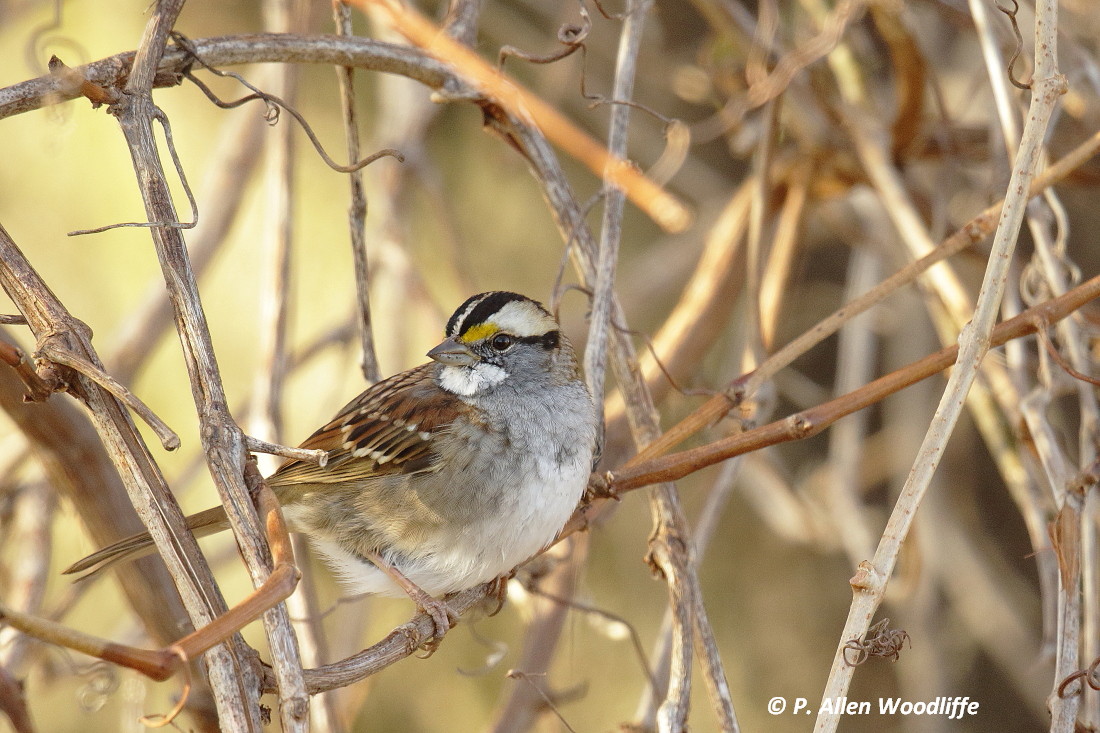
White-throated Sparrow
This trail is also a spot to see White-tailed Deer on occasion. This one was only a short distance away, but reluctant to move off. After a few moments of trying to stare me down, it eventually settled back down.

An occasional Great Blue Heron remains in the area, not surprising given all of the open water. This one was taking shelter along the canal adjacent to Lagoon Road.

With the imminent arrival of colder weather, it will be especially interesting to see how many of these species are recorded on the upcoming CBC!