Showing posts with label Virginia Opossum. Show all posts

Tuesday, 29 November 2022

Lingering shorebirds, lots of ducks, an opossum and a late moth!

 The autumn is getting quieter, but there are still lots of things to get one's attention. I have stopped at the Blenheim Sewage Lagoons, and there was a lot of ice, but that didn't mean there weren't any birds. I had a couple of species of shorebird, including several Killdeer walking on the ice...


....and a late Pectoral Sandpiper working the edges where there was a little open water.

One of the lagoon ponds had a bit of open water, where the waterfowl were concentrated. Given that it is waterfowl hunting season, although not here at the lagoons, the birds were a bit nervous, and the Northern Shovelers were often up flying around.
The Ruddy Ducks were more tolerant, even allowing me to get some relatively close photos.
Ruddies, plus a Bufflehead at the back

I went to the Erieau Marsh Trail, and there were a lot of ducks and coots out in the open water of Rondeau Bay, but well beyond photo range.

I did manage to see a Wilson's Snipe, quite motionless and presumably hoping I wouldn't see it due to its cryptic pattern. I got a distant photo.

A few Song Sparrows stopped their busyness in some shrubbery long enough for me to get a few shots

I had a reason to get out to Clear Creek Forest Provincial Park, and got a few photos. Some Wild Turkeys were feeding in a field immediately adjacent to the park, at a distance....

The park is closed on weekends for the deer herd reduction going on there, but since it was not a weekend, I decided to take a short walk to one of my favourite vantage points. It looks much more barren and winter-ready than the second photo below, taken in late October, from roughly the same vantage point. The creek bed in the first photo sure represents the dryness of the last few months, as there was not a drop to be found anywhere along this stretch.

The woods in winter are not for everyone, but I enjoy the solitude. On one occasion I went to Rondeau specifically for a twilight walk along a quiet trail, and other than a few geese flying overhead, a Sandhill Crane heard way out in the marsh, and a few Great Horned Owls and an Eastern Screech Owl calling, it was peaceful. Until I came across a Virginia Opossum along the trail, and it scolded me quite loudly for interrupting its solitude. It was way too dark to get a photo. This is one from a few years ago.

The even bigger surprise of this walk was to find a moth! It is an Autumnal Moth, a species that I have only seen on a couple of occasions when some came to my black light in early November a couple of years ago. As its name suggests, it is usually encountered fairly late in the season. This one was just sitting on the lower trunk of a maple tree. I didn't have my macro lens, so this is a heavily cropped photo, and given the twilight time of day, I had to use a very high ISO (3200) and held the camera as steady as I could with the lens being wide open (f/5) to get even a record shot like this. Fortunately the moth never moved, and I didn't need much depth of field to capture the pattern.

On another occasion I went out much earlier in the day, and saw a greater diversity of birds, and even got some photos. But the heavy overcast conditions made it challenging. There were several thousand Red-breasted Mergansers flying northeast, but well out in the lake....

...a bit of a surprise was to see almost 4000 Ruddy Ducks spread out over a large area of the lake, east of the park. They were not very close, and were spread out for well over a kilometre along the east side, enjoying the relative calm of the lake for a change. I have seen large numbers of this species on the lake before, but never in quite this abundance.
Along the trail I came across a group of 5 Cedar Waxwings, busily feeding on some berries and then flying up into a nearby tree.....

....and in the campground, there was a flock of 4 Eastern Bluebirds. I hadn't seen Cedar Waxwings or Eastern Bluebirds for quite awhile, so it was nice to catch up to a few of them.

The light was not good, and they were a bit flighty and against the sky, making a careful examination of them difficult. I am always hoping that some day, I will see a Mountain Bluebird, which has never been recorded in the park. I have seen them in Essex and Lambton, but so far not in Chatham-Kent.

A couple of Hairy Woodpeckers were along my paths.
I came across a couple of Norway Maple trees, in the campground, that still had leaves but were heavily blotched with a condition called Black Tar Spot, a pathogen that affects maples and sycamores and typically shows up in late summer and early autumn. I seem to find it primarily on the non-native Norway Maple more often than not. While it looks problematic, it apparently doesn't usually affect the long-term health of the tree.

If you would like to subscribe, or unsubscribe, to Nature Nuggets, send an email to: prairietramper@gmail.com


Saturday, 13 March 2021

Bird Action Increases!

We've had some very nice late winter weather, making it feel more like spring every day. But the forecasts look like things will slow up a bit, which is likely a good thing. Nonetheless, with some warm weather, brisk southerly type winds and lots of sunshine, it has spurred more activity amongst our feathered friends.

It was only a few days ago (March 2) when I took this photo of the piles of ice along the Rondeau shoreline.

In a matter of just a few days, that ice had all but disappeared. 

Waterfowl continued to pour in to the open waters of Rondeau Bay and even the local sewage lagoons. The warm, southerly winds caused most of the Tundra Swans to depart, although some continue to linger. The Greater White-fronted Geese that showed up periodically at Ridgetown over the last week or so seem to have left, but up to 15 Snow Geese were still there earlier this week. Snow Geese are much more of a novelty here than in extreme eastern Ontario, where tens of thousands of them pass through both spring and fall. This first photo shows all Snow Geese, including a single blue colour phase individual, and a single Tundra Swan.

This close-up shows a difference in size between two individuals. I had hoped the smaller one might have popped its head up, to see if it showed any characteristics of a slightly smaller Ross's Goose, but it remained in this sleeping pose. Then, as I was photographing something else, all of the Snow Geese took flight, although I don't think I 'shot' the smaller one in any of the several photos I got. It may have been a hybrid between the two species, which is known to happen with some regularity.


Rondeau Bay attracts thousands of waterfowl. In the last few weeks, Tundra Swans have been in impressive numbers, but most have left and it is dominated now by ducks. They are often too far to photograph, let alone get a good view of, but as was the case yesterday, several rafts of both Canvasback, shown next, and Redhead, were close enough to make the attempt. Note that there is a single American Coot at the far right of this photo.

Since several pairs of Bald Eagles have been observed at the early stages of nesting, with an adult sitting on the nest presumably incubating one or more eggs, I went part way down the west branch of Rondeau's South Point Trail to check out the nest there. It is barely visible from a limited part of the trail, and a 'scope is really useful. This next photo shows a white head sitting above the nest, so it would appear that this pair is also into the nesting cycle. This photo was taken and cropped to about 45X, so not easy to see or photograph.

While I was there, I had three cyclists stop by and I gave them a view through the 'scope, and as they were leaving three young fellows came by and also got a look. None of them had seen an eagle's nest in the park before.

The sunshine has definitely triggered some increase in activity amongst the smaller land birds, and yesterday I was treated to a fair bit of activity in the campground area. I got several firsts of the year, including Tufted Titmouse (they are year round residents, but not always easy to find)...

...a couple of Yellow-bellied Sapsuckers......
..and two Yellow-rumped Warblers. It is likely they were over wintering individuals, although there had not been any reports of them in the Rondeau area for several weeks.

I also had a single Evening Grosbeak perched at the top of a cottonwood tree, but it was seen from a distance and before I could get even a distant photo, it flew north. They were quite frequently seen in mid to late autumn last year, and presumably this is one that was on its return to the boreal forest region.

Other, regular winter residents cooperated nicely for the camera.

White-breasted Nuthatch

Northern Cardinal

House Finch

Golden-crowned Kinglet

Black-capped Chickadee

Red-bellied Woodpecker

Downy Woodpecker, male

Downy Woodpecker, female

Elsewhere in the park, I came across several Turkey Vultures. They will be a regular occurrence from now on....

....and three Killdeer.
This Eastern Screech Owl is showing up in its usual beech tree a bit more regularly.
I came across this Virginia Opossum along the Tuliptree Trail.
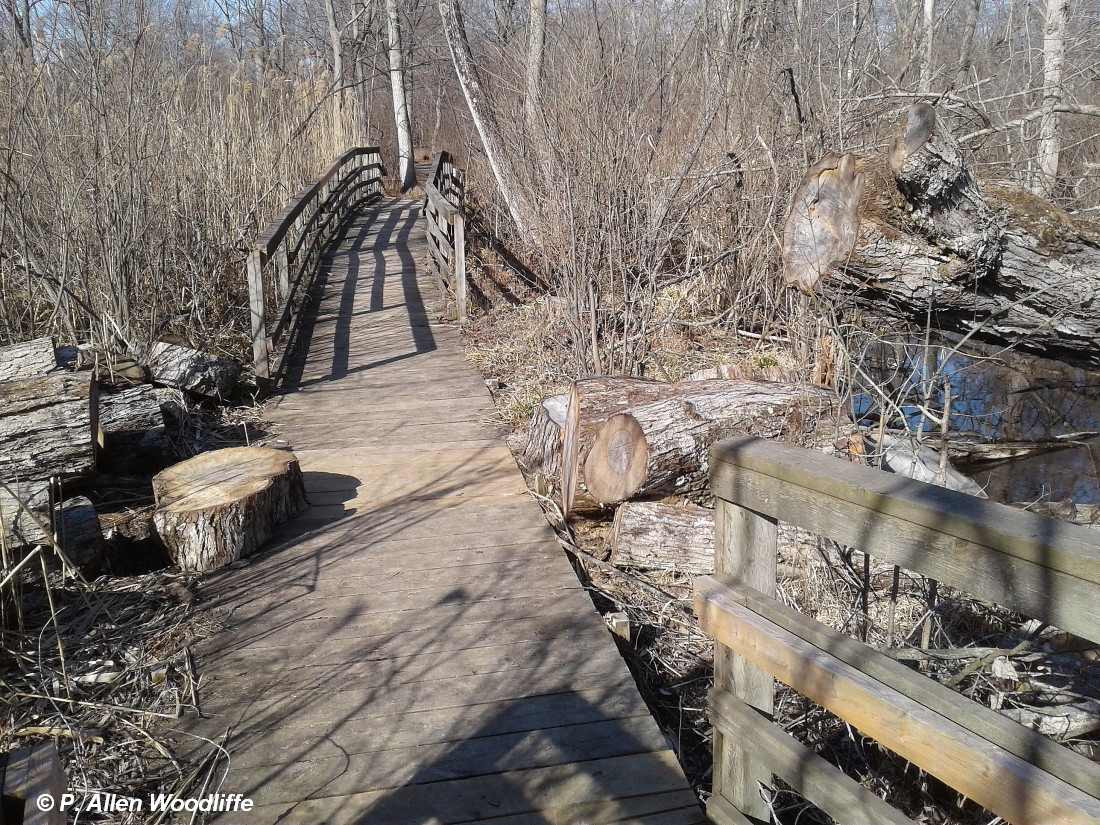
The Spicebush Trail did not have much birdy action, partly because the brisk westerly winds had them hunkered down, or elsewhere. I hadn't been around this trail for several weeks, and noted that since my last time around, a large Silver Maple had come crashing down across the boardwalk, likely due to one of the strong easterly wind events.

On one occasion while returning home, I saw this Striped Skunk scampering along the edge of a field. Normally you don't see skunks out in broad daylight and so far from any cover, although as they emerge in the warming days of spring, they may forage farther afield. A closer look at this individual, however, shows a diseased or damaged left eye. I did use a telephoto lens, but still got fairly close to get these photos. I made sure that the wind was blowing in the skunk's direction, just in case!


Wednesday, 20 January 2021

Outings in mild mid-winter settings

 I've been out a few times since the last post. The mild, open winter conditions certainly make it easier to get around, and there have been very few other people out and about, so it is easy to keep a distance.

 I did want to check on the Great Egrets that have been hanging around the mouth of the Thames River, and in particular the Jeannette's Creek boat launch area. Sure enough, there were at least three birds still there, as well as one or two Great Blue Herons and a few Bald Eagles. The egret was in the canal right beside the boat launch, and the heron was on the far side of the river. No eagles were within photographic distance on this trip.


 A drive around the former Dover Township can be worthwhile, and with no snow on the ground, the Snowy Owls are a lot easier to find even if they are well out in the fields. A fair bit of cropping is usually required.


I haven't been to Rondeau a lot in the last couple of weeks, but a couple of times. Woodlands are fairly quiet, and one can go for long walks without seeing many species, or even birds. I did manage to see and photograph a few, including the Bird of the Year highlighted in the previous post.

This American Tree Sparrow seems to have something not quite right with its eye.
The cardinal was more intent on feeding on something on the ground than it was in avoiding the stare of my camera lens.
The cavity in this American Beech tree has been a popular spot for a roosting Eastern Screech Owl. However I only see it there about one time in ten, so it must have multiple roosting cavities, or it can sit down and out of sight.
With no ice along the shoreline, and lots of wave action along with the high water levels, shoreline erosion continues unabated. This concrete slab is associated with the former south campground office, which was in operation from the late '50s (I think) until the early '70s when, record high levels at the time, caused flooding in the campground and it was closed. Depending on the wind and wave action, sometimes there is enough deposition of sand and gravel to cover the concrete, but at the moment, it is quite visible again, and a definite reminder of the constant of change.

At one point just before returning to the parking lot, this Virginia Opossum scampered across the road in front of me. It disappeared in some thick shrubby undergrowth, so I was not able to get anything different.

Yesterday I decided to take a drive to Erieau, since I hadn't been there for several weeks. There was the usual gull mix, but not many duck numbers. A bit of this and a bit of that, but no large numbers of anything. However the entire bay as far as one could see was open, so waterfowl had lots of area to choose from to avoid the wind and waves. The more protected area of the marina harbour did have a few things.

Canvasback

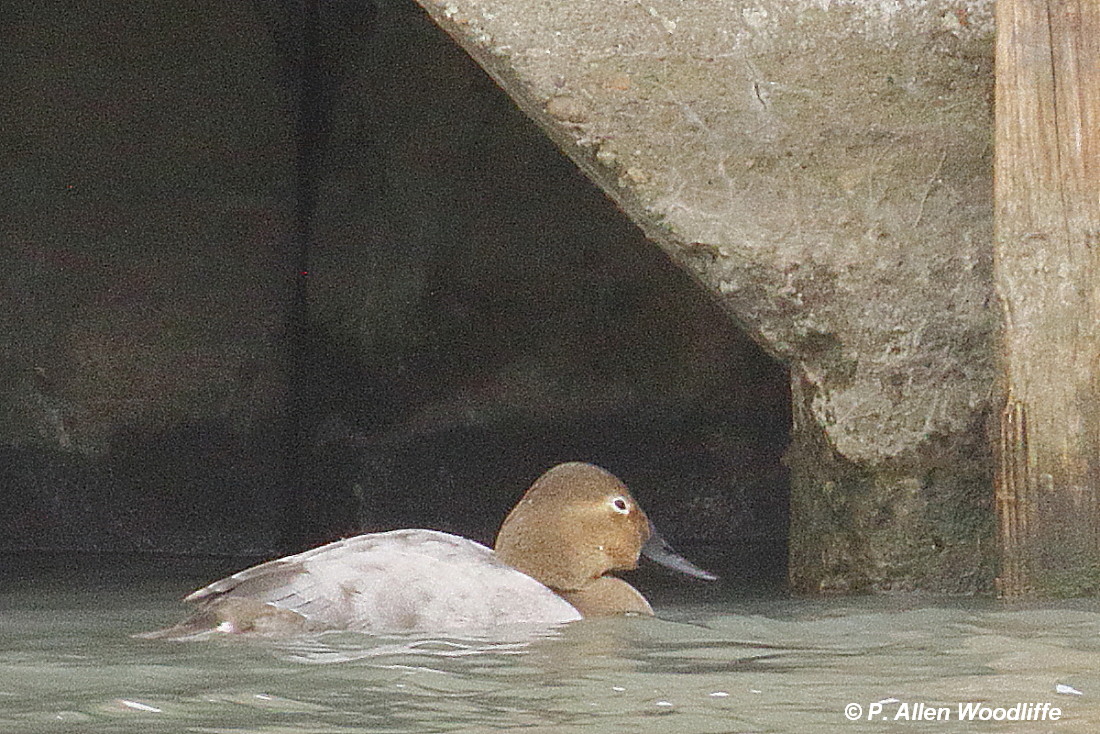
Redhead female
I was pleased to find the previous two species, as well as a couple of scaup that I couldn't get photos of. I was especially glad to have caught up with this Horned Grebe hanging out in the main marina slip. It is in its full basic, non-breeding plumage. A closer look at the first photo shows the position of the legs, towards the back of its body. This is typical of the grebes and loons, and it makes it difficult for them to walk on land. Hence you almost always see them on the water, unless you happen to find a nest which is close to the water's edge to minimize the requirement for walking on land.

House Sparrows aren't hard to find, but it has been a long time since I have bothered to photograph them. This one was in a group of about 60 birds all huddled in some dense shrubbery. It was quite open, obviously, but the sky background was not exactly what I would like. But you have to take what you get and make the most of it.
A side trip to Shrewsbury did not turn up much other than lots of Canada Geese and at least three Bald Eagles. These two were at the edge of the ice, while a third was in a nearby tree and was camera shy.
Now that the colder weather has arrived, and with it a little bit of snow, it will be interesting to see what turns up at feeders, or a few open patches of water that will be slowly decreasing in size. Winter has arrived, at least for the moment.