Showing posts with label Pacific Loon. Show all posts

Saturday, 23 November 2024

Autumn's final warm fling?

 Butterflies in late November? Yes, and a few other warmish season creatures have been out and about. Eastern Comma, first, is a species that will overwinter as an adult, so when the weather is warm, they can be out basking as this one was.

Common Buckeye does not overwinter in southwestern Ontario, but there has been a good number of them this late summer and fall, so it isn't all that surprising to see the occasional one stick around in this unseasonably warm weather.


  There have been a few Autumn Meadowhawks flitting around in sunny, sheltered places.

Next is a Black Blow Fly.

...followed by a Common Drone Fly.

There were a few of this next one around. It is a possibly a Tufted Clusterfly, although the exact type of clusterfly has not yet been determined.
Woolly Bear Caterpillars are often seen, even in winter. It is the larval stage of the Isabella Tiger Moth, and this first image shows the typical coloration.
According to a specialist on iNat, this next one is a Tiger Moth of the Phragmatobia species.

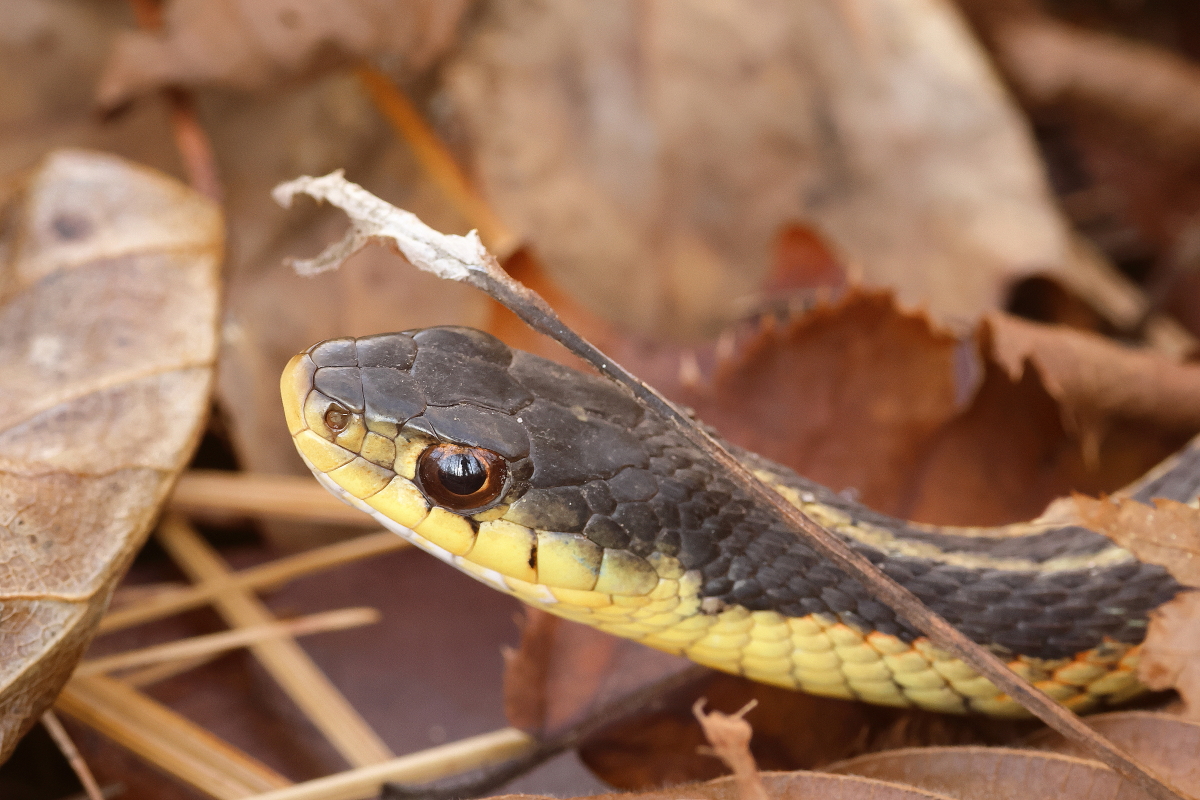
Reptiles are cold-blooded, and are not often seen this late in the season. However due to the warmer than normal temperatures, a few Eastern Garter Snakes were out....
.....as were a few Midland Painted Turtles.

I even heard several Spring Peepers on more than one occasion! I'm sure all these reptiles and amphibians are now safely in their winter quarters!

On one of my outings to Rondeau, I spent a bit of time scanning the lake from the east beach. I was hoping for a few loons, especially a Red-throated Loon or even a Pacific Loon. Both have been seen on occasion in the last week or so. I did see up to a couple of dozen Common Loons.....


....and there was at least one Red-throated Loon mixed in from a distance, but I didn't get any photos of it. As for a Pacific Loon, I struck out on that one so far, but I have seen them in Ontario in the past. When I was involved with some wildlife surveys at Polar Bear Provincial Park in about 1990, we came across a nest, and one of the adults was cooperative enough to allow me this photo. The fall plumage is considerably more drab than this photo, however.
While looking for loons, there was a massive movement of Red-breasted Mergansers flying by. I think they had been stirred up by a passing ship, so there were probably 3-4000 of them in flight that stretched like this photo, for at least a kilometre with smaller groups going by as well.

I spent a bit of time up along the Mitchell's Bay North Lakeshore Trail, and while I didn't see any shorebirds on this occasion in spite of the extensive mud flats, there were some raptors in the area keeping an eye on waterfowl and other things. There were probably three adult Bald Eagles in the area, although they were sometimes on the move for a short distance and maybe there were only two.


This Merlin, next, was initially seen hopping around in some shallow water. Not sure what it was trying to do, maybe wash something before eating? It wasn't clear, but after a few moments it got up and left....
....and this next photo is likely of the same bird, on the top of a pole a short distance away, surveying its domain.

I also spent a bit of time along the Erieau Marsh Trail. There wasn't a huge diversity of birds, but a few things caught my eye and gave me some photo ops. I was a little surprised to see at least a couple of dozen American Pipits flying around in a loose group and landing near the tree tops. I usually see them in much fewer numbers, and typically on the ground, but these were migrating so were behaving a little differently.


American Tree Sparrows are one of the more common sparrows this time of year. This one was busily tearing into some goldenrod seedheads.
A Downy Woodpecker was digging into a tree trunk....
...and this is a Rusty Blackbird, one of a small flock of a dozen or so on the move.
This Great Blue Heron was first noticed when I heard its loud 'croak' that indicated where it was, so enabled me to get this rather distant and cropped photo.


If you want to subscribe, or unsubscribe, to Nature Nuggets, send an email to: prairietramper@gmail.com

Wednesday, 3 February 2016

Ground-hog Day or World Wetlands Day....take your pick

Yesterday, Feb 2, was Ground-hog Day. While I don't want to denigrate the ability of those furry rodent prognosticators across the land in speculating the arrival of spring, perhaps just as importantly, it was another notable day: World Wetlands Day.

There is a worthwhile blog post about wetlands on the Canadian Geographic site, located here.

Wetlands, and of course the lakes, rivers and streams that they are often associated with, are critical to a lot of life, including yours and mine. In fact the survival of most plant and animal life is dependent to varying degrees, on water.

Here in Chatham-Kent, at the time of settlement, according to a 1987 paper, the landscape was made up of 66% wetland, which includes both marsh and swamp. By 1967, only 5% remained and by 1982, that number had dropped further to 3.7%. I don't have figures for the current status, but I expect we have all seen more wetlands disappear than re-appear on the landscape, and there are continuous threats to those few remaining wetlands. For a municipality with less than 5% natural area, not a lot of that is in wetland form, so it is fair to say that wetlands have declined significantly since 1982.
St. Clair area wetlands
In the early 1970s, 21 participating nations met in Iran, and established the Ramsar Convention, which is more formally known as the Convention of Wetlands of International Importance. Its purpose was to be a treaty for the conservation and sustainable utilization of wetlands for their economic, cultural, scientific and recreational values. Wetland sites were nominated across many of the participatory nations, which typically were some of the most nationally and internationally significant sites.

Some of the wetlands in Chatham-Kent and neighbouring counties were nominated, but currently only two have been adopted as a Ramsar Site. They are Point Pelee National Park and St. Clair National Wildlife Area.
St. Clair NWA
The wetlands along the eastern and northern sides of Lake St. Clair are well known for their attraction to migrating and nesting waterfowl. Some of the stats regarding its significance (based on the Ramsar Convention website) are:
  • 25% of the North American population of Tundra Swans pass through the area;

Resting swans and geese

  • over 200,000 Canada Geese pass through the area.
Tundra Swans, Canada Geese and a few ducks
Canada Geese
  • up to 360,000 individual waterbirds pass through the area, including Canvasback, Redhead and Mallards. During the most recent Christmas Bird Count for this area, on January 1, 2016,  our one day count of waterfowl totalled over 55,000 birds. In 2007, our one day count totalled over 95,000 birds!
Diving ducks
Canvasback
Redhead
In addition there are numerous species of wildlife besides waterfowl as well as plants that are dependent on these vast wetlands, including many species at risk such as Swamp Rose Mallow, where at times, can be incredibly profuse as this next image shows. The Canadian range of this species is largely limited to the more significant wetlands of extreme southwestern Ontario.
A lot of Swamp Rose Mallow
Swamp Rose Mallow
At the opposite extreme of the province is one of the largest wetland complexes in Canada: the Hudson Bay Lowland. Polar Bear Provincial Park is a huge part of the Hudson Bay Lowland with an area of almost two and a half million hectares, and is Canada's second largest Ramsar site. (The largest is the Queen Maud Gulf in the NWT, which encompasses over 6 million hectares). I was privileged to have spent several weeks in Polar Bear PP doing some wildlife surveys in the early 1990s. It is an incredible place.


The numbers of shorebirds and waterfowl are amazing. For example, on migration, more than one million Snow Geese pass through, and some breed here in huge colonies.
Blue phase Snow Goose with young
During migration, the area supports almost the entire Arctic population of Red Knot.
Red Knot (Black-bellied Plover in background)
It also supports the entire Arctic breeding population of Marbled Godwit.
Marbled Godwit
Marbled Godwits
We found Parasitic Jaegers nesting, as well as Pacific Loons.
Parasitic Jaeger
Pacific Loon
Semipalmated Plovers were nesting close to our camp, and Bonaparte's Gulls were nesting in some of the spruce trees.
Semipalmated Plover
Bonaparte's Gull
In spite of the recognition of these internationally significant wetlands, so many other significant wetlands of southwestern Ontario have been lost, or are threatened and may be gone tomorrow, or next year. These losses are attributed to our economic development of the area, including agriculture and urbanization. We are all at least partially responsible, and the decline in habitat quality and species diversity continues. Yet I read just today of a prominent spokes person for the industry stating that to demonstrate the environmental responsibility of his industry, the evidence is in the increasing numbers of frogs, birds and other animal populations on the landscape.

Huh???

No examples were provided, because to this person, it was evident by just looking around. I'm not really sure what that person was looking at, however, as the overwhelming evidence is exactly the opposite. Our native populations of flora and fauna have been in decline for decades, and show no signs of letting up. In fact the number of officially, legally Rare, Threatened and Endangered Species has never been higher, and there are dozens and dozens of other species waiting to be evaluated to determine their status. The only thing that is increasing on the landscape is the abundance of non-native invasive species. And that will be discussed in another post.