Showing posts with label Red-tailed Hawk. Show all posts

Monday, 29 December 2025

"Only" birds here and there

 In spite of the winter, there have been opportunities to get out, go for a long walk, explore and even get a few photos to feature the season.

A recent eBird post indicated a Snowy Owl had been seen not far from St. Clair NWA. Since I was heading out somewhere anyway, I decided to swing that way since it was only a couple of hours later. Unfortunately, even with slow and careful viewing, the owl was not to be seen. It wasn't reported by anyone else either. But I did get photographs of a few other things while I was in that vicinity.

Sub-adult Bald Eagle

As I crossed over a wide creek, I noticed this Great Blue Heron standing on the ice, waiting for....something. Maybe spring????

A little further down the channel, was another one. At least it was standing in some water. I am amazed that in spite of standing in almost freezing water, on ice, it apparently doesn't seem to bother them. And even farther down the channel was a third heron.
In a field nearby, were 7 Sandhill Cranes.....
...and a few Tundra Swans flew overhead.
But no Snowy Owl to be seen.

An outing at Rondeau and area didn't produce a lot to photograph, but there always seems to be something. 

White-throated Sparrow
It was bright/heavy overcast, which didn't produce great lighting for a mostly dark House Finch perched on a branch against the sky. It seemed to be busy feeding on the numerous berries of some of the Red Cedars in the campground.
A Hairy Woodpecker was busy searching for insects.
American Tree Sparrows are relatively common, or at least somewhat regular at the moment. They often travel in small flocks.
A single photo gives a good view....

In other odds and ends, there are often Canada Geese somewhere around...

...or a Ruddy Duck...

...or even a Red-tailed Hawk.
No butterflies, insects, or plants to photograph these days, but at least there are a few birds!


If you would like to subscribe to Nature Nuggets, send an email to: prairietramper@gmail.com 

Monday, 9 December 2024

Late November, early December highlights

 In spite of the warmer than normal weather in late November, one doesn't expect to see swallows still around. However Cave Swallows, if they are going to show up in southwestern Ontario, have a habit of showing up after the majority of the others in that family have gone south. Such was the case when I got a text message saying that a Cave Swallow was at the Erieau pier. Since I was almost ready to head out somewhere anyway, it made the decision of where to go very easy. 

As I got to the main channel, just as I was getting parked, I saw this swallow scoot by, heading for the pier that juts out into the lake. Bingo! And as I glanced towards the base of the pier a minute or so later, I saw 4 people looking intently at something, so with camera in hand, out I went. 

And there it was, resting at the edge of the lower section of the pier, trying to keep out of the brisk wind. You can tell by its posture and fluffed up feathers it wasn't really enjoying the cool wind.

It seemed quite tolerant of us. Every few minutes it would get up and fly around, and sometimes flew by almost within arms reach, before returning to the edge of the pier.

However after awhile, it got up and flew east towards Rondeau, and we never saw it again. What a great sighting in late November! This swallow species seems to show up quite regularly in small numbers. I have had one to five of them at Erieau on at least 3 occasions, and along the east beach of Rondeau.

I've been able to find, and photograph, other species which, although they are much more common, are always a delight to see as well. Here are some of the highlights.

Bald Eagles always get ones attention, especially a fully adult bird with its distinctive white head and tail, and its fierce look if one gets a close enough look.


The above bird was in a tree right along the roadside near St. Clair NWA and it didn't seem to be concerned when I got out and aimed my camera at it. The next photo is of a bird that was well out from the trail at Keith McLean Conservation Area, and it flew off as I got within several hundred metres of it.

On one of my several visits to Rondeau, I photographed some smaller, land birds. A Hermit Thrush, not all that common this time of year but usually there is the occasional one lingering, was feeding on some berries at the side of the trail.

Its spotted upper chest area and the rusty tail are good indicators to separate this species from others in its genus.
Northern Cardinals are year-round residents, and the males really show up well with their bright red plumage.
Less brightly coloured but perhaps even more attractive with a more subtle, warm brown plumage, is the female cardinal.
Not a small bird, of course, but Wild Turkeys are regularly seen in their family groups. There were four others in this group, but I just zeroed in on this one for a full frame photo.

Elsewhere on my Rondeau travels, I photographed some Cluster Flies even though the temperature was barely above freezing...

..and I noted this White Pine seedling also along the trail. White Pines are an important element of Rondeau's vegetation, and while they are often eaten by White-tailed Deer, hopefully some will survive to maturity. This past weekend the park was closed to the public, as a deer hunt/cull was in progress. In the absence of natural predators at the park, periodic culls are important to keep the population of both the deer, and the vegetation, in a healthy condition. At one point in the mid 1980s or so, and in the absence of any kind of cull for a decade or so, the winter population of deer approached 600! The vegetation was in horrible shape, and one winter there were about 20 deer that died of starvation and severe cold. Deer biologists that specialize in herbivory determined that the population in winter should not exceed about 125 animals.

In other travels, I have often been near wetland areas which have not been iced over. Not sure how long that will last, as it isn't officially winter for a few days yet. Waterfowl are always fun to focus on. This first photo is of a female Bufflehead at the lower left, and a female Hooded Merganser on the right.


Female Hooded Merganser
As is the case with some mergansers species, the females have a tufted head, as the hoodie shows. The next photo is of a female Red-breasted Merganser which is much larger than the hoodie.
I photographed these Ruddy Ducks at Erieau, which were taking advantage of the quiet water in the harbour area. This first one is of a male...
...and next is a female.
This next one is of a female Ruddy Duck that was not resting, but quite alert.

Typically in the St. Clair NWA vicinity at this time of year, there are lots of swans. Mute Swans, shown first, are not present in large numbers, but as long as there is any open water, are present throughout the year .

But what gets more attention due to their seasonal variation, and huge numbers are Tundra Swans. It is not uncommon to see upwards of 10000 birds in scattered flocks, especially if there is an unplowed field to feed in....
....or a wetland area to take refuge in.
Small groups are frequently seen flying from one field to another, or back to the NWA.

There are still some flocks of Sandhill Cranes reluctant to leave the area. I came across over 150 only a few days ago, in two separate areas. They were quite a way off in a field, so not easy to get the kind of photos that I was hoping for, but this is what it is.


Sometimes they are on the move as well, to a quieter or better feeding area.

And even though the main raptor migration is over for the autumn period, some raptors will be content to stick around. I was out looking and hoping for Snowy Owls, but didn't see any. However there are a few Northern Harriers, a.k.a. Marsh Hawks, around hunting in open fields or in wetland areas.


And Red-tailed Hawks, such as this immature one, are regularly seen along woodland edges and even on power line poles.
Not the greatest shot of this bird on a power line pole, but you do what you can to capture the setting!

If you would like to subscribe, or unsubscribe, to Nature Nuggets, send an email to: prairietramper@gmail.com

Wednesday, 25 September 2024

On the hunt for Marsh Tickseed, and lots to see in other open wetland areas

 Readers of my last post will note that Marsh Tickseed, a species at risk was something I found at St. Clair NWA, and since there were a couple of older records for this species at Rondeau, I tried diligently to find it there. The search got me out to places I hadn't been for awhile, at least not at this time of year, so I was hopeful. The south beach, along the edges of the marsh, was the place to search. Unfortunately the habitat has changed due to variable water levels as well as the onslaught of the non-native Phragmites.

This is the plant that I was looking for. A sort of typical looking sunflower type....

...but with very distinctive finely cut leaves.

I did find a few other things to aim the camera at, however, including this adult Bald Eagle, which did not like me getting any more than about 300 metres away before it left its perch....

...a moth, this Rubbed Dart, feeding on a relative of the Marsh Tickseed (I looked at a lot of tickseed types!)
And this small but colourful plant, the Trailing Fuzzy-Bean, a member of the legume family.

I saw a number of Double-crested Cormorants, as usual but for some reason this one was quite tolerant of my presence.


Elsewhere, while checking out some of the multitude of goldenrods, I came across a Northern Paper Wasp....

....a type of cluster fly...
....and this Bald-faced Hornet.

While some of these critters are capable of giving a painful sting, I have never been stung yet, as they are much too busy feeding on the nectar. I leave them alone as much as possible, but sometimes I use a macro lens and flash, and may only be inches away from them.

On my way to and from the park, I sometimes stop at the Blenheim Sewage Lagoons, as there is always a good variety of birds to view. On occasion they even are close enough to photograph! Bonaparte's Gulls can be fairly plentiful and sometimes quite close to the edge of the cells.

My target species for this visit to the lagoons, however, was to find one of the Red-necked Phalaropes that have been there lately. It is very much an irregular migrant, and one doesn't see them every year. Unfortunately it is often well out in the middle of the lagoon, making a decent photo hard to come by. This was taken at a magnification of about 22X, and then cropped considerably to more like about 80X.

One of the intriguing birds recently reported in southern Ontario, was a Cinnamon Teal, near Grimsby. It is quite the rarity at any time of year. Apparently hundreds of birders flocked to see it, but I wasn't one of them. I have seen it in Ontario before, as a fairly brightly plumaged spring male was at Rondeau for a brief period back in May of 1994. It was well out along the Marsh Trail and I, along with a good number of others, managed to see it. I didn't get a photo of it, but I do have a photo of one that I took out in southern Saskatchewan in July of 2018, where it was hanging out in a prairie pothole area along with numerous shorebirds, especially Wilson's Phalaropes, shown next. Not a brightly plumaged male.

A trip to St. Clair NWA is almost always worthwhile, and not just to see the Marsh Tickseed. Waterfowl are building in numbers, with Canada Geese numbering in the several hundreds by now.

Tucked well out of the way along the shrubby shoreline of the wetland, was this immature Green Heron. It was likely about 300 metres away, and when I first saw it through binoculars, I thought it might be an immature Black-crowned Night-Heron, but when I got a distant photo and highly cropped it, also to about the equivalent of about 80X, I could see the darker crown and the slightly dull green back. An immature BCNH would show a more evenly coloured brownish back. This bird is a little more fluffed up to make its body look a little more BCNH like, adding to the challenge of identification, especially in poor light and at a considerable distance.
Mallard are in the area, also by the hundreds.
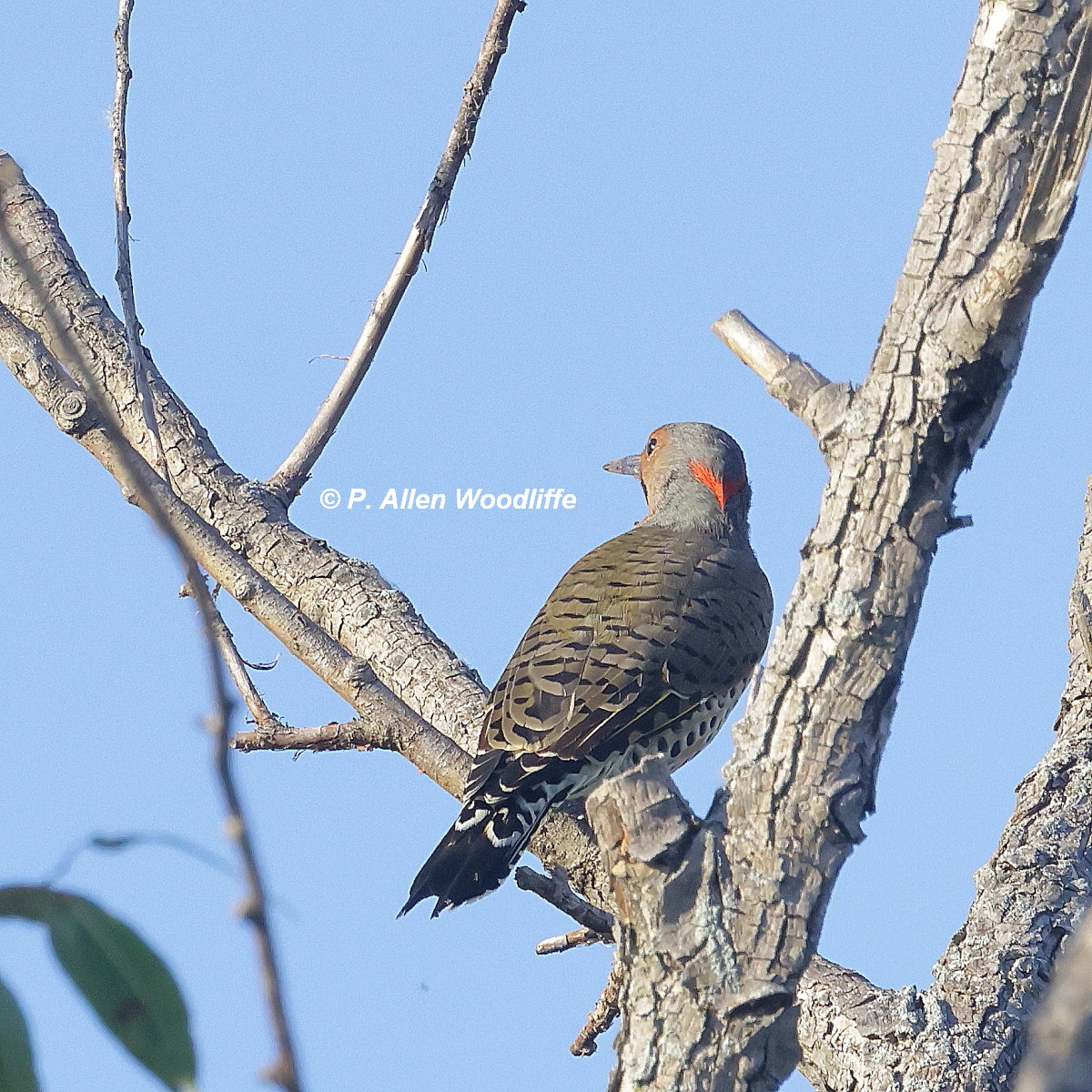
This Northern Flicker was in one of the few trees along the dyke trail.
Sandhill Cranes can often be heard, and occasionally seen and even photographed on their flights to and from the NWA.
Sometimes they will be feeding in a field immediately adjacent to the NWA.
Along the far woodland shore, there often are a few Wood Ducks tucked away, giving only distant views and photos. Sometimes up to 20 can be seen in one or two places....
....and on occasion, a brightly coloured male, shown next, will even linger in the channel adjacent to the trail, and a cautious approach might result in a photo such as this next one.

Northern Harriers are periodically seen, although usually in flight mode, and often heading away, giving a rear view only.

I typically add visiting the Mitchell's Bay North Shore Trail to one of my more northern forays in Chatham-Kent. The openness means there is often a comfortable breeze. As I have mentioned before, it is a great spot to see a few Great Egrets with typically at least half a dozen seen on each visit. On a cloudy day when they are sitting up in a tree, they may be a bit more challenging to get a good photo, but it is always worth a try.

There is enough shallow water or muddy shoreline along the edge to attract a few shorebirds, such as this Lesser Yellowlegs....
...and a Wilson's Snipe.

This adult Red-tailed Hawk was keeping an eye on me from a safe distance.

My next post may finally get me to do the one I had in mind awhile ago, featuring a variety of late summer orchids, including the endangered Nodding Pogonia, a.k.a. Three-bird's Orchid (Triphora trianthophoros). Stay tuned!


If you would like to subscribe, or unsubscribe, to Nature Nuggets, send an email to: prairietramper@gmail.com