Showing posts with label Climbing Prairie Rose. Show all posts

Saturday, 12 July 2025

Prairie plants and other colourful elements of nature

I thought it was time to give the Sandhill Cranes header a rest, and this new header features a beautiful day-flying moth called a Nessus Sphinx. It was quite active visiting some Common Milkweeds in my yard, so I snapped a bunch of photos, as you might expect :-).

In spite of the greater heat and humidity of late, it is still worth getting out from time to time. A popular plant to see and photograph these days is Butterfly Milkweed. 

This site is at the north end of Rondeau, immediately across from the campground. This photo was taken several years ago, and although it had grown rather shrubby of late, it has been burned in the spring over the past 2-3 years, so it getting more open again, and the Butterfly Milkweed is fairly abundant.

It is always worth paying attention to other things that are around. On one occasion several years ago when I was photographing this patch of Butterfly Milkweed, I caught a glimpse of a large butterfly visiting a nearby patch, and realized it was not a species I was familiar with. So I grabbed my other camera and got this one photo before it took off. I tried to follow it, but it could fly much quicker than I could get through the vegetation!

Once I got home and checked to see what it was, I discovered it was a Gulf Fritillary, and it was the first photographed/confirmed individual for Canada! You can see the wings are a little tattered, so it likely got blown off course via a southerly wind, and ended up at Rondeau. One just never knows what might be out there waiting to be found...

 Something to be aware of regarding these prairie/savanna habitats at this time of year, is the presence of something called Chiggers. They are the larval stage of a type of mite. They are very tiny creatures, which you can barely see even with a hand lens. They will get onto clothing, and eventually on your skin, and a few hours after they catch on to you, you may notice some little red itchy spots! They aren't known to spread any disease like deer ticks that can pass Lyme Disease on, but they can be quite itchy for a few hours. Some people react more strongly to them than other folks, but it is worthwhile to be aware of them. Something like calamine lotion will alleviate the itch fairly quickly in most cases.

 This sandy prairie site is a good spot for other prairie/savanna plants. A common but rather small one is Pale-spiked Lobelia, and it, too, has been in flower for a few days. 


The flowers can be almost pure white, or have a distinct tinge of blue.

 And another prairie species, mainly towards the north and open sections of the Marsh Trail is this next one, Tall Meadow Rue.....


 .....and Wild Bergamot, which also grows in prairie-like settings.

A close relative, but more woodland than prairie, is Scarlet Beebalm. It is quite uncommon.

Some other prairie/savanna species, although not found at Rondeau, include Foxglove Beardtongue...

Foxglove Beardtongue


...and Climbing Prairie Rose, which when found often is climbing up a small open tree. I have even seen this species growing along roadsides in Chatham-Kent, which of course are quite open and have dead trees so provide a good climbing medium.


Next is a plant that is quite rare in Ontario, called False Indigo Bush, which normally grows in prairie/savanna habitat. It is not native to Rondeau, but was likely intentionally planted by someone who may have been the same person who planted the endangered Prickly Pear Cactus back in the early to mid 1990s, and is found in the same general area.


I have been keeping an eye on the progress of another Species At Risk, American Ginseng, which is indeed native to Rondeau.
 
 
 The flower buds were developing earlier in the season....
...and eventually put out a few small flowers, which aren't very showy....
....but have developed into a few seed capsules, that eventually will turn red.
 

A few other things to feature on this post, include a couple of fungi such as this Goblet Waxcap...

...and one with only a Latin name, called Crepidotus nephrodes.
Another plant which can grow in a variety of places, including the edges of woodlands, is Common Selfheal.
This next plant is a shrub, and like many others growing along trails and roadsides, is not native. It is Common Privet.

If you would like to subscribe, or unsubscribe, to Nature Nuggets, send an email to: prairietramper@gmail.com


Sunday, 3 July 2022

Grasslands, wetlands and other odds and ends

 I've been out intermittently these last few days, depending on the weather, and trying to mix my day time excursions satisfactorily with my night time black lighting.

Grasslands are always intriguing. Most of the ones I've visited lately aren't really tallgrass prairie types, at least not yet, but they have some long term potential. But even hayfields can be worth checking out.

One spot a bit west of Chatham has been a hayfield for a few years, although it is periodically pastured or cut for hay. But it is suitable for attracting grassland birds, and has had Dickcissels there on a somewhat regular basis in recent years. There were 2-3 males there recently, although they seldom come within good photogenic range from the road. Given that it is private property, that is as close as one can get. A visit to it a few days ago enabled me to get a couple of decent record photos.

It isn't super sharp and is heavily cropped, but at least the sun was at the best angle and the background worked well. I went back to this spot a couple of days later hoping for better success, but by that time the cattle had been moved into this area and had trampled a lot of the vegetation. Given how dry the weather had been, the cattle had to be moved somewhere from their other pasture, so it wasn't a total surprise. Unfortunately there were no Dickcissels to be seen or heard.

In a more encouraging scenario, some friends of ours had purchased an agricultural field next to their woodlot, and had a mix of pond/wetland, prairie and hayfield established over the several hectares of this new acquisition. I've had the pleasure of advising them on the tallgrass prairie portion of it, and even scattered some native prairie seed that I had available to me to help it along. So I get to visit it on occasion, and a few days ago I went out to see if any grassland birds had taken to it. I was pleasantly surprised to see a few, including lots of Savannah Sparrows, 

....and at least 3 Dickcissels. It was well away from the road, and I was able to get some better shots of this species in various spots. Sometimes they were sitting up on a tall Dock (Rumex sp.) species as this first photo shows.
At other times they would be on a developing sunflower, singing away and advertizing their territory. I noticed a couple of times when one male would be chasing another one, so it looks like they have found this spot to their liking. Both of these Dickcissel photos are heavily cropped as well. I plan to get out again, and see more evidence of their approval of this site.

I went out to the Dealtown Crown Land, which back in the '90s, was planted into tallgrass prairie to be the source of seed for future restoration projects. After a few years, a better location for the prairie seed nursery was found so this ceased to be a priority for managing for that purpose. As a result, much of the site is quite shrubby, although there are some good sized open grassy areas, and I was hoping that some Dickcissels had shown up as they had in previous years. But none were to be found on this visit. There were lots of other birds, but nothing unexpected. I managed to get some photos of other species, just so it wasn't a complete wash. There were several Cedar Waxwings, which will be in nesting mode by now....


...and a few Mourning Doves. This one had a nest with two eggs, in a Red Cedar tree.

I've been out to St. Clair NWA on occasion as well. There is always something to see and photograph here.

Evenings are great, as the daytime temperatures cool a bit, the bird activity seems to pick up. And the golden light of late day conditions work well. This Tree Swallow was using a nest cavity just below where it was sitting.

Canada Geese are abundant, not surprisingly, but are also photogenic at times.....
...Mute Swans, well they are an invasive nuisance species, but also photogenic. One can see why they were imported decades ago to dress up gardens and ponds.
Unfortunately they do create havoc to many native waterfowl species.
There is a pair of Northern Harriers, formerly known as Marsh Hawks, occupying a territory at this NWA. Once in awhile, one might get a fairly decent photo of them as they flyby, like this female did.
Of course wetlands are heavily occupied by Red-winged Blackbirds. There is no shortage of them here, and one can get some pretty decent photos of them in the golden glow of the evening.

On other occasions, I have been there in the morning, and had some photographic fun. Again, Red-winged Blackbirds can be easy subjects....

...but capturing them in flight is a much more challenging proposition.
Great Egrets are more predictable with their flight lines.
An Osprey was perched high on a dead branch overlooking the NWA.
....and a pair of Northern Flickers were busily chiseling out a hole, and taking time out for some copulation.
Getting flight shots of Barn Swallows was even much more challenging than for the Red-wings. Swallows are smaller, and fly quickly and erratically, so even with the capabilities of my camera having multiple focus spots specifically for this type of photography, I deleted far more photos than I bothered to save.

I also checked out the Fletcher Ponds, which can sometimes be good for a few birds. It is like an island in a sea of agriculture, so can be a magnet for birds in on occasion. However on this visit it was surprisingly quiet. The only thing of note was not a bird at all, but a Species At Risk plant: Climbing Prairie Rose. It looks a lot like other species of rose, but a couple of the main features to differentiate it is the three leaved arrangement, and the stem of the leaf has a couple of wide wings at the base, with each wing resulting in a separate pointy look to it. These can be seen to the left of the flower.

Another botanical highlight of the last few days is to come across a new population (to me) of a provincially rare orchid: Purple Twayblade. I found a loose cluster of 7 plants at Clear Creek Forest Prov Park, 5 of which showed evidence of flowering. However they were all well past their best, and this single flower shown below was the best example remaining. Now that I know where they are, I hope to check them out more strategically next year.


If you would like to subscribe, or unsubscribe, to Nature Nuggets, send an email to: prairietramper@gmail.com


Monday, 12 July 2021

More atlassing and related explorations

 Collecting data for the current Ontario Breeding Bird Atlas is beginning to wind down. Not that there won't be some birds in nesting mode for a few weeks yet. One year I was able to photograph a nest full of Cedar Waxwings as late as the first week of September! But for many birds, things are more likely to be gearing up for migration, which for some shorebird species, is already underway.

I've been out several times over the last few days. And as usual, even though I'm more or less focusing on birds, there are so many other things to be distracted with.

On one occasion I was out at the McKerrall Forest, a few kilometres north of Chatham. The birds weren't overly vocal, at least for my ears. I mostly saw or heard the usual woodland species, but did get a good, but distant look at a male Orchard Oriole.

I'm not really 'into' sedges, but this one usually gets my attention. It is called Gray's Sedge, a relatively common woodland species.

If I come across American Beech trees, I check for Beech Leaf Disease, an insidious relatively new disease that may play havoc with any beech trees that have survived other stresses. The disease is relatively identifiable with its dark, blackish bands in between the leaf veins.

When I got to the one end of the forest, I looked out across the bean and wheat field, and noticed a couple of ears sticking up. They quickly morphed into the head of this deer.

After a few moments it decided I wasn't any real threat, so it continued along its way.....
....always keeping an eye on me, but eventually emerging almost totally. However when I finally moved, it decided enough was enough, and so it quickly bounded away to the woodlot at the far side of the field.

I've also been on the CASO trail again, which I described in some detail in my previous post. The light wasn't great, and I didn't get any bird photos. I was able to update or confirm breeding for a few species. I also took note of more of the developing plants along the corridor. Here are a couple of quite frequently encountered ones, and not surprisingly, both are non-native.

Chicory


Globe Thistle

I also had the opportunity to visit Moravian First Nation, also known as the Delaware Nation of the Thames. My friend Darren, a member of this Delaware Nation, had invited me out to explore some parts of it. In part he wanted to show me the devastation by the Gypsy Moths, which can almost totally defoliate a tree. It is certainly at a peak of their 7-10 year cycle, and early in the season the effects can be quite worrisome. However the trees seldom die, but after the hatch of larvae have done their deed in devouring the new leaves, the tree will leaf out, but with smaller leaves.

Gypsy Moth larva

The adults don't live for very long, just a few days. Even though the female, shown here with the lighter colour, has wings, it seldom flies. It emits a pheromone to attract a male, and mating can take place for up to an hour.

I checked a few American Beech trees, and some showed signs of the Beech Leaf Disease.
On a brighter note, we checked one of the populations of Heart-leaved Plantain, a legally endangered species. It flowers in mid to late spring, and at this time of year, only the leaves are visible.
Heart-leaved Plantain looks a lot like another wetland species: Skunk Cabbage, which is fairly common throughout wet woods in southern Ontario. Here the two species are side-by-side, with the plantain on the left and the cabbage on the right.
Another highlight was to see a large stand of Pawpaw, one of the largest stands I have ever seen. Some individuals were almost 40 feet high. I use the term individuals lightly, while they appear as individual stems above ground, it quite likely is one very large clone.

Another nice find was this Silvery Spleenwort, a somewhat rare woodland fern.


It is identified by its long fronds, and especially by the silvery sori on the underside of the leaves.

 Late last week I received a phone call from a friend, who heard a bird call he couldn't identify. Even while he was talking on the phone, I could hear what I thought was a Northern Bobwhite calling. Marie and I went out to see, but the bird had gone quiet, and even after almost an hour, it did not call, so we left. No sooner had I gotten home when Marcel called again to say it was back, so back I went. The bird was calling from the trees in the front yard, and after a very few minutes, I located the bird in the thick of a birch tree. The backlit bird against a rather bland sky made it a challenge to photograph and process.

This is an endangered species also and there were several factors making it difficult to advertise this bird. While I was assessing this conundrum, I found out that it was a released bird, so birders intent on adding this to their list really had no reason to check it out, since only wild birds are considered legitimate.

On Saturday I re-visited the Dealtown Crown Land Prairie. It isn't the easiest place to get to, but well worth it if you like grassland and shrubland birds, as well as lots of tallgrass prairie plant species. The prairie site was established in the early 1990s as a tallgrass prairie species seed nursery. Seeds produced here were harvested and used for various prairie planting in the tri-county area and beyond. It was used for a few years, but then the seed nursery was situated at a better place in Lambton so this site was left alone. While the diversity remains intact, it is becoming much more shrubby, and is in dire need of a prescribed burn. There is lots of grasses of the tallgrass prairie type and when they are as dense as they can be, the vegetation is quite wet. I was soaked well above the knees in fairly short order. Such is the life of prairie trampers!

Immediately upon getting past the forest and entering the prairie site, I was met with this stand of Purple Coneflower. While it is an impressive species, and certainly native to the mid-western tallgrass prairies, it is not native to Ontario. It is most definitely popular with gardeners, however, and shows up in many places.


The butterflies enjoy nectaring on this species.
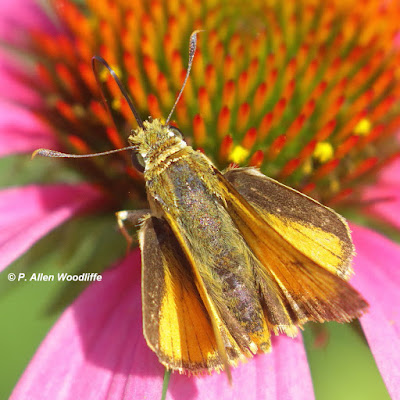
Hobomok Skipper
There were probably at least 100 individuals of this next one scattered across the Dealtown Prairie, the Common Wood-nymph.

Climbing Prairie Rose is a species designated as 'Special Concern' in Ontario and Canada. It was planted here more than two decades ago.
Compass Plant, another rarity, is thriving here.....

...the relatively small and less conspicuous Flowering Spurge is nice to see.

Grey-headed Coneflower is scattered throughout.

Swamp Milkweed is not limited to prairies or swamps, which is fortunate for the many butterfly species that come to visit it.
Wild Bergamot is also scattered here and there.
As for birds, I found a few to upgrade or add to the overall list, including things like Field Sparrow, and Northern Mockingbird, but I didn't get any photos of either of them. I did have this Eastern Kingbird sit up in an open spot.


I was a little surprised to see this Green Heron hanging around, but they seem to be more plentiful than usual in the area this year.


I had hoped that I might find and photograph a Dickcissel, which was relatively common here during the invasion of 2017. Fairly early in my meanderings here I did hear one. Usually they sit up in nice view, but the area I heard it from was quite shrubby. I eventually was able to see through a gap in the shrubs and find this individual on an open branch, but lower than I usually expect it.

It eventually moved to what I consider a more typical spot, and fortunately the light and background made it a quite successful photo op. I saw two males at this site, but no females, so presumably (hopefully!) they might be on a nest.


Additional note: Please be advised that if you are a subscriber to this blog, the blog site has indicated that sometime after July it will no longer be providing automatic email notices of when this blog is published. I will try and get a subscriber's list assembled and let you know, but in the meantime, if you would like to be advised of the publication of future posts of Nature Nuggets, let me know via this email: prairietramper@gmail.com.

The blog post appears to still have the email subscription function. The blog feeder has just indicated that it will discontinue after July.