Showing posts with label Blue Jay. Show all posts

Saturday, 15 November 2025

Autumn migration continues

 The weather ups and downs continue, as does the bird migration. The snow of a few days ago is just a memory. Not sure how long that will last.

I've been out here and there, although one of my regular 'go to' spots, the St. Clair NWA, continues to be off limits due to trail maintenance. I have meandered around the former Dover Twp a bit, and have managed to get a few photos of seasonal things, including the following.

At one spot that I regularly check out at this time of year, I encountered at least 14 Sandhill Cranes back against the edge of the field. This first photo is of a few at the south end of Walpole Island.... 

...and this next flight shot is of 4 of the 14 a bit farther north....
 ...that flew from the far edge of this field.

Tundra Swans are arriving in ever increasing numbers. Soon many will be seen in flight almost anywhere in the southwest, or out on the recently harvested fields of corn. That is until the corn stubble is plowed up.

Heading south, a stop at the Keith McLean Conservation Lands did not turn up much in the way of shorebirds, but I did manage photos of a few Red-breasted Mergansers swimming by...
...and three Killdeer showed up about the time I was ready to leave. A low, searching flyby of a Northern Harrier did short work of the Killdeer stay, however.

Camping is over at Rondeau, and now it is all available to fellow birders, a few dog walkers, and some birds. This Blue Jay was maybe hoping for a return of some campers, to provide some handouts on the picnic table.

Cedar Waxwings are fairly plentiful and widespread these last few days.
Dark-eyed Juncos are quite abundant.
It is always a highlight to see Fox Sparrows, and this is their time. They can be found at the edge of the roadways...
...or partially hidden as they dig out something in the leaf litter.
Northern Cardinals are here year-round, but not always cooperative for a photo, as this female was, sort of.
White-breasted Nuthatches are fun to watch going up or down a tree either searching for something they have hidden in the cracks in the bark, or putting something away for a future meal.
White-throated Sparrows are increasingly abundant, and at least some will stay over the winter.
Blackbirds are passing through in good numbers, including the Rusty Blackbird. Note to potential Rondeau hikers, the park will be closed for a couple of days at a time in order that the November/December deer hunt can take place. In preparation for this hunt, some cracked corn has been put out at feeding stations, and I sometimes check them to see what critters are taking advantage of the food. I found 6 Rusty Blackbirds at one spot, as shown next.

The raptor migration is winding down, and although technically not a raptor, Turkey Vultures are always counted at the various hawkwatches. Turkey Vultures have gone through in their normal many thousands, and seeing one now is more of a rarity.

 In other news, not related to Rondeau, I had a friend from the K-W area send me a photo of a bird that had been coming to his suet. He is not an avid birder, but enjoys what comes to his back yard feeders. At first he thought it might be a female Evening Grosbeak, and indeed a few of them are making their way south. However it turned out to be a female Summer Tanager! Summer Tanagers are not common or predictable in Ontario at anytime of year, but more likely to be encountered in the summer. That said, they can show up at really unexpected times. In checking the rare bird report for this past week, there had been one seen in Toronto a few days ago. This next photo is of one I photographed at Rondeau back in December of 2015! It was feeding on the berries of a vine that had been growing up the chimney of this cottage.

With birds, expect the unexpected!

If you would like to subscribe to Nature Nuggets, send an email to: prairietramper@gmail.com


Thursday, 14 November 2024

A mix of rarities and more common things to enjoy!

 One of the birding highlights in recent days was to hear about a Western Cattle Egret hanging out with a few black angus cattle a bit north of Erieau. I had been out at Keith McLean Conservation Area on the lookout for migrating raptors with the favourable winds, when I got the word, so I headed over to look. Sure enough, there it was, but it was flighty, moving from one group of cattle to another before it finally got up in the air a little higher and headed towards Rondeau Bay.


A few days later, this past Tuesday to be exact, an even rarer bird got the attention of many, many birders, at the KMCL, a Mountain Bluebird. More on that a little later.

In between these bird highlights, I was out and about looking for whatever I could find. The sometimes breezy winds from a northerly direction was promising for raptors, and I spent a bit of time at the Morpeth Cliffs area. There were a few raptors on the move, but most were very high up and difficult to see against the almost entirely blue sky. My hope was to see a Golden Eagle or two, as this is prime time for their migration, and several of the hawkwatch sites had reported then regularly. Even though I had been on the lookout for them at other times over the past few weeks, today was to be the day. I had two fly over, way up high. This photo of one of them was the lowest. Fortunately my camera/lens combination latched onto it with good focus, and this is what I ended up with.


Both birds were almost impossible to see with the naked eye, up against the brilliant blue sky. Binoculars were a necessity. After I got the photos processed, and greatly cropped, these were the best of the bunch, and after all was said and done, they are shown here at the equivalent of about 100X magnification!

There were some sunny warmish days to go out wandering around Rondeau on occasion, so out I went. Birds were not always that plentiful, but there are always other things to see and photograph.

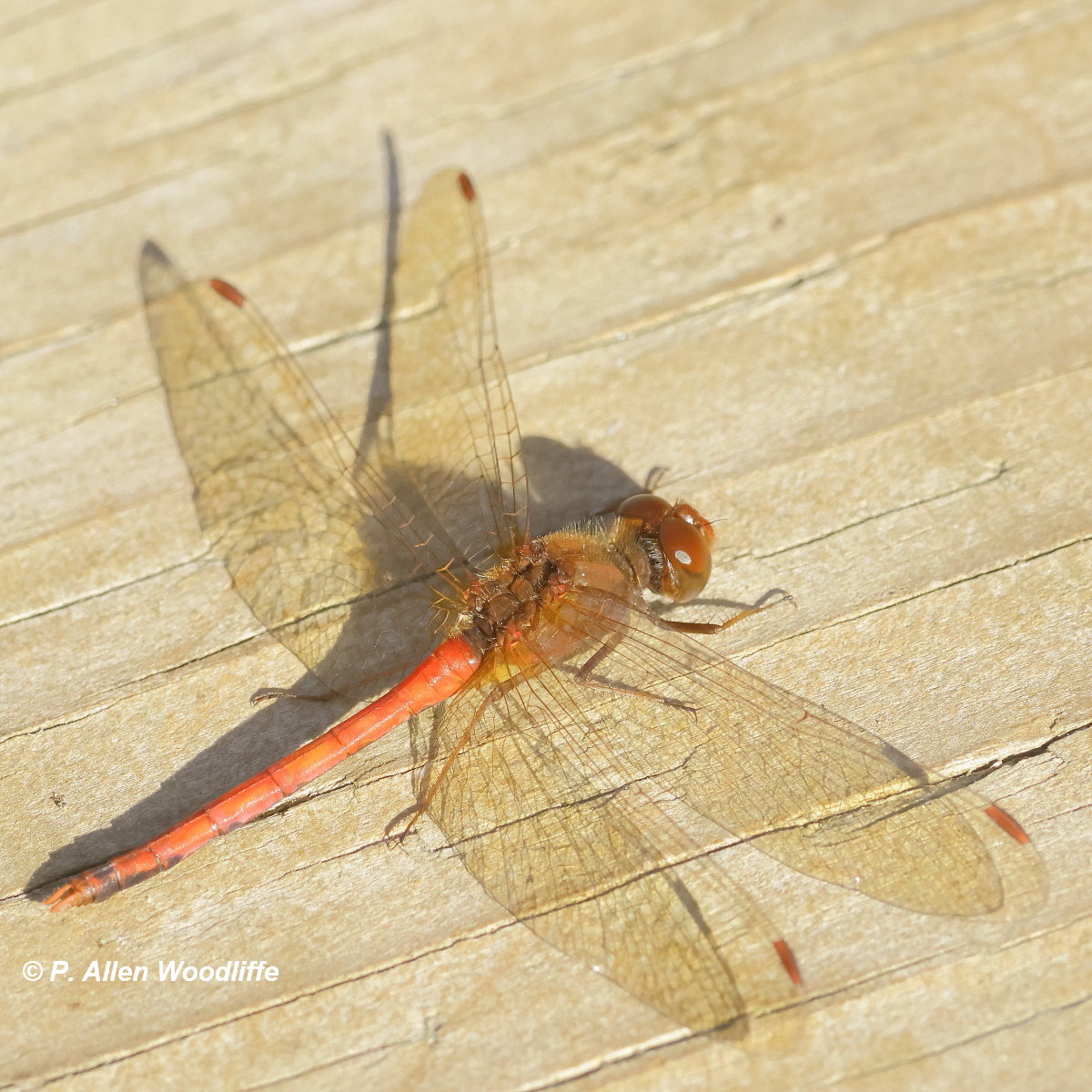
During the sunniest period and sheltered from the wind, there were often a lot of dragonflies flitting about. They were all of the Autumn Meadowhawk species as near as I could determine, and their pale/yellow legs were telltale. It used to be called the Yellow-legged Meadowhawk, and perhaps is still referred to as such.

Common Buckeyes were still around, and sometimes paused long enough for a close approach with the camera.
As there were still the occasional dandelion flowers quite visible, they attracted several of this next critter, the Common Drone Fly. It is not a native species, but has become quite abundant at times.
Eastern Black Squirrels are quite common, as usual, especially where there were a few oak trees around, as they were searching for acorns.
Another butterfly is this next one, a Fiery Skipper. It is typically more of a southern species, and arrives in Ontario in the later summer. Some will stick around for quite awhile!
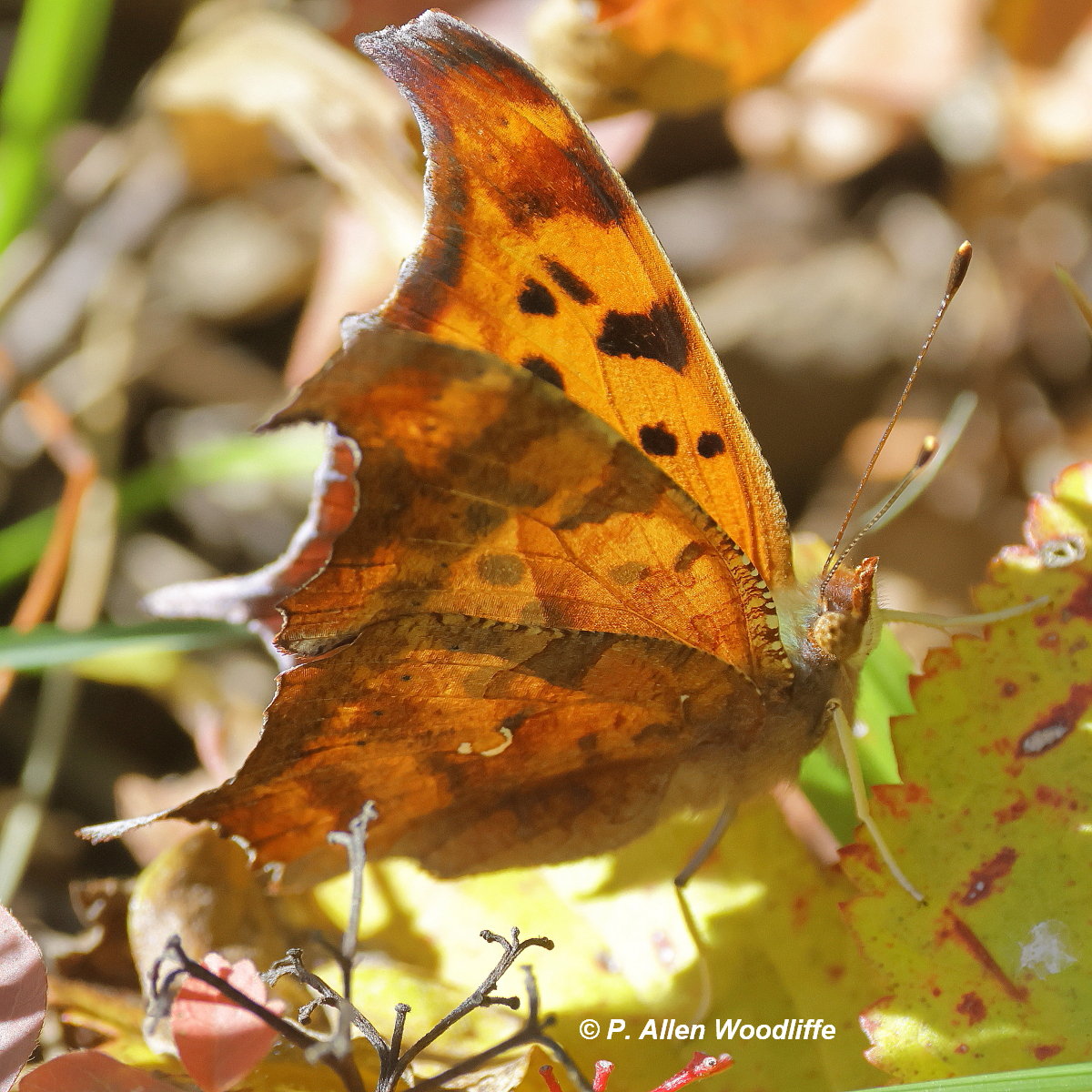
Another butterfly I caught up with is this Question Mark.

There were a few birds to be found, and some allowed me to get some worthwhile photos. Blue Jays are migrating through in good numbers, with some searching for sustenance to carry them on their journey.

No doubt some will stick around all winter, as usual.
Dark-eyed Juncos are fairly common. Here are a few having a bath in a shallow puddle.
Red-bellied Woodpeckers are permanent residents now. They were extremely rare up until the 1980s or so, and have since became well established here in southwestern Ontario.
Rusty Blackbirds are not as plentiful as they used to be, but still migrate through in decent numbers. This one was feeding on a seed of some sort on the ground.

Mushrooms have not been plentiful compared to some years. The quite dry spell we have experienced over the last few months made all the difference. But a few have appeared. This first one is a type of puffball, and may be the Pear-shaped Puffball.

Next is the Orange Jelly Fungus...
...followed by Shaggy Mane.

Some days have had some quite brisk east winds. This first image is of the waves along the east beach of Rondeau.

I went over to Erieau hoping for some impressive wave action hitting the pier and splashing over. This next one is one of the better ones, but overall it wasn't as impressive as I was hoping. Maybe a different day...

This next photo shows one of the better ones I took in late October of 2021. Some of the waves and spray almost obscured the lighthouse!

Getting back to the Mountain Bluebird. It was first seen this past Tuesday, and I got word from Steve Charbonneau who was the one who found it, in the very early afternoon. I am not on Discord, the birding app that keen birders who like to chase the latest notable birds are on, and since Steve is aware of that, informed me directly (thanks, Steve!). However it just didn't work out for me to scoot out to the Keith McLean area to catch up to it that afternoon. It was apparently feeding quite readily in a good spot, and since this species is fairly hardy even in poor weather conditions, I thought it might still be around on Wednesday. A lot of others were hoping for that outcome as well. There were lots of people who saw it on Tuesday, and even when I went out on Wednesday, I could barely find a spot in the parking lot. Unfortunately no one reported seeing it at any time on Wednesday. Perhaps the strong wind forced it to take shelter, and it might have been around and was even amused by the number of people roaming around with 'scopes, binoculars and camera gear. However it was not reported. Hopefully it might still be around at an accessible location not far away. This species has been considered long overdue for the Rondeau checklist area. But so far I cannot add it to my Rondeau list. I have seen it on two occasions in southern Ontario in the past, as well as on a few trips to the western part of the country. The first time in Ontario was one I saw on a Christmas Bird Count on Pelee Island, back in the '90s. The second one was one I heard about in southeastern Lambton, so Marie and I went searching. We successfully tracked it down and photographed it, just a short distance from Chatham-Kent. We caught up to it on January 20, 2012.

January 2012 provided another good photo op for an uncommon species, this time for White-winged Crossbill. There have been a few migrating through so far this autumn, and on one occasion I thought I heard one or two, giving their high-pitched rattle calls, but could not find it perched anywhere. It was probably passing through quickly and vocalizing. At any rate, here is a photo I took of one at Rondeau on January 25, 2012. It was part of a flock of a couple of dozen feeding in this spruce tree.


If you would like to subscribe, or unsubscribe, to Nature Nuggets, send an email to: prairietramper@gmail.com


Saturday, 21 October 2023

October wind, waves and more birds!

 October can be one of the windiest months of the year. When strong east type winds occur, I like to get out to Erieau and watch the power of the waves hitting the pier.

It can be impressive, to say the least. One must be careful with the camera to protect it from wind-blown sand and spray. The first two photos were not taken this October, but on another occasion when the conditions were just right for these photos. Maybe later this month, or when the gales of November arrive, I will be photographing there again.
I did get out to the southern part of Rondeau a couple of days ago, and the wind direction was from the south, and brisk. This next photo shows the wildest ones I was able to get. Nice, but nothing like a strong east wind at Erieau.

Rondeau is the place to be almost anytime of the year, but I particularly like it in the autumn. The changes happen steadily. It was only a couple of weeks ago when most of the forest looked like this next photo.

Just a couple of days ago, the changes were quite obvious, as shown next, but in the next week or two, the colours will be much more dramatic.

Birds have been steadily arriving, and departing, as they should. Blue Jays have been passing through in large numbers, and making good use of the abundant crop of acorns on many oak species this year.


Yellow-rumped Warblers are by far the most common warbler species now, and with a good crop of berries on things like Red Cedar, have lots to keep them happy while they build up reserves for the next leg of their southward journey.
White-throated Sparrows are increasing in abundance......
...as are Rusty Blackbirds. It is a species at risk overall, but can be reasonably common for a short time in the autumn.
One of the most common members of the thrush family is the Hermit Thrush, next.
There are some lingering species, such as this Eastern Phoebe, a flycatcher that has to deviate from flying insects once the cold weather arrives. However with the impressive hatch of midges in the last week or so, there is lots of food for flycatchers in the short term.
Lots of the summer sparrow residents have gone, to be replaced by the autumn/winter species, but sometimes some of the summer ones linger, such as this Chipping Sparrow. Of course the weather conditions haven't been all that bad yet, so there will be a few species and individuals reluctant to move any farther south than necessary.
Robins, with their diverse diet, will stick around for quite awhile yet, even well into or over the winter.

I had intended to stop at the Keith McLean Conservation Lands to look for, and hopefully photograph, one of the Nelson's Sparrows that is currently there. However since I neglected to return the flash card to the camera after having downloaded the images from the day before, my camera was not functional! Oh well, live and learn (I hope!). Maybe this coming week I will have my act together better, and it will coincide with a cooperative Nelson's Sparrow or two. One can always hope, since this species can be quite elusive even at the best of times.

I've been to St. Clair NWA and the Mitchell's Bay lakeshore trails a time or two recently, partly because they are closer to home than Rondeau. With much of the habitat in these areas being wetland, it is not surprising that quite a few Swamp Sparrows can be found.

An occasional Eastern Phoebe may be lingering in the shrubbier areas close by.
Rusty Blackbirds, a species that prefers wet woodlands and similar habitat types, will be around.
Sandhill Cranes continue to be in the area. Their yodeling calls can be heard from quite a distance, enabling a photographer to get ready if they come close enough.
On one occasion I saw at least a dozen in the area in about an hour's time in the late afternoon. Overcast skies do make it a bit more challenging to photograph.
A few Great Egrets continue to be seen. Their numbers are diminishing but as long as there is open water, a few may continue to be in the area. I have even seen up to three in early January in the past!

The Lake St. Clair Marshes are well known for attracting waterfowl, and therefore hunters. In fact it was in part due to hunt clubs of the past to protect some of these wetlands over the years, and we are enjoying the benefits of those efforts nowadays, even while some private wetlands continue to be used by hunters from both sides of the border. Due to no hunting at St. Clair NWA, it is a great place to observe the huge numbers of ducks and geese making use of this protected wetland. On one occasion recently, I saw anywhere from a few dozen to a thousand or more birds in the air all at once, and it was like that continuously for most of the hour and a half I was walking the dyke trail.

I will be out again, to be sure!


If you would like to subscribe, or unsubscribe, to Nature Nuggets, send an email to: prairietramper@gmail.com