Showing posts with label fungi. Show all posts

Tuesday, 16 January 2024

Fruit on the Forest Floor, Part II

 I had another post topic planned for this time, but for various reasons, it will have to wait a bit longer. So in the meantime, without a lot of birds to report on now that Christmas Bird Counts are over and winter has settled in, I will catch up a bit on this fungi topic. The first part of this topic, which explains a lot that I won't repeat here, can be found at this link. 

On to fungi! 

The ones featured here were photographed in the fall of 2023, as winter isn't exactly prime time for fungi. Some might still be visible, but with the snow and cold of course, they just aren't going to be in good fresh looking condition.

This first one is a member of the Bonnet group, based on the shape of the cap.

Next is the Ochre Bracket.
It is always useful to get an overview of a fungus, as well as a closer view of the underside. These next two show an Oysterling.

A fungal group that really caught my eye is this next one. It is likely the Pestle Puffball, although it might just be a Puffball. There were well over 100 of these scattered across a well rotting log, and even on the ground, undoubtedly growing on rotting wood just below the surface. This huge cluster was along the Black Oak Trail of Rondeau.
Next is a type of Ramaria, a coral root.
Here is a Ringless Honey Fungus. It grows so close to the ground that I couldn't get any idea of the underside without breaking pieces off.
 

This next one with the bright, colorful cap is a member of the Russula group.

Clearly there are critters in the wild that like feeding on mushrooms, as this slug is doing.
Next is probably another type of puffball, in its early developing stage......
...as it matures, the covering will start to dry and open. It is at this time that a drop of rain, or some other slight disturbance, will result in a little 'puff' of the spores inside to release into the atmosphere, to drift off and find a suitable growing surface, hence the name of puffball.
Some names are quite descriptive. This one is probably a Stinking Orange Oyster......
...as is this one, photographed as late as December 30!
Next shows the upperside of Trametes gibbosa, a type of shelf or bracket fungus.....
...and this is the underside view. It shows little round holes where the spores disperse from, rather than gills of many other types of fungi.
Next is Trametes pubescens.....
....and a species of Tricholomopsis, which due to the hole on the top, shows both the shelf type of form as well as the gills.
Turkey Tail, shown next, is one of the most common members of the Trametes group.
Less common, at least where I have been, is this White Jelly Fungus.....
...and last, but not least for this post, is the quite delicate, but attractive Woolly Oyster Fungus, not common at all in my experience. The upper side has a fuzzy/wooly look....
and this angle shows the gilled underside and the delicate parts of the edge and upperside.


If you would like to subscribe, or unsubscribe, to Nature Nuggets, send an email to: prairietramper@gmail.com

Friday, 1 December 2023

Fruit on the forest floor, Part 1

 No, I am not talking about walnuts, or acorns or something like that scattered on the forest floor. I am referring to fungi.

There are many, many types of fungi, and the part that we see growing on the forest floor, or a rotting log, is the fruit of the fungus plant. The main part of the fungus is underground, or in the rotting log, in the form of extensive mycelial threads that act to decompose the rotting log. But more than that, the threads cover extensive areas and travel for huge distances underground. These mycelial threads are actually known to 'communicate' with each other, and share energy, and they are critical components of what makes a forest healthy.

So the actual fungus is just the fruit which bears the seeds or more correctly, the spores, which are dispersed by the breezes. The names and shapes of such fungus are highly varied.
Aborted Entoloma

I have spent a fair bit of my time roaming about forests in the late summer and fall, on the lookout for fungi. They are busy doing their thing under ground, or in a log, for a good part of the year, and seem to be the most visible during the more humid periods of the season when they get to the fruiting stage, although some fruit even in spring. Sometimes I consider my outing to be part of a fun, fall, foray for fungi!

They aren't all colourful, like many warblers or wildflowers, but are fun to find and photograph regardless.

These 'fruits' release their spores, through their gills. Gills are often shown like this following fungus, known as member of the Agaricomycetes group of fungi. The type of gills aren't always visible from the top. In looking at the first photo above, the gills are not noticable unless you break off or look underneath the fungus. Given that most fungi grow quite low and on the ground, looking underneath is challenging, so some mycologists, the name for persons who study fungi, break off the fungus to see the type of gill.


Other fungi have hidden types of gills, such as this next one, known as the Bear's Head Tooth fungus.
This next one, illustrated by the next three photos, is fairly common, at least in forests where American Beech are common. It is known as the Beech Rooter fungus.


Note to the reader: while I have attempted to put a name to the fungi that are in this post, and I believe many of them are correct, I am anything but a specialist when it comes to fungi. I rely fairly heavily on the Computer Visualization capabilities of the database on iNaturalist, where there are thousands of examples of various species which it will compare to, in order to come up with a strong possibility. Over time, specialists in the mycological field will take a look and either confirm or correct its name. So while I believe most identifications here are fairly accurate, there is no guarantee that 100% of them are at this point.

Back to some fungi.

Some are small, looking like a small parasol. This next one is a member of the Bonnet's group.

They can be quite colourful, such as this Chantarelle Waxcap, next.....
...or are typically less colourful as these next ones demonstrate,
Deer Mushroom

Deer-colored Mushroom

Closeup of Deer-colored Mushroom
Most of the fungi shown above, were growing out of the ground, or a moss covered log. One fungus that I came across was growing out of the end of a Tulip Tree log which had been cut to clear a path. It was a bit larger than normal and quite distinctive. I got a couple of photos with the camera I had in hand. It is known as the Destructive Pholiota.
I went back to the fungus a couple of days later with a different camera/lens combination. The fungus had changed a bit...
....a closer look at the underside showed the gills as well as the brownish ring at the upper side of the stem. It didn't last long, however. The fruits of fungi seldom last in good condition for any more than a few short days. As soon as the spores are released, the fruit head deteriorates quickly.
I don't know who comes up with the names of fungi. This next one is called the Dog Vomit Slime Mold. While some fungi are edible, just the name of this one is enough to turn one off! I have no idea of whether it is edible or not......
Not all fungi grow out of the ground. This next one is known as Dryad's Saddle, and typically grows out of the side of a dead tree trunk.
A fungus that is fairly widespread and visible is this next one, the Chicken-of-the-woods.

A lot less colourful is Hen-of-the-woods, shown next.

As mentioned, looking underneath the 'cap' shows the gills, as this Honey Waxcap shows.

This next one is a member of the Hygrophoraceae group. Yellow ones like this do not seem to be all that common.
This next one is the Lion's Mane Mushroom.....
....and this next, colourful one is one of my favourites, the Mycena leaiana, or Orange Mycena.

As mentioned at the beginning, these fungi are exceedingly important in the transfer of energy not only to other fungi. Trees and non-woody plants obtain significant amounts of energy from the mycelial threads that are extensive underground. It is what helps to keep a forest healthy. When one part of a forest is disturbed, that disturbance can be communicated to other parts of the forest via these mycelial threads and end up causing problems. And that is why forests that are logged or otherwise have the soil disturbed decline in health. Their connection to the multitude of other plants is severely disrupted. It is also why attempts to establish a plantation on a previously worked up agricultural field is seldom very healthy, at least not for many, many years. The constant work-up of the soil through cropping, as well as the application of so many chemicals to benefit the agricultural crop, has destroyed the mycelial threads and severely limits the trees growth and development. It may take many decades for the soil to become more natural with mycelial threads for the transfer of energy to the multitude of the forest inhabitants.

That's it for this post, but I expect to feature more fungi in a future post!


If you would like to subscribe, or unsubscribe, to Nature Nuggets, send an email to: prairietramper@gmail.com

Friday, 4 August 2023

Autumn migration, re-appearance of an endangered orchid, and more!

 There is always something to see, even in the mid-summer heat. I haven't ventured too far, but try and catch up to as many things as I can, all the while being a bit more focused on things to help move my next book project along.

The autumn shorebird migration is well underway, as evidenced by an increase in the species and numbers at sewage lagoons or areas of exposed mudflats. One of the highlights was to see my first of year Stilt Sandpiper....

..and my first of the fall, Pectoral Sandpiper.
Both Greater and Lesser Yellowlegs are around, at least in small numbers
Lesser Yellowlegs

Least Sandpiper
Spotted Sandpipers are quite plentiful these days, with both adults....
...and the unspotted young. It is not uncommon to see 30 or more at the lagoons.

Anytime I get close to wetlands, there are some of the larger birds to be seen. None are migrants, yet, and will likely be around for a few months. These all breed in the area, so are just out wandering around feeding, etc.


It is a bit hard to believe that Sandhill Cranes used to be a bit of a rarity, but now you can find them quite regularly, since they have become regular breeders in the larger wetlands. This one was feeding with its mate, in a recently harvested wheat field.

It is the time of year when some of the tallgrass prairie plants are nice and showy, and not always in a prairie. Flowering Spurge, shown first, usually occurs in wide open prairie and savanna sites, but this one was along the more forested Black Oak Trail at Rondeau.


Gray-headed Coneflower is doing well in any kind of a prairie setting, along with its tallgrass prairie companions.
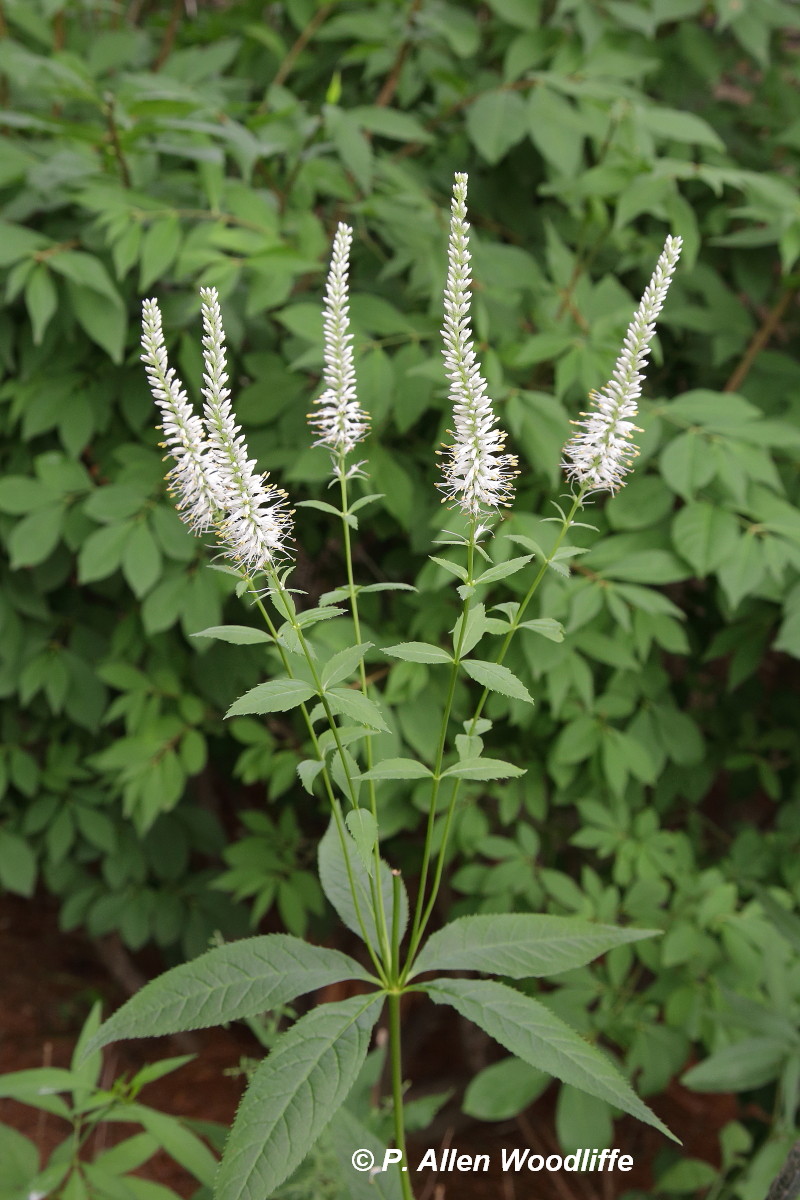
Culver's-root is a rarity of the tallgrass prairies.

While I was on my way to check on the Nodding Pogonia, the endangered orchid that only occurs in Canada at Rondeau, I came across this moth in the grass along the trail. It is a Giant Leopard Moth, and fairly uncommon. I think it is only my second record for Rondeau.

The orchids I was searching for were not out in flower on this visit, but a few days later, found some that had been in flower the day before. The blooms only last for a single day. This photo is from a previous year, and I have been checking up on this orchid in various ways for exactly 50 years! Needless to say I will be out again shortly when the conditions are right for the next blooming period, so stay tuned for an update (hopefully!).

With a fair bit of moisture in recent weeks, it bodes well for a good showing of fungi. They are fun to find and photograph, but not as much fun to try and identify. Here are some of the more distinctive or colourful ones I have encountered in recent days. The first ones have not been nailed down as to species quite yet. I often try and photograph the gills on the underside, as they can assist in their identification.


This next one is quite possibly a Lactarious psammicola. I am not aware of a common name.
This next one is probably a Red-mouth Bolete.
And finally, a Yellow Earth Tongue, sometimes called an Orange Earth Tongue, and typically grows out of a mossy log.


If you would like to subscribe, or unsubscribe, to Nature Nuggets, send an email to: prairietramper@gmail.com