Showing posts with label Eastern Prickly Pear Cactus. Show all posts

Sunday, 9 October 2022

More migrants, some late leps, a cactus conundrum and a house of yesteryear

 Autumn is unfolding as it should, and that means there are lots of things to photograph. A few days ago I was out in the Erieau area. I took time to check the main pier, as the uncommon Purple Sandpiper could appear any day. I walked all the way to the end, flushing a multitude of the usual gulls along the way, but only came up with a single Sanderling right at the end.

Maybe next time there will be a Purple Sandpiper to greet me.

A walk along the Erieau Marsh Trail and McGeachy Pond Trail is often worthwhile, so I included it in my itinerary. There was a nice mix of passerines, including:

Eastern Phoebe

Northern Parula

There were several others, but due to the very contrasty light, were hard to photograph.

Butterflies, on the other hand, were typically out in the open where they could benefit from the sunlight energy while nectaring on the flowers. The deep purple of New England Aster seemed to be the main flower attraction.

Orange Sulphur

Clouded Sulphur
The first two are pretty common, but these next ones are much less common. In fact the Fiery Skippers, of which there were several, were the first ones I had photographed this year.

Bronze Coppers, shown next, are to be expected at some point and usually much more common than the Fiery Skippers.
Female

Male

I also spent a bit of time up along some accessible areas along Lake St. Clair. There were some migrants, not surprisingly, including a good number of Blue Jays on the wing....


 ...and some even landed for another shot.


There were a lot of Yellow-rumped Warblers, by far the most abundant warbler almost everywhere you go these days.

And since it is still relatively early in the season, a few Great Egrets are to be found, and occasionally are in an excellent spot to be photographed.

On another outing, I photographed this Prickly Pear Cactus. Cacti of this type are popular, and always fun to be found. But they present a problem, mainly in the taxonomy. What species is it? For many years, the cacti known in southern Ontario were called Eastern Prickly Pear (Opuntia humifusa). A bit later, taxonomists changed the name to Opuntia cespitosa, and most of the ones are still known as that. However this first one apparently is a different species, known as Grassland Prickly Pear (Opuntia cymochila). It is more of a western species, but due to the arrangement and angle of the spines, is believed by Opuntia experts to be this species. This makes for an interesting element to Ontario's Opuntia, as this particular population in the former Howard Township was quite abundant back in the 1940s. A former co-worker of mine, when I was at Rondeau back in the late 1970s, told me of this population which occurred in a large sandy area almost right across the road from where he and his wife lived. His wife was a teacher at the schoolhouse just down the road, and walked by this population almost every day. That was back in the mid 1940s. However as time went on, the sandy area was converted to agriculture, and it eliminated most of the cactus. Now only a couple of dozen plants persist in the road allowance.

Another population of cactus occurs at Rondeau, in the southeast beach dunes. They do not occur there naturally, as some unknown persons transplanted them there in about 1994. They have done fairly well there since. This population has been determined to be genetically similar to the naturally occurring population on Pelee Island. Therefore the species is legally endangered under the province's Endangered Species Act. The conundrum is: what to do with these plants? They are endangered, sort of, but it is debatable whether transplants are covered under the Act. Or should they be removed, since they may end up being a problem species in an otherwise highly significant natural habitat in one of the most significant provincial parks in Ontario? At the moment, park staff are reluctant to remove them, so they continue where they are.

On quite a different topic than the ones above, here is one of the most photographed abandoned houses in southwestern Ontario, perhaps in all of Canada if you believe some reports. It is known as the Guyitt House, and if you google that name, you can find out lots more information about this house. Regardless, it is along the former Hwy 3, now the Talbot Trail, in eastern Chatham-Kent a short distance east of Palmyra and few kilometers before you get to the Elgin Co border. It was built in the 1840s and was occupied up until about the mid-1980s. I took these photos at various times in about 2010-2011. It has continued to deteriorate, but does so 'gracefully' and it is interesting to see the process.

I took these next two and processed them to reflect an earlier age

This next one was taken during a full moon, with a long exposure of slightly more than 300 seconds using the moon as the sole source of light. You can tell it was a long exposure by seeing the white streak just to the left of the chimney on the right hand side, which is how far a star 'moved' in those 300+seconds.

In recent weeks, an unknown person has complained about its condition, and asked the municipality to enforce a by-law forcing the owner to either repair it or remove it. This has caused a great deal of angst for the landowner, who would like to keep it as is, since it is such a popular photographic subject. The landowner gets nothing for it, just the satisfaction of having a popular photographic subject. There has been a lot of support to leave it as is. At this point nothing has been decided, so stay tuned.

Back on the lep theme, here is what Marie and I call our October Cat. It is a fairly well developed caterpillar of a Black Swallowtail. Interestingly although Black Swallowtail butterflies have been in our garden area periodically all season, it wasn't until the last couple of weeks where we could find any caterpillars.


We have seen about 7 in the last couple of weeks. Today we couldn't find any, so it is possible that the remaining ones have gone off to change over to a pupal form, in which it will overwinter.

And finally, a Magnificent Frigatebird appeared near the mouth of the Thames River yesterday. It was initially seen by some fishermen but word didn't get out until late in the day. It was believed to not be in good health. Several keen birders were there first thing this morning, and one group saw it tumble from its overnight roost and fall into the water, barely able to struggle to a log on the bank of the river. Clearly it was not likely to survive. A few people reported seeing it in the morning, and one or more believed a rehabber was tracking it down and taking it in to see if it could be saved.

Marie and I went for a drive out that way in the early afternoon. I had mixed feelings, as I don't chase as many rarities as I used to, and chasing a bird that was almost dead was not all that appealing. We didn't see it, so perhaps it has been rescued by a rehabber. I haven't heard any more on that. Update: it may have been euthanized due to its poor condition.

I wasn't too concerned about not getting to add it to my Chatham-Kent list, as I had the opportunity to see and photograph a quite healthy one off the south beach of Rondeau, back in early July of 2012.


If you would like to subscribe, or unsubscribe, to Nature Nuggets, send an email to: prairietramper@gmail.com


Monday, 12 September 2022

Late Orchids and other rare to endangered species

 As promised in my previous post, this one will focus primarily on orchids, some of them quite rare, that occur in the August/September time frame.

As is featured in the current header, Nodding Pogonia (Triphora trianthophoros) is one of the rarest in Canada. While I have seen it in flower in very late July and as late as mid-September, typically about the third week in August is when it is at its peak.The following photos of this orchid were taken on August 25. It is legally Endangered, as the only known location for it in Canada is at Rondeau Provincial Park.

 It is very small, as you can probably tell from the first photo. They rarely exceed 12 cm in total height.

The flowers, all of which are developed to a certain point, will open simultaneously for a single day, can be slightly more than 1 cm in height. Singles are the norm, and it is always nice to see them with lots of magenta.
Doubles on the same flower seem to be plentiful at times.....
....while three flowers on the same plant, open all at the same time, is more unusual. In checking on this rare orchid annually since the early 1970s, I don't see a triple flowered one every year.

As tiny as Nodding Pogonia is, here is one that is even less conspicuous. It is Autumn Coralroot (Corallorhiza odontorhiza) and is also quite rare, although not as rare as the first one. It is a bit taller on average, but the flowers are much less showy. There are two varieties of this orchid. The one shown here is var. pringlei, and this is the 'open-flowered' variety. Even though the drooping flowers are open, the seed capsules are already well-developed. The form with flowers that never really open is even less obvious. In both cases, self-pollination occurs. To give you an idea of how small this is, it was taken with a 100mm macro lens plus 68mm of extension tubes, and then cropped some more.


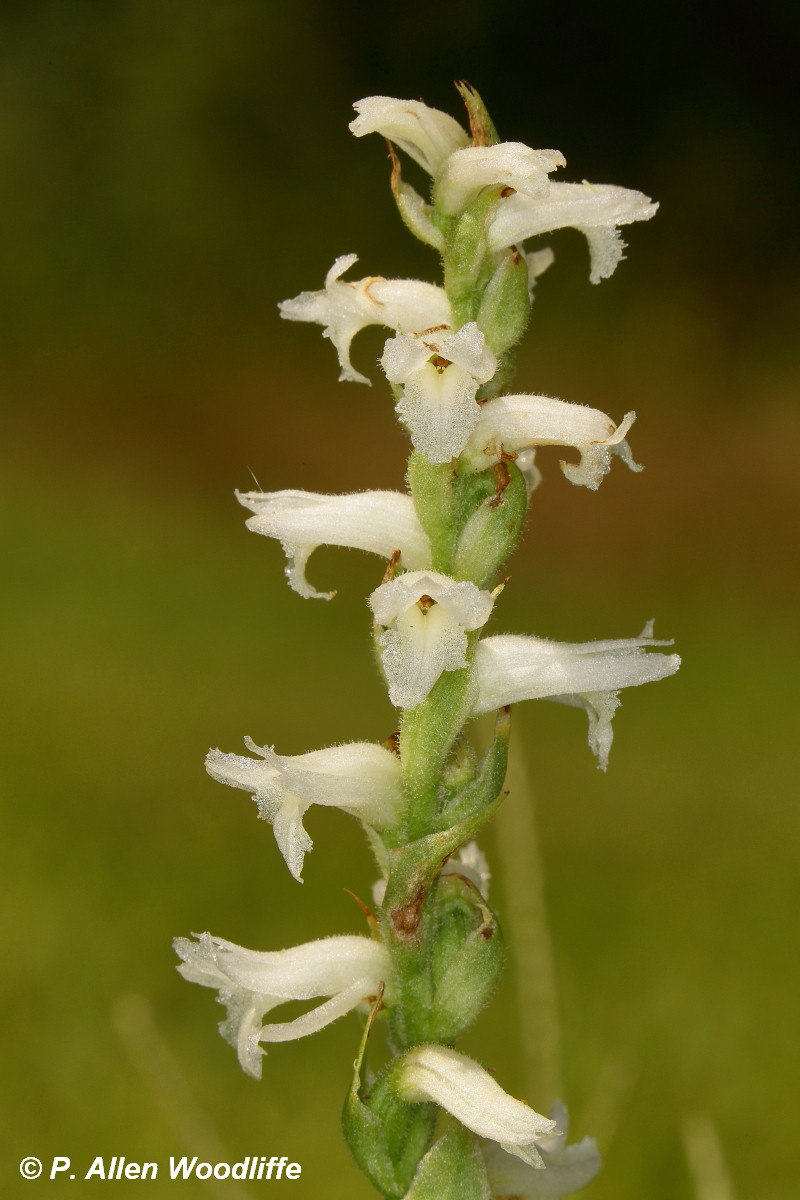
Sticking with orchids a bit longer, there is an interesting group of them in the Ladies'-tresses genus, and some can be challenging to tell apart. A previous post featured the most common one at this time of year, the Sphinx Ladies'-tresses (Spiranthes incurva). I photographed it at Rondeau a few weeks ago. While looking for an endangered gentian in eastern Chatham-Kent, I photographed this same species.

Its flowers are almost entirely white, with little or no fragrance. The brownish spots appearing are an indication that it is past its best. It was photographed on Sept 1, and normally would have been in its peak condition around the third week of August
It has small leaves at the base.

A similar looking one is this next one: Southern Slender Ladies'-tresses (Spiranthes lacera var. gracilis). It is quite dainty, and not easily seen amongst the fairly dense prairie vegetation.

A closer look reveals one of the key characteristics of its spiral flowers: the distinctly green centres of each flower.

Sometimes the spiraling of the flowers takes on a slightly different look with a more drawn out spiral.

It is an extremely rare species, with only this one population showing up in the iNaturalist database. There are older records that I am aware of, but they have not been seen for several decades, primarily due to a change in the overall vegetation.

I have been out to check on another extremely rare orchid of this group: Yellow Ladies'-tresses (Spiranthes ochroleuca), but it was not visible on this date. It occurs on a normally fairly dry sandy site, and it is possible that the extremely dry late June through early August period may be the reason it hasn't appeared. Or maybe I was a few days too early, so I will be out checking for it again soon.

Another one in that genus, while considered rare in Ontario but is relatively common at Rondeau, is Great Plain's Ladies'-tresses (Spiranthes magnicamporum). It is a bit early for it at the moment, but should be showing up in the next week. It is a more robust looking species, with a slightly creamy centre as well as a spicy vanilla scent, and no basal leaves. It grows in grassy areas.


Not an orchid, but an Endangered gentian, is the White Prairie Gentian (Gentiana alba). It grows in the same vicinity as the Southern Slender Ladies'-tresses, and so I combined the time out to photograph them both. There are three sub-populations of this gentian, and at the moment, are the only ones known for Canada. Key characteristics are the creamy white flowers, most of which are fairly closed but not always tightly closed. The flowers also have slight ridges, typically with greenish lines. The plant grows best in high quality tallgrass prairie/savanna vegetation communities.

They can sometimes be confused with another gentian, commonly known as Bottle Gentian (Gentiana andrewsii), which is fairly widespread in a broader vegetation community. Normally they are quite a deep blue, but on occasion they can be white. Such was the case where I was investigating a reported occurrence of the White Prairie Gentian (WPG) in eastern Chatham-Kent. We didn't find any WPG, but did see this white colour form of the Bottle Gentian. The flowers are more tightly closed, and doesn't have the more obvious ridges with greenish edges.

Just to add a little non-botanical information to this post, while I was in eastern Chatham-Kent on the hunt for some of the species above, I stopped by a couple of spots along the Thames River to look for some rare, and very rare, damselflies. The first one is much more common than the second species: American Rubyspot. It has a partially reddish area near the base of the wings, and their abdomen shows definitive brighter rings. They don't always sit in an ideal place to photograph them, but when they do, the patience required is worth it. In Ontario, it is found in many scattered locations west of the Toronto to Barrie area.


Much rarer is the Smoky Rubyspot, next, which shows a bit of red near the base of the wings, and a smoky tip of the wings. Also the abdomen is only faintly ringed, if at all. In Ontario and Canada, it is found primarily along the Sydenham River, the lower reaches of the Thames River and in a couple of places along the Ausable River.

I also managed to check on a couple of rare plants I knew about in the area, both of which are ranked as Endangered. The first one is Eastern Flowering Dogwood (Cornus florida), and while it is not in flower now, it is still quite distinctive. It has a small cluster of red berries.....

...and the large buds of next year's flowers are quite prominent.
In the same general area is a remnant of a population of Eastern Prickly Pear Cactus (Opuntia cespitosa), also Endangered. It was once part of a large population that was widespread across a sandy hillside back in the 1940s, according to a former co-worker of mine who lived across from the site. But eventually the hillside was converted to agriculture, and only a small remnant persists along the roadside.


If you would like to subscribe, or unsubscribe, to Nature Nuggets, send an email to: prairietramper@gmail.com




Tuesday, 19 January 2016

Pelee Island: a spectacular southern natural area

Pelee Island is the southernmost occupied part of Canada. It is south of the 42nd parallel, which is the northern boundary of California. In fact there are at least 11 of the US states that are entirely north of this latitude.

Considering that Pelee Island is within 5-6 hours drive of millions of Canadians, it is surprising how many people have never been there. Perhaps that includes you. One of the problems is that you can't just drive to it on a whim. It takes planning and reservations on a ferry.

My first recollection of Pelee Island occurred in the late 1950s, when I went to the island by ferry with my grandparents, who were making a day trip on business. Little did I know at the time how much I would have to do with Pelee Island later on. I have never figured out exactly how many times I have been there, but it is safe to say that during my 36 year career with OMNR, I probably visited Pelee Island over 200 times. Some years it would have been just 3-4 times, whereas in other years it would have been more than a dozen. Some were day trips, some were for 3-4 days. Some were supposed to be day trips, but in more recent years when the weather looked like it could go south, one had to be prepared to wait an extra day....or sometimes two.

One of the main ferries for years was the Pelee Islander. It doesn't handle a large number of vehicles, but it is low and can go through some pretty impressive wave action. I recall on one occasion coming back in a November gale, having to hang on to the underside of my seat for a good part of the way back to keep from getting tossed out of my seat!

Pelee Islander

The current main ferry is the Jimaan, which is Ojibwe for Little Canoe. (This is a smaller version of the Chi-cheemaun, which is Ojibwe for Big Canoe, and goes from Tobermory to Manitoulin Island.) It is fairly high and the wind can make it very challenging for some of the ship's captains to swing it around in the harbour as it needs to, to get moored correctly.
Jimaan

 On windy days, especially when it is brisk from the east, it is particularly challenging. This next image shows some moderate wave action on the east side. It didn't seem to be all that strong, but apparently the ship's captain did, and so I was stuck on the island for another day and a half. I was prepared, fortunately, and spent some useful additional time.


There were many reasons to go to the island over the years: leading nature tours, doing inventory work at one or more of the island's provincial nature reserves, participating on the Christmas Bird Counts, doing site inspections at properties for which there were development applications, assisting with biological research, etc. etc. We often said that Pelee Island, at ~4000 hectares and easily the smallest municipality in our entire district, had by far, the most complicated issues in the entire district when it came to natural heritage and species at risk. In fact the current provincial Endangered Species Act, 2007 came about in part because of the immense number of complicated issues pertaining to species at risk on Pelee Island, and I was involved with virtually all of them.

Life was never boring!

One of the most interesting parts of the island is Fish Point Provincial Nature Reserve (FPPNR). From the air, it looks like a miniature Point Pelee, and is shaped by similar forces of wind and water.

The unvegetated sand spit, at the time I took this photo, was a little more than one kilometer in length.

Here is what it looks like from the end of the vegetation, looking south. It is a prime location for numerous gulls, terns, cormorant and shorebirds. The little sliver of land at the water's edge on the far right is Middle Island, the southernmost land mass in Canada. I will describe it a little bit in the next post.
The vegetated part of FPPNR is wonderfully lush especially in spring. There is a trail running through part of this nature reserve, and at times, there is an attractive and welcoming trail entrance sign.

The first display of spring wildflowers in late April are carpets of Dutchman's Breeches, out before the leaves on the trees are very far along.
Next is White Trillium.

A little later a rare plant is on full display....well rare almost anywhere else in Canada, but tremendously abundant in some parts of Pelee Island. It is the Appendaged Waterleaf (Hydrophyllum appendiculatum).


There are numerous other plants here, but most are far less conspicuous. The endangered Eastern Prickly Pear Cactus occurs, and it is believed that the small population here and the ones at Point Pelee NP are the only two naturally occurring populations in the province.
Red Mulberry (Morus rubra) another endangered species, also occurs at FPPNR. It is well represented in some out-of-the-way locations here, and is the only place on the island where it presently occurs.
Eastern Redbud (Cercis canadensis) is often seen on residential properties on the mainland, as it is a beautiful, decorative small tree. It is considered native to Canada, but only because of an historic record for it on Pelee Island.

During one of our inventory projects, we came across an Eastern Box Turtle. It isn't conclusive, but it is entirely possible that it is native here, the only place in Canada.
Just like Point Pelee, Pelee Island is well situated for bird migration. When I first started going to the island on a regular basis back in the early 1980s, one hardly ever saw another birder at all during May. However that has changed, with the need for birders to expand beyond PPNP in what PPNP used to refer to as 'Operation Spread Out'. It doesn't hurt that there are some highly talented birders who are resident on the island, at least part of the time, and have even started up the Pelee Island Bird Observatory, doing regular surveys as well as banding during migration, and nest monitoring of species at risk and others during the breeding season. Their main banding station is at FPPNR.

It is getting more popular amongst Ontario birders and others. An active Heritage Centre on the island has a sightings board which is helpful for birders scouring the island for birds to add to their checklists. And one well-known Ontario birder spent several spring migrations on the island monitoring reverse migration for his M. Sc. Good planning, Ken!

With the increased number of birders exploring the island, and having immediate access to posting sites like Ontbirds, it attracts even more birders. This is all good for the local economy, as it gives island residents a reason to protect and enhance the wonderful natural areas rather than exploiting them.

Spring birding can be fabulous, which is one of the reasons I led some nature tours to the island in the late 1980s and early 1990s. Songbirds and in particular warblers are well represented.
Blackburnian Warbler
 Prothonotary Warblers have recently been confirmed nesting at FPPNR. Yellow-breasted Chat nests on the island, and is likely the current stronghold for them in Ontario.
Prothonotary Warbler (female)
 Northern Mockingbirds are regularly seen.
The tip of FPPNR is also a great location to see Monarch butterflies during their September migration!


Note the triangular wetland which is part of FPPNR, and is separated from Lake Erie by a narrow barrier beach. This wetland is known as Fox Pond.
Here is what it looks like from the small observation platform along the trail. In the wetland forest across the pond was a large heronry in the 1970s, made up mostly of Black-crowned Night-Herons. One count put it at about 900 birds! I recall standing along the trail near where this photo was taken, back in the spring of 1976 or 1977, looking across at all the herons and listening to their various squawks. At one point, looking through the 'scope, I noticed a Cattle Egret sitting on a nest, one of the few confirmed nesting records for this species at the time.

Turtles used to be very common in Fox Pond, including Blanding's Turtle.

The wetland has deteriorated to some extent, as the lake breached the barrier beach a few years ago during a period of high water.  It is still, however,  home to some rare plants, including this Leafy Blue Flag (Iris brevicaulis). It used to occur on the Ontario mainland in Essex, but I believe the only extant records in Canada are currently on the Erie Islands, including FPPNR.
 Another southern specialty, and sometimes found even in wet prairies of the mid-west, is this Wild Hyacinth (Camassia scilloides), a Threatened species.
 A small number of Swamp Rose Mallow (Hibiscus moscheutos) a Special Concern species, is also found.
There has been an increase in the number of shoreline development applications, which has been detrimental to the shoreline habitat and that which occurs immediately in from the shoreline. This next panoramic image shows the armour stone along the shoreline, necessary to protect the island from crashing waves and fluctuating water levels. Normally the shoreline has vegetation associated with the armour stone, and sometimes the area immediately inland is lush and rich. But with shoreline property in high demand, there is a constant clash between protecting the natural features and allowing some development. This image shows a recently built 'cottage' in what was not that long ago a functioning swamp forest......
....which brings back an amusing, but somewhat painful memory of another development not too far from this one. It was at one of the few functioning swamp forests on the island. Much to my chagrin, development was approved for a couple of cottages to be put in, and effectively destroying the swamp forest. One of my colleagues and I went over to talk with the new cottage owners once they got it built and the property landscaped to advise him of species at risk in the immediate area. It wasn't a small property. As we were departing, the cottage owner asked me in all seriousness "How can we make this lot look more natural?" Sheesh....He was actually serious. I really don't recall exactly what I said as I was still a little dumbfounded by the irony of it.

More of the Pelee Island story in a future blog post......