Showing posts with label black oak. Show all posts

Saturday, 20 November 2021

Autumn bird action and colours

 It continues to be an interesting time of year for various reasons. The bird contingent is changing, as are the forest colours, and lakes are going through their seasonal turnover.

While many bird species have moved on to more southern destinations, the autumn species are showing up in greater numbers.

White-throated Sparrows are fairly common.....

....and surprisingly, Fox Sparrows are as well. In fact, in my last few forays around Rondeau, I have seen far more Fox Sparrows than White-throats. On one outing, I saw a minimum of 35 Fox Sparrows. They were mostly in two loose flocks, but a few individuals were seen scattered about elsewhere.
If you can find a puddle in a quiet area, there is a good chance birds will stop by, such as this Fox Sparrow....
....as were these Cedar Waxwings. As I was partially hidden in some brushy vegetation, and remained quite motionless, I noted more than a dozen birds of several species coming and going quite regularly.
I liked this trio of waxwings, with the central one sipping a drink and being nicely balanced by the two others.
Golden-crowned Kinglets are becoming more abundant than their Ruby-crowned cousins, as expected for this time of year. They can be challenging to get a photo of, as they seem to be constantly in motion.
While Black-capped Chickadees can be found even during the breeding season, they are not plentiful at that time. However their numbers are increasing now as more northern individuals are passing through, or maybe planning to stick around for the winter.
Carolina Wrens are year round residents, most often found in tangles of vegetation. Their numbers fluctuate, depending on the severity of the winter.
Yellow-rumped Warblers are still around in small numbers, and some may stick around all winter if they can find enough berries and spiders to subsist on.

A late Blue-gray Gnatcatcher and Black-throated Blue Warbler have both been seen in the campground recently, but I have not caught up to them yet.

Waterfowl are quite abundant, with often several thousand of several species scattered across Rondeau Bay. In quieter ponds, such as at Keith McLean Conservation Lands, species like Hooded Mergansers can be abundant. On one outing a quick count resulted in 87 individuals that I could see, with likely more in some more out of the way areas.


Also at KMCL is this pair of Bald Eagles, with the male on the left, and the larger, female on the nest. It looks like the female is about a 4th year bird, given its dusky head.

One or both have been seen perched on this platform for a few days in a row. In southern Ontario, late November and into December is typically the time when eagles either repair existing nests, or begin to build a new one. It is possible that this pair is planning to make use of this platform in 2022, usurping the long-gone Osprey pair that used it in 2021. It may be a new pair that has come into the area, especially since it seems to involve a 4th year bird. Birds as young as 3rd year can pair up, but this is more likely to happen when the population is very low. Now that the population has grown considerably in the past 2-3 decades, birds that pair up and start to nest are likely at least 4th year birds. They don't get their full adult plumage of bright white head and tail until their 5th year.

Back on about the last day of October, Steve C, Mike B and I spent some time at Erieau, watching for gulls and other waterbirds to fly by on the brisk winds. While there wasn't anything all that unexpected, we did get distracted by this dark gull on the pier. What made it stand out was that it appeared a lot like a first year Herring Gull, but it had some definite differences. It was darker than a normal first year HEGU, as well as being smaller than those HEGU quite close by. It also has dusky legs and a smaller head and bill, additional characteristics that didn't quite fit. 

We puzzled over it and never quite came up with a definitive identification on the spot. Fortunately the photos that both Mike and I took ended up being helpful in order to study the bird and compare it with various gull reference materials. It was interesting that when I posted it on iNaturalist for its computer visualization process, it came up with various options, but Herring Gull was way down the list, so that added to the puzzlement. We eventually thought it must be some unusual type of Herring Gull, and at first thought it might be the Atlantic Coast type, as some characters fit. There had been several Atlantic seabirds show up in eastern Ontario, so why not an Atlantic Herring Gull?

I sent the photos to a gull expert in the Toronto area, who has had considerable experience with them along Lake Ontario and elsewhere, especially in the region of Niagara Falls which annually hosts thousands of gulls. He indicated it was a Herring Gull, but not one that was hatched anywhere in southern Ontario. Apparently birds hatched in the northern parts of Ontario and Canada are typically darker, smaller and with a smaller bill and dusky legs. Mystery solved.
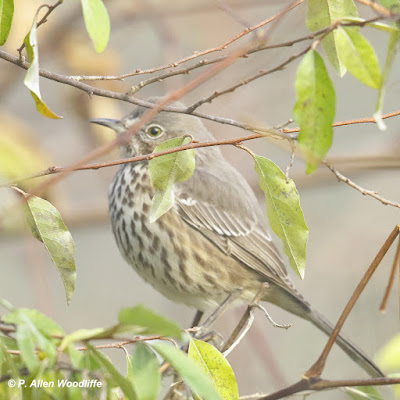
The Sage Thrasher has continued, at least for a few more days, along the Mitchell's Bay South Lakeshore Trail, although not seen as regularly in the last few days. Views continue to be partial due to the branches, although there are fewer leaves to contend with as the days go by.

The bird was not reported for a day or two, but when I was out on Nov 18, after about two hours and checking an area a little way from its usual tangle, I spotted some movement, determined it was the bird in question, and managed this one photo. All of my other attempts were messed up with branches and leaves. There have been birders out there since, but to my knowledge, no one has seen it since, at least according to eBird.
It likely isn't too far away as there is a long stretch of shrubs and berries along that dredged ditch. Given how furtive the bird has been even at the best of times, it may be very difficult to find again.

On one occasion after I left the site of the Sage Thrasher, I meandered down the back roads towards St. Clair NWA. I noted a large falcon flying low and around a cedar hedge, but couldn't quite catch up to it for a photo. I sped up to the end of the cedar hedge and waited, with camera in hand. The falcon didn't quite get to the end before it peeled off and headed across a field, continuing to fly quickly and relatively low. I got off a couple of distant photos, but didn't manage to capture much detail. What follows next is the best I could do, and it really wasn't very helpful. When I posted it on iNat, the CV came up with Prairie Falcon, which would be quite unusual but not impossible. Prairie Falcon is a western species, of course, and moments ago I had come from viewing a definite western species, the Sage Thrasher, so why not a Prairie Falcon. However the detail is just not sufficient to make any kind of accurate ID, and it is most likely a juvenile Peregrine Falcon. Probably.....or not.

November happens to be one of the windiest months of the year, as is March. It is not unusual to see this along the lake front.

And now this cement structure has become visible again. It is part of where the camp office structure was located, back in the day when there was a south campground in operation at Rondeau in the 1960s and very early 1970s. Eventually the sand will shift and it may be covered up again, but for now it is at least partially exposed. Such is life on a sandspit.

There have been some mighty fine colours to enjoy in places at Rondeau.

It is obvious why this one is called Red Maple.
Closely related is Sugar Maple. It was in prime condition for a very short time, as a brisk wind blew most of the leaves off a couple of days later.
More subtle are the seed heads of an uncommon prairie plant, Cylindrical Blazing-star, which is widespread across the southeast beach dune area.
On one of the days I was roaming Rondeau and it was pleasantly warm, I saw a few Eastern Garter Snakes basking on the pavement. Unfortunately more than one had been schmucked by a vehicle of some sort, but this individual was still okay when I last saw it.
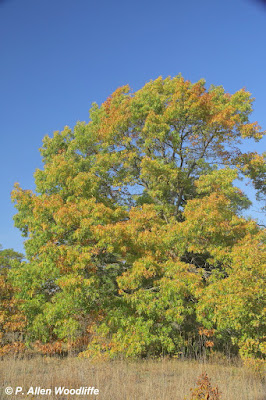
And finally, some of the oaks were in fine shape. I had been particularly focusing on Black Oak for a photo project I was working on, paying close attention to several that were especially photogenic for various reasons. This first one is along the southeast beach, and was looking promising on this occasion.
Five days later it looked like this, showing the golden brown colours this species is known for.
The campground has a lot of Black Oaks, and were relatively colourful on one of my last visits, but by now most will have turned to a deep dark brown, or will have fallen off altogether.


If you want to subscribe, or unsubscribe, to Nature Nuggets, send an email to: prairietramper@gmail.com


Friday, 3 April 2015

Big trees, birds, butterflies.....and snakes!

The last couple of days have been more spring-like, and great to be out! On Wednesday, I went out to Rondeau in search of Big Trees, and found some :-). On this day, I concentrated most of my time in the vicinity of the south half of the campground, as well as the day-use area between the campground and the maintenance area.

There are some big trees there. You've probably driven by this first one on many occasions. It is right along Rondeau Park Ave, immediately south of the campground. It is an Eastern Cottonwood, a fairly fast growing species. It measured 135 cm dbh, which is exactly the same diameter as the huge Red Oak I posted about previously.

Eastern Cottonwood, 135 cm dbh
A large Black Walnut was nearby, but measuring a mere 113 cm dbh.
Both of these two, although they appear to be open grown, are quite tall without any large lower branches. The next two are oaks, and are open grown and the one in particular shows the remains of two very large lower branches, which have been cut off for some reason. Since it was in the campground, maybe they were cut off to prevent interfering with camping trailers.

Black Oak, 120 cm dbh
 Clearly this is not a forest grown tree where the trunk would be straight and unbranched for 6-10 metres or more. The extra bulges where the lowest branches used to be happen to be at the height where official measurements are to be made (1.4m).
Red Oak, 131 cm dbh
Overall I managed to measure about 70 trees, most of which were in the 80 cm to 135 cm range, and would qualify them as representing older growth. So far I've measured about 100 trees, and have barely scratched the surface......the more I look around specifically for trees in that size range, the more I see from one end of the park to the other......I probably have only a couple of thousand more to go! And I am intentionally not measuring anything below 70cm dbh, unless it is a species which seldom grows that big even at the best of times (e.g. Sassafrass), or I would have a lot more to do. While some references on Old Growth indicated that any tree bigger than 50 cm might be an indication of old growth, there are a huge number of trees at Rondeau which are in the 50-70 cm range.

In spite of the snow still on the ground in patches, when the sun was out it was fairly warm at ground level. But I was a bit surprised to see these two Eastern Garter Snakes out basking. I suspect they must have just emerged that day. I noticed a small hole about a metre away, going into an old tree root where they might have accessed a suitable cavity below the frost line.
In addition to these two snakes, I saw my first butterfly of the season...an Eastern Comma, but it was so active and flying steadily away, I didn't get any photos.

This Killdeer was a bit more cooperative, and it was successful in getting some small worm-like creatures to feed on.
Yesterday, I decided to take a break from measuring trees (although in my travels, I certainly was on the lookout for them). I figured with the clear skies the previous night and the southerly winds, some new bird migrants might have shown up. I was successful in finding a few, and even got a few photos of some.

There was a significant arrival of Northern Flicker, as I saw at least 11 in various places.

Eastern Phoebes were widely scattered. I saw at least 9.
There was the typical mix of Brown-headed Cowbirds, Red-winged Blackbirds and Common Grackles in various places.
Brown-headed Cowbird
This immature White-crowned Sparrow was near the Visitor Centre. It might have been the one that was seen coming into the feeder most of the winter, but I hadn't seen it for a couple of weeks. Turkey Vultures have been around for a few days; some were roosting in trees rather than soaring around.
imm White-crowned Sparrow


Turkey Vulture

I also saw a single Tree Swallow flying low over the still frozen Rondeau Bay, and heading south! There were more Golden-crowned Kinglets around than I've seen in awhile, and a Brown Thrasher was scratching around in the leaves at the side of the trail. Black-capped Chickadees and Tufted Titmice were singing away, and it seemed like there were more Brown Creepers around.

I stopped in at Erieau at one point, hoping that with much of the bay and lake still frozen, waterfowl might be a little more concentrated, providing some photo ops. There were lots of Canvasback in flooded fields just outside of the village, with a few other typical species also present.
Gadwall
Red-breasted Mergansers
Bonaparte's Gulls were around in greater numbers than I have seen for several months. There were at least 40, and some were sporting some darker head feathers.

While scanning the marina slip for different gulls, I noticed some movement on the far side. A little distant for a good shot, but still identifiable as a mink.

Camera equipment for sale
A few posts ago, I mentioned that I have a new Canon 100-400mm L II lens. It has been working extremely well, and I am looking forward to using its close focus capabilities for birds, butterflies, dragonflies, etc as the opportunities present themselves along the trails. But this means that my faithful older Canon 100-400mm L lens is no longer needed, and I am willing to sell it. Many of the butterfly, dragonfly and even bird shots of the first year of this blog were taken with it.

In looking at some of the main camera dealers, a brand new version of this lens is $1870.00, plus tax. A used version of this lens on their web site is $1300.00, plus tax.

I am willing to sell my lens, which is in very good shape, and includes a Pro 1 77mm UV filter, for $950.00.

I also have a Canon 1.4X II tele converter. A used one retails for $320.00 plus tax. I am willing to sell mine for $250.00.  Update: this item is now sold.


If you are interested in either piece of equipment, just let me know.


Tuesday, 31 March 2015

National Take A Walk In The Park day

Yesterday, March 30, I was on my way out to Rondeau. On my way out, I overheard the radio DJ say that it was national Take A Walk In The Park Day.......hey....it sounded like a great idea, so I kept on going. As if I needed an excuse.....

My intent for this visit wasn't necessarily to check off as many birds as possible, although I am always on the lookout for them. I went out the South Point Trail at first, but with the southerly winds off the frozen lake, it was quite cold, and birds were few. There were a handful of ducks in some of the open leads well out from shore, but virtually no land birds put in an appearance along the trail.

Later I went along the Tuliptree Trail....it was considerably warmer and out of the wind. There were a ton of grackles, cowbirds and redwings around, and even a few Rusties, the first I had seen this spring.

Red-winged Blackbird


This upturned mossy Silver Maple root along the western most part of the trail often gets my attention.

At ground level there isn't much greenery these days, which makes things like this moss stand out. I'm not sure exactly what kind it is, but it may be Rock Spike Moss.


 One of my goals this trip was to start surveying the big trees that might qualify as old growth. There are a number of characteristics of a woodland that indicate old growth. Size matters, of course, in the context of trunk diameter. Age of the tree matters as well, but is difficult to determine unless one cuts a cross section to count the rings or has a tool called an increment corer, which drills a very small core out of the trunk. Age and size are not always directly related, as the site a tree grows on makes a huge difference, depending on the growing conditions. But the growth habit also matters, as do the bark characteristics, the amount of fallen log material on the ground in the general area, as well as the lack of disturbance on the ground and the diversity and abundance of ferns. Of course there aren't many ferns visible so early in the season. But on many of my previous hikes, I have noticed an abundance of large diameter trees. So I have taken it upon myself, with the park's blessing and encouragement, to begin to document as many large diameter trees as I can. And since it is much easier to see them when there are no leaves to contend with, and the snow is mostly gone from the forest floor, now is the time to make progress.

I had made up a template to record information such as species name, diameter at breast height (officially at 1.4 m above ground) and GPS coordinates. In many cases, large diameter trees that might qualify for old growth status in the current era would be anywhere from 50 - 100 cm dbh. Anything that would be in that range historically would be considered small, however. Here is one of the largest trees of the last century, a Sycamore. Just before it died in the late 1960s, it measured over 167 cm dbh. The photo was taken in 1908.

 This next one was a White Pine that measured about 152 cm dbh at the time it was cut. Three people were able to sit inside the stump.

I thought that looking for trees in excess of 150 cm dbh might be a lost cause, so I decided that anything over 60 cm might qualify. I knew I could find a few that would be greater than 100 cm since I had noted a few during some hiking last fall.

Checking along roads, trails and such is the easiest way to cover the territory most efficiently. But there are a lot of specimens not visible from any road or trail. That is when it gets even more fun, because it gets one into areas that few people have spent much time in. And so my first area to target was along a wide ridge north of Gardiner Ave where an old access trail from many decades ago occurred. It hasn't been used for anything for at least 30 years, and for all intents and purposes, doesn't exist as a trail of any sort. I had gotten wind of a particularly large tree about a kilometre in from the nearest road, and so that is where I headed.

There were lots of decent sized trees along the way, many of which qualified, and I began measuring. I found American Beech, Basswood, White Oak and Tuliptree that were in the 65-80 cm range, so I duly recorded their vital statistics, And I came across a huge Red Oak. This one measured 134 cm! It was actually in pretty good shape, too. To get an idea of scale, you can see my notebook at the bottom. Next time I will take a tripod and get myself in it for a better sense of scale.


This Red Oak is the largest tree I have measured in the park so far. I did come across a Tuliptree last December that measured 125 cm, although I think there are larger ones of this species, as well as Silver Maple, which don't live long but grow to large size in a relatively short time.

Tuliptree, 125 cm dbh
 I knew there were some large trees in the campground, and thought there might be a few birds as well. This very large Black Oak caught my attention. It measured 102 cm dbh. And there are larger ones that I didn't get to yet.


There were a few birds in the campground, but the brisk cold wind kept them under cover for the most part. A few robins were around, as were many Song Sparrows, and this Red-bellied Woodpecker.


I came across a couple of Eastern Bluebirds, a male and a female. But they didn't cooperate for a photo. While trying to get close enough for a photo of the bluebirds, I came across this colourful nest of a Baltimore Oriole that persisted from 2014. Apparently someone from the campground must have left some deteriorating tent or tarp material behind last year, and the oriole added a few long strips to the nest. It was in remarkably good shape, especially considering how exposed to sun, winter winds, snow and rain it would have been subject to for most of a year. It is certainly testament to the durability of this species' engineering skills.


I hadn't actually been aware of National Take A Walk In The Park Day before, but now I will put it on my calendar!