Showing posts with label Cackling Goose. Show all posts

Saturday, 22 January 2022

Mostly Water Birds

 It is that time of year, when most water is frozen, that an open spot is where water birds can be found. And since most other birds are scattered far and wide, and difficult to photograph, any place of open water is a worthwhile place to check out.

One of my 'go to' places this time of year is a warm water outlet along the Thames River, on the downstream side of Chatham. There can be hundreds and hundreds of water birds, as this first photo illustrates. There are at least as many other birds upstream, to the right, of this image.

Canada Geese can be fairly abundant......
....but a closer look reveals these two very similar Cackling Geese with their shorter, stubby neck, smaller body size compared to nearby Canada Geese, and a stubbier bill.
There is often a variety of other ducks that have dropped in, sometimes for a day, or sometimes longer, such as this female Bufflehead.
This male Wood Duck is one of the most vividly colored ducks.
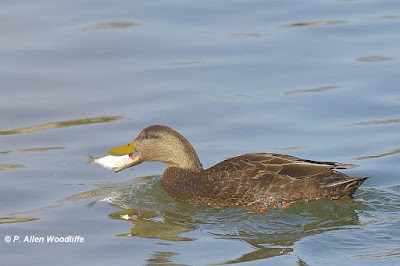
American Black Ducks are more common in winter.....
.....and when the opportunity arises, will try out a fish dinner, although it has to be quick as other ducks and gulls will attempt to go after it, hoping that their harassment will force the duck to give it up.
It is not uncommon to see a duck that has a mix of Mallard and Am Black Duck genes. This next photo shows an Am Black Duck with a distinctive green stripe on the head, likely indicative of some Mallard heritage at some point in its past.

 Mallards are, of course, one of the most abundant species anywhere, and this location is no exception. Probably at least 95% of the waterfowl here are Mallards.
 
 
A female Common Merganser is occasionally present...
...as is a Common Goldeneye. You can see that the ice is a common resting place for the waterfowl!
I much prefer this photo; the same bird, but location, location, location makes all the difference in the appeal of the photo!
Pied-billed Grebes are very uncommon at this time of year. This is one I saw on the St. Clair NWA Christmas Bird Count at the beginning of the month, just a short distance down stream from this spot. Apparently it has decided to hang around for the time being.
There is often a small number of gulls cruising up and down the river, or stopping in for a rest, such as these two Herring Gulls were observed doing.
Not really a water bird, but crows are scavengers and there is often a handful in the immediate vicinity waiting for an opportunity.

Just upstream from this spot is where a Peregrine Falcon sometimes overwinters, as it is able to feed opportunistically on a large flock of Rock Pigeons that hang out on some of the commercial buildings. I haven't seen any sign of the falcon yet this year, and presumably the pigeons are resting more comfortably. And even though some of the buildings have added fake Great Horned Owl and Peregrine Falcon decoys on top of the buildings to scare the pigeons, clearly they haven't had much effect, as this next photo shows. I haven't seen any pigeons land right on the owl, but certainly within a couple of metres! The sky leaves a lot to be desired, at least from a photographic perspective.

The ice is building rapidly out in Lake Erie, although there are a few open spots within view of Erieau. I was there a couple of days ago and noticed several thousand ducks crammed in to three open spots, two out in the lake and one in the bay. This first photo is immediately across the main channel. There were probably at least a couple of thousand ducks there, the majority of which were Greater Scaup, with Redhead, Canvasback, Lesser Scaup, Common Merganser, Red-breasted Merganser, Bufflehead and Common Goldeneye mixed in, but in much smaller numbers.


There were flocks in the air regularly, as birds moved around from one open spot to another.

After leaving Erieau, I went to Rondeau for a nice long walk, and always on the lookout for birds. Birds were few, and even a usually active bird feeder was devoid of birds, which probably was due to this non-bird critter rooting around for something to eat.

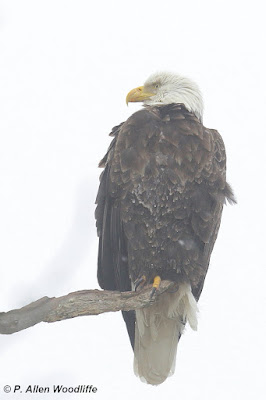
Along the water front was this adult Bald Eagle, perhaps waiting for something to drift by.
Today, I went out to where the Pump Road meets the Thames River, and had a lot of ducks in the open spot a few days ago, including Snow and Greater White-fronted geese. There were very few ducks or geese of any kind on this visit, but I did see this light-phase Rough-Legged Hawk on the prowl along the grassy bank, hoping to flush something out to chase down. It was always facing away from me, so this is the best I could do.


If you want to subscribe, or unsubscribe, to Nature Nuggets, send an email to: prairietramper@gmail.com


Saturday, 6 March 2021

Early migration continues, nesting begins

 Spring is teasing us, and bringing back more birds, as well. A recent visit to St. Clair NWA didn't turn up a lot of migrants, as most of the wetland is still frozen. However there were lots of Red-winged Blackbirds scattered throughout. They were in the trees....

....and spread out amongst the remnant cattails. All were males, trying to establish their territory for when the females return in a few days.

I made a trip out to the mouth of the Thames River. The river is almost entirely open in the lower reaches, but when it enters Lake St. Clair, there is still lots of ice. I figured there would be lots of gulls, and I wasn't disappointed. There were easily 4-5000, but most were too far out at the edge of the ice. I had hoped for some of the rarer species, but all I saw were the more expected ones. However the ones that were in close are always an interesting study. There are numerous 'battles' over a dead fish. Given the number of dead fish lying on the ice, one would think there was enough for all, but most had been picked over. These Herring Gulls were by far the most common and close enough for photos.


Some seemed content to just stand and watch. Maybe they were trying to look inconspicuous, waiting for an opportunity to swoop in and catch another gull looking the wrong way.
Others were squawking about something or other.
This next one was taken at a different time, but illustrates the type of feistiness that gulls can display.
Ring-billed Gulls were not nearly as common.
One of my all-time favourites was taken a few years ago, showing these two Ring-bills definitely having a difference of opinion. I liken it to a mated pair, and one is definitely 'hen/gull-pecked.' Regardless, these adult gulls are at their most impressive appearance, with the feathers looking crisp and clean, and the bare skin parts looking quite vibrant. I especially like the bright red mouth.

A recent trip to Rondeau was good for a nice long walk, but not for seeing many birds. This Red-tailed Hawk was the only bird I was able to photograph successfully.

After being at Rondeau, I swung by Shrewsbury, and amidst a large group of Canada Geese, I spied this Cackling Goose. They are often hard to get a photo of, as they are so much smaller and often at least partially hidden behind the larger Canada. But this one came out into the open enough to get a clear view. The size difference of the body and the bill is pretty obvious.

Yesterday there were two Greater White-fronted Geese at the Ridgetown lagoons. Since I was heading that way anyway, it was an obvious reason to stop and check them out. Unfortunately at that particular time, they had gone into hiding. I met the Sadler brothers, so I hoped that more eyes would give a better chance to locate them, but it didn't work out that way. They weren't visible in the north lagoons or the south pond. There were hundreds of Tundra Swans, and a mix of other geese and various ducks, but no white-fronts. I even drove around to the west side of the south lagoon and stood on the cover on the back of the truck to see over the berm, but still no white-fronts to be seen. There is a fairly extensive stand of tall shrubs in the water along one part of the lagoon, and it is possible they were out of sight there. At any rate, some other birders who stopped by an hour or more later did report seeing them. While we didn't see the white-fronts, we did see a small group of Snow Geese drop in. But once they got mixed in with the swans, their much smaller white bodies were harder to pick out. The first photo shows at least parts of 4 of the Snow Geese......

.....and this one stands out a bit better.

Tundra Swans were coming and going regularly.

And in other news, there are now more local eagle nests showing evidence of nesting. This first one is just east of Thamesville, seen from Longwoods Road, and an adult seems to be in an incubating posture.
This next photo is of the nest at the north end of Scane Road. It shows two adults right on the nest, but with them both standing on or in the nest, they may not have any eggs in it quite yet. But I'm sure there will be eggs soon, and a few weeks later, the eaglets will be peering over the edge.


Wednesday, 9 November 2016

They're baaaack!

It is November, and the crows are whirling around Chatham-Kent like they own it. Just like snowbirds head south for warmer climes in places like Florida, Texas and Arizona, those large black avian creatures have arrived in C-K from points farther north, intending to spend the winter here.

It happens every year. By mid-October hundreds of thousands of American Crows are beginning to pass through southern Ontario. They only go as far south as they think they need to go, and that means C-K is a likely spot to linger. Large numbers of them do continue on eventually, leaving Ontario for places even farther south. For example three years ago, over the course of about a month there were more than half a million documented heading across the Detroit River for Michigan and places beyond.

Driving around Chatham at daybreak or sunset these days, one can see huge numbers of crows in the air, in the fields, in the trees and on the rooftops of office and commercial buildings. This first image is of a small number of crows I saw yesterday. They were in a field of about 15 ha right next to my former office. About half of the field was covered, and more kept pouring in while I watched.
 Almost every tree within about a 4 sq km area had crows in it.

I estimated that there were about 125,000 crows in the area yesterday, at least from what I could see. I expect there were many more elsewhere around the city beyond my view. Some bird experts have estimated that there are often 250,000 or more that are in the Chatham area at this time of year, before tens of thousands move out, leaving us with 'only' 150,000 or so around for the winter.

A peculiar thing about the crows this year is that many may not have even arrived yet. Or maybe haven't left either. In 2013, as mentioned above, about 550,000 crows had been documented leaving Ontario. In 2014, by this date, there had been almost 175,000 of them documented leaving. In 2015, more than 153,000 had been documented leaving.

However in 2016 so far, there has been a mere 36,560 crows recorded leaving.

What is going on, especially this year? Has the population of crows in Ontario dropped? Not likely. Have the crows decided not to leave quite yet, uncertain about the chaotic elections south of the border? Again, not likely. Have those folks counting them at the two hawkwatches in Essex and Michigan been sleeping on the job? Not likely. Have they been distracted by such huge numbers of hawks that they haven't been able to keep track of the crows? Not likely. Have the crows taken a slightly different route to head to the US, at a location beyond the viewing of the two hawkwatches? Perhaps.

My guess is that with the unseasonably mild weather in 2016, crows haven't even arrived this far southwest yet. They are likely stopping at other similar urban/agricultural centres which provide the many benefits to them that C-K does, at least until winter sets in. In looking at the Christmas Bird Count data from counts across southwestern Ontario in the last few years, the numbers of counts  with larger and larger crow numbers are on the rise.

So maybe there are a lot more crows to come, but are waiting for winter to encourage them to move closer. We will have to wait and see.

A couple of years ago, I wrote a fairly extensive blog post on why crows are so enamoured with Chatham-Kent. Rather than repeat a lot of that, you can read about it here.


There are other birds that are around in rather large numbers. The other day I was driving along just east of Mitchell's Bay when I encountered probably the largest single flock of blackbirds I had ever seen. As with any huge, mobile flock of birds, it is difficult to get an accurate estimate, let alone an actual count. But I concluded there had to be about 40,000 birds, and at least 90% of them were Common Grackles, with a few Red-wings, European Starlings and Brown-headed Cowbirds mixed in. These next two images show very small portions of the flock. They were on both sides of the road, in the corn fields, in the trees, in the air and on farm lawns. I was hoping to see a Yellow-headed Blackbird, and undoubtedly there was the odd one, but it was so hard to scan through the entire flock.

At one point when a large section of the flock that was quite close all got up to fly, it sounded like a low rumble of thunder. It was truly an impressive sight and sound.

There are lots of waterfowl around these days as well, a fact well known to many. Chatham-Kent and particularly the Lake St. Clair marshes and adjacent areas have for more than a century and a half, been renowned for their waterfowl hunting opportunities. Hundreds of thousands of ducks, geese and swans pass through each fall.

Some of the geese are smart enough to know that hunting doesn't take place within Chatham. As a result, sometimes a thousand or more can be found within the city limits, either in some of the recently harvested fields, or in the green belt area. The Mud Creek area offers prime viewing. And with the large numbers of Canada Geese, one can find other species. For example a couple of Snow Geese have been seen from time to time. Garry Sadler advised me today of an adult and juvenile bird that had just arrived with a large flock of Canadas, so I headed out to get a few photos.

Adult Snow Goose
Juvenile Snow Goose

I've seen other species of waterfowl at Mud Creek as well, although not frequently. However on occasion one can find a Northern Pintail or Wood Duck joining the gang. These next four photos were all taken at Mud Creek at one time or another.
Northern Pintail
Wood Duck

Cackling Goose looks like a miniature Canada Goose, and can sometimes be found with a bit of effort. They are small, not much larger than the Mallard in the background of this next photo, and definitely smaller than the more common Canada Goose also in the background.


Late this afternoon, I headed for the Mitchell's Bay North Shore Nature Trail, hoping for something of interest. There was a huge number of American Coot.....an estimated 5200 of them in various flocks out in Mitchell's Bay, but too far away to bother with a photo.

It was a beautiful evening, and I spent a bit of time enjoying the sunset. If you didn't catch it from where you were, I hope you can enjoy it vicariously through this last photo.