Showing posts with label Lincoln's Sparrow. Show all posts

Thursday, 12 May 2022

Bird migration continues, with regular, rare and very rare sightings

 Now that we have entered the middle third of May, birders expect lots of bird action. While it seldom is as active as most birders would like, there has been a steady stream of birds arriving.

I have been to Rondeau a couple of times lately, of course. The lake effect of the wind off the water keeps things cooler than inland, and so the leaves on the trees have not developed as far along as trees inland. Therefore the birds even high in the trees are a little more visible.

Almost all of the expected warblers, vireos and flycatchers have been recorded, although not in very great abundance. Here are some of the ones I've been able to capture on digital film so far.

 While looking for a reported Kirtland's Warbler, along with several dozen other birders, this Cape May Warbler obliged at the top of a low red cedar. The Kirtland's never did show up again.

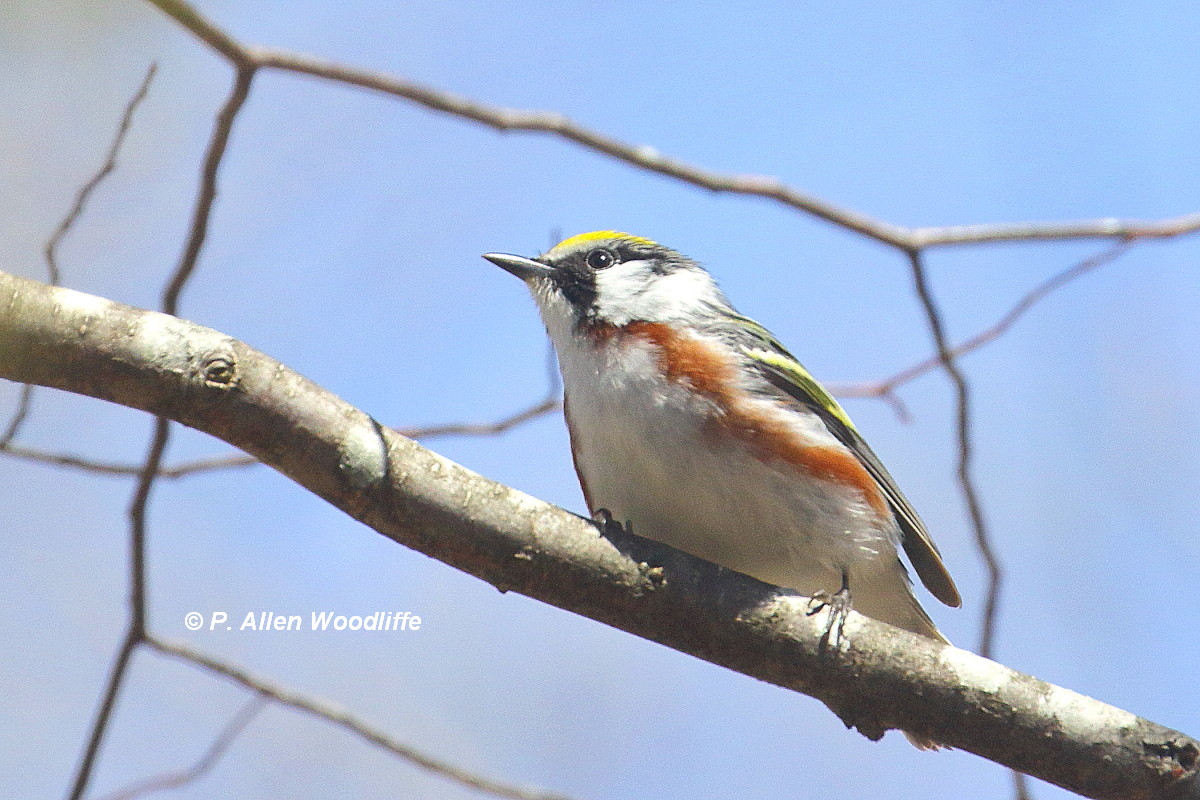
Chestnut-sided Warblers were one of the more common warblers in the last few days.
Magnolia Warblers are beginning to increase in numbers.

Nashville Warbler
One of the warbler highlights of spring, and throughout the summer breeding period, is to see a Prothonotary Warbler. They never cease to draw oohhs and aahhs from any birder observing one.
Only the males have shown up so far, although the females will be arriving soon if they haven't already. Rondeau happens to be the first location in Canada where this species was discovered nesting, and it has remained the main stronghold for this very rare species.
Aside from warblers, things like Blue-gray Gnatcatchers are widely scattered. They are constantly on the move, and get into a variety of postures as they attempt to glean insects from the twigs, etc.
Great-crested Flycatcher is a breeding flycatcher at Rondeau.
Lincoln's Sparrow, on the other hand, is not a breeding species, and they are typically quite furtive along trails and forest edges.
Northern Cardinals are not uncommon, but when one pops up for a photo, I will take it. They are heard regularly throughout the park.
White-throated Sparrows were around by the dozens, even the hundreds, for a few days. Their numbers seem to be dropping now, as they have moved on to their more northern breeding locales. This one was enjoying some morning sun on an otherwise cool morning, and allowed me to approach fairly closely.
Wood Thrush is not a common species, and due to its overall decline in Ontario, is considered a species at risk. Their flute-like calls are always nice to hear in the quiet of evening.
On one occasion, I was heading down a trail to get GPS coordinates of a rare orchid that I had discovered a new location for a few days earlier. I noticed this Turkey Vulture preening and soaking up some early morning sunshine.
On another trail, I heard the distinctive churring of a Red-headed Woodpecker, and located it on a dead tree not far away. It seemed to be staking out its territory, checking out some holes in the tree, and otherwise looking quite at home. While this species is on the decline, the numbers reported at Rondeau this year seem to be a bit higher than the past few years, so hopefully it is a good sign.

American Woodcocks have been back for several weeks, and are well underway in the nesting process. They rely on the cryptic coloration, and so allow quite a close approach.

On sunnier days, one has to be vigilant regarding where one is walking. This Ribbon Snake was on Harrison Trail, and I could have easily missed it.
It is a species at risk, and although it looks generally similar to the much more common Eastern Gartersnake, can be told via its more distinctive yellow lines, and the small white patch in front of the eye.
Red Trilliums are starting to be in good bloom these last few days. They are typically in flower a bit earlier than White Trillium, shown following, and are also starting to appear rapidly in the considerably warmer temperatures of late.

I made a brief stop at Bannerstone Conservation Area, just north of Rondeau. I saw a Bay-breasted Warbler, normally a species that shows in the latter part of the warbler migration...

....and the Tree Swallow boxes look like they have been claimed by some for this season.
I got wind of a pair of Black-necked Stilts being at the Blenheim Sewage Lagoons yesterday, so of course I decided to stop in and look. Sure enough, along with numerous Dunlin, Lesser Yellowlegs and a single Wilson's Phalarope and such, there were the two stilts.

 Quite a few birders had already seen them during the day, but they still allowed a couple of distant photos. These are cropped quite a bit. This is a species that normally will be found in the mid-west, but occasionally show up here in southern Ontario on migration, much to the delight of birders.

The male has a completely black back....

...whereas the female has a brownish back.

I've also spent a bit of time at St. Clair NWA where the large managed wetland complex is a wonderful and accessible spot for finding marsh birds.

Common Yellowthroats are, rather common, although one is more likely to hear them than see them. On occasion a male will sit up in an open spot at the top of the cattails, or in this case the invasive Phragmites, and belt out its call.

Black Terns are a somewhat declining species. On this day, I saw about 18, with many of them flying north along the lake shore so were likely continuing their travels to their breeding grounds. A few will likely remain. They fly a bit erratically, so getting photos is not an easy thing to do!


Eastern Kingbirds like the openness along the wetland complex edges.
Blue-headed Vireos were using the shrubby edges to rest and forage before moving northwards.....
....an Eastern Wood-pewee was also there, but just using the shrubby edges for resting and feeding as well.
Warbling Vireos, on the other hand, like the openness of the cottonwood edges and at least a few will likely stay to nest.

The next few days look quite promising for bird migration, so I plan to be out a few times putting my camera to good use!


If you would like to subscribe, or unsubscribe, to Nature Nuggets, send an email to prairietramper@gmail.com




Friday, 11 May 2018

Birds, birds and more

It is a great time of year to be out. Birds are about at their peak of diversity. In Chatham-Kent, the general Rondeau area is the place to be (with all due respect to the many other natural areas in C-K).

Just a few days ago, the Keith McLean Conservation Area just outside of Rondeau hosted a couple of relatively rare water birds: American Avocet and Willet. The views were quite good in spite of the distance, with a 'scope. Not so good for photos, unless one wanted to go around the wetland and risk spooking the birds. Shorebirds are unpredictable. Sometimes they can be quite tolerant of humans and other times they spook easily. I chose to stay back to ensure they didn't spook and deprive others of getting a look at these birds.
American Avocet
American Avocet with Willet on the far left
Willets showing their wing pattern
 There are lots of other birds to see at this conservation area, and I'm sure that now some rarities have been found, birders will not hesitate to check it out more often. It was a great spot to see a diversity of waterfowl a few weeks ago. Over 140 species have been recorded on eBird to date.
Caspian Tern
The north end of the park has been quite good these last few days, as it is slightly warmer with more insect activity to attract birds. It is also the narrowest part of the park, which allows the birds to be more concentrated than at the more difficult to access and cooler south end.

Summer Tanagers, a southern rarity which occasionally shows up, is present in surprising numbers. There are probably up to 5 birds in the park and include both males and females. Perhaps this is the year that a pair bond will form, and maybe the first confirmed nesting record for Ontario.
 The Norway Maples which are in flower are a great spot to find insect eating birds, if you can see through the density of flowers and developing leaves. Cedar Waxwings have not been very abundant lately, but are starting to show up.
 One or more White-eyed Vireos, a more southern specialty, were cooperating, along with both its Red-eyed and Warbling relatives.
White-eyed Vireo
 Someone had spotted this Eastern Screech Owl fly in to this clump of leaves in an oak. It was hard to get an unobstructed view of the bird, made even more difficult with the harsh back lighting.
 A few Yellow-bellied Sapsuckers are still around, but will be disappearing shortly for places farther north.
 Yellow Warblers are the most common warbler species. It is hard to believe that back in the 1970s this species was on the Audubon Blue List as a rare and declining species to watch out for.
 Sandhill Cranes have been seen regularly flying in or out of the park, heading to or from the marsh.
Elsewhere in the park was this Eastern Whip-poor-will resting in a cluster of small branches along the Tuliptree Trail. One is much more likely to hear them singing their distinctive song in the twilight hours than actually seeing them. This one was fairly high for the species. Normally they seldom roost more than a couple of metres off the ground, or sometimes right on the ground. This one was up at least 6-7 metres.

Other wildlife was visible, and gave photo ops.
A trip to the Erieau Rail Trail resulted in a few birds. There was an abundance of White-throated Sparrows, and I was fortunate to find a Lincoln's Sparrow that cooperated.
This Sora was quiet and behaved in typical rail fashion by skulking furtively in the cattails and Phragmites.
The Blenheim Sewage Lagoons are always worth checking out. Sometimes you get something rare, and sometimes you don't, but there is often a good diversity of water and land birds.
Dunlin in the sprinkler cell
Palm Warbler in the cedars

A trip to the Tilbury Sewage Lagoons is another local sewage lagoon option. The water levels are high so it doesn't currently have the same appeal for shorebirds. For some reason even the waterfowl are not as abundant here. But one can usually find something of interest. Black-crowned Night-Herons follow the creek system to this spot.
 A Beaver lodge is visible along the creek system.
A Great Egret wanders around the berm with trucks on Hwy 401 zooming by in the background.
A bit of a surprise was to see a flock of 36 dowitchers fly in and land on the shrubby/rocky bank. At first I wasn't sure whether they were Long-billed or Short-billed.
They are probably most difficult to separate at this time of year based on their plumage characteristics, and one has to rely on their call notes. The characteristics overlap, and some birds exhibit Long-billed characteristics and others exhibit Short-billed characteristics. It is possible that both species were present. I am not sure how often they travel in mixed flocks, but it happens. The vocalizations were not as clear as I would have liked, due to my hearing as well as the steady flow of traffic on the nearby highway. However I would lean towards most of these being Short-billed Dowitchers.
scaly back with bright white feather tips typical of LBDO
clear, unspotted throat and upper chest typical of SBDO

A swing by the Jeannette's Creek area and the Thames River brought some nice sights. Turtles are abundant and quite visible now that warmer, sunnier days are here. Most logs and other basking sites are crowded with either Painted or Map Turtles. The latter species is considered a Species At Risk in Ontario, although seeing them in the abundance here there is certainly no shortage of them in the lower reaches of the Thames River and its tributaries!

 While I was waiting for a train to pass at the south end of the Jeannette's Creek boat launch area, a Black-crowned Night-Heron flew in right along where I was parked, and proceeded to fish. I got lots of photos of it in action, which I may devote a future post to.
And there are still Snowy Owls around. One sees them posted on eBird almost daily, from various places in C-K and adjacent municipalities. This one was 'shot' on a post along Hwy 40 just south of Wallaceburg.