A walk in the woods these days can be very quiet. Bird song has diminished greatly, and already warblers that passed through in May on their way to the more northern breeding grounds, are making their way back south. But they aren't singing, so all is very quiet. There aren't even many mosquitoes!
That's okay, as there are lots of other things to be captivated with. There are things to see and photograph no matter where you go. Certainly in the last week or so I have been on the prowl for mid-summer plants, some of which are extremely rare.
One of the target species at this time of year, is to find one of Canada's rarest orchids: Nodding Pogonia (Triphora trianthophoros). As far as anyone knows, the only place in Canada where it occurs is at Rondeau. It is legally endangered, and due to that status and the extreme difficulty in finding it, it is not something that can be show cased, much to the great chagrin of serious orchid enthusiasts.
It is not like it is even a large orchid that can be appreciated from a safe distance. It is typically only about 8-10 cm high. The flowering is triggered by specific weather types, and all of the buds that are ready to open will do so on the same day, and only for that day. It may be a week or more until another weather event triggers the next round of flowering. Even when it is in flower, it can be difficult to see. When it is not in flower, which is most of the time, it is extremely difficult to see, even when you know it is right close by.
I've been out a couple of times recently, trying to time my search for a day when it is in flower. I missed out on the first attempt, but yesterday I managed to time it perfectly. In an area that I have been monitoring since the 1970s, I encountered about 115 plants, most of which were in flower. On occasion they will be in a small cluster, as shown in the first photo.
Sometimes a plant will have two, or rarely three, flowers in bloom simultaneously.
But typically only one flower will be open at a time. Upon a closer examination, it clearly is an intricate little flower. To give you an idea of size, this flower is about one cm in height!
A much more widespread, but not common, orchid is this Small Green Woodland Orchid, or Club-spur Orchid (
Platanthera clavellata), which typically grows in fairly wet spots such as at the edge of a slough.
Aside from orchids, there are many other wildflowers to take note of, scattered here and there.
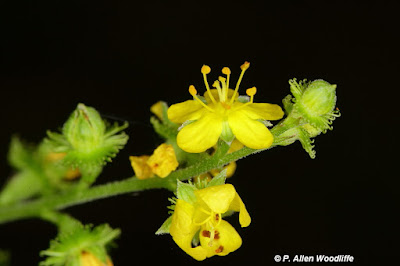 |
Small-flowered Agrimony
|
This next one is American Spikenard. It isn't a common species, and this particular individual was one of the largest I have ever seen. The actual flowers are small.....
...and the leaves and their arrangement are distinctive.
Climbing Nightshade is fairly commonly scattered at the edges of openings.
This next one is Cup-plant (
Silphium perfoliatum). It is a tall plant, with distinctive leaves joined at their base to give its 'cup'.
It is a member of the sunflower family. I don't believe it is naturally occurring at Rondeau. It is an obvious plant, and I only saw one cluster in an are of the park that has recently been left to be naturalized. It is not on the park's previous plant checklists and this is the first time I have seen it. I can only conclude that someone decided to introduce this species, and likely without permission. It is native to Ontario, and is not uncommon along the Thames River in flooded woodland edges.
 |
Hoary Tick-trefoil
|
 |
Great Lobelia
|
This next one is fairly rare, called Hairy Mountain-mint. It differs from some of the more common mountain-mints due to its quite hairy stem, as shown in the close-up.
 |
Marsh Skullcap
|
A fairly common species, especially in open damp areas, is Spotted Joe-pye-weed.
The stem is typically heavily spotted with purple....
,,,,and sometimes the stem itself is mostly purplish.
A closely related species is this Sweet Joe-pye-weed. It usually grows in more wooded areas, and the stem is mostly free of any purple.
I came across another Species At Risk, this one being Black Ash. Ash species in general have been greatly affected by the Emerald Ash Borer, but Black Ash has always been uncommon. It is identified by its blackish terminal bud, as shown in the first photograph.....

....and by the leaves that are joined right at the stem without having a
petiole, and the underside of the leaves are fuzzy/hairy.
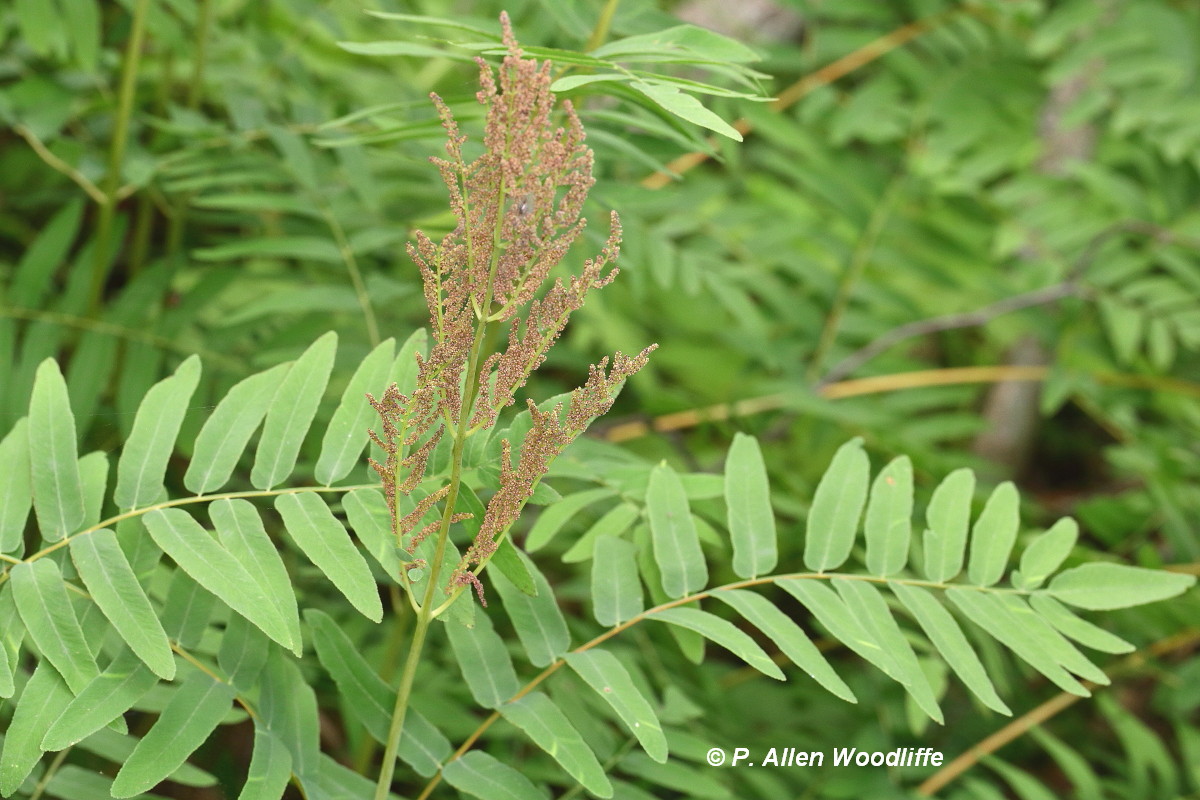
Royal Fern is not common, but can be found in sloughs and wet wood edges.....
...nor is Red-berried Elder common. The berries are not edible, unlike its relative, the Common Elderberry.
Water Parsnip is fairly regular in grassy damp areas along the edges of woodlands.
Woodland Sunflower is very common at the woodland edges, but looks quite a bit like others in the same genus.
One of the main differences is that Woodland Sunflower has leaves that do not have any petiole or stem, and are tightly joined to the main stem of the plant. Also, the leaves are rough to the touch on both upper and lower sides.
There are a lot, and I mean a lot, of different sedges. Most of the time they mystify me, but there are a few that I kind of recognize. This one is probably Hop Sedge (
Carex lupulina). However there is another one that looks almost identical, and is extremely rare. It is in fact endangered.
One of the main differences is in the shape and appearance of the seeds, or achenes, inside the pouches. When I checked this one, it has a strong similarity to the Hop Sedge look-a-like, known as False Hop Sedge (
Carex lupuliformis). Back in my District Ecologist days, some co-workers and I were checking out several sites for False Hop Sedge, and came across at least a couple of sites for it in Middlesex County. One of the main differences between the two species was to look at mature achenes, and if they had knobby edges or corners it was more likely the False Hop Sedge. This one, shown below, has some knobby edge features on its more or less triangular shape, but I am waiting for confirmation or correction on this which I posted on iNaturalist. One of my former OMNR co-workers who is an expert on sedges (and many other things) has not yet responded. If it is False Hop Sedge, it will be one more officially ranked Species At Risk for Rondeau!

American Ginseng is not common at Rondeau, or anywhere else for that matter, and it is also a Species At Risk. I know of a few small populations, and I check out one or more of them from time to time. The hot, dry early part of the summer was not kind to this species, and many of the ones I checked had already withered away. A very small number were still trying to develop some seeds, shown here in their green stage. After fully ripening, they will be bright red.
With the greater moisture of the last few weeks, some fungi are starting to appear. This first one is a type of Jelly Fungus....
...and this next one is in the group known as the Coral Slimes.
I noted this bug on the leaf of an ash tree. It is a young stage of a Green Stink Bug; an adult is shown immediately after.
Milkweed Tussock Moth caterpillars can be found in clusters on milkweeds.
Walking through the woods these days will give one plenty of encounters with spider webs. This is probably a member of the
Micrathena genus.
I noticed this Robber Fly zip out and grab something, then return to its perch to devour it. It is not a common species of Robber Fly, and does not have a common name. Its scientific name is
Machimus snowii.
There is always lots to see during any wanderings in a natural area!
If you would like to subscribe, or unsubscribe, to Nature Nuggets, send an email to: prairietramper@gmail.com