Showing posts with label Twelve-spotted Skimmer. Show all posts

Thursday, 11 July 2019

Butterfly Count Scouting

Tis the season for butterfly counts. While there are a number in the area, the only one I participate in is the Rondeau area one, coming up this weekend. So in order to get in the mood, I spent a bit of time last Monday at Rondeau checking out one of the most prolific patches for butterflies in the park. It is actually an old dump site, known as the Dillon Dump. With the high water this year, and a tree that had come down across the entrance to the trail leading to the dump, I don't believe anyone had been in there for weeks, possibly not for months. I talked with some of the park staff ahead of time, and one or more of the maintenance crew cleared a pathway at the entrance through the fallen tree limbs making access possible (thanks, Jon!).

One of the things that this site has going for it is that it is an opening of about one hectare, completely surrounded by deciduous woodland and swamp, and the main plant there right now is Common Milkweed. Fortunately it is in peak flowering condition right now. There must be upwards of 2000 plants, and with each of them having several flower heads and each head having at least several dozen individual flowers, there may be 10,000 or more individual flowers for pollinating insects to feast on. Butterflies were fairly abundant, not surprisingly. I spent about an hour there in the sweltering heat and came up with 14 species of butterfly. I'm sure there were others. There wasn't anything unexpected, but with the butterfly season to date seeming to be a little behind time, it was nice to see this diversity in one location.

I managed to get photos of the following species. There were Monarchs a-plenty, not surprisingly.
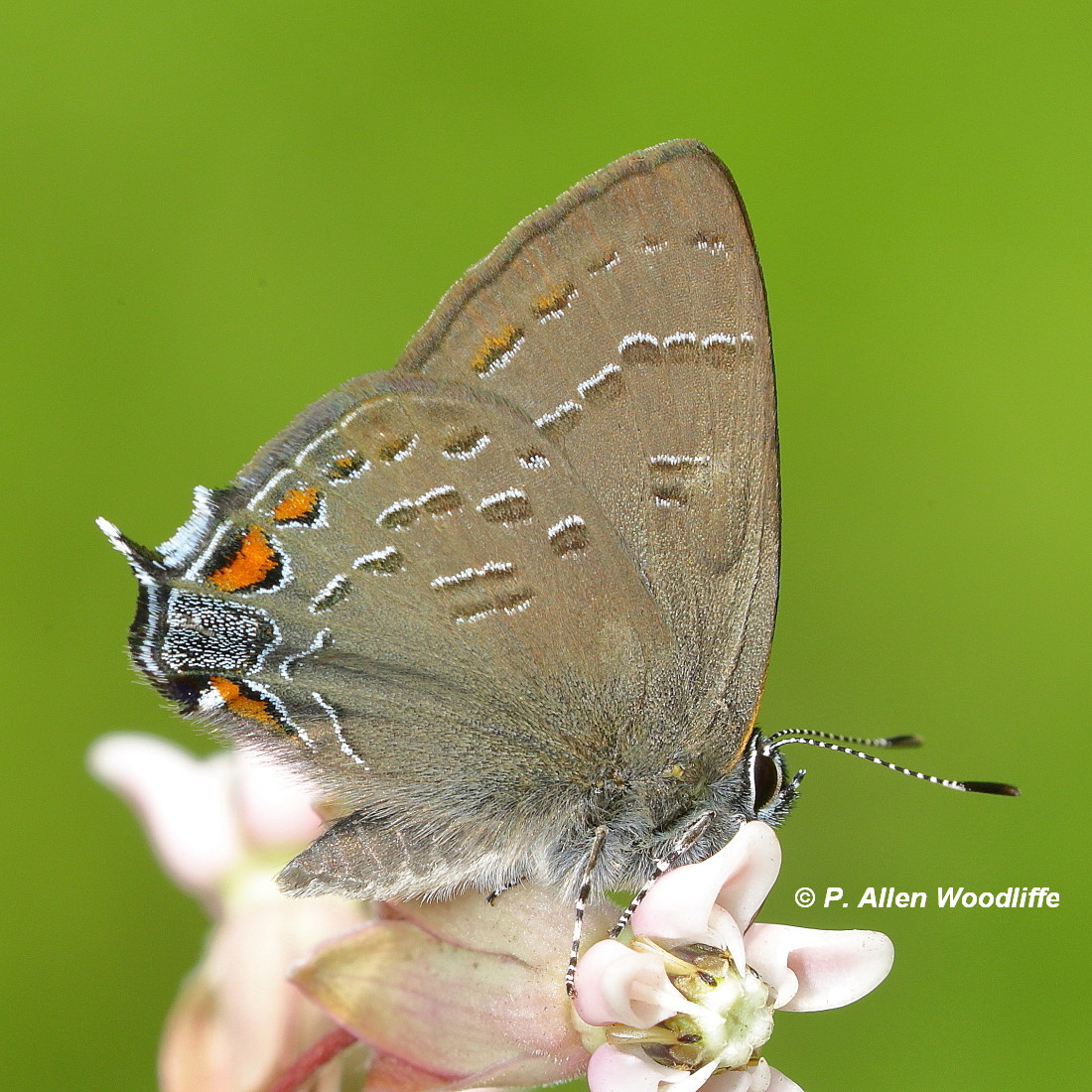
A couple of Banded Hairstreaks were nice.

Eastern Comma
Eastern Tiger Swallowtail
Hobomok Skipper
Pearl Crescent
Question Mark

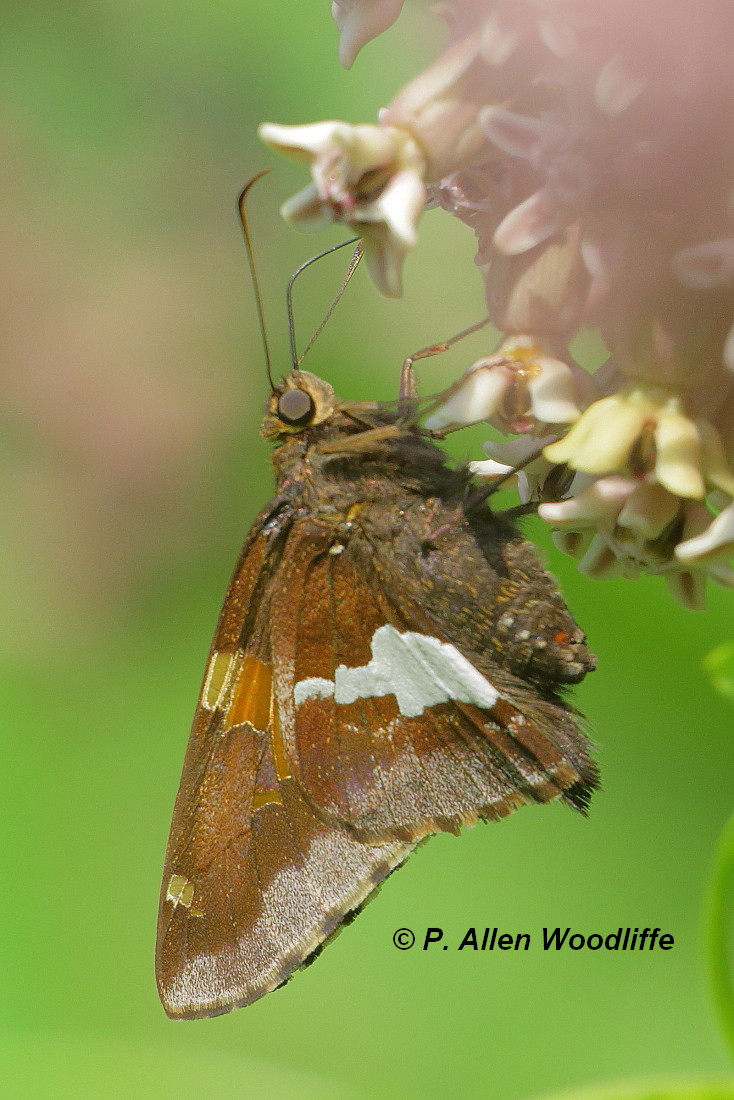
Silver-spotted Skipper
Little Wood-Satyr
There were a few that I didn't get photos of, including Summer Azure, Red Admiral, Tawny-edged Skipper and Northern Broken Dash, as well as a couple of skippers that skipped away too fast to get any kind of decent look at. And there were likely others that I didn't see, but might have if I stuck around long enough. I did get a Viceroy a bit later on.
There were lots of dragonflies as well, although almost all of them were of the Meadowhawk type. I just wasn't sure which one, as the three possible ones are often difficult to distinguish in the field.

 There were lots of damselflies as well, but I only tried to get photos of this one, a type of Spreadwing in the Lestes genus.
Hopefully the upcoming butterfly count will have a decent result, but time will tell. However unless someone wants to venture out the officially closed Marsh Trail, a significant part of the count area will not be covered. This next photo shows the north end of the trail, at a location where hundreds of birders stood patiently last September and October waiting for the famous Great Kiskadee to show itself. Things have changed considerably, due to the record high water levels of the lakes; hence the closure of the trail.

I also had some things to do in the vicinity of Clear Creek Forest Provincial Park, so I took a bit of time to look for butterflies and dragonflies around the open area and ponds at the north side of the park. The butterflies were much the same as what I got at Rondeau earlier, but with less diversity. The dragonflies were plentiful though. Again, nothing really unexpected but it was nice to have so many to choose from in such a small area.
Blue Dasher
Calico Pennant
Common Whitetail
Twelve-spotted Skimmer
Widow Skimmer
 There were quite a few Eastern Pondhawks, including young males with their thorax still transitioning from green to pale blue.

With all of the dragonflies around, it was no surprise to see the exuviae still clinging to the tops of dead stems, where the nymphs had climbed out of the water to subsequently emerge as adults.
Whilst on the watch for dragonflies, I noticed this Bronzed Tiger Beetle scurrying across the sandy edge of one of the ponds.
There were a couple of dragonfly types that just wouldn't land and so I never got a chance to identify them let alone photograph them. Maybe next time.


Sunday, 26 June 2016

Summer wetlands

World Wetlands Day is in early February but in this part of the world, wetlands are entrenched in their winter solitude at that time. This post will highlight some of wetland values at the current, more active time of year.

Wetlands are hugely important to a healthy landscape. For example they help contain runoff from rainfall so there is less soil erosion and degradation of our lakes, rivers and streams. They recharge the ground water table which keeps water wells supplied and forests healthy. Unfortunately their benefits have been ignored by many, so the majority of them have been drained for various kinds of development. Based on soils and early surveys, it is estimated that at the time of settlement more than 66% of what is now Chatham-Kent was one type of wetland or another (marsh or swamp). By 1982 less than 4% of the municipality was in wetland. That has since dwindled further, as currently only about 4% of the entire municipality is in any kind of natural cover.


Wetlands are a fun place to explore, but the best time is in the early morning or evening, unless you like the heat! There is an abundance of plant and animal life out there, although some of it takes more than a bit of effort to find.

June is prime egg-laying month for many turtles.
Midland Painted Turtle
Sometimes you see them up laying, but more often than not, the first hint of turtle egg-laying activity is this, where the buried eggs have been dug out of the hole and only fragments of egg shells remain.
The culprit? Raccoons are probably the most likely one, although skunks, foxes and opossums will take advantage of these fresh eggs as well. I remember on one occasion watching a snapping turtle laying eggs, and a raccoon was sitting right behind it, pulling each egg out of the nest hole as it was laid. It doesn't get any fresher than that!
Turtles are long-lived, so in order to keep turtle populations healthy, they only need to have a small number of eggs successfully hatch and the young reaching maturity to eventually replace the adults in the population. So even though the majority of turtle eggs are eaten, it may not do any significant damage to the overall turtle population.

The openness of the wetland landscape is great for seeing a multitude of birds. Waterbirds, including herons, egrets and terns are frequently seen.
Black-crowned Night-Heron

Green Heron

Forster's Tern
Unfortunately there is an expanding population of Mute Swans in our wetlands. While they are attractive birds in their own way, this non-native species is very aggressive and chases out our native waterfowl.

Mute Swan and cygnets

Much smaller things with wings are common, especially dragonflies. The Calico Pennant is one of the more striking dragonflies, in my opinion.
Calico Pennant
 Blue Dashers are much more abundant.
Blue Dasher male
Blue Dasher female
Twelve-spotted Skimmer

The Black Horsefly is a huge fly, with the body length up to 28mm. Fortunately it seldom bites humans, but it can be a nuisance to livestock.
This Black Horsefly was low down on a dead stalk of Phragmites, just a bit above the water. It might have ended up as a snack for a Bullfrog, which is by far the largest frog in Ontario. Bullfrogs are easily identified by their resonant 'jug-o-rum' call that you can hear from quite a distance. When you get to see one, you can tell it from the somewhat similar, but smaller, Green Frog, since the Bullfrog does not have ridges that go from behind the eye down the back almost to the hind legs. Bullfrogs are quite the vicious predator, in the sense that they will eat fish, other frogs, small snakes and even small birds.
Bullfrog

Plants are numerous in a healthy wetland, with a constantly changing array in flower. Right now, things like Fragrant Water Lilies (Nymphaea odorata) dot the surface of wetlands, poking up through the covering of lily pads.


Pickerelweed (Pontederia cordata) is not a weed at all, but an attractive flower which pollinators such as bees like.


Arrowhead (Sagittaria latifolia) is a common plant in shallower water.


A less obvious wetland plant is Giant Bur-reed (Sparganium eurycarpum).
Giant Bur-reed, male flowers

Giant Bur-reed, female flowers

Tufted Loosestrife (Lysimachia thrysifolia) is found along wetland edges.

There are many, many more things to get your attention.....I encourage you to get out and enjoy a wetland!


Monday, 8 June 2015

Do you know where Swamp Cottonwood is?

I've had occasion to check out Bickford Oak Woods Conservation Reserve three times in the last few weeks. It doesn't take all that long to get there, but there aren't any official trails, so one has to be willing to follow some overgrown logging trails, or bushwack their way through once you arrive. At 308 hectares in size (760 acres) and much of it being wetland, it isn't the easiest place to get around, but usually well worth the effort.

Drainage is poor, leading to all sorts of small and large wetland pockets.
Typical forested wetland of Bickford Oak Woods
One of the things that Bickford Oak Woods Conservation Reserve (BOWCR) is known for is the only location in Canada for the tree species called Swamp Cottonwood. It was discovered by Gerry Waldron, John Ambrose and Lindsay Rodger in 2002, while doing some inventory work. It is hard to believe that even in this 21st century, new tree species are being discovered in southern Ontario!
Swamp Cottonwood
Swamp Cottonwood grows to a fairly good size, and occurs in a buttonbush swampy area. There are several dozen trees of various sizes.....the image here is from a very short young plant.

The wetlands are great spots for amphibians, such as this tiny Western Chorus Frog, only about 2-3.5 cm long.

In general, the BOWCR does not have a lot of large trees. It was acquired by business men during a time when industrial expansion of that part of Lambton County was thought to be a good investment. But industrial expansion did not occur in this area, so it sat for decades. It did undergo fairly intensive timber harvest about 50 years ago, as well as some cattle pasturing, so it wasn't in the most pristine shape. But in the late 1990s, the owners called me to see if any government or private conservation agency would be interested in purchasing it, and so a plan of action was put into place. With the extreme generosity of individuals, local field naturalist groups, the Nature Conservancy of Canada as well as Ministry of Natural Resources, it was acquired and eventually designated as a Conservation Reserve. The forest is rebounding from the harvesting and pasturing activity of the past. But hints of such activity remains, if one only looks at the type of tree form that is common to see throughout the drier sections of the forest.

Multi-stemmed tree trunks abound. Oak was a valuable forest product, and so the merchantable timber was taken out. But oaks have a tendency to sucker after harvest, and some of those suckers are now the well established tree trunks. It is quite common to see double and triple stemmed trunks of various oak species.

Triple-stemmed White Oak
 And on occasion, one may find one with as many as five trunks such as this Red Oak below shows.
With this forest being so large at over 750 acres, it has a significant amount of what is known as Interior Forest, which is the forested portion at least 100 metres from the edge. This is the maximum distance at which edge species, such as Brown-headed Cowbirds, will normally venture in, giving a safer area for birds such as Wood Thrush, Ovenbird and other forest interior species to breed without being parasitized by the cowbird which lays its eggs in other species nests.

Ovenbirds, Wood Thrush, Scarlet Tanager, Yellow-throated Vireo, Rose-breasted Grosbeak and others are fairly common here. Less common species include Cerulean Warbler, Tufted Titmouse and even Acadian Flycatcher. I have seen or heard all of these here from time to time, other than the Acadian......that one is pretty infrequent here.

Some of the largest wetland areas in the BOWCR will support Beaver, and a Great Blue Heronry is in the vicinity of these same interior wetlands.
Beaver cutting
I noted this One-spotted Stinkbug along the trail.
And in October, one can easily find Witch-hazel, a shrub that only flowers in the fall.
Some of the property that was formerly in farmland has been left to regenerate, and even had some tallgrass prairie plants and wildlife shrubs established about a decade ago. Right now, these areas are great for butterflies and dragonflies. This first one is a Common Baskettail, but it had me fooled at first because they normally have an obvious dark spot at the base of the wing. It is more noticeable in the second photo.
Common Baskettail
 Also fairly abundant was Common White tail, as in the next photo showing an immature male of the species.
 Twelve-spotted Skimmers were also well represented.
Twelve-spotted Skimmer
Wildlife shrubs, such as this Nannyberry, are coming into good flower these days, which is great for butterflies.
Nannyberry
Eastern Tiger Swallowtail
Giant Swallowtail
American Lady
In the grasses and clover were some smaller lepidoptera:
Common Ringlet
Juvenal's Duskywing
Peck's Skipper
I'm not 100% certain if this is a Peck's Skipper.....those little rascals are sometimes a challenge unless you get just the right angle to show the important characteristics.....if anyone has a better idea, please let me know.

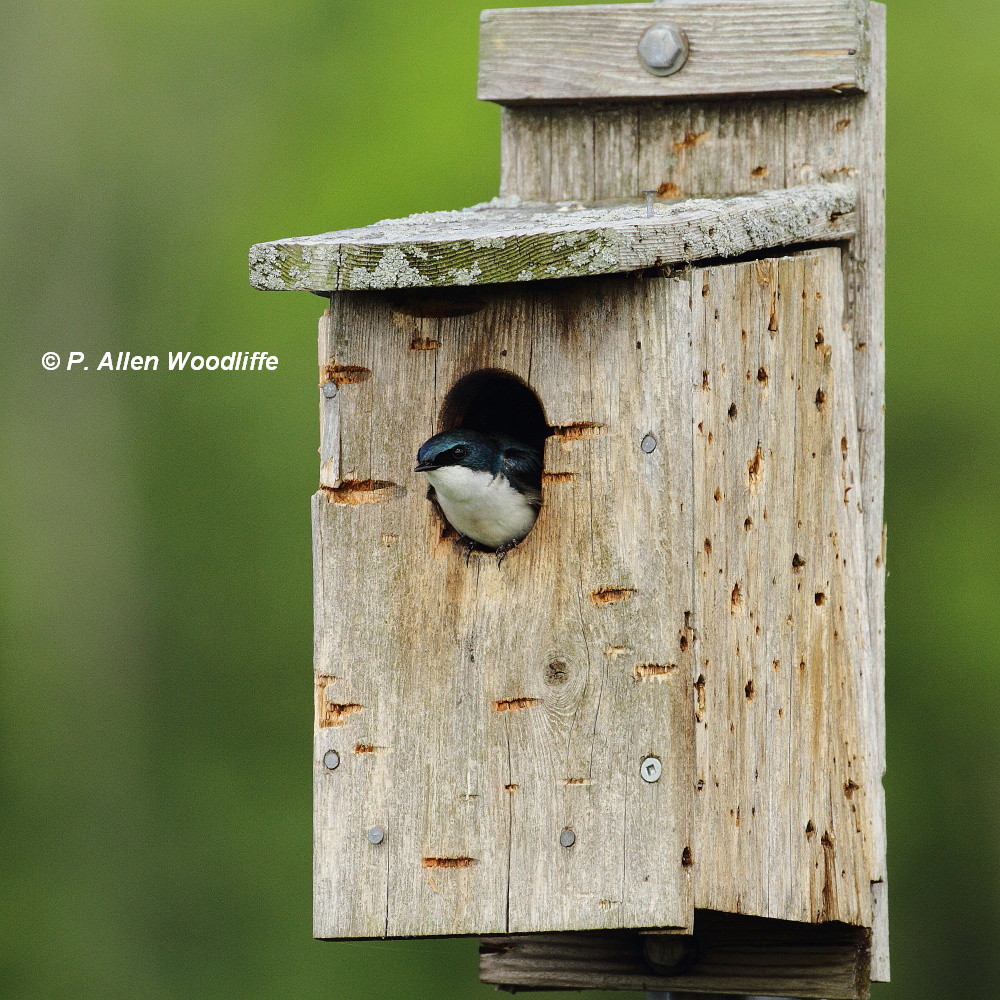
While I was busy photographing butterflies in the open grassy area, this Tree Swallow and its mate were keeping an eye on me.