Showing posts with label Black-throated Blue Warbler. Show all posts

Saturday, 4 May 2019

May has arrived, and so have the songbirds!

What a difference a few days make. April was relatively slow for songbird migration, but it seems now that the first few days of May have arrived, so have the birds. There has been a very good representation of songbird migrants....not as good as it will be in a week or so, but quite rewarding to be out just the same.

The sand spits of the north shore of Lake Erie are prime places to see these avian arrivals, and Rondeau is my favourite. And there is a new trail! Well not really a new one, but a trail with a new name. It used to be referred to as the maintenance loop, as it was an unofficial walkway along the south side of the maintenance compound, with a loop that went south for a few hundred metres through an area that used to be a deer enclosure as recently as the 1960s, and when that was removed, part of it became a place to store unneeded material such as posts and parking barriers. It has been popular for a few years now for both birds and butterflies, and it is officially called Warbler's Way. You can access it from either Harrison Trail or Rondeau Road.
Warblers have been arriving in decent numbers, and I believe as of today, there have been at least 28 species recorded. I haven't been out as often as some folks, and have only seen about half that many so far, but that will change shortly. Some species are in very low numbers, as expected. I haven't caught up to some of the rarer ones, such as Louisiana Waterthrush and Golden-winged Warbler, at least not yet. Here are a few warbler species that I have caught on camera. The first three species have been fairly abundant.
Black-and-white Warbler
Black-throated Blue Warbler
Black-throated Green Warbler
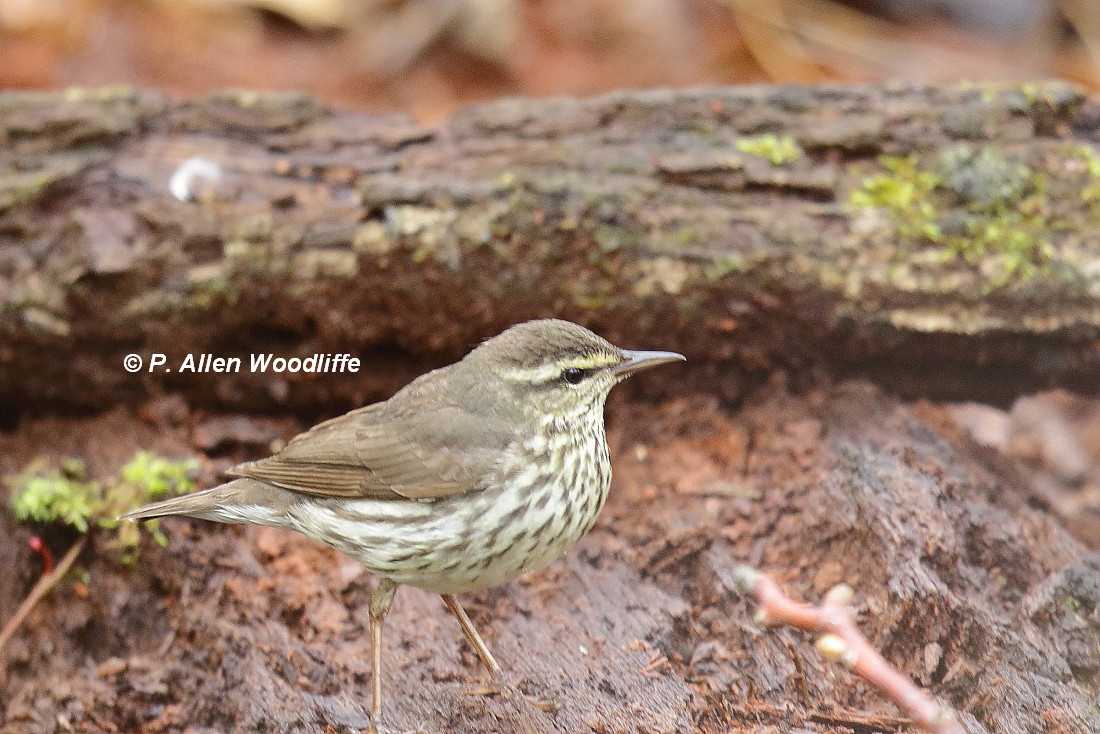
 This next one, the Northern Waterthrush, has had a few around, and I watched this one feeding and singing at the edge of a slough along Warbler's Way.
Northern Waterthrush

Ovenbird
Palm Warbler    
Of course there are lots of other members of the songbird group. Northern Cardinals are looking their most spectacular this time of year.
 Less colourful, but important in their own right are Gray Catbirds, which have just arrived in good numbers.....
 ....as are Rose-breasted Grosbeaks.
 Members of the thrush family are quite melodious. Wood Thrush is probably the most melodious of the group, at least in my opinion, and it nests at Rondeau. I have only seen a couple so far and haven't got a photo yet. The Veery is quite melodious in its own right.
Veery
 Sparrows can be hugely abundant. White-crowned Sparrows have just started to arrive...
 ....on the other hand, White-throated Sparrows are going through in massive numbers. Sometimes it seems like the forest floor is moving, they are so abundant. It is not uncommon to see several hundred in just a couple of hours. There must be thousands of them at Rondeau right now, but that can change in a hurry as they quickly head on to their more northerly breeding range.
 Brown Creepers are subtlety marked and a few of them are often seen these days.
 You never know what you might find. I came across this along the west side of the South Point Trail yesterday.
Someone is likely not happy. If you hear a youngster fussing along a trail somewhere in the park, it might be because he or she is lamenting the loss of something important.

Thursday, 11 May 2017

C-K hotspot action and a migrant magnet

These last few days have been interesting, with lots of spring migrants putting in an appearance. The cold, rainy windy weather of last week is all but forgotten.

Visits to Rondeau (of course!) as well as Mitchell's Bay area, Wheatley Provincial Park and Paxton's Bush have all been productive. In looking at the number of entries on ebird, it is clear that there are a lot of birders, too, and checking out parking lots at the usual hotspots have proven that. At times if the birds aren't abundant, it is a great time to visit with folks along the trail that you sometimes see only at this time of year.

At the tail end of the windy weather, Great Egrets were seen well away from the waterways, and in some cases, they had to hunker down and face the wind like this one below, just to keep from being buffeted by the wind.

 Some Bald Eagles were not bothered by the windy weather, as at least 4 were noted soaring overhead along the Mitchell's Bay trails. The wind must have kept the Yellow-headed Blackbirds under cover, as they were not seen by the dozens of intrepid birders who were searching for them. Perhaps they have moved out to their preferred stand of cattails, which isn't in a highly visible location, ready to get the nesting season underway.
Rusty Blackbirds still linger, as a few persist in the wet woods of Rondeau. In many years, they have moved out of southern Ontario by about this time. They appear in various plumages, making one look carefully to see if a rarer species is mixed in. Some appear relatively glossy compared to their winter attire.


Red-breasted Nuthatches are still moving through.
Hairy Woodpeckers are permanent residents, but seem to be less common than they used to be. Two males were vying for territory along Rondeau's Tuliptree Trail.
The always popular Prothonotary Warbler has been cooperating for most viewers, and some of the time for photographers as they are setting up their territory. The bird spends a lot of time popping in and out of the branches and debris at the water's edge, making getting a photo rather challenging.
 A bit of patience rewards the watcher, and the photographer, with less obstructed views.


 On several occasions, the male has been observed taking moss to one of the nesting boxes.

Yellow Warblers are likely the most common warbler around these days, and will remain so for the entire breeding season.
 Black-throated Blue Warblers have arrived in good numbers. It is not uncommon to see a dozen or more in an outing.
There have been many other warblers appear, but as the weather warms and the insect activity is greatest higher up in the trees, getting a decent photo is next to impossible. But things like Blackburnian, Northern Parula, Chestnut-sided, Black-throated Green, American Redstart, Blue-winged, etc have all arrived much to the satisfaction of birders. Species like Yellow-breasted Chat, Golden-winged and Hooded are all present as well, but getting a glimpse rather than a photograph is about the best most people can hope for.

While searching the tree-tops for warblers, one might miss an intriguing item at ground level. This is the season for morels, and they blend in well.


On the outskirts of Blenheim there is a grassy industrial lot along with a low wet spot which has sometimes attracted a few shorebirds. The grassy area has a few Bobolinks....

.....and Savannah Sparrows.
On a recent visit, there were two Solitary Sandpipers. Which begs the question, if you see two close by, are they not really Solitary anymore? And if so, what would they be?
A not-so Solitary Sandpiper


 Earlier today I decided not to drive off somewhere else to look for birds, but to visit Paxton's Bush, a 20 acre or so woodlot on the north side of Chatham and only a 10 minute walk from home. Turns out it was a great idea. With so little forest cover in this part of Chatham-Kent, a woodlot this size can sometimes be a magnet for migrants. Along a trail no more than a kilometre long, I tallied 19 species of warblers, including First of Year Magnolia, Orange-crowned and Golden-winged. There were also lots of Rose-breasted Grosbeaks, several Veerys, FOY Swainson's Thrushes and FOY Scarlet Tanagers,  well as FOY Philadelphia Vireo and FOY Alder/Willow Flycatcher.


Veery
Who knows what tomorrow will bring? Enjoy the spring migration....the fall migration will be starting in about a month!


Thursday, 12 May 2016

Birds are picking up!

It has been a slower than hoped for spring migration here in southern Ontario so far. On some trails one sees more chipmunks than warblers!
I don't mean to denigrate Eastern Chipmunks......they are entertaining to observe, and they also make a great menu item for many predators!

But fortunately the spring migrant birds are picking up in diversity and overall numbers. Some species are less common than they were a few days ago, such as Rusty Blackbirds...they are very hard to come by these days.

White-throated Sparrows have declined.
Other sparrow species are more obvious, such as White-crowned Sparrows.
Both of the previously mentioned sparrows are heading north to their breeding ground, so it is expected that their numbers will diminish.

Field Sparrows are a local breeding species, and can be seen here and there.
Field Sparrow
A sparrow that breeds in the sub-arctic tundra region and northern boreal forest, is the Lincoln's Sparrow. It is a beautiful looking sparrow upon a close examination, with all of its warm colours and fine markings unlike the bolder appearance of other sparrows. Lincoln's Sparrows are just starting to appear in southern Ontario.
Lincoln's Sparrow
Clay-colored Sparrows are an uncommon migrant. At least a couple of them have been at Rondeau in the last few days.
Clay-colored Sparrow
Vireos are becoming more abundant, although I have only been able to photograph Blue-headed Vireo so far this year. I got my first White-eyed Vireo today.
Blue-headed Vireo
Rose-breasted Gorsbeaks have been back for a few days and it is always a delight to hear their melodious songs through the forest.
 Baltimore Orioles are also back en masse. Orchard Orioles are far fewer.
Baltimore Oriole
Scarlet Tanagers are just beginning to show up. Today I had three, but for some reason, I could only find females, and the light was not very good for this one.

The che-winking of Eastern Towhees can be heard throughout the forest edges and shrubby openings.
Eastern Towhee
Flycatchers are back. Eastern Phoebes have been back for a few weeks, but the small grayish-green Empidonax flycatchers just appeared in the last few days. Another flycatcher, the larger black and white Eastern Kingbird, arrived in good numbers in the last day or so.
Bluebirds haven't been all that common this spring, in my experience. I was pleased to see this male towards the end of today's outing.
The Bald Eagles are now feeding young. This nest is the one along the Marsh Trail.

Earlier in the week there was a very cooperative Solitary Sandpiper in a small pond right along the road. I got some decent shots, but had even more success when a friend offered me the use of his Canon 600 mm II lens. (Thanks, Arni!). Arni was the one who, a few years ago, lent me his Canon 500 mm lens, and I subsequently ended up getting my own 500 mm II lens. I don't think I will be switching my 500 to a 600 anytime soon, however.
Solitary Sandpiper
It was right near this same location where today, a Northern Mockingbird showed up. Mockingbirds are not typically migratory like other members of the Mimidae family (thrashers and catbirds), and one hadn't been reported in the park since at least last year to my knowledge, so it was nice that this one appeared. It was very cooperative, at times coming almost too close to focus with the 500 lens.

Of course this time of year, birders are out to see as many warblers as they can. Today I came across at least 16 species, certainly my best outing so far this year. Highlights included a couple of Northern Parula, Canada Warbler, Wilson's Warbler and Northern Waterthrush, as well as the more common species. Unfortunately most were high up in a pine tree, silhouetted and very active, so my photos are few. Yellow Warblers are abundant....it is hard to believe that back in the 1970s, they were on the Audubon Blue List, indicating a concern about declining populations. Fortunately their decline did not continue.
Yellow Warbler

I saw several Black-throated Blue Warblers, but only this female allowed me to get a reasonable photo.
On the way home, I came across this cooperative Savannah Sparrow singing along the roadside.
All too often, one sees feral cats on the landscape, even in the forest. Feral cats are very good hunters, and quite adept at killing birds and small mammals. Some studies have concluded that there are about a billion birds a year killed by cats!!!
 Fortunately the cat in this tree should pose no threat to the woodland birds!