Showing posts with label Eastern Gray Squirrel. Show all posts

Tuesday, 25 November 2025

Another cattle egret, a snake, a millipede and more

 If the forecasts are accurate, we will be experiencing another blast of winter in the next few days. Fortunately I was able to get out to a few places, including Rondeau, to continue some exploring of late November and enjoy some lengthy walks. I hadn't caught up to anything out of the ordinary regarding birds.....just wasn't in the right place at the right time. But there were a few of the expected species that paused long enough for my camera.

American Goldfinches are present most of the year, but many from farther north have been migrating through in good numbers over the last week or so. 

Dark-eyed Juncos are quite common, and at least some will be around all winter.
Of course Downy Woodpeckers are present all year.
I always look forward to seeing Fox Sparrows in late autumn. This vividly patterned sparrow likely will be present in very small numbers over the winter, but are often hard to find.
Northern Cardinals are another year-round species, fortunately, especially for those with winter feeders....

...as are Red-bellied Woodpeckers. They have been busy storing some of this year's abundant acorn crop in crevices in trees, in case feeders don't meet their needs.
Wild Turkeys are permanent residents and get a little more bold in wandering around open areas in the autumn when the park is quieter, looking for acorns.
There are often a few other creatures out and about. Of course Eastern Gray Squirrels are also looking for acorns and such. I enjoy watching their acrobatics, etc. This one is suspended by its two hind feet while the two front feet are handling something it is nibbling on.

It is getting late in the season for cold-blooded creatures, but just yesterday I came across this Eastern Garter Snake sitting at an open spot along the trail.

Another cold-blooded creature is this Common Pink Flat-back, a type of millipede, roaming across Gardiner Ave.

Certainly a bird highlight of recent days is yet another Western Cattle Egret, seen by many on several occasions at the Keith McLean Conservation Lands. I have seen it on at least three different days from the road, but on one occasion I decided to park there and try and get some decent photos. Here are some of the results.


This is the second time I have seen one in the last month or so. It may be the same one that moved over from its previous spot just north of Erieau where it disappeared from after a few days. Unfortunately for this individual, some recent observers have reported that it was seen to be limping, and wondered if it could be captured and taken to a wildlife rescue place. I'm not sure if that is possible, as when I got these photos, it was walking okay but more importantly it could fly quite well. So unless it ceases to be able to fly, and can survive for a bit longer given the wintry weather forecast, it will probably not be rescued. It is a juvenile, and is clearly well beyond its normal range, so it might just be a victim of its unfortunate wandering well beyond safe habitat.

In addition to Rondeau, I have been meandering around parts of the former Dover Twp, which is actually closer to home, and I always enjoyed exploring St. Clair NWA. However the NWA is closed for trail repairs until early January, so my exploring in Dover is more random elsewhere. But there have been things of interest even though the Gray Kingbird featured at the heading, is long gone somewhere. 

Tundra Swans are becoming more numerous, but often are feeding so far away from the road I didn't bother trying to photograph them. This small group was a bit closer.

 This Red-tailed Hawk remained on the pole long enough for a photo or two. While the species is a year-round resident in C-K, there are lots migrating through from their more northern range.

Sandhill Cranes are hard to find these days. However I came across a couple at the edge of a corn field just north of Mitchell's Bay on one occasion, where I was able to put my long lens with teleconverter to use to capture this one digitally.

If you would like to subscribe to Nature Nuggets, send an email to: prairietramper@gmail.com

Thursday, 6 April 2017

More early bird action

It is that up and down weather so typical of spring. Sunny and mild one day; blustery with cold rain and even snow the next. Nevertheless, birds are attempting to move north as evidenced by some of the latest findings.

A couple of trips to the Rondeau Provincial Park area in the past few days has been worthwhile. Sparrows are a typical early season migrant, and there has been no shortage of them. There have been lots of Chipping Sparrows....

 ....I got my first Savannah Sparrow of the spring.
 ....Song Sparrows are everywhere.
 ....I had at least 4 Vesper Sparrows on one occasion.
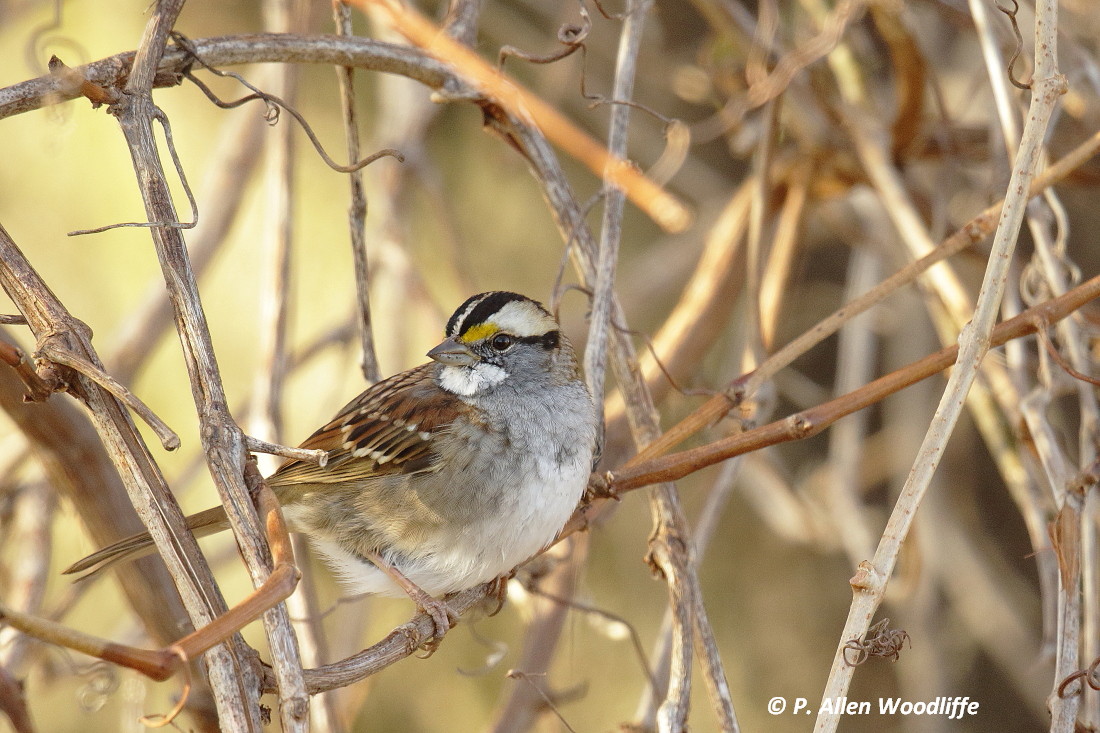
I also got my first Swamp Sparrow of the spring, although no photo as it scurried amongst the branches and fallen logs in a slough. There are still lots of American Tree Sparrows and Dark-eyed Juncos present, and an occasional White-throated Sparrow has shown up.

The sloughs are also good for Rusty Blackbirds, although I haven't seen hordes of them yet. Hopefully there are more to come. It is a declining species in Ontario, but not officially At Risk yet.
There have been lots of Golden-crowned Kinglets, although in their continuous active search for food, it is hard to get them in focus long enough for a photo. At least the cooler weather has kept them down low.
 Eastern Phoebes can be seen throughout....sometimes along the forested edges of Lakeshore Road, and other times deep in the forest playing hide-and-seek amongst the trees. They will be nesting very shortly, if they haven't started already.
 There has been an occasional Yellow-bellied Sapsucker noted over the winter, hanging out at the north end of the park. This is the first one I have seen in the forest, so a spring migrant.
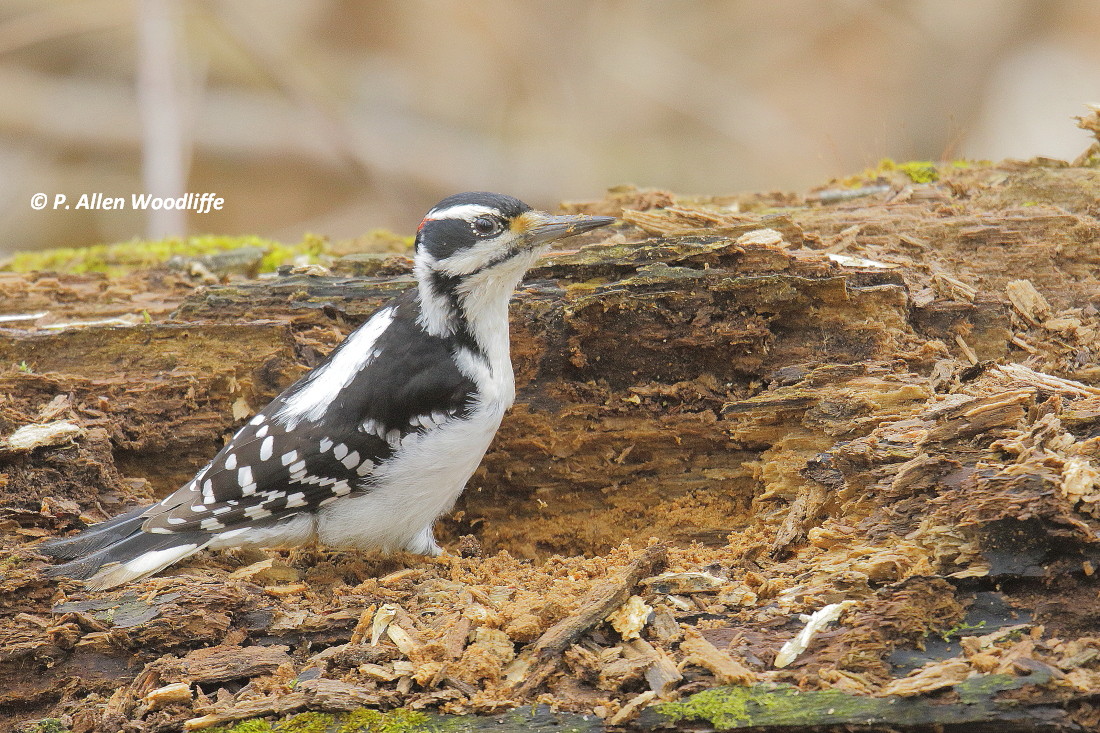
On one of my trips around the Spicebush Trail, I had 5 species of woodpecker, missing only Red-headed. There haven't been any spring arrivals of Red-headeds yet that I am aware of, although there has been an occasional one overwinter somewhere in the extreme southwest. Hairy Woodpecker is not as commonly seen as it used to be, and photo ops are even fewer in my experience. This one cooperated for me for a few seconds.
Hairy Woodpecker
Killdeer have been back for awhile now, and their nesting season has begun. One of the adults is usually pretty close to the nest, especially during this cold wet weather. They aren't incubating yet....that won't likely start until the third of four eggs is laid.

Killdeer nest


Some of the park's other wildlife provided photo ops in my travels, including this larva of some insect which was resting on the top rail of one of the boardwalks. I don't expect it to get much older given the exposure and wet weather.


Sandhill Cranes are a normal occurrence these days, which is nice compared to the rarity that they were a couple of decades ago. The first nesting record for the Rondeau area occurred about 15 years ago, and there are probably 2-3 pairs that nest annually now. It might have nested historically, but probably at least a century or more ago and was never recorded to my knowledge. This pair was apparently gleaning residue from a nearby soyabean field just outside the park.
The weekend looks promising, and the camping season at Rondeau begins tomorrow (Apr 7).


Tuesday, 6 December 2016

Early December action

December has arrived, and that triggers the period for winter birding lists. It also means local birders are out scouring the bushes to see what lingering avian critters might be around for the upcoming Christmas Bird Count (CBC). The Blenheim/Rondeau count is less than two weeks away!

For this count, Rondeau Provincial Park and Erieau are two of the hotspots known to catch the attention of late migrants. A male Eurasian Wigeon has been fairly reliable at the north end of Rondeau, although not often seen close to shore (although I got a text today from Garry Sadler that it was at the edge of the bay under the willow tree closest to the normal viewing point.....a day when I had other commitments and couldn't get out). This first photo, greatly cropped, is one of my more successful attempts.
Eurasian Wigeon on the right
It is often in the company of American Wigeon and Gadwall.
American Wigeon
Gadwall

There has been a handful of less common birds scattered in various place in Rondeau, but they are not always easy to catch up to. One place I often check is the north end of Harrison Trail and also the adjacent campground, which is closed, but has easy access and lots of shrubbery for birds. Yesterday I went for a hike in this area. It was much quieter than I expected. I saw nine Gray Squirrels...


....a feral cat....
...and a mouse before I saw or heard a single bird (full disclosure: my hearing isn't all that great, so it is possible or even likely that there were birds I missed). Eventually I did get some birds for my day's list at this location, including Black-capped Chickadees, American Goldfinches, Hairy and Downy Woodpeckers, Northern Cardinals, Golden-crowned Kinglets, etc.

I know there was a Golden-crowned Kinglet on the branch in this next photo when I pressed the shutter....honest! They never seem to sit still, so in the ensuing millisecond of time, it was gone. (Over the years I have collected a few shots of empty branches.....😏)
 

There have been some strong winds from the southeast recently, and I wanted to check on the state of erosion along the south and southeast beach areas of the park. The wave action so far didn't seem to do too much damage.
Southeast Beach
South Beach

The Erieau pier and channel has received the brunt of such wave action as well.

Note the uppermost branches of the tallest tree in the previous photo. For those who have spent time over the last couple of years birding the Erieau area, you have undoubtedly noticed the dead Double-crested Cormorant blowing in the wind. It has been there for at least two years, and is a testament to the tough, leathery skin of a desiccated cormorant. Maybe we should start a pool to see who can predict how long it will remain?

These gulls in the next image would normally be out on the pier, but as you can see from the third photo above, it wasn't a popular place to hang out on this day. The birds in this next photo were about to get a shower.

The Rail Trail and the McGeachy Pond trail are two good spots to check out. There has been an interesting assortment of song birds in the last few days, including Wilson's Warbler, Palm Warbler, Orange-crowned Warbler, Blue-gray Gnatcatcher, Blue-headed Vireo, Gray Catbird, American Robin and Bohemian Waxwing, among other more expected species. The density of the shrubbery adjacent to the phragmites as well as the abundance of non-native rose hips makes it attractive to such lingering migrants, but sometimes very challenging for birders! I haven't spent as much time combing the bushes as some others, and so haven't caught up with all of the above. In fact of those listed, I have only seen the Blue-gray Gnatcatcher, American Robin and the Bohemian Waxwing. The latter species was probably the most surprising, as they are rarely seen in Chatham-Kent in any year. In fact I have only seen them in C-K about three times in the past four decades. This individual shown below was with a flock of about 125 of the much more common Cedar Waxwings.
American Robin feasting on rose-hips
Blue-gray Gnatcatcher from a different day
Bohemian Waxwing
Cedar Waxwing
Cedar Waxwing enjoying fruit of Red Cedar
The Rail Trail is popular for sparrows.
Front to back: Song Sparrow, White-crowned Sparrow, Fox Sparrow
White-throated Sparrow
This trail is also a spot to see White-tailed Deer on occasion. This one was only a short distance away, but reluctant to move off. After a few moments of trying to stare me down, it eventually settled back down.

An occasional Great Blue Heron remains in the area, not surprising given all of the open water. This one was taking shelter along the canal adjacent to Lagoon Road.

With the imminent arrival of colder weather, it will be especially interesting to see how many of these species are recorded on the upcoming CBC!