A healthy woodland is always interesting to explore. There are breeding birds, of course, but not always as obvious with the heavy foliage. Here, a Great Horned Owl is peering out at me.
There is so much more diversity in the other types of wildlife and vegetation, however. And often the human crowds are not much of a problem, at least on some of the more remote trails.
Some things are brightly coloured and easily noticed, such as this Chicken-of-the-woods fungus. They can be seen at anytime, from June through September.
Other orange things include this Wood Lily (
Lilium phildelphicum), found along some of the more open sections of woodland.....
...as well as this Michigan Lily (
Lilium michiganense).
A bit earlier in the season, one can see this orangey scene at various places of a woodland.
These oblong cavities are characteristic of where a Pileated Woodpecker has drilled into the trunk of a Hop-hornbeam (
Ostrya virginiana) digging out insects. The indirect result is the ensuing run of sap. Sap contains good concentrations of sugars especially in the spring, and these sugars are attractive to yeasts for feeding on. The type of yeast here is
Cryptococcus macerans. It can appear on many different types of tree and even on wild grape vines and is often seen where there has been a wound that lets the sap out.
There isn't a lot of sunlight getting to the forest floor these days, and wildflowers are not abundant.
You are more apt to see the spring wildflowers in this condition, with their seeds ripening, such as this Large-flowered Bellwort (
Uvularia grandifolia).
Where a tree has died, or fallen over, it lets a bit more sunlight to the forest floor, and it is there where there is a greater profusion of vegetative growth. This American Beech tree (
Fagus grandifolia) has fallen over, and the growth on the forest floor is beginning to become more prevalent than in the adjacent shaded area.
There are a few flowering plants, however, even in the somewhat subdued light. Purple-flowering Raspberry (
Rubus odoratus) is scattered about. Its fruit is not considered edible like many other raspberries are.
Fringed Loosestrife (
Lysimachia ciliata) may be found in some of the damper sections.
A close-up of the leaf stem shows the fringe, which gives this plant its name.
Another plant found in rich woodlands these days, and mostly restricted to the Carolinian Life Zone, is Richweed (
Collinsonia canadensis).
It wasn't until I got these images on the computer that I noticed the colourful little critter on the stem...a Red-banded Leafhopper!
I usually see these leafhoppers on milkweed plants in more open areas, so I was a bit surprised to see this one here.
 |
| A close-up from a previous year |
Thimbleweed (
Anemone virginiana) is not all that colourful, but is distinctive.
This vine, named Wild Yamroot (
Dioscorea villosa), is not common, and the flowers are not particularly impressive. Its seeds are more obvious than the flowers, and in the fall, the heart-shaped leaves turn an attractive golden brown.
Maidenhair Fern (
Adiantum pedatum) is quite abundant in these southern hardwood forests. It is one of the more delicate fern species, and will disappear with the first frosts.
Bottlebrush Grass (
Elymus hystrix) is an obvious grass species well represented along the trails.
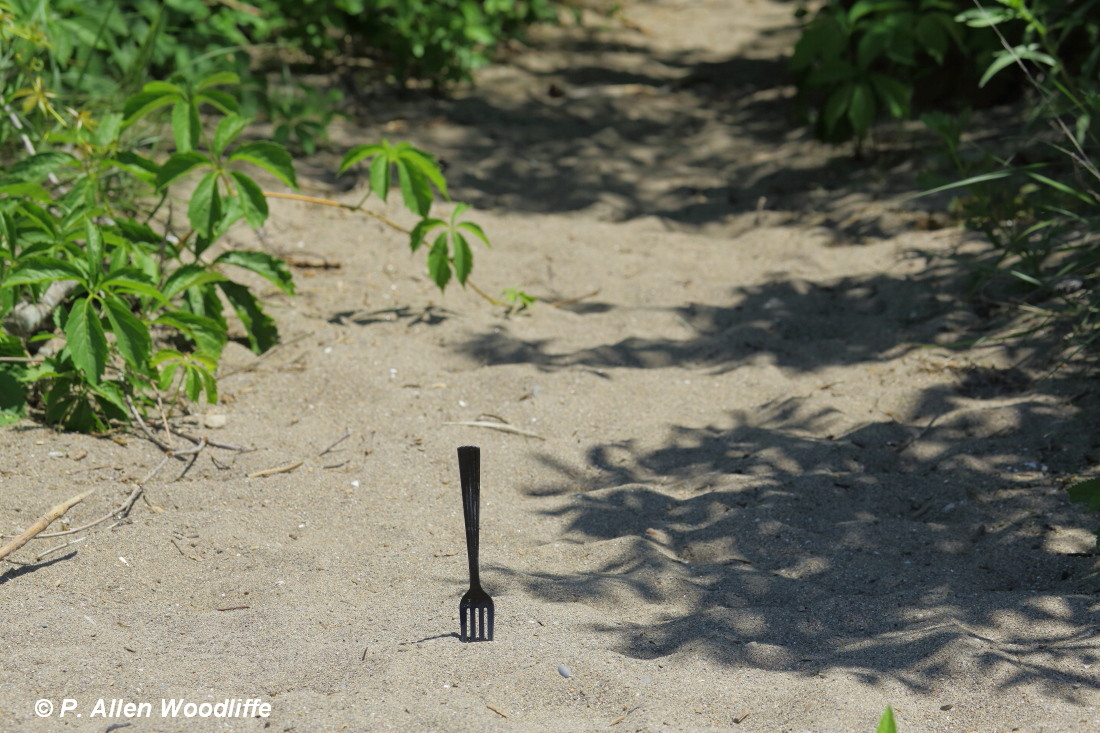
Occasionally one might come across a fork (
Forcus plasticus) in the trail :-).
If you look closely to where you are stepping, the distinctly marked caterpillar of a Mourning Cloak butterfly may be crossing the trail.
This next image shows a Brown Stink Bug (
Menacles insertus). I didn't handle it to see if it lived up to its name.
Even in the forest, dragonflies occur. Here is presumably a female White-faced Meadowhawk, well away from its normal wetland haunts. The various species of meadowhawk are notoriously difficult to tell apart in the field, especially the females.
Even during these dog days of summer, there is lots to see!


m.jpg)