Showing posts with label Brown-headed Cowbird. Show all posts

Sunday, 15 June 2025

Some Birds of late May and Early June

 A few multi-purpose outings have resulted in quite a few photo ops. This post will focus mainly on birds that I have encountered.

If anyone was out along the Marsh Trail of Rondeau earlier this spring, the feature that used to be this for several years, much to the delight of those hiking the trail...


 ...which due to high water and ice damage, was destroyed and in its place was a structure designed to be a haven for Barn Swallows to use for nesting. It lasted for several years, but alas, the continued high water levels and ice damage resulted in it looking like this earlier this year.


I haven't been back out to this spot really recently, but the last time I got a glimpse, it looked like it had tumbled down the rest of the way. I expect the swallows gave up on it before nesting got into full gear.

I came across this Barn Swallow nesting underneath a boardwalk along the Tuliptree Trail.
This one, along with its mate, had successfully nested under the top level of the observation tower along the trail at St. Clair NWA. While this species seems to be fairly abundant at least in SW Ontario, it is considered a Species At Risk, with the ranking of Vulnerable.
Exploring the open, wetland areas along Lake St. Clair are always a highlight for me and my camera. Canada Geese are quite plentiful, with their overall numbers increasing considerably by dozens and dozens of recent additions to the flocks.
Eastern Kingbirds are scattered throughout, but in small numbers.
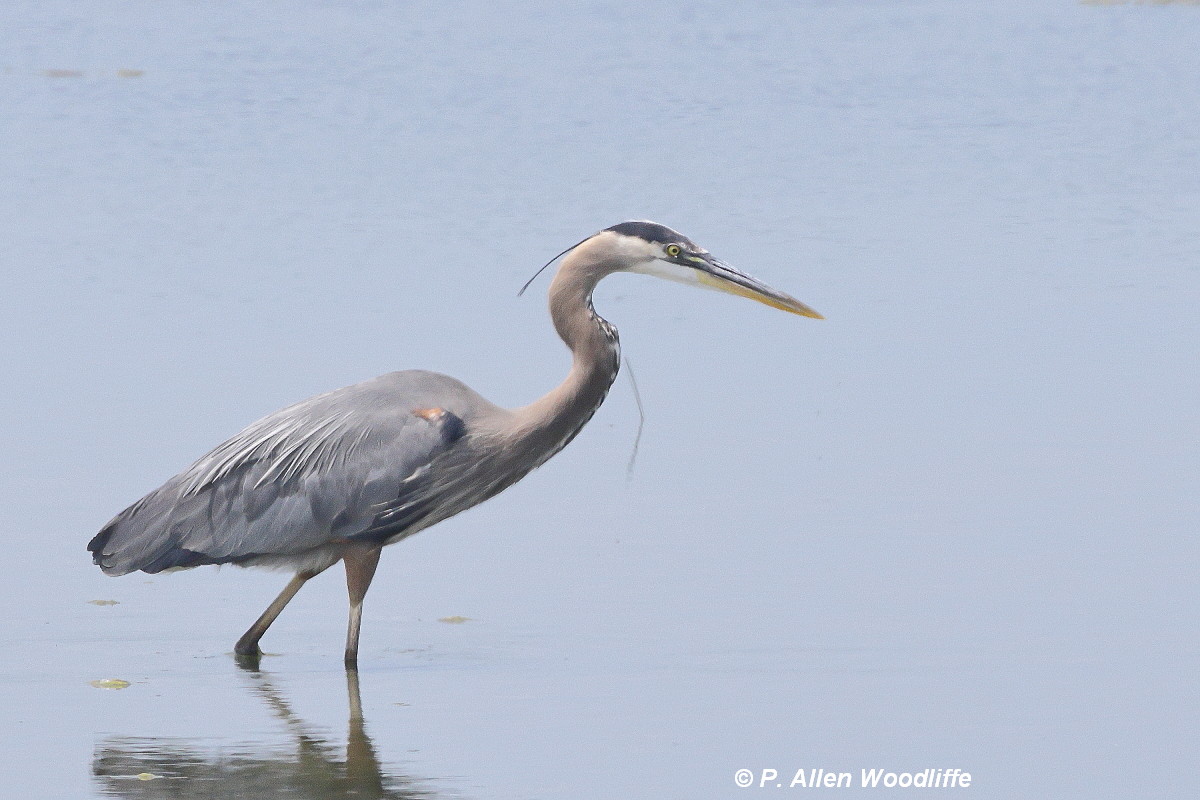
Great Blue Herons don't nest in the immediate vicinity, but at least a few are found feeding in the shallow water.
Great Egrets can be found, sometimes fairly abundantly. It isn't all that uncommon to see half a dozen to a dozen feeding, or flying by, as they nest at some of the nearby, offshore islands.

A much smaller member of the heron family is the Green Heron, usually quite elusive. This one was a long way off, and the photo is highly cropped.
The cattails harbour many, many individuals of the Marsh Wren. They are quite frequently heard, but seldom does one sit up so cooperatively.
Sandhill Cranes are more abundant these days, and a few days ago I saw this family of three wandering around in a field adjacent to SCNWA. It seemed rather early for this youngster, which had probably hatched at least two weeks earlier, but there it was.
Flyby cranes are always fun to try and get with the camera. 
In the wooded areas of Rondeau, there is quite a different array of birds such as this Wood Thrush, which had a nest just off the Warbler's Way trail. 
While walking along one forested trail, I was a bit startled to hear lots of thrashing going on in the thicker shrubbery right close by. It was this Turkey Vulture, which must have been feeding on something, and sat up in this tree, waiting until I left the area before it returned to continue its meal.
Rose-breasted Grosbeaks are not common, but regular.
These next two species are quite abundant, and in spite of that I always enjoy seeing them. I like the iridescence that is so well shown on the head of this Common Grackle.
Brown-headed Cowbirds are seldom the favourite of anyone, but hey....they are birds too, and I won't hesitate to aim the camera in their direction when the opportunity avails itself, (and when things are fairly quiet with not a lot of others to aim at).

Baltimore Orioles, next, are frequently heard as they are often higher up in the forest canopy, but don't often come down except to feeders.
And American Robins are abundant in many different habitats. This one was nesting on the shelf behind the sign, and was quite upset with me walking by.
Of course what is a bird themed blog in late May or early June about unless it features the iconic Prothonotary Warbler! I have had a few good encounters so far this season. On one occasion I was watching a female gathering nesting material to take to a natural cavity, and it flew in so close to me I couldn't get the entire bird in my field of view! I only got this one photo. It isn't cropped at all.

On another occasion while I was watching a male Prothonotary singing away, it actually landed on a branch right over my head, and had I a slightly longer arm, I could have reached up and touched it. However it was quite active in some of the small saplings nearby, and I got several photos, including this next one.

It doesn't get much better than that!

I will conclude this bird featured post with a highlight of a few days ago, when I encountered a flock of about 40 Whimbrel along the southeast shoreline of Rondeau.

They weren't around for long, presumably anxious to get to the breeding grounds well to the north.


If you would like to subscribe, or unsubscribe, to Nature Nuggets, send an email to: prairietramper@gmail.com


Thursday, 17 February 2022

Bison Birds

The American Bison was historically called buffalo. That is a misnomer, as buffalo are actually old world species, but when European explorers first arrived to North America and encountered these huge animals, they named them something that they were familiar with.


 Bison once roamed in the millions, mostly across the wide open plains of middle and western North America. There is some historical record of them even in extreme southwestern Ontario, in the vicinity of what is now the Windsor area, as there were hundreds of hectares of tallgrass prairie before settlement. But that is the topic for another post.

Bison were well adapted to the cold, fierce winters of the mid-western part of the continent. Their winter coats were densely hairy, as this image shows, with the front end of the animal being the most densely hairy.

This was incredibly useful when facing the wind, which they typically did, to withstand the cold.

After the winter weather, they lost much of the dense hair towards the back of their bodies as shown next. Even so, the front end of the animal still retained a lot of dense hair. 

 Bison were always known to roam widely. The huge herds would have a home range of hundreds of thousands of square kilometres or more of open grassland. This next photo shows a single bull bison on a huge grassland at Grasslands National Park in extreme southern Saskatchewan. At the time I took this photo, in July, the bulls are usually well away from the cows and calves.

 It was said by early explorers that bison always moved into the wind as they were foraging, especially during the more inclement weather. This resulted in their long-range movements, and was advantageous in that a large herd of bison, numbering in the thousands, would eat off much of the short-grass prairie, but by keeping on the move, they would find new grasslands and give the areas they moved from, a chance to regenerate in time for a following season. Sometimes they would feed intensively on areas that had burned off via a prairie fire, and was regenerating with lots of tender fresh, green fodder.

Tallgrass Prairie National Preserve, OK

And that brings us to the Bison bird.

Most birds build their own nest, lay their eggs in it and raise their young.  This next photo shows a typical eastern grassland type bird nest. It is that of a Song Sparrow, and at the time of taking this photograph, it did not have a cowbird egg in it.

 But the Bison bird is a species that depends on following Bison, for the insects they disturb by their hooves during their movements as well as the seeds they break off of the grasses they are moving through. So the birds must follow the movements of these herds of Bison, and don't stay in one place for several weeks while they build a nest, lay eggs and feed the young to the point of the next generation being able to fend for themselves. No, these Bison Birds adapted so as to lay their eggs in the nests of other birds, with the new host raising the young of the Bison bird.

As time went on, Bison herds diminished considerably, and were at great risk due to the loss of foraging and roaming habitat due to settlement as well as the slaughter of millions of animals for their hides, or just for what was considered 'sport'. Large areas of the Bison's former habitat was turned into grazing lands for other animals, such as beef cattle. Probably the most best known breed at one point was the Texas Longhorn, but other breeds were eventually added. Hence the likely reason for the current name of this bird species. Texas Longhorns were aptly named, and came in various colours. They were the new grazer of the mid-western part of North America, some roaming free and others on large fenced grazing lands.


I'm sure that most readers will have caught on quite early in this post that the bird species I am referring to is none other than the Brown-headed Cowbird. 

male

female
 It is the only North American bird species that demonstrates this 'parasitic' behaviour, much to the dismay of some bird enthusiasts. I admit that I have had mixed feelings over the years, especially when I see a cowbird egg in the nest of a more 'desirable' species such as a Yellow Warbler, Prothontary Warbler, Wood Thrush, or some other species. All three of the aforementioned species have been, or are, considered a Species At Risk. 

Yellow Warbler
Not quite sure if this next image showing the young bird being fed is a cowbird or a young Yellow Warbler. It has some characteristics of being a cowbird, but would be easier to tell a few days after this photo was taken.

  Cowbirds are certainly not at any level of risk. In fact they often can be seen in huge flocks.


Presumably when these Bison birds were more or less confined to the wide open spaces of the mid-west, they had fewer potential host species to choose from. But as the eastern forests were cut down and opened up to a more agricultural landscape, these Bison birds adapted and became widespread throughout the east. In fact the cowbird is known to parasitize more than 220 species of birds in this way! As a result of the loss of forests, cowbirds became the dreaded edge species as they would regularly venture into a forest for 100-200 metres, and interior forest bird species nesting within that zone were heavily parasitized. Some ornithologists consider interior forest to be a minimum of 100 metres from any edge, whereas other specialists consider interior forest to be at least 200 metres from an open edge. Currently most forests in southwestern Ontario have been reduced to the extent that there is very little good quality interior forest to prevent cowbirds from entering and impacting the interior breeding bird species. Wood Thrush, now a Species At Risk, is usually an interior forest species, but sometimes can be found near the edges especially when proper interior forest is diminishing.

 This next photo shows an adult cowbird visiting the nest of a Yellow-breasted Chat, an extremely rare breeding bird in Ontario. 

I took this photo in about 1980. This was the first confirmed nesting of the Yellow-breasted Chat at Rondeau, and one of the few in all of Ontario. It was well away from any real forest edge, although a severe windstorm had caused a lot of blow-down which resulted in some shrubby habitat dominated by raspberry. It was great habitat for chats, but cowbirds also made it into the area. Fortunately the young chats in the nest were well along in their development so that if a cowbird laid an egg, it would not hatch before the chats would likely have fledged.


If you would like to subscribe, or unsubscribe, to Nature Nuggets, send an email to: prairietramper@gmail.com


Sunday, 11 April 2021

Roaming around south Chatham-Kent

 There have been lots of nice days to be out lately. Other things pop up so I don't get out every day, but in spite of the current lock down, I've managed to check out a few places.

Erieau, both the town site and nearby McGeachy Pond CA and Rail Trail sites near by have been some of my target places. The Bonaparte's Gulls have arrived in fairly good numbers for the time of year, and the marina at Erieau is a great spot to get a close view with photo opportunities. While the Bonaparte's are plentiful one always can hope for something a little less common. The Bonies are in various stages of plumage development, and this first one is looking pretty well complete in its breeding plumage.

Forster's Terns have arrived, pretty much on schedule. They can be hard to photograph, as they dipsy-doodle around and not always in the best light.
Horned Grebes are fairly abundant. These next shots show the variability in plumage as they shift from basic winter to alternate breeding plumage.

Killdeer have been back for awhile, and are well into the nesting cycle. When I pulled in to a parking spot to look over the marina, I no sooner turned the vehicle off that this one came right up to me squawking. Clearly I knew that a nest was likely near by, so I didn't move or even get out of the truck for awhile.
The adult put on quite a show, trying to lure me out of the area with its broken-wing act.
I eventually got out and walked carefully so as not to step on any eggs. I figured I had either parked right over top or had driven over the nest, so wanted to look around to see. After a bit of gull and tern shooting, I discovered this nest with one egg, and carefully moved the vehicle and left.
A subsequent trip two days later indicated that the nesting process had continued with now three eggs. I parked along the roadside since I knew where the nest was, and didn't want to upset the adults any further. They were a lot less concerned on this visit. But with the nest right in the middle of a parking area, it might not remain undamaged to completion.

Along the McGeachy Pond trail there weren't many birds to see close by, but there were several hundred birds of various species out on the lake, including at least 100 Red-breasted Mergansers and 150 or more Bonaparte's Gulls, all diving after what I presume was a school of fish swimming below. There were a few Ring-billed Gulls mixed in, as well as a Little Gull, but I couldn't get its photo.

There were a few logs along the trail that had turtles busy soaking up some sun. Most were Blanding's Turtle, the larger turtle with the yellow throat and considered Rare in Ontario, and a few Midland Painted Turtles, the two smaller turtles to the right of this next photo.

The Rail Trail is often worth a visit, and the light for photography is usually better later in the afternoon. There were several pairs of Northern Shovelers near by.....


.....and lots of Blue-winged Teal.

Several Canada Geese were quietly resting....

...and then all of a sudden, there was a mass exodus of many of the ducks. Before I discovered what the confusion was, the ducks had noticed this adult Bald Eagle approaching overhead and not all that high up.


Teal in flight

Gadwall

 The resident Mute Swans did not seem to be bothered, however.


Female Mute Swan on a nest

Around home we don't have a lot of bird action, but sometimes it pays to keep an eye out the window. Unfortunately with the window facing east, the light isn't the best for early birds, but you do what you can. We have had 2-3 Red-breasted Nuthatches hanging around for several days....

.....and three female Brown-headed Cowbirds sat on a nearby limb for a few minutes.

A recent stop at the Keith McLean Conservation Area resulted in seeing much the same species of waterfowl as what I had noted at the Rail Trail. But a couple of Great Egrets were present, although decided to get up and leave to a more distant part of the wetland complex.

Getting to Rondeau is always worth the time, although on occasion one wonders where the birds might be. There are often a few spring wildflowers to check out, including:

Carolina Spring Beauty

Cut-leaved Toothwort

Colt's-foot (not native)

Other things aren't surviving quite as well. This little Northern Brown Snake was attempting to cross the road at the designated crossing on Lakeshore Road for the Tuliptree Trail. Unfortunately it lingered too long, or the driver did not see it, or both. It will now likely be a meal for some scavenger.

Yellow-rumped Warblers are arriving in small numbers, and a few other warbler species have shown up in ones or twos. It won't be long, hopefully, that there will be 25-30 species seen in a single day!
I had this male Eastern Bluebird hanging out in what appears to be a good territory for it. I didn't see its mate, but will keep a lookout for it to confirm nesting for the current Breeding Bird Atlas.
There is no question that the bird highlight of the last few days has been the sighting of a Black Vulture initially along the east side of the park. I was otherwise occupied, doing some gardening things at home so wasn't able to get to the park to see it. However I have seen this rarity a couple of times before, including one inside the park back in 2000, and the one below, just outside the park.
March 15, 2009
Maybe this one will stick around for a few more days to greet the birders who are exploring the area.