Showing posts with label Common Hackberry. Show all posts

Friday, 16 April 2021

Spring slows, but there are still things to see

 There is no question that the current cooling of the weather has slowed the unfolding of spring, and that is the way it should be. Things, especially plants, were way ahead of themselves, and would risk a severe set back if they continued to develop and got hit with a significant frost in the next few weeks. It happens, as we have had snow even in the second week of May in recent years.

Nonetheless, there are still things to see and enjoy with a little bit of effort. I was at Rondeau earlier in the week, hoping to see the Black Vulture that treated birders on the last weekend. I spent a lot of time checking every vulture I could find, from the north end of the park to the south end. I saw black vultures, but not 'the' Black Vulture.

I also stopped at Mel's place, where the White-winged Dove that has graced the park with its presence over the last several years, is most apt to show up any day now. I didn't see any sign of the target species, but noted this next one on an adjacent lot. Rock Pigeons are not often seen in the park, as they are more often hanging around rural areas, especially farm yards.
Given the bright sunny day, there were a couple of Carolina Wrens advertising their territory.
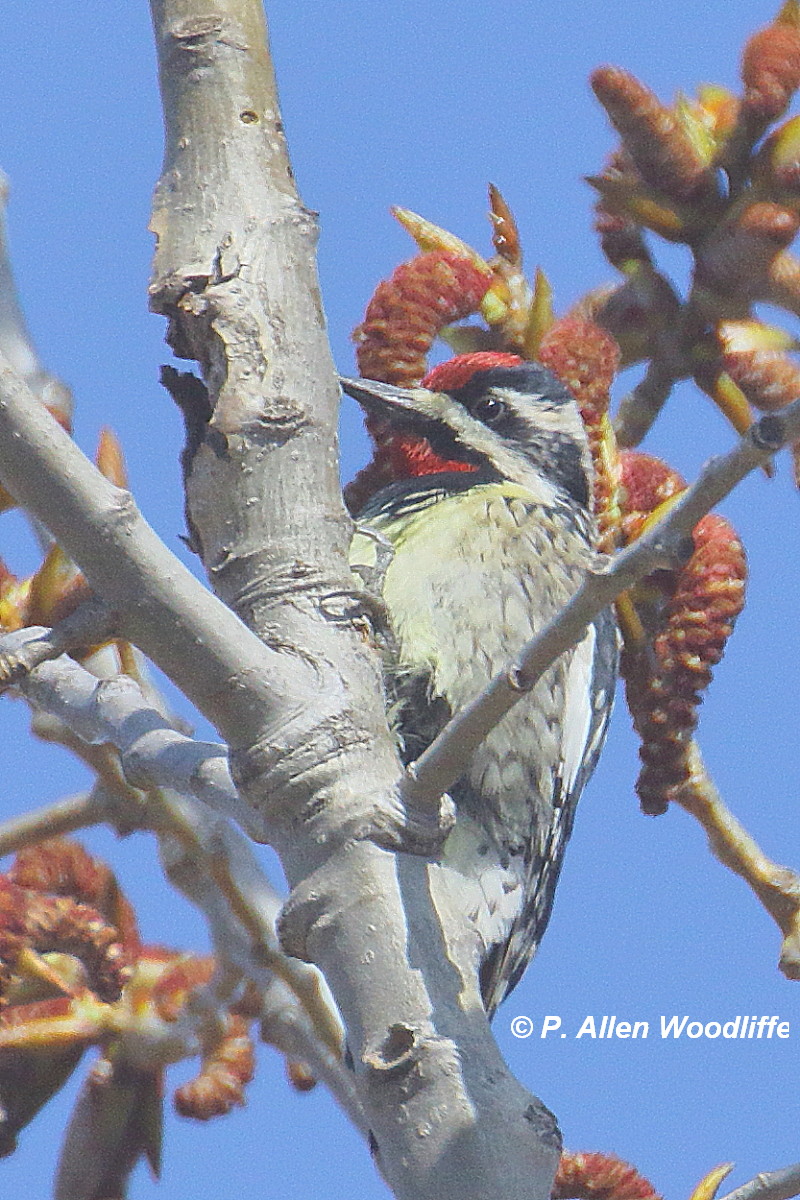
Yellow-bellied Sapsuckers are scattered far and wide in the park, but not always conducive for a good photograph.
Along one of the trails, this Northern Ribbon Snake was slithering by. It is a Species At Risk, and prefers swampy forest habitat, of which there is plenty at Rondeau. I am more likely to see them swimming on the water of a slough rather than through the leaves.
It looks a lot like an Eastern Garter Snake, but has more vivid black and yellow stripes, as well as a rusty brown stripe along the edge of the belly scales. Also it has a white dot right in front of the eye.
Wildflowers continue, such as Bloodroot.....
....and Spicebush, a shrub that is dominant especially in the damper areas of the park. In other words, it is almost everywhere!

This is a great time of year to explore Sinclair's Bush, about half way between Rondeau and Blenheim. Spring wildflowers are fairly diverse and abundant, but certainly are not at their peak quite yet. 

Early Blue Cohosh is one of the earliest, and is out nicely right now.

Yellow Trout Lily is abundant. Their mottled leaves are everywhere, although only a small percentage of plants actually put up a flower.
The petals open up, and curl back, on bright sunny days, but on cloudy days, will almost close right up.
A much less conspicuous wild flower is Wild Ginger. Usually you just see the green leaves poking up through the dead leaves of last year......
....but if you pull away some of those dead leaves, you will see this flower that rests on the ground. It doesn't need to be seen by the flying pollinators that most plants attract, as this species is pollinated by beetles and ants, that spend most of their time at ground level.
Always a pleasant sight to see is Dutchman's Breeches.

Closer to home is the Thamesgrove Conservation area, along the Thames River at the east side of Chatham. The birds were not unusual, but I kept an eye open for flowering plants. I found Common Hackberry, a Carolinian tree species that is abundant along the river.

Several patches of Lesser Celandine, a type of buttercup that is a garden escape but still quite attractive, were here and there.

One of the highlights is to see the White Trout Lily in flower, a close relative to the Yellow one featured above. The white version is relatively uncommon in Chatham-Kent.

In other news, I got a new camera body to add to my equipment. It is the Canon EOS R6, a mirrorless full frame camera, which will also crop to 1.6X. With an adapter, I can use all of my existing lenses. It is a bit different than the two cameras I have had for several years, a Canon 5D3 and 7D2, and will require a bit of experimenting and adjustment to get comfortable with the new layout, features, etc. But so far it has been a relatively smooth adjustment. I haven't ventured into the more challenging photo situations that I do regularly with my other bodies, but have played around with it at home. Here are a few shots I've taken right from the kitchen window.


I'm looking forward to putting it through some more rigorous photography to see what it is really capable of. One of the things I am looking forward to trying out is low level photography. This camera has a tilt screen, so instead of lying on the ground, I can remain somewhat upright and tilt the screen to see the subject and get the right composition. As I become less and less able to kneel at a low level and get back up quickly and easily (a condition that many seniors eventually have to deal with :-), it will make low level photography less problematic, I hope.


Sunday, 5 April 2020

Spring sightings away from the traditional hotspots

As the travel restrictions get tighter and tighter, exploring natural areas has diminished considerably. However before the latest restrictions, I did manage to get out to a few local places where there was no one else around to speak of. And it was nice to get a little more evidence of spring happening 'out there' rather than being limited to the back yard.

A drive out through parts of the former Dover Twp enabled me to see this occupied Bald Eagle's nest across the field from St. Clair NWA. The NWA is closed, so other than peeking over the berm along the road on the south side of the NWA, there wasn't much to see other than the usual mix of waterfowl.
A Snowy Owl was lingering along Mallard Line a few days ago. A more recent trip in the area did not turn up any Snowies, so presumably the few that were around all winter have moved northward. Of course there has been a fair bit of farming activity in the area where they were most often observed this winter, so that may have caused them to move elsewhere.
A walk along the edge of Lake St. Clair brought this quite distant Great Egret into view.


Painted Turtles were out by the dozens, basking in the sunshine. I looked for other turtle species, but it seemed that only Painteds were to be seen.
There were oodles of boaters out on Lake St. Clair, and most were fishing, as were quite a few people on the banks. I didn't see anyone actually catching anything, but I did see this Pumpkinseed floating by. It was still alive, and eventually wriggled out of view. It was a fair size for the species, so I don't know if it just was able to escape the hook it was trying to get the bait off of, or whether it was tossed back in the water since it wasn't the target species of the particular fisherman. Maybe it will survive, or maybe it will end up as a meal for something like a Snapping Turtle.
I managed to see several Tree Swallows and my first of year Bank Swallow along the trail, but didn't get any photos.

In a local woodlot, I caught up to some Mourning Cloak butterflies.....
 ...several Northern Flickers.....
 ....and Bloodroot, one of my favourite early spring wildflowers.
Another early spring wildflower is this Spring Beauty.....
 ....which had a type of Lady Bird Beetle was busily exploring it.
I came across a single Common Hackberry, a Carolinian tree species with very characteristic bark that is largely restricted to extreme southwestern Ontario. I hadn't recalled seeing this species in this woodlot in the past.
While checking out Paxton's Bush for any more Great Horned Owl activity, Marie and I came across an Eastern Garter Snake....

 ....and this Groundhog which quickly scampered back into the forest once it caught sight of us.
 ...as well as the local Mallards. While Mallards are very common and it is easy to not pay a lot of attention to them, they really are quite an attractive duck especially at this time of year.

We didn't see any owl activity on this warm day, so we assume that the adult decided to take a break from looking after the young in the nest since they are growing fairly quickly and don't need constant attention.

I was at another woodlot in eastern Chatham-Kent for awhile one day, and came across a spring wildflower called Skunk Cabbage.


There were several Yellow-rumped Warblers checking out some Staghorn Sumac berries. While Yellow-rumps occasionally over winter, the 5 I saw here were the most I had seen at one time since last fall. I'm sure they were here all winter anyway, given the large number of sumacs that still had lots of berries for easy pickings.
It won't be long until a lot more diversity of warblers will be showing up. In fact a Pine Warbler, one of the first warbler migrants to arrive, was reported in the area just a few days ago, and a Louisiana Waterthrush was reported from Rondeau several weeks ago. The unfortunate thing, at least for birders, is that the migrants will have hot spots like Rondeau and Point Pelee all to themselves this spring it seems, given the current closure of these and other parks, NWAs etc.


Saturday, 16 November 2019

Autumn reflections

I had planned on posting this a few days ago, but during some recent outings, the birds took priority, especially due to the presence of lingering shorebirds. So I will take the opportunity in this post, to highlight some of the reasons autumn is one of my favourite times of year.

Some folks have told me recently that autumn is not very interesting to them. The forests have lost their greenery and flowers are long gone. Reptiles and amphibians are quickly disappearing, going into their cold weather senescence underground. Birds are fewer and certainly quieter. Even people are not out and about as much, making the trails quiet.

In one sense, these are the exact reasons I look forward to autumn (aside from the fact that October is the month Marie and I were married 43 years ago :-).

Instead of the constant change of wildflowers, various shades of the green growth, and the natural areas being full of action that is sometimes hard to keep up with in spring and summer, autumn can be a time of reflection. We all need quieter times, not the continued busyness that dominates our lives. Certainly the colours change quickly from green to shades of gold, yellow or red before turning brown and then disappearing altogether. And then the colours are even more muted, with varying shades of gray dominating until the white stuff appears.

I had been up to the Sydenham River Nature Reserve not that long ago. It is a relatively recent acquisition by Ontario Nature and is located on the border of Lambton and Middlesex counties. It is a deciduous forest in a largely agricultural landscape, with both the Sydenham River and an unnamed creek going through it. I didn't get to a lot of it, as the boundaries are not well marked, and it is surrounded by private property with numerous No Trespassing/No Hunting signs, so I didn't venture too far this time.  The stream in the following photos is just of the unnamed creek, not the Sydenham.

There are some nice specimens of Common Hackberry here, certainly a Carolinian species that is not all that common even in the Carolinian Forest Zone of Ontario.


Closer to home, I have gone hiking at Rondeau on several occasions. The lake has been riled up from time to time, providing some good photographic moments along the lakeshore. There have also been some serious erosion problems, but at least at the park's south point, there aren't any human habitations under threat.

On occasion, the lake can be quite placid.
The grasses dominating the sand dunes have turned a golden brown. Little Bluestem is one of the most common grasses, and their backlit stems show the fluffy seeds.
On one of my hikes, I was on the lookout for evidence of a somewhat rare orchid. Orchids at this time of year, you ask? Well yes, at least in the case of Puttyroot (Aplectrum hyemale). Its leaves are most visible from November to April, if there isn't any snow on the ground. When it puts up its flowering stem in late May and early June, the single basal leaf has dried up and disappeared. This first image shows a very fresh leaf.
 Here, about a dozen leaves have emerged through some recently fallen maple leaves.
 Only a small percentage of plants will flower in a given year, typically around 10%. Here is a dried up stem with a few capsules.
 One one of my hikes, I came across an unusual sight. The green plant is Maidenhair Fern, a fairly delicate fern species. Most of them by the time of year I took this (Nov 7)  are quite brown and dried up. I guess due to the southern location in the park, and the lake effect which minimized any killing frost, this cluster was still green. It looked quite out of the ordinary to be so green, but with a bit of fresh snow on it.
Due to the temperature of the lake being warmer than the more quickly declining inland temperatures, this 'lake effect', results in the leaves being slower to change from green to gold to brown to gone. Even the south end of the park is delayed compared to the north end. Regardless, the changes throughout the park are fairly rapid in just a few weeks time. This next series of photos were taken along Bennett Avenue.
October 23
October 27
November 7
November 14!
For what it is worth, winter isn't officially here for another 5 weeks!