The bird migration has slowed to a crawl now but soon, the autumn migration will begin! Shorebirds that had nest failures in the arctic or sub-arctic may be back on their southward migration. Fortunately there are lots of other things to spend time looking for.
At Rondeau, I've wandered around looking for plants, some of which are extremely rare. Puttyroot, shown first, is not officially a Species At Risk, but it has been considered in that context in recent years.
Ash trees have taken a major hit in the last couple of decades, due to the Emerald Ash Borer, and while there is lots of regeneration of the species in various natural areas, Black Ash is now considered a Species At Risk. It grows in wet spots, usually in standing water. One of the key ways to separate it from other ash species is to look at the underside of the leaves. At the base, it is obviously hairy/pubescent.
Chicken-of-the-woods is a colourful fungus that can be seen from spring to fall. This is a small part of a large outcropping of this fungus that I saw on a large fallen log, along the Tuliptree Trail.
A short distance away, I encountered an Eastern Tiger Swallowtail having a snack.
Unfortunately this next item is not rare. It is Beech Leaf Disease, and is quite evident on the many American Beech trees at Rondeau as well as many other natural areas in southwestern Ontario. The future of this beech tree does not look good, as the disease can kill trees.
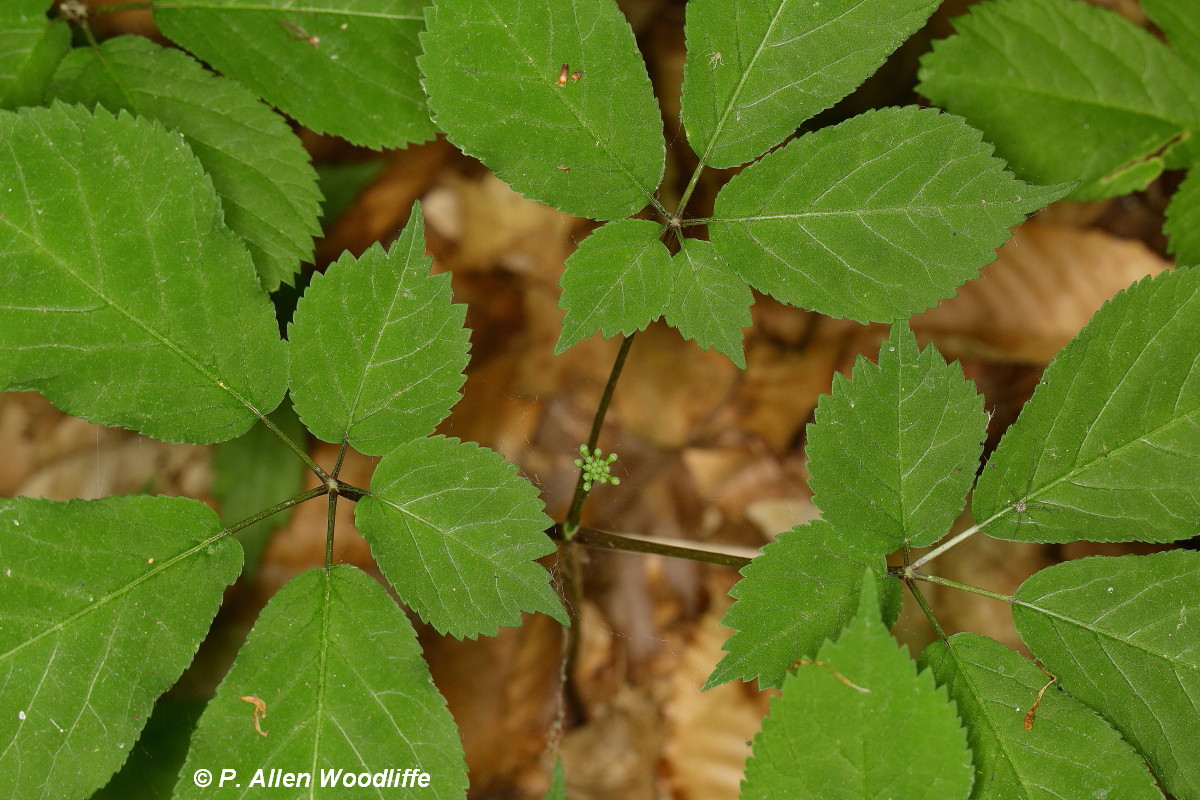
A quite rare plant species is this next one: American Ginseng. There are a couple of places where I have seen it, but due to its popularity for supposed medicinal purposes, it gets picked a lot. It will likely be in flower any time now.

This is what the developing flowers look like, at great magnification.
A species that is a general look-alike to the previously featured one, is this next one, known as Wild Sarsaparilla. It is widespread.
June is the month when Tuliptrees are in flower, and the flowers are impressive to say the least. It is an unofficial flagship species for the Carolinian Zone.
Fungi are more often seen in the damp, humid conditions later in the season, but some can be found when the right conditions occur even quite a bit earlier. This one is called the Eastern American Platterful Mushroom.
On sunny days, one might come across another Species At Risk, known as the Eastern Five-lined Skink, which is Ontario's only lizard.
And even during the day, one might encounter moths. This one is a Morbid Owlet....
...and this one is Three-spotted Fillip. I've been out to Rondeau with my black lights a couple of times so far, and will be featuring some of the moths that have visited my set-up one of these days.
On occasion you might encounter a black mass clinging to an American Beech branch. It is Black Sooty Mold, and forms as a result of a gathering of Wooly Beech Aphids, sometimes known as Boogie-woogie aphids due to their 'dance' when they feel threatened. They sip on the liquids in the branches and leaves, and secrete a large amount of liquid onto the branches, which then supports this mold.
As shown above, butterflies are out and about and once in awhile I will photograph some cooperative ones. This is a Hobomok Skipper, nectaring on a type of fleabane.
I spent a bit of time at McKerrall Woods, a municipally owned woodlot located a few kilometres northeast of Chatham, looking for bird action that could be contributed to the ongoing Breeding Bird Atlas. It is a woodlot that seldom gets visited by anyone else. At the small parking lot, there was lots of clover which attracted a rare butterfly, the Giant Swallowtail.
It clearly had had a rough time of it at some point, based on the damaged part of its hind wing. It didn't seem to hinder the flight of the butterfly, however.
Between the parking lot and the woodlot, one walks past a good-sized hayfield. There were lots of grassland birds....
Bobolink were fairly common, with at least 15 or more in the area, the males doing their courtship flight and chasing off competitors....
...while females took note in between carrying out their parental duties, carrying food to some nestlings.
Savannah Sparrows were even more abundant, shown below, but hard to photograph. I was hoping for a Dickcissel, but none were seen or heard.
Looking across the hayfield, I noticed this critter walking through, but at a distance.
Then it would leap and bound to make better progress passing through the tall vegetation.
There are no trails in this woodlot....
...but a few places that are not covered with vegetation.
That makes wandering through this woodlot a bit of a challenge, as there is lots of woody material under the dense growth ready to trip you up. A good walking stick is handy to have.
There is very little in flower now, as the leaves of the canopy have shaded the ground, and all the spring wildflowers have gone into seed production mode. This next photo is of a sedge, known as Gray's Sedge, not a common species but fairly widespread.
I did record a few bird species for the atlas, but due to the heavy canopy, did not get any photos to share.
I also have been at Clear Creek Forest Provincial Park in eastern Chatham-Kent. It is always a worthwhile place to visit, although the forest birds are hard to photograph. The wetland areas are more productive, photographically speaking.
A Turkey Vulture was resting on a broken stub above the wetland. The light was fairly harsh, against the mottled background. After preening for a few minutes, it flew off and joined some others.
Dragonflies are fairly plentiful in the various wetlands pockets here. This first one is a Dot-tailed Whiteface, aptly named due to the white dot on the tail, and the white face. This branch is a popular place for it to rest, as shown by the exuviae of other dragonflies using this stick from which to crawl out of an earlier stage of development before taking flight.
Next is a Calico Pennant with its quite distinctive colour and markings.
Blue Dashers were probably the most common dragonfly species that I saw. Some were just sitting...
...and presumably on the lookout for a mate with which to reproduce with. This next photo shows a pair of them 'in wheel', and preparing for the next step of reproduction.
A short time later, the female hovered over the water for a few seconds.....
...and then would regularly lower the tip of her abdomen to the water surface, depositing an egg onto a bit of vegetation. In a few days, the eggs will hatch, and the very young dragonflies will emerge and spend the first part of their lives underwater, before escaping the confines of their exuviae at the larval stage, as shown on the lower part of the Dot-tailed Whiteface dragonfly above. At that point, they will carry on with their life's adventures.
Stay tuned for more atlassing adventures, as well as some black lighting highlights!
If you wish to subscribe, or unsubscribe to Nature Nuggets, send an email to: prairietramper@gmail.com