Showing posts with label Turkey Vulture. Show all posts

Saturday, 23 March 2024

Nesting season begins, as do some spring wildflowers

 Nesting season is upon us. Of course Bald Eagles and Great Horned Owls usually are at some beginning stage of their nesting season by mid-March or even late February. I have seen eagles on their nests, presumably incubating, in at least three different sites over the last several weeks. However perhaps the biggest surprise this year is the arrival and the nest-building of a species that has never nested in Chatham-Kent that we know of, and in fact has seldom even been seen here. It is the Black-billed Magpie, as shown in the header photo and what follows.

This pair was noted almost two weeks ago, at a residence just north of Shrewsbury. I have no idea how long one or the other had been in C-K, although there was one seen and photographed a bit earlier at the NE corner of Rondeau Bay. But for some reason, this pair came along and decided a residence near the corner of Fargo Road and Bisnett Line was the place for them. They normally live in and nest in open areas, and this site met those conditions.

Normally the magpies are a mid to far western species in Canada, although a small number occur in northwestern Ontario, specifically in the Rainy River/Lake-of-the Woods area. There was one or more birds seen in Elgin and Middlesex Co last year. But here they are.


On the occasion when I saw them, they were out in the field opposite the residence, either foraging for food or looking for nesting material. There have been many folks stopping by and watching them, and some have seen the birds carrying nesting material to the upper part of a tall spruce tree. Of course this nesting activity will be closely monitored over the next several weeks to see what happens, so stay tuned. It is definitely an interesting addition to the current Ontario Breeding Bird Atlas, now entering its 4th year.

On one of the warmer and sunnier days in the last week or so, I went to Rondeau doing one of my normal things, just to meander around to see what I could find. There hadn't been a lot of new bird arrivals, but Turkey Vultures are becoming more and more visible. As is sometimes the case, several decades ago it was rather unusual to see a Turkey Vulture in C-K, but nowadays, it is a common occurrence. Even this early in the season there are a few floating around.

Killdeer are getting paired up, and hanging around a likely nesting location.
On one of the sunnier, but not necessarily the warmest of days, Wood Frogs could be heard in some of the larger and more open sloughs. Wood Frogs are about the earliest amphibian to be heard.
On one occasion as I was walking the east South Point Trail, I came across this view. At the big S bend, where the former camp office was located in the 1960s and 1970s, the former road came close to the shoreline of the lake. With the regular east and southeast winds, the erosion has continued to the point where the road, and more recently not much more than a hiking/biking trail, is almost gone right here.
looking west

same vantage point, looking north
The concrete vault that is the remains of the washroom which was part of the camp office, has been seen close to the shoreline for several years. Now, as shown in the photo above, it is well away from the shoreline.

As shorelines of sandspits such as Rondeau regularly undergo changes, it is hard to say what to expect at this point in the near future.

On another occasion I went out to Clear Creek Forest Prov Park in eastern C-K. I was looking in part, for lichens (more on that in a future post), but also wanted to see if any spring wildflowers were showing. It was a bit early, I knew, but with the weather being what is has been, and that the park is a little more inland than Rondeau which results in the earlier showing of plants, I thought it was worth checking out. I saw a few things like Cut-leaved Toothwort and Yellow Trout-lily showing some development, but none in flower. However a really early spring wildflower was well along: it is the Eastern Skunk Cabbage.

When it first appears, even sometimes through the layer of snow, it will show the dark 'spathe' which is where one will find the developing flowers. Older spathes are quite dark in appearance, but younger ones apparently have more of a greenish tinge. The ones I saw were mostly older ones.


Flower developing inside the spathe
Unlike most wildflowers, the relatively large and vividly green leaves develop well after the flowering parts of the plant, and at this point are quite visible even from a little distance. The next two photos were taken in a previous year, as they are not anywhere close to this stage yet.
The leaves are quite a bit taller than the spathe, shown next.

If you would like to subscribe, or unsubscribe, to Nature Nuggets, send an email to: prairietramper@gmail.com


Thursday, 21 September 2023

Brilliant blue skies and raptor photography

 Migrating raptors have been on the move a lot recently. The two hawk watches in extreme SW Ontario and SE Michigan have documented thousands of raptors, especially Broad-winged Hawks, but sometimes ten different species over the course of a day. Mid to late September is definitely the peak time for the Broad-wings. However seeing them, and photographing them, certainly have their own challenges.

Many raptors, especially the broad wing types, also known as Buteos which is the genus of their scientific name, use the uplift of air thermals from the effects of bright sunshine on the ground, to carry them upward, When the effect of the uplift falls off, the raptors then stream off in the direction they intend to migrate to catch the next thermal uplift to form the next kettle of soaring hawks. It really is quite amazing, but means that weather is a significant factor influencing their migration. On sunny, warmish days with winds from a generally northerly direction, the migration along the lake shoreline can be quite spectacular. They seldom fly over the lake, as there are no thermals created by the sun reflecting off the water, so they follow the shoreline and leave Ontario, via crossing the Detroit River, to continue on their southward migration all the way to Central or South America.

The challenge can be, in a bright blue sky, and if the hawks happen to be at the top of their kettle, they can be impossible to see without good optics. So to help to find a kettle, a hawk watcher will explore some of the white clouds while using binoculars as a dark raptor stands out better. But that makes it challenging for photography, as a dark hawk against a bright white cloud, is not the kind of lighting photographers like.

I have been out on several occasions trying to see and photograph migrating raptors. Success has been variable, but on one recent occasion, things worked out fairly well. It was on a morning when there was lots of blue sky of late summer, and only a few white clouds. At first I was not seeing much of anything, but when I started to explore the sky through my binoculars, I could see hawks on the move. This first photo shows a distant group of Broad-winged Hawks, flying almost directly overhead, but without binoculars, I couldn't see them at all. I managed to find them in my telephoto lens, and this first shot is taken at about the equivalent of a 22X binocular. The birds are not all that big, are they (the large on on the lower right is a Turkey Vulture, while the rest are all Broad-wings).

I took several photos, and cropped some to show them in a little more detail, as the next photos illustrate. These are shown at an equivalent of about 75X.

One kettle of Broad-wings I estimated to be around 400 birds,and there were several smaller kettles. In less than a couple of hours, I concluded there were at least 800 Broad-wings which had gone over. According to the hawk watch sites a little farther to the west, there were probably 10,000 or more of this species pass by over the course of that same day.

There were other broad-winged types of hawks go by, especially a few Red-tailed Hawks.


 Other species went through as well, albeit in much smaller numbers. The accipiters and falcons generally did not soar quite as high, and were fairly quick to show up and flew directly southwest, so it was hard to get the camera and focus on them very successfully. A few American Kestrels came by....


....as did some Sharp-shinned Hawks.
Northern Harriers came by in very small numbers, and I didn't get any photos of them. They were usually too far to attempt. Turkey Vultures, were steadily in sight but not always very close by.

All in all, it was quite a successful time, and I am sure there were many hawks that I missed since I was on my own, and putting most of my effort into photographing them. At the hawk watch locations mentioned earlier, there are usually several watchers whose main purpose is to record everything in sight, and some days the records are in the tens of thousands overall.

On other occasions I went to places like the Erieau Marsh Trail. There wasn't a lot to photograph or even see during the time I was there, but I did get a few photos. Small groups of Wood Ducks are here and there. They are normally skittish when people are around, but I got these photos through some small gaps in the shrubbery surrounding the ponded area they were feeding in.


An adult Bald Eagle flew quickly overhead, and this shows what photographing a black and white bird against a white cloud can end up looking like even after a lot of processing.

A quick stop at the local sewage lagoons turned up a few species of shorebirds including a somewhat uncommon White-rumped Sandpiper, but I only got photos of the much more common Lesser Yellowlegs....

...and Pectoral Sandpiper.

If you would like to subscribe, or unsubscribe, to Nature Nuggets, send an email to: prairietramper@gmail.com


Saturday, 19 March 2022

Birds of Chatham-Kent, then and now, Part II

 The next group of a dozen or so species of birds with which to compare their status 3/4 of a century or more ago, continues.

Turkey Vulture


Then: Wood describes it as a common summer resident, with an occasional nest being found, and the species being more common in the eastern part of the county. 

Now: I hesitated to include this species in this series, mainly because it is currently a common summer resident although in my opinion, there have been some changes over the decades. The amount of forest cover a century ago was considerably more than there is now, although I don't have any hard facts to back that up. Currently there is less than 4%, and considering how farming has changed to bigger and bigger fields, some of it owned and operated by corporations with large holdings and requiring bigger and bigger equipment, I feel quite confident in stating that woodland is now the lowest than it has ever been. So a century ago, there would have been more woodland, and thicker hedgerows scattered across the municipality. By the 1970s or thereabouts, seeing Turkey Vultures was a much rarer event than today. I expect it was partly due to habitat loss.

In the last 2-3 decades, however, seeing Turkey Vultures during the breeding season has increased, but not because of increased habitat in Chatham-Kent. The population has gradually expanded northwards, as some bird species tend to do. And that was reflected in the results of some of the hawk watches in southwestern Ontario and adjacent Michigan. At the end of 2018, more than 60,000 Turkey Vultures were counted during the September through November period, as they traveled within sight of the Essex/Michigan hawk watch towers. In 2020 there were more than 72,000 vultures counted, and the long-term average of over 51,000 birds. Some days were quite spectacular, with scenes like this next photo, not all that uncommon.
As for nesting birds, actual nests are not easy to find. However comparing the two Breeding Bird Atlases, they were found with some breeding evidence in more squares during the second atlas than the first. And just to illustrate that they don't always require a good quality habitat, this next photo show one that I photographed in 1993 in the former Raleigh Twp, one of the least forested areas of C-K. It was in a hedgerow that had a bit of junk placed on it, including an old bed spring, which the nest was under!

Cooper's Hawk 

 Then: A common spring and fall transient, but rarely breeds and is occasionally seen in winter.

Now: still common in spring and fall, but is a regular breeding species. It is typically more common in winter than its smaller relative, the Sharp-shinned Hawk, which Wood thought was more common in winter than Cooper's. The second OBBA found it to be much more common than in the first OBBA. While it is not 'fair' to compare the habitat at Rondeau to the rest of CK, there are typically several pairs that nest there annually. Some are in tall coniferous trees, such as this White Pine. Several of us watched the courtship, copulation and nest building of this pair. But more often the nests are found in the hardwoods, which dominate the woodland habitat at Rondeau.

Golden Eagle


 Then: considered an accidental visitant.

Now: a fair assessment would consider it an uncommon but regular autumn migrant. For example the Detroit River Hawkwatch has a long-term average (beginning in 1983) of 94 birds per year during the September-November count period. 

Bald Eagle


Then: considered a permanent resident, nesting not far from lake shores. Others of the day back then considered it to be rather rare.

Now: certainly times have changed dramatically. While it was a rare, permanent resident in the early part of last century, by the 1970s it was even rarer. In fact in 1969, there was only one known active nesting pair between Long Point and the mouth of the Detroit River, and that was a pair at Rondeau. Even there it had limited nesting success, as although they actively attempted to nest, there were as many years with no success as there was with raising a single eaglet. As the use of certain agricultural chemicals such as DDT was eventually greatly reduced, the numbers of eagles and their nesting success improved. Currently I am aware of at least 26 nesting pairs in CK alone, and I suspect there are a few more in areas where there is limited access to for surveying. So that is a huge change for the better!

Northern Harrier

Then: considered a common summer resident, with a few remaining through the winter. It was noted as breeding sparingly at the St. Clair Flats.

Now: certainly not a common summer resident, but with the persistence of some of the larger wetlands adjacent to Lake St. Clair, it is periodically seen in summer. With some wetland and other open habitats increasing slightly over the past few decades, there was an increased number seen with breeding evidence throughout CK in the second OBBA compared to the first.

American Kestrel

Formerly known as American Sparrow Hawk

Then: formerly considered a common summer resident, but by the 1940s, there were very few nesting in CK, and only an occasional one seen in winter.

Now: A species which has had its ups and downs. It is more of an open habitat nesting species, and with the loss of trees like Elms due to Dutch Elm Disease, there were numerous dead trees in tree and property lines across CK. By the middle to latter part of last century, there was more habitat (dead trees) and a slight up-tick in the abundance of this species. Indeed the records with breeding evidence between the first and second OBBA did not change much, at least in terms of the number of atlas squares reporting breeding evidence. However as those dead trees fell down, and as farm fields were expanded to accommodate a significant increase in the size of farming equipment, habitat in the form of tree lines between farm properties was lost. Currently the abundance of this species across CK is much less than it was even 2-3 decades ago, even in winter. The Blenheim/Rondeau CBC supports this, as the average for the last 20 years is about 11 birds per count, whereas the average for the previous 20 years was about 27 birds per count.

Spruce Grouse

Then: considered a former resident! A specimen was taken near Chatham in the late 1870s!

Now: none have ever been reported since, to my knowledge. CK is way out of its normal range, so this record is likely to be an escaped bird from someone's collection, or possibly mis-identified. It is a conifer specialist, especially Spruce, as its name implies. The closest record for either of the two OBBA was several hundred kilometres away in the Muskokas.

Ruffed Grouse

Then: Ruffed Grouse was considered to be a formerly abundant, permanent resident but now (in the 1940s) probably vanished from the county.

Now: there are probably a few reasons for its decline even back then. Certainly the loss of forested habitat was happening. Also, a likely ever increasing population of Eastern Coyotes, which adapted well to the wider open spaced due to decline in forest, would have been a factor. Also there had been a hunting season, and this game bird was sought out.

That being said, there was likely enough forest habitat scattered here and there to maintain a small population.  And since the species is known for an erratic fall flight, it can disperse from more established populations. There has been the occasional record in southern CK over the last decade or so. This next photo shows a nest I came across in a woodlot in central CK back in the late 1970s. That forest was mostly cleared by the mid 1980s, unfortunately. 

(Greater) Prairie Chicken

Lesser Prairie Chicken

Then: Formerly a common resident, locally. Possibly there are still a few left on St. Anne's Island (technically Walpole Island First Nation, Lambton Co.). They were known from the Raleigh Plains, an extensive stretch of low, marshy prairie along the south side of the Thames River, where as many as 75-100 chickens were reported. They were also known from the greater Mitchell's Bay area in the later 1800s and were hunted by at least a few local hunters who prized their meat. At this time, it was just known as Prairie Chicken, but in recent decades it has been separated to Greater and Lesser Prairie Chicken.

Now: this species has been gone from southwestern Ontario for many decades. While the species is generally considered a mid-western prairie species, there used to be what was known as the 'prairie peninsula' extending into southwestern Ontario. Early surveyors and botanists described the prairie vegetation in the tri-county area of Essex, Kent and Lambton. With the exception of parts of Walpole Island (Lambton) and northwestern Essex and much tinier remnants in CK, the tall grass prairies are long gone. I have seen Greater Prairie Chicken in several places in the mid-west, especially parts of Missouri, but never gotten a photo of one. The photo of the Lesser Prairie Chicken shown above, is a much more restricted species than the Greater. I got access to a blind that overlooked a lek on the Cimarron National Grassland in extreme southwestern Kansas back in 2012. 

Gray Partridge

Then: a species introduced in about 1914, and lasted a few years but were apparently gone by the late 1920s.

Now: gone

(Northern) Bob-white


Then: the population was known to fluctuate widely, from being quite plentiful to being almost to the point of extirpation.

Now: the native population is gone, as a result of habitat loss, severe winter weather three years in a row in the mid to late 1970s, and the increasing presence of Eastern Coyote. There have been efforts to re-introduce a few individuals by well-meaning persons. However most of these birds have been pen-raised and are not fit to survive in the wild. This is especially problematic when all meaningful habitat is long gone. The first photo above is one taken in June, 2009, in Missouri, in a natural habitat. The second photo was taken in 2021, in CK, of a released bird, at the edge of a village and farm land.

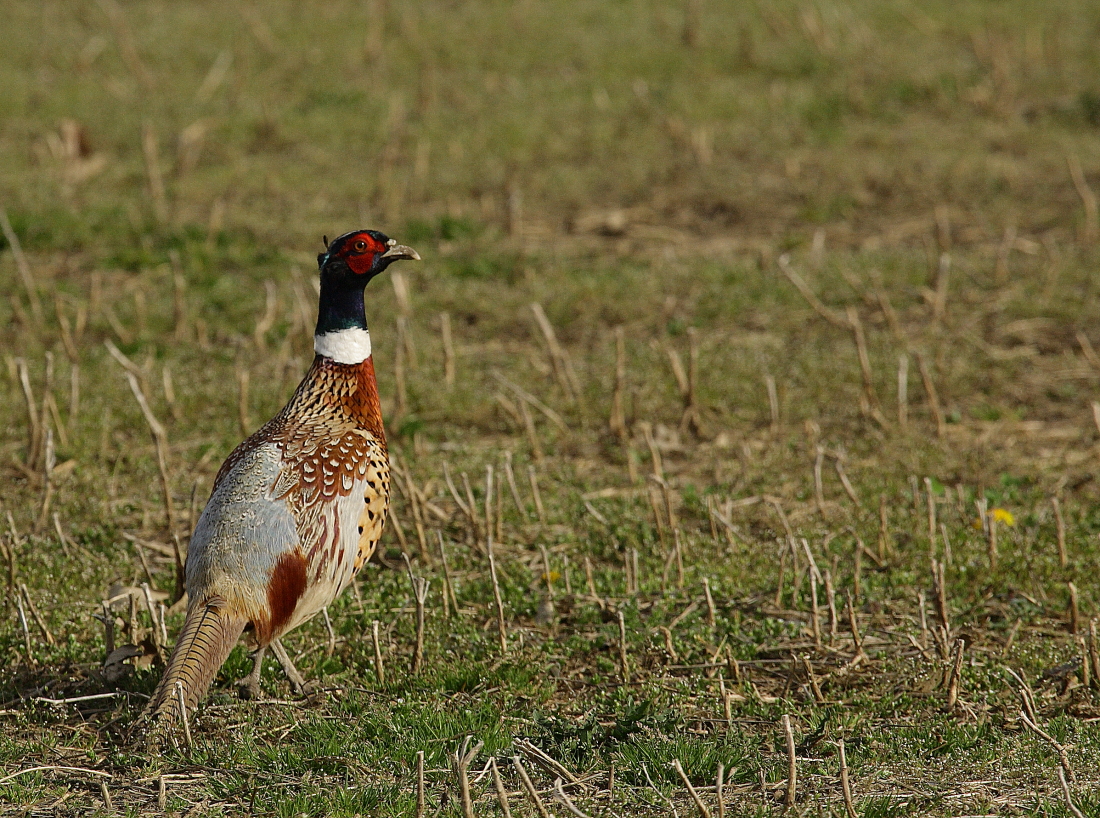
(Common) Ring-necked Pheasant

Then: another introduced species, brought in by the Ontario Department of Game and Fisheries. They became well established. For most of a decade beginning in 1939, there were small groups of pheasants scattered throughout the county. By 1946, they were much fewer.

Now: it is a species which has continued its downward trend. Between about 1981-2000, they were seen regularly on the St. Clair NWA Christmas Bird Count, with sometimes between 20-45 reported. In the last couple of decades we are lucky to get one or two, with none seen in the last 5 years. I don't think hunting pressure has been a factor, but the increase in the Eastern Coyote population undoubtedly has.

Wild Turkey

Then: Formerly a permanent resident in the heavily forested areas, but at the time of Wood's writing in the later 1940s, they had vanished from the county. They were considered plentiful in Rondeau in 1768, and in 1796 they were reported as in great numbers in the Fairfield area. In 1833, they were seen in considerable numbers in Raleigh and Tilbury townships. The numbers fluctuated over the years until the early 1900s when they were very restricted. In 1920, a few birds from more southern parts of their range were introduced in Rondeau where they were known to be present for a few years.

Now: for most of the 1900s, Wild Turkeys were almost non-existent in CK. A southern Ontario wide re-introduction program was undertaken beginning in 1984, and in spite of their usual preference for heavily forested areas, began to do quite well even in such unforested habitat in CK. In examining data from the Blenheim/Rondeau CBC, they were virtually non-existent from 1939-2003, but beginning in 2004 until the present, there is typically anywhere from several dozen to almost 350 birds tallied for that count. In comparing data from the first two OBBAs, the species was virtually unaccounted for in the first atlas (1981-1985) but found in almost every atlas square during the second atlas (2001-2005).

Sandhill Crane


Then: formerly a rare transient, occasionally remaining to breed in places such as the St. Clair Flats in the late 1800s; by the 1940s, it was an accidental transient.

Now: this species has been more successful in recent decades. While in the 1970s and 1980s, it was quite rare to see one other than on migration, beginning in the 1990s, they were a bit more plentiful during spring migration and a few have remained to breed. Larger wetlands such as those along Lake St. Clair as well as at Rondeau seem to be the most likely breeding areas, and numbers on migration have risen substantially. There was a moderate increase between the first two OBBAs, largely restricted to those larger wetland areas. Clearly there has been greater nesting success in places farther north, as up until the early 2000s, it was a species hardly recorded during the CBCs, but for the Blenheim/Rondeau CBC, they have been seen annually beginning in 2009, with more than 100 individuals recorded on two occasions during that time.


Part III of this series will continue in a future post. Stay tuned.


If you want to subscribe, or unsubscribe, to Nature Nuggets, send an email to prairietramper@gmail.com


Saturday, 23 October 2021

More fungi and bird migration highlights

 There have been some recent good winds from time to time, resulting in lots of raptor migration activity. Sometimes even close to home! On more than one occasion, Marie has drawn my attention to Turkey Vultures spiraling in good numbers visible from the front patio. 

These Turkey Vultures were circling over Paxton's Bush, which is less than a kilometre away from our house. I suspect they roosted there over night, as this was around 9 in the morning when the temperatures were getting to the level where there was some 'lift' for the birds to use. Occasionally there were hawks mixed in, usually Red-tailed, although on one occasion a few weeks ago Broad-winged Hawks were the main raptor.

Blue Jays have been showing some daily movement, and sometimes almost right overhead. I captured this photo of one flying over the driveway.

On another occasion we went out to Morpeth Cliffs, just a few kilometres east of Rondeau, which has been known as a good vantage point to observe migrating raptors when the wind is correct. Back in the day when I was working at Rondeau, I spent a few lunch hours over the course of each autumn, with my eyes to the skies looking for raptors. It is still a good spot, although doesn't get quite the same notoriety as places along the Lake Erie shoreline farther to the southwest, where any raptor movement is bound to be more concentrated as the birds search for a location where there is the least amount of water to pass over.

As usual these days, Turkey Vultures....not really a raptor in the true sense, but have similar migration habits....are the most abundant migrant.

Some pass by quite low. This photo is not really cropped; I just couldn't get the whole bird in it was so low.
Red-tailed Hawks, shown next, were regular in small numbers, and an occasional Red-shouldered Hawk, Northern Harrier, Sharp-shinned Hawk and American Kestrel, were also seen, but were not close enough for a good photo.
I had 5 Bald Eagles go by, with the occasional one close enough for a photo, albeit a cropped one. I also had a Golden Eagle pass by, but too far away for a photo.
sub-adult Bald Eagle

Another migrant species, although not an avian one, was this Monarch, sipping away at some late-flowering dandelion flowers right close by.

While at Rondeau visiting some friends, there were a few kettles of vultures noted, as well as a few small birds hunting for something near a patch of tallgrass prairie. There were at least a couple of Eastern Bluebirds, although only one stuck around long enough for a photo. As it was in a tree, there were more shadows than clear views. It was the first one of the fall for me.

I stopped at Erieau on one occasion, hoping to catch up to the Purple Sandpiper on the pier that had been reported somewhat irregularly. No success with the Purple, but I did have 38 quite cooperative Sanderlings flying by, or landing on the pier quite close by. At one point they let me walk within two metres, too close to photograph with the lens I was using. I often find Sanderling to be fairly tolerant of humans, so I wasn't overly surprised.


Later that day, I went to Keith McLean Conservation Lands, in hopes that the ibis sp. that was there earlier in the day was still around. It may have been, but I didn't see it, nor did the other birders that were there more or less at the same time. But I did have some success with other birds.

A young Long-tailed Duck was in the largest pond. It isn't the typical place, or time, one would expect to see this species here. They are much more likely a bit later in the season, and on the open water of Lake Erie.

Great Blue Herons are still regular, and likely will be until freeze-up.
I checked some productive weedy patches for sparrows, and saw lots. There were several Savannah Sparrows, shown next....
.....as well as a few Swamp Sparrows, below. It was nice for them to sit up long enough for a few decent photos. Song Sparrows were also around, but less cooperative for the camera.
There were at least a couple of Nelson's Sparrows, and this one sat out in the more or less open, which isn't always the case. KMCL has become a reliable spot for autumn migrating Nelson's Sparrows over the last few years. It wasn't that long ago that the species was really hard to find any time of the year, but with the availability of the KMCL, it has become relatively easy to find. Perhaps they were there before, when Keith McLean owned and farmed the area, but the property was not accessible. Thanks, Keith!

Marie and I have been to Rondeau at least a couple of times for various things, and we always spend a bit of time looking for fungi. 

Marie taking a break from fungi hunting

With Marie's eyes being sharper than mine, I call her my fun-girl :-). The fungi were a little less noticeable the last time or two, compared to the warm damp conditions of earlier in the month, but there are always a few. The first two are probably a member of the Gymnopilus genus.


This next one is actually part of the same Gymnopilus cluster, but clearly has been attacked by another fungus. It is a hard life out there, even for fungi!


Honey Mushroom type

Waxy Scarlet Cap type

Another of the Honey Mushroom type
This next one may be Mycena haematopus.

This next one is a type of Geastrum, a.k.a. Earthstar.


 And slugs gotta eat too! Not sure what kind of fungus this little slug is chowing down on.

This past Wednesday, the weather looked reasonably promising for some late season black lighting, so off I went to Rondeau. I figured the light southerly winds off the warmer water would keep the temperatures from falling to the point where moth action ceased. I had forgotten that on this day, it was full moon, and after I got my equipment set up, I looked over and saw the moon emerging over the lake. I took a bit of time to enjoy that spectacle, although a little cloud spoiled my first photo attempts as it was climbing the sky. I had to wait until it got a bit higher and fully visible, so it isn't quite as large and orange as it started off as.


I hadn't seen this full moon rise over the lake for quite a few years. It was a regular thing back in the day when for five and a half years, Marie and I lived in the park, with our home looking over the lake. We enjoyed the sunrise and moon rise on a frequent basis! That was 'many moons' ago, and this event brought back lots of good memories of those days. And my best friend Marie and I recently celebrated our 45th wedding anniversary!


If you want to subscribe, or unsubscribe, to Nature Nuggets, send me an email at: prairietramper@gmail.com