Showing posts with label Eastern Garter Snake. Show all posts

Tuesday, 25 November 2025

Another cattle egret, a snake, a millipede and more

 If the forecasts are accurate, we will be experiencing another blast of winter in the next few days. Fortunately I was able to get out to a few places, including Rondeau, to continue some exploring of late November and enjoy some lengthy walks. I hadn't caught up to anything out of the ordinary regarding birds.....just wasn't in the right place at the right time. But there were a few of the expected species that paused long enough for my camera.

American Goldfinches are present most of the year, but many from farther north have been migrating through in good numbers over the last week or so. 

Dark-eyed Juncos are quite common, and at least some will be around all winter.
Of course Downy Woodpeckers are present all year.
I always look forward to seeing Fox Sparrows in late autumn. This vividly patterned sparrow likely will be present in very small numbers over the winter, but are often hard to find.
Northern Cardinals are another year-round species, fortunately, especially for those with winter feeders....

...as are Red-bellied Woodpeckers. They have been busy storing some of this year's abundant acorn crop in crevices in trees, in case feeders don't meet their needs.
Wild Turkeys are permanent residents and get a little more bold in wandering around open areas in the autumn when the park is quieter, looking for acorns.
There are often a few other creatures out and about. Of course Eastern Gray Squirrels are also looking for acorns and such. I enjoy watching their acrobatics, etc. This one is suspended by its two hind feet while the two front feet are handling something it is nibbling on.

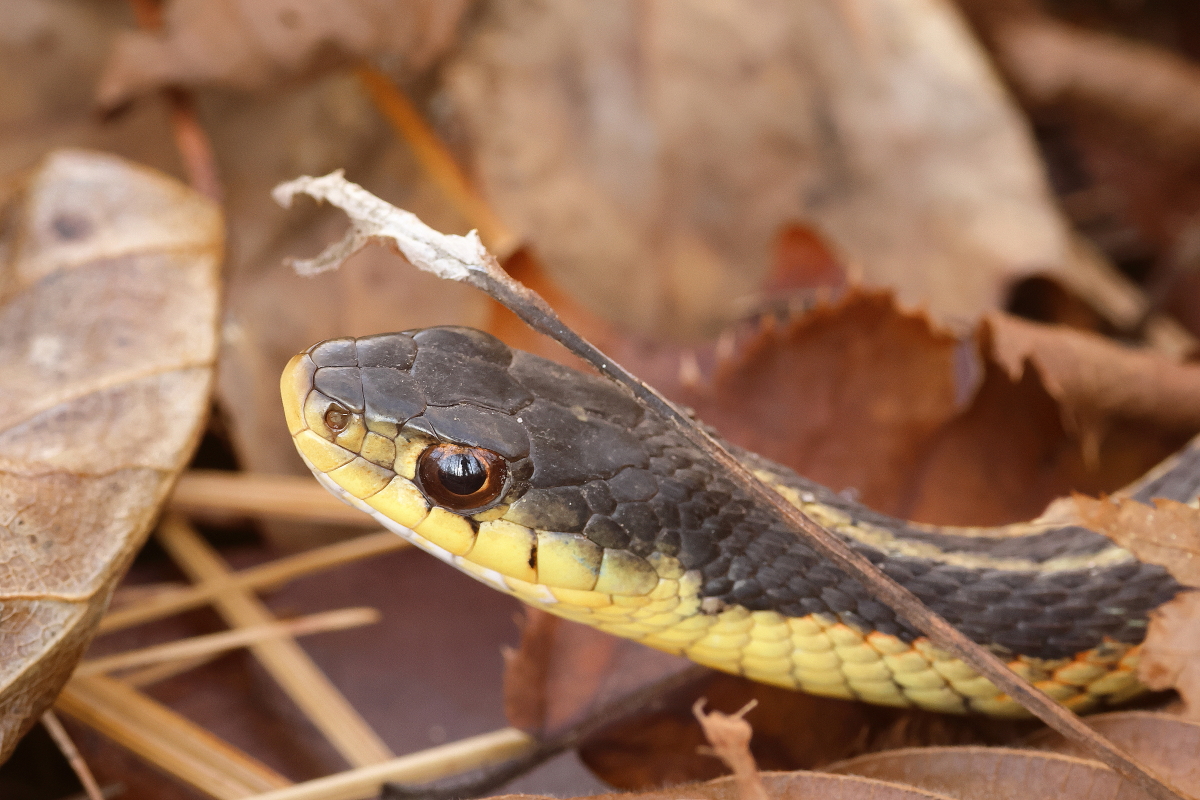
It is getting late in the season for cold-blooded creatures, but just yesterday I came across this Eastern Garter Snake sitting at an open spot along the trail.

Another cold-blooded creature is this Common Pink Flat-back, a type of millipede, roaming across Gardiner Ave.

Certainly a bird highlight of recent days is yet another Western Cattle Egret, seen by many on several occasions at the Keith McLean Conservation Lands. I have seen it on at least three different days from the road, but on one occasion I decided to park there and try and get some decent photos. Here are some of the results.


This is the second time I have seen one in the last month or so. It may be the same one that moved over from its previous spot just north of Erieau where it disappeared from after a few days. Unfortunately for this individual, some recent observers have reported that it was seen to be limping, and wondered if it could be captured and taken to a wildlife rescue place. I'm not sure if that is possible, as when I got these photos, it was walking okay but more importantly it could fly quite well. So unless it ceases to be able to fly, and can survive for a bit longer given the wintry weather forecast, it will probably not be rescued. It is a juvenile, and is clearly well beyond its normal range, so it might just be a victim of its unfortunate wandering well beyond safe habitat.

In addition to Rondeau, I have been meandering around parts of the former Dover Twp, which is actually closer to home, and I always enjoyed exploring St. Clair NWA. However the NWA is closed for trail repairs until early January, so my exploring in Dover is more random elsewhere. But there have been things of interest even though the Gray Kingbird featured at the heading, is long gone somewhere. 

Tundra Swans are becoming more numerous, but often are feeding so far away from the road I didn't bother trying to photograph them. This small group was a bit closer.

 This Red-tailed Hawk remained on the pole long enough for a photo or two. While the species is a year-round resident in C-K, there are lots migrating through from their more northern range.

Sandhill Cranes are hard to find these days. However I came across a couple at the edge of a corn field just north of Mitchell's Bay on one occasion, where I was able to put my long lens with teleconverter to use to capture this one digitally.

If you would like to subscribe to Nature Nuggets, send an email to: prairietramper@gmail.com

Saturday, 23 November 2024

Autumn's final warm fling?

 Butterflies in late November? Yes, and a few other warmish season creatures have been out and about. Eastern Comma, first, is a species that will overwinter as an adult, so when the weather is warm, they can be out basking as this one was.

Common Buckeye does not overwinter in southwestern Ontario, but there has been a good number of them this late summer and fall, so it isn't all that surprising to see the occasional one stick around in this unseasonably warm weather.


  There have been a few Autumn Meadowhawks flitting around in sunny, sheltered places.

Next is a Black Blow Fly.

...followed by a Common Drone Fly.

There were a few of this next one around. It is a possibly a Tufted Clusterfly, although the exact type of clusterfly has not yet been determined.
Woolly Bear Caterpillars are often seen, even in winter. It is the larval stage of the Isabella Tiger Moth, and this first image shows the typical coloration.
According to a specialist on iNat, this next one is a Tiger Moth of the Phragmatobia species.

Reptiles are cold-blooded, and are not often seen this late in the season. However due to the warmer than normal temperatures, a few Eastern Garter Snakes were out....

.....as were a few Midland Painted Turtles.

I even heard several Spring Peepers on more than one occasion! I'm sure all these reptiles and amphibians are now safely in their winter quarters!

On one of my outings to Rondeau, I spent a bit of time scanning the lake from the east beach. I was hoping for a few loons, especially a Red-throated Loon or even a Pacific Loon. Both have been seen on occasion in the last week or so. I did see up to a couple of dozen Common Loons.....


....and there was at least one Red-throated Loon mixed in from a distance, but I didn't get any photos of it. As for a Pacific Loon, I struck out on that one so far, but I have seen them in Ontario in the past. When I was involved with some wildlife surveys at Polar Bear Provincial Park in about 1990, we came across a nest, and one of the adults was cooperative enough to allow me this photo. The fall plumage is considerably more drab than this photo, however.
While looking for loons, there was a massive movement of Red-breasted Mergansers flying by. I think they had been stirred up by a passing ship, so there were probably 3-4000 of them in flight that stretched like this photo, for at least a kilometre with smaller groups going by as well.

I spent a bit of time up along the Mitchell's Bay North Lakeshore Trail, and while I didn't see any shorebirds on this occasion in spite of the extensive mud flats, there were some raptors in the area keeping an eye on waterfowl and other things. There were probably three adult Bald Eagles in the area, although they were sometimes on the move for a short distance and maybe there were only two.


This Merlin, next, was initially seen hopping around in some shallow water. Not sure what it was trying to do, maybe wash something before eating? It wasn't clear, but after a few moments it got up and left....
....and this next photo is likely of the same bird, on the top of a pole a short distance away, surveying its domain.

I also spent a bit of time along the Erieau Marsh Trail. There wasn't a huge diversity of birds, but a few things caught my eye and gave me some photo ops. I was a little surprised to see at least a couple of dozen American Pipits flying around in a loose group and landing near the tree tops. I usually see them in much fewer numbers, and typically on the ground, but these were migrating so were behaving a little differently.


American Tree Sparrows are one of the more common sparrows this time of year. This one was busily tearing into some goldenrod seedheads.
A Downy Woodpecker was digging into a tree trunk....
...and this is a Rusty Blackbird, one of a small flock of a dozen or so on the move.
This Great Blue Heron was first noticed when I heard its loud 'croak' that indicated where it was, so enabled me to get this rather distant and cropped photo.


If you want to subscribe, or unsubscribe, to Nature Nuggets, send an email to: prairietramper@gmail.com

Friday, 25 October 2024

Some early autumn outings: birds, herps, leps and odes

 The autumn weather so far has been a boon to birds, and birders alike. I have spent a few outings exploring some of the wetland areas along Lake St. Clair. The skies at sunset can be impressive, especially when there are myriad individuals of waterfowl in the air. This first image was taken from the trail at St. Clair NWA. There were almost always some groups of waterfowl in the air nearby, but I was taken with the larger numbers of them almost continually flying along the shoreline. It was a beautiful sight.

Waterfowl of various species are building in numbers and diversity. On one or more outings to SCNWA, I was treated to the following.

Mallards are by far the most common duck.

A bit of a surprise was a group of three Trumpeter Swans, two of which are shown in the next two images. I first saw them from afar, but as they emerged from an open part of the marsh, circled around and flew by in a good range and in good light.
Trumpeters are not common here in the southwest, although they have been around in slightly increasing numbers in recent years. Given the time of year when the much more likely Tundra Swan is around, a little more careful look shows the broad black area in front of the eye, and no yellow colour on the bill.
Right about the same time, Tundra Swans are showing up, with several dozen being in view during my last outing. Here you can see the narrower black area in front of the eye, and a spot of yellow on the bill.
The next photo shows a family of three Tundras, with a young bird on the left. Being mixed in with Canada Geese, is a good size comparison. There was a good variety of other waterfowl species mixed in and widely scattered amongst the geese and swans.

There are other birds to see while being out and about. American Tree Sparrows, next, are increasing in numbers.

A sub-adult Bald Eagle was soaring high overhead.
A Red-tailed Hawk was also noted flying through.
A few White-crowned Sparrows were observed right along the trail.

There are usually a few non-birdy things to enjoy, especially given the sunny, mild weather. Common Buckeyes are fairly common this year, and always nice to see.


Leopard Frog
Next is a young Northern Water Snake, which was reluctant to move off of the sunny trail.

Up along the Mitchell's Bay North Shore Trail, there are more of the same types of things, but with its own variety. Great Egrets continue, although the numbers are gradually declining.

I came across this Long-billed Dowitcher feeding along the muddy shoreline. It is very similar to its relative the Short-billed Dowitcher, but the gray tertials and the split eye-ring are helpful.

The occasional Monarch is still flying through. Many I have seen look rather worn, but this individual looked quite fresh.
In some of the dead trees not far off the trail, there can be dozens and dozens of Tree Swallow taking a rest in between forays out over the marsh prowling for insects.
This pair of Wilson's Snipe was along the muddy shoreline, but didn't linger before disappearing behind some vegetation.

I have been out to Rondeau on several occasions, but mainly to chat with the park staff, deliver some canvas prints of things relevant to Rondeau and to follow the change in colour of the forest. More on that in a future post. The Visitor Centre is currently open Thursday-Sunday. 

I have managed to photograph a few other things, as follows:

Dragonflies were fairly abundant along the trails, on those bright sunny days. Here a male Autumn Meadowhawk is resting on the boardwalk.

There were a few less brightly coloured females as well. This one is munching on a midge, and allowed me to get fairly close.

Blue-headed Vireos were scattered here and there....
...Brown Creepers were seen on occasion.
Another Common Buckeye!
I have seen a few Eastern Bluebirds. This one was perched in the shade with a bright background. I tried to pull out as much detail as I could in the processing.
Eastern Phoebes, even though it is a flycatcher, will likely be seen into December depending on the weather.
An Eastern Gartersnake was enjoying an open sunny spot along one of the trails.
Ruby-crowned Kinglets are quite plentiful, although challenging to photograph due to their constant, rather frenetic, activity.
Turkey Vultures have been passing through steadily, in some impressive numbers. Many are quite high up...
...but on occasion one will be quite low.
Certainly the most abundant warbler to be seen is the Yellow-rumped Warbler. Some will likely be present all winter.

If you would like to subscribe, or unsubscribe, to Nature Nuggets, send an email to: prairietramper@gmail.com