Showing posts with label Violets. Show all posts

Sunday, 29 May 2016

More than just birds!

The peak of the spring bird migration is now behind us for another year, much to the chagrin of keen birders. There are still some species heading north, but in just a few short weeks, others will be heading back south!

During the last couple of weeks or so, there have been some lulls in the bird activity, and then it is time for me to get out a different camera and lens combination to focus on plants. I am almost glad for these lulls in birds, since the parade of spring wildflowers is nothing short of amazing in its own right.

Exploring the forest is a rich and rewarding experience, especially on a quiet day with little wind and after a cleansing rain. This post will highlight, in no particular order, some of the more recognizable herbaceous wildflowers one can see in the woodlands or adjacent areas. Perhaps some of you were noticing these plants in your quest for birds, but didn't know what they were. The ones shown here are fairly typical of similar habitats across southern Ontario.
 
There are many sloughs at Rondeau, which is perfect habitat for the Yellow Water Crowfoot/Buttercup (Ranunculus flabellaris), a member of the Buttercup family. This year was a particularly good one for this species. I don't think I have ever seen it as profuse as what it was this year. Even though it started flowering early in May, it is still in flower in small numbers. It shows up towards the back of the image above. My main purpose for taking that photo wasn't for the flowers, however, but because I like the large Silver Maples in the slough with the green setting.


A similar species, but one which didn't start flowering until a few days ago, is the White-water Crowfoot/Buttercup (Ranunculus longirostris). It tends to be in the quiet, shallow water of cattail marshes. The submerged leaves of both of these species are very finely dissected, as they appear in this next image.

Everyone knows the trillium. But this next one is a rarity. It is the yellow form of the Red Trillium (Trillium erectum).

Wild Columbine (Aquilegia canadensis) is a delicate wildflower found especially at the edges of pine oak forests. Hummingbirds love them. On occasion you will see a hummer hovering below, sticking its long bill up to get the nectar at the top of the flower tube.

This first image is what it typically looks like.
 Sometimes you may find a paler version.
 This year I found a creamy yellow version, only the second time I have seen it in Rondeau.

I expect that everyone knows the Jack-in-the-pulpit (Arisaema triphyllum).

Large-flowered Bellwort (Uvularia grandiflora) is abundant. Since its flowers hang down, the yellow colour gets lost on the bright, sunny days. It is much more showy on an overcast day and when you get down to take a closer look.


Wood Betony, a.k.a. Lousewort (Pedicularis canadensis), is common in the sandy pine-oak forest. It can be mostly yellow....
 ....or sometimes mostly burgandy.

Also at the edges or openings of the forest is the Starry False Solomon's Seal (Maianthemum stellata). It is a member of the Lily Family.

This Blue-eyed Grass (Sisyrinchium montanum) is not very noticeable unless you get a close look. Contrary to its name, it is not a grass at all, but a member of the Iris family.


White Baneberry, a.k.a. Doll's-eyes (Actaea pachypoda), is scattered throughout the hardwood forest. If you see these plants in fruit, you may notice the hard, bright white berries with black dots. Pioneers used the fruit as the eyes for their home-made dolls.

Wild Geranium (Geranium maculatum) is widespread in forests of all types, as well as in very open habitats.

Blue Phlox (Phlox divaricata) is also abundant. It can be almost pure white, pale blue or even pinkish purple.

Mayapple, a.k.a. Umbrella Plant, (Podophyllum peltatum) is dominant in the hardwood forest under storey.

Foamflower (Tiarella cordifolia) is very local at Rondeau.

The forests of Rondeau support orchids of many types. In fact there are at least 19 species of orchid that occur in various parts of the park. Some are relatively showy, such as this aptly named Showy Orchid (Galearis spectabilis). It doesn't get very tall...seldom getting over 10 cm high, but its flowers are indeed showy.
 Being relatively short, this orchid is challenging to get a ground view look at. Hence I dug out my P&S camera with the swivel screen and macro feature.....it sure is a lot easier on the back!


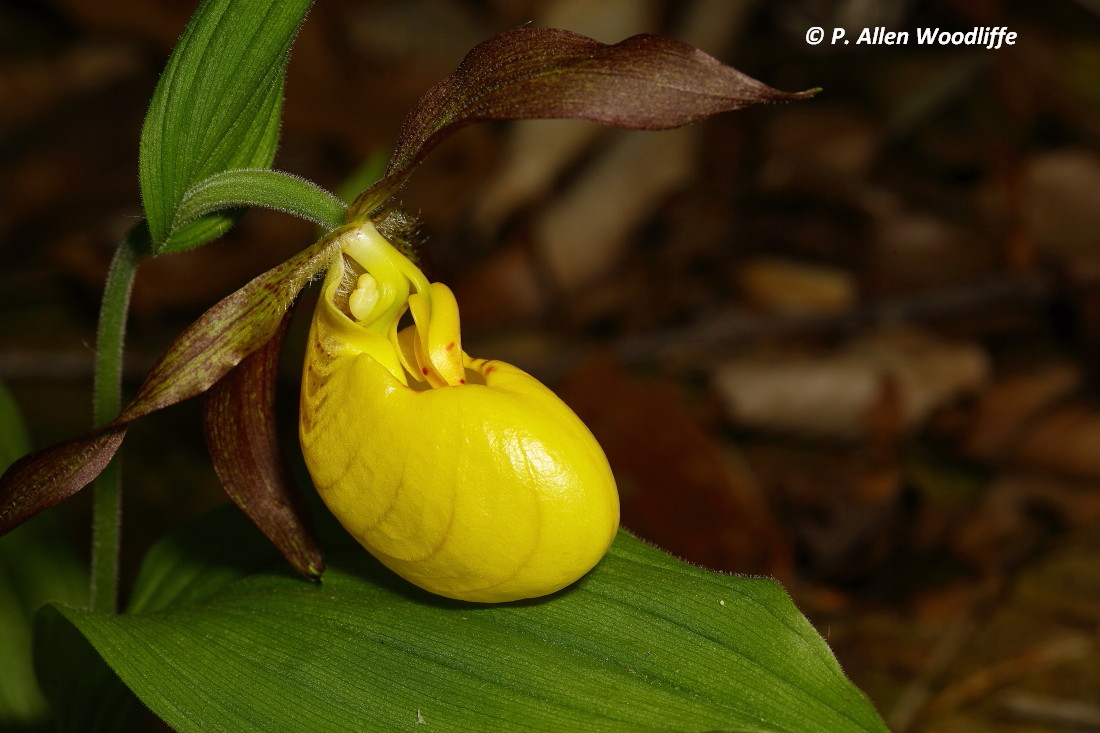
The Large Yellow Lady's-slipper (Cypripedium calcelous var pubescens) is an orchid that most people would recognize. It occurs in several locations at Rondeau. This one grew no more than 20 metres from one of the common trails in the park, and is quite visible from the trail. I imagine that hundreds of birders and other hikers walked by it without seeing it.

Violets are abundant, colourful, and sometimes confusing. Some of the most common ones are
Long-spurred Violet (Viola rostrata), accurately named because of the long spur protruding behind the front of the flower.


Yellow violets are abundant as well, including this Downy Yellow Violet (Viola pubescens).

Canada Violet (Viola canadensis) is local but widespread in the deciduous forest. There are much rarer violets which I intend to highlight in a future post.

An intriguing plant that most people have never really seen is Mitrewort (Mitella diphylla). The flowers are tiny....really, really tiny. The overall plant may get 15-25 cm high, but there are only a couple of small leaves on its single stem, and a very tiny cluster of delicate flowers at the top. Individual flowers are extremely tiny....typically only about 4-5 mm across. But if you take a close look, they are amazing! For this next image I used a full frame camera, a 100mm macro lens with extension tubes totalling about 68mm, and then I cropped it heavily. Did I mention that it is tiny??

In the last few days, Sweet Cicely (Osmorhiza claytonii) is starting to appear. This plant doesn't have large showy flowers, but is better known for its seeds. If you are walking through a patch of this plant after the seeds have formed, you will discover long black seeds with very sharp points stuck in your socks, your pant leg, or you!

Not all plants are green. This next plant, looking like a pale coloured pine cone sticking out of the leaves, is called Squawroot (Conopholis americana). It does not have chlorophyll, but gets its energy from tapping in to the roots of other plants. This species is most often found in the pine-oak forest.

There is always something to see!


Friday, 30 May 2014

The limey green season

I love this time of year at Rondeau, when the vegetation is such a vivid green, the breeding birds are in full song, the mosquitoes are almost non-existent, or at least tolerable, and on weekdays, there is hardly another person in the park. The trails, indeed almost the entire park, is all mine :-).


One can really appreciate what the natural world has to offer, when you are in it by yourself. The only sounds, sights and smells are those of nature. You aren't distracted by human chatter, passing vehicles and such.


And it can be a real opportunity to see wildlife when it is less inhibited. Just recently I was walking along the trail shown in the first two photos, Spicebush Trail, and there is at least one pair of Pileated Woodpeckers that have a territory overlapping this trail's area. I had been photographing wildflowers since there was a profusion of them, and during the middle part of the day the birds were quieter. So the only lens I had was my 100mm macro lens, on a full frame camera, which had very little telephoto effect. I noticed some movement out of the corner of my eye and there, ripping into a rotting log, was a female Pileated Woodpecker. They are not typically tolerant of humans, but this one was an exception. She could see me, I was sure, but made no move to fly, so I cautiously crept closer, getting a few photos as I got closer. The one shown below was taken with my macro lens....I was no more than about 3 metres from this bird and as I got closer I wondered if I would have to use my macro feature! In all my years at Rondeau, this is the closest I have been able to approach.


After watching her for a few moments, she moved off to another rotting log a short distance away. And I went back to shooting wildflowers, which are abundant in this early spring season, but still revelled in the encounter with this magnificent bird.

Violets are extremely common, and there are several kinds. Some violets have flowers on the main stem that also has leaves, such as this Smooth Yellow Violet.


Other species have the flowering stem separate from the leaves, such as this Wooly Blue Violet.

Similarly, the Long-spurred Violet has flowering stems on separate stems from the leaves. They are easily distinguished by their much paler colour and the very long spur at the back.

Wildflowers didn't use to be so lush and abundant at Rondeau, due to the extremely high number of white-tailed deer. At one point there were about 600 deer overwintering in the park, and when the first bits of greenery showed, the by now ravenously hungry deer devoured the fresh plant material....it was a welcome change from dry twigs all winter! But it played havoc with the wildflowers. Back in about 1978 there were two deer exclosures constructed, to demonstrate the impacts of a high population of deer browsing. The response of wildflowers from no deer browsing pressure in those exclosures since that time has been dramatic.

This first photo shows typical spring wildflowers and greenery inside the deer exclosure.


For this next photo, I turned around 180 degrees and took a shot showing what the wildflowers looked like in the unprotected area.....same camera, same lens.

The exclosures are just south of Bennett Ave and also just south of Gardiner Ave. They can be viewed by the public, although the trails to them aren't as obviously marked as they once were, so take a look for yourself next time you are in the area. It is dramatic!!!


Some wildflowers are easily recognized by most people. Trilliums, for example. But these next few photos show trilliums that you probably have never seen before.


This is actually a Red Trillium. I don't have the Photoshop capabilities to produce something like this :-). I had never seen one with six petals before. I have seen trilliums with four petals on occasion, but never six. This individual occurred along the Spicebush Trail in 2013. It did not reappear in 2014.


This is also a Red Trillium.....very rarely a yellow colour form will occur. I have only seen this on 3 occasions. This one was growing right next to a typical Red Trillium as shown in the next photo. Interestingly I first found this individual in 2013, and the same one appeared at exactly the same spot in 2014.


Other typical spring wildflowers are as follows:

Wild Blue Phlox

Wood Anemone
The next one is a species that you have walked by on numerous occasions if you have been on Spicebush Trail, but chances are you have never noticed it. It is known as Mitrewort, and is quite diminutive. This first photo is an overall shot, and you can see a spike of tiny white flowers. The whole plant is often less than a foot high, with two small paired leaves.

As one gets a closer look, the intricate details become obvious.

 And if you get really close, you may be amazed at the level of detail in this tiny flower, which in real life measures only about 3 mm in diameter! I took this with a 100 mm macro lens at minimum focus, and then put on all three extension tubes (an additional 68 mm) to increase the magnification. Then I cropped it heavily on the computer, to illustrate the detail seen here.

You really have to get on your hands and knees to see this beauty, and even then it is handy to have a hand lens. The macro world is fun and fascinating to explore!

As I completed the loop of the Spicebush Trail, the very southern section had another Pileated Woodpecker show up, and he was quite agitated. Actually he was agitated before he got close to me, but I don't know what about. This is the male, as the red crest extends from the beak to the back of the head, whereas in the previous image showing the female, the area closest to the beak is brown, not red.