Showing posts with label Common Redpoll. Show all posts

Wednesday, 9 January 2019

St. Clair NWA record breaking 2019 Christmas Bird Count

The results are in and the count week is over. Officially this 39th Christmas Bird Count, centred around St. Clair National Wildlife Area along the east side of Lake St. Clair, ended up with 93 species, one better than the previous high of 92 in 2014. And one could make the argument that since Thayer's Gull, which was one of the 92 species that year, has now been dropped from full species status, the 2019 count is two higher than our previous high.

The weather was quite decent for a change, at least compared to the bitter cold and snow of the previous count, which tallied a mere 62 species. Our most recent ten year average is 78 species, so hitting 93 was major indeed. In fact I believe there were only three counts across the entire province that exceeded this total. Considering that an estimated 75% or more of this count's circle is active agricultural land, or Lake St. Clair itself, or private wetlands that were inaccessible, the total of 93 is even more impressive.

Waterbirds, and especially waterfowl, are critically important for the species diversity and overall numbers for this count. All the water was open this year, making it attractive to the myriad ducks, geese and swans. While the cold snap of November and early December caused many ducks to move on, we were fortunate that some environmental conditions caused a major influx of ducks, especially Mallards into the area just a few days before our count. At times the skies seemed full of winged waterfowl. The NWA had lots of open water patches and almost every one had many ducks and geese.
(Note: I did not have my camera with me for most of the day, so most of these photos are from a bit earlier time.)

 We achieved new high totals for several species, including over 46000 Mallards.
 American Black Ducks set a new record with 7560 being recorded.
 Our record for Tundra Swan is almost 11000; we had about half that many, which is still quite a few!
We set a new high for Ring-necked Duck at 215.
Both scaup were represented.
 Only 6 Hooded Mergansers were recorded.
 We had 71 Snow Geese, so our record of 87 was not in jeopardy. We also had two Ross's Geese, which doubled our previous high.
Snow Goose
There were eagles aplenty. Our previous high number for this count was a pretty impressive total of 27 birds achieved in 2016. The 50 birds recorded this year blew that number out of the water. What helped, I am sure, is that because there was no ice on the lake, all the eagles were limited to perching in trees along the shoreline as they waited for a crippled duck or dead fish to come into sight.
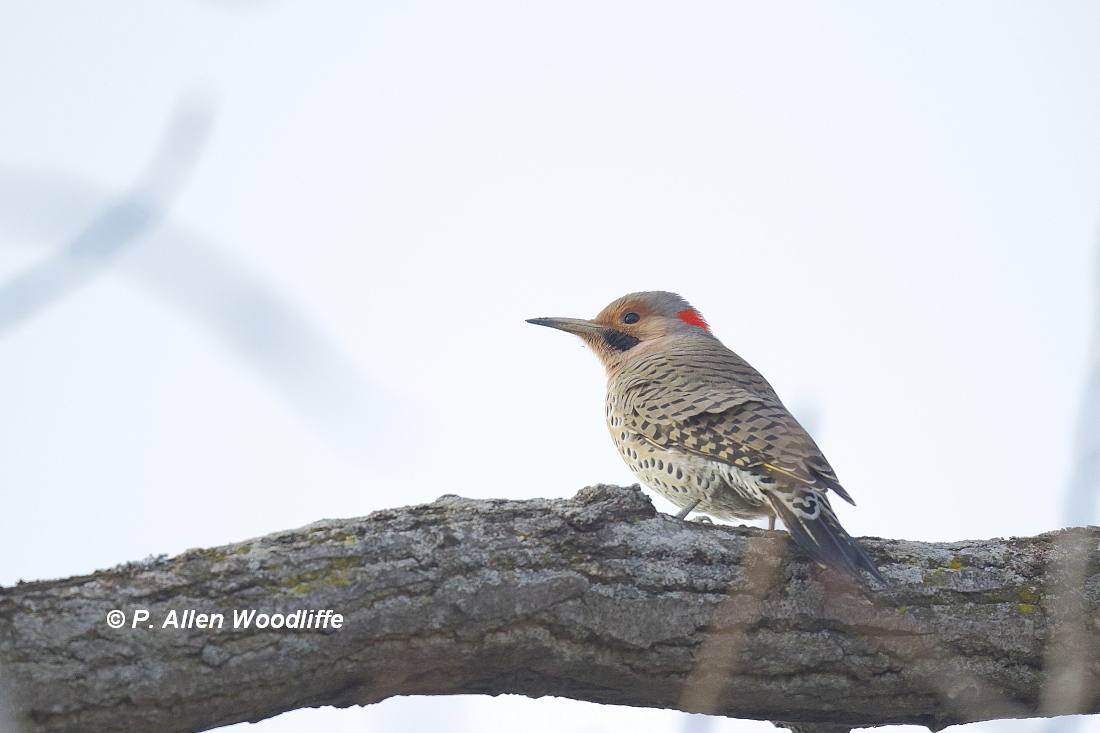
We set a new record for Northern Flicker, with 11 being seen.
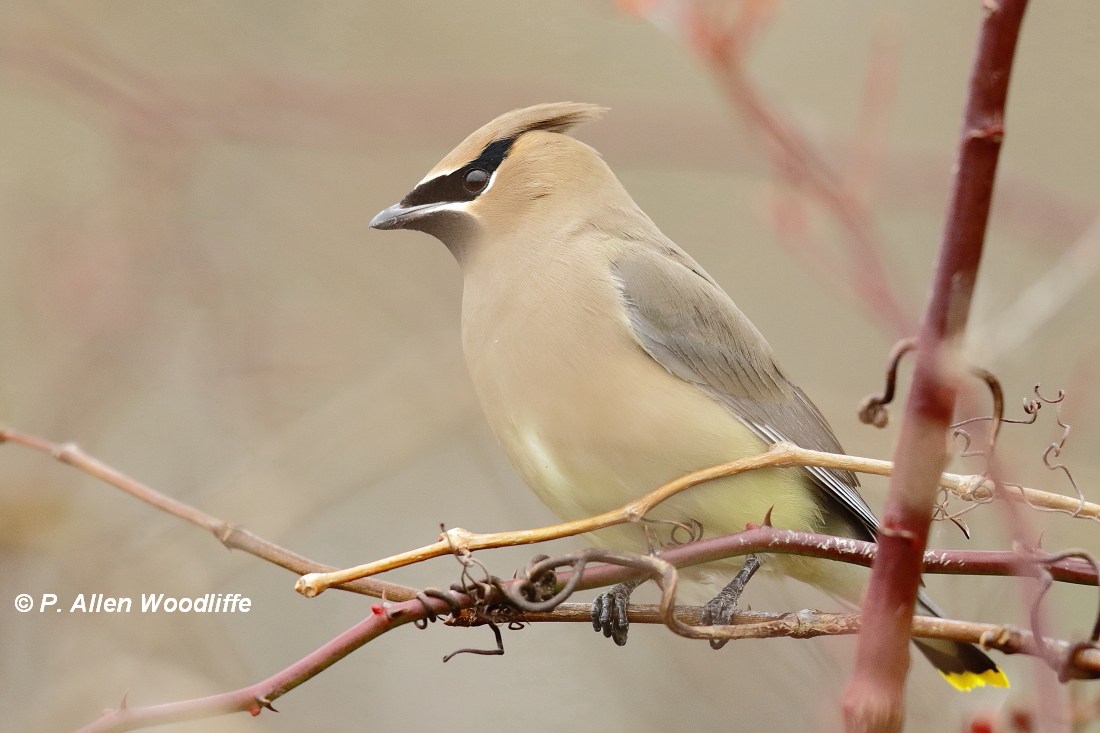
Cedar Waxwings are pretty uncommon on this count, so we were pleased that 17 were seen.
Not quite as infrequently seen as the waxwings, but still pretty hit and miss, is Common Redpoll. With the eruption of winter type finches into southern Ontario lately we were happy to count 32 of this species. Our record of 607 redpolls of 2008 will likely be intact for quite awhile yet!
It used to be that getting even one Snowy Owl was an achievement, and for the first couple of decades of this count we missed them more often than we got them. But something is happening to this arctic breeder, as we have had them for 8 straight years, and got 6 this year. It is a far cry from the 18 we had in 2016, but it is nice to consider it a regular species nowadays.

The waterfowl hunting period is now over for another season. There still are lots of ducks, geese and swans in the area, and as long as much of the lake and wetland area is open water, lots of them will remain. They won't be disturbed from being hunted, and will continue to travel between the wetlands and the fields nearby in relative safety. If a cool-down settles in over the next few weeks, with a bit of snow cover as being forecast, some will likely move on to points south so there won't be as many to see. But the St. Clair NWA is worth a visit at any time of year.


Thursday, 1 November 2018

The Snowy North...a hint of things to come

We recently went on a little trip up to North Bay, something we do once or twice a year to visit 'the kids'. The photo in the header is of Brooks Falls, showing the Magnetawan River in some of its autumn splendor, just a few kilometres east of Hwy 11. This is a photo of a couple of years ago, since at the time we went this year, the colours were well past their best. In fact it was one of the snowiest trips we have made to North Bay, but more of that later.

We did see the Magnetawan River, but from Hwy 124 rather than the location of the header photo. Here Marie gazes at the tumbling water.
The weather was rather dreary, with mostly cloudy conditions that produced either a bit of rain or snow. While we always enjoy visiting our daughter Kristin and her husband Alex--the kids--I also enjoy getting out and exploring some of the landscape that consists of rocks, hills, lakes and trees, which is quite a bit different than that of the extreme southwestern part of Ontario.

Our daughter had noted that a falconry demonstration was going to be held in nearby Callandar, and so we took it in. The demonstrators had 4 species of raptors to show, including a Gyrfalcon/Peregrine Falcon hybrid, a Harris's Hawk, a Red-tailed Hawk and a Peregrine Falcon. This first one is the Gyr/Per hybrid. Raptors don't normally hybridize in the wild, but for captive birds, it does happen.
 Harris's Hawks are normally a bird of the southwestern US, but are favoured by raptor specialists for their demeanour and ease of handling.
Laurier Woods is a conservation area at the edge of the city. It encompasses about 97 hectares (240 acres) and has more than 10 km of trails through the aforementioned rocks, hills, lakes and tree landscape.

Beaver lodge
There had been a bit of wet snow falling during my hike, but it was just warm enough that it didn't stick. However by the next day, with the slightly falling temperatures, it was a different story. We woke up to this:

Here are the same two spots along Laurier Woods Trail, shown above, but 24 hours later.

 And a couple of more photos of the same area.

As one might expect, birds were not terribly abundant at this time of year, and under these conditions. However I did see a few, including
American Robin
Black-capped Chickadee
 Common Redpolls were in fact fairly common. I saw several groups in various places I visited.

 And I saw my first Snow Buntings of the season.
I also saw a lingering Hermit Thrush and Winter Wren among about 30 species overall, but without getting any photos. The Winter Wren was close by this beaver dam.

 As mentioned, Common Redpolls and Black-capped Chickadees were quite regularly found.

When we left North Bay, it was still pretty white, and the landscape along Hwy 11 was a reminder of what the southwest might be experiencing before too many more weeks go by.

Quite often we stop in at Brooks Falls either on the way up or back, but with the snow, I didn't relish climbing up and down over slippery rocks and leaves, so we passed it by this time. This next photo is from several years ago when I did venture close, but refrained from climbing. It wouldn't have had this much snow this time, but gives an idea of what it can look like in late winter.
By the time we got close to Huntsville, the temperatures had warmed to a balmy 4C, and with the brilliant blue skies, the snow had all but disappeared. I stopped briefly at a lake along the highway. If you look closely you can see a bit of snow on the shadier side of the spruce trees. This is one time of the year when the Larch trees really stand out with their golden needles just about to drop. I didn't have to enhance the colours at all!


Wednesday, 25 February 2015

A great day to play with a new toy

Today was a relatively nice day to be out. Bright sunshine, winds that were tolerable from the ENE, and temperatures...well they were still well below normal, reaching a high of only -11C, but that is a lot better than most days!

Part of my goal today was to try out a new lens. I had been planning on getting the long-awaited Canon 100-400mm L MK II lens for awhile. I thought I might not get it until the spring, but when I got a whiff of a reasonable sale price a few weeks ago, I jumped at it. Who knows the way the dollar is going what it might increase to in a couple of months. And maybe there will be another earthquake in Japan that will seriously hinder production, and I would have to wait another year. It all sounds like pretty reasonable rationale, doesn't it?

As versatile, practical and amazing as the initial version of this lens has been, and I have enjoyed it for almost 8 years, the design and technology of it goes back to 1993. Needless to say there have been some fabulous increases in technology since that era. This lens had been rumoured to be in the upgrade mill for more than a decade, and that upgrade was often dubbed a unicorn, since it never came to light.

Fast forward to the early fall of 2014, and Canon announced it! And what amazing improvements in the features: better optics, Image Stabilizing good for 4 stops, faster auto-focus, ability to maintain auto-focus with a teleconverter (on my 5D MK III, not the 7D), an even more rugged build and, what was really a major upgrade, a minimum focus distance even at 400mm of only 3.2 feet! That is insane. The first version had excellent minimum focus of 5.9 feet, which was very useful when photographing butterflies and even flowers. But 3.2 feet!!!!!

So this new lens arrived via Canada Post a couple of days ago, and I could hardly wait to put it to the test. My first task was to do some tests and make adjustments via the Auto-Focus Micro Adjustment feature, an absolute necessity for today's photographic equipment. So I got that looked after, and true to form, the lens, when matched with my 7D, needed a bit of tweaking.

Today I decided to do some field tests with it, even if there wasn't anything too exciting to photograph. I mean it wouldn't do to really need it for something exciting and not know how it was going to perform!

I headed to Rondeau since I thought at least the bird feeders would have some action. Besides, I hadn't been to the park for at least two weeks, and I desperately needed my Rondeau fix! On the way, I noticed about 8 Wild Turkeys in a field by a busy road. I find that normally when a vehicle stops along the road, turkeys leave in a hurry. This particular group did not seem to be very concerned, however, and didn't appear to move any more than they had before I stopped the car. The conditions were not great for attempting to photograph them: a black bird, backlit by a bright sun, against a snowy background, so it was a good test for this new lens. In addition, there was enough traffic that I couldn't get out of the car, so I shot the turkeys from inside, which is a no-no.....the temperature difference and the heat escaping out the window can play havoc with the auto-focus. But one of the shots was reasonably acceptable.


I got to Rondeau, and only saw two other hikers. My kind of day.

Kudos to the staff at the Visitor Centre.....the feeders have been well-stocked for the past few weeks, so birds are able to survive this cold, snowy winter. I saw or heard 18 species of birds, just while I was standing there: three Wild Turkeys were skulking just outside the feeder area; I heard a Pileated Woodpecker drumming not far off; there was the usual Red-bellied Woodpecker (1), Downy (2) and Hairy (1) Woodpeckers, American Goldfinch (4), Dark-eyed Junco (6), Black-capped Chickadee (3), Red-winged Blackbird (2), Brown-headed Cowbird (2), House Sparrow (2), White-throated Sparrow (1) and White-crowned Sparrow (1). In addition I got shots of:

American Tree Sparrow (35)


Common Redpoll (7)


Northern Cardinal male (1)

Northern Cardinal female (1)

White-breasted Nuthatch (2)

Eastern Towhee (1)

Interestingly there were no Blue Jays or Mourning Doves observed.

There is usually one or two Gray Squirrels around. Hopefully it won't be too long until Eastern Chipmunks emerge from hibernation!
Gray Squirrel

All of these photos were cropped, some quite a bit. The bottom line is that I was quite pleased with the results of my first time with this new lens. It is definitely a keeper, and I can hardly wait to take it with me along the trails, and in the kayak exploring those out-of-the-way places around Rondeau Bay. That latter activity will have to wait awhile....there is at least 2-3 feet of snow-covered ice...but hopefully by late May when lots of shorebirds and gulls are using those out-of-the-way places.

And in case you are wondering, my original Canon 100-400mm L lens will likely be on the market before long. It is still a great lens, and is especially handy for hiking. But with my new one, chances are the original one that has been so faithful since I first purchased it in 2006 will not be needed. I have taken more bird and butterfly shots with it than any other lens, and it is capable of lots more. If you are interested, let me know.