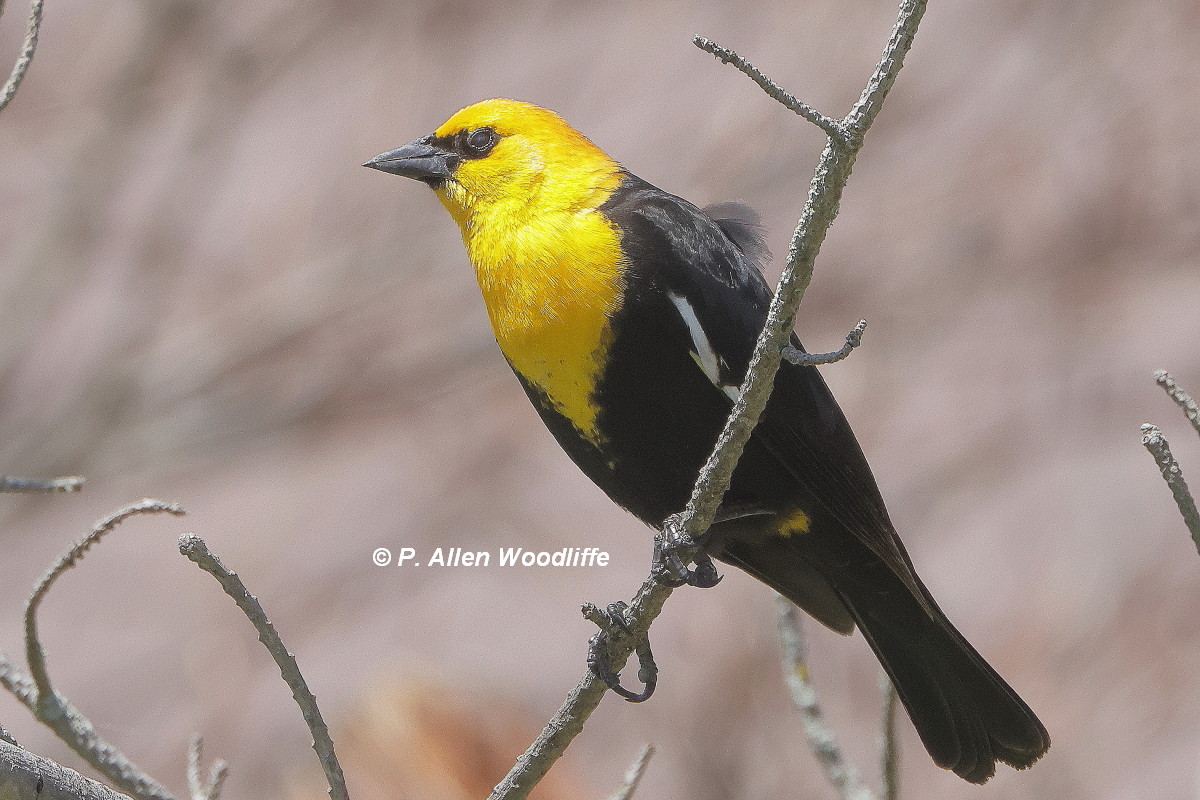
Certainly one of the highlights in recent days, at least for me, was to be able to photograph a couple of Yellow-headed Blackbirds. This predominantly western species has taken a liking to the east side of Lake St. Clair, and some friends of mine have a feeder within their breeding territory that attracts them. It is a private residence, but I have permission to visit on occasion, and sometimes the birds cooperate for the camera.
Sometimes they are just cruising on the lawn....
...but other times they come right in to the feeder. They are a bit skittish, so I can't get too close, but at times they are rather tolerant as long as I don't make any sudden moves.
I've just seen the males so far. It is possible that the females are out on the nest. I did manage to get out in my kayak a couple of years ago, and got quite close to where they were nesting. It was a great time, as Great Egrets, Black-crowned Night-Herons, Forster's Terns, Green Herons, Common Gallinules and others were nesting, so there was always lots to aim the camera at. Here is the link to the description of that post.
The same day I photographed these characters, I meandered around the general area and came across my first Eastern Kingbird of the year.
I also came upon a couple of Greater Yellowlegs feeding along the mudflats.
At SCNWA, and other places, there were a few Tree Swallows soaring around, and occasionally landing. This one was nicely perched on a rotting tree trunk that the species nested in a couple of years ago.
One or more Great Egrets are periodically seen.
At the NWA, there are often a few Canada Geese moving around....
...or just resting quietly on the water. It is possible that this one shown below, had a mate nearby.
When you see a goose trying to look inconspicuous, with its head held low over the water and frequently swimming quietly away from you, chances are it has a nest quite close by.
It is that time of year when some of the early nesting geese are swimming around with the next generation in tow.
Sandhill Cranes continue to be around, and it is nice to know they are expanding their breeding territories to the point of being almost predictable.
It is a bit early in the season for them to be nesting, but some are likely staking out prospective territories as they fly over the local large wetlands before settling down, or moving on.
Bald Eagles are always a highlight to come across. At the NWA, there have sometimes been several seen soaring in the vicinity. Most are typically fairly high up....
...but with a bit of persistent and careful photography plus some cropping, one can sometimes get a good photo. There are a couple of nests in the general area of the NWA, but neither are easy to get close enough to, to get photos of any action.
It is a slightly different story at Rondeau, however. This nest is visible from the west South Point Trail, but not always easy to see, even in the trees' leafless state. I checked this nest a few days ago, and sure enough, one of the adults was perched at the edge. I suspect the young have hatched. As I moved a bit closer on the nearby ridge, it decided to move off and soar around a bit, probably checking me out.
But it came back a short time later, and landed in the tree, perching just above the nest.
At some point before too long, I might see one or two dark heads of the nestlings appear above the edge of the nest.
Brown Creepers are here and there and constantly on the move....
...and a few Hermit Thrushes are typically found. Swainson's and Wood Thrushes are back, but I haven't managed to photograph them yet.
Warblers have returned and typically several Yellow-rumps, as shown next, can be found. A few of the other warblers have also appeared, but in smaller numbers.
I had a very nice encounter with a male Pileated Woodpecker on one recent occasion. It was busily digging into a rotting log, which was on one of the burned sites.
I managed to get quite close, even though I was very much out in the open. These photos are hardly cropped at all.
Pileated Woodpeckers are hard to figure out. At times they can be very furtive, even elusive as soon as they see you, and at other times, such as this one, it was almost as if I didn't exist and it just carried on. I probably took over 50 photos. Many of them were of it digging, and only had its head up and visible for a split second. I missed a lot of those, but got these.
Purple Martins have come back to the martin houses they inhabit. They have adapted to them very nicely, but it begs the question of what they used before people put up these houses. Of course there were more tall dead trees with random holes in them, that they would have used. So this somewhat rare species is now dependent on human-constructed housing for survival.
One doesn't often see a raccoon roaming around mid-day, but this one was. It seemed to be healthy enough. At least the eyes seemed clear, and there was no evidence of distemper in this individual.
As has been the case in recent days, Red Admirals and American Painted Lady butterflies are abundant, with a few other species present in lower numbers.
Forster's Terns are back and often seen at various wetland areas. Common Terns are not nearly as plentiful, yet. Both species will nest in the area, with the Forster's Tern much less common due to its more westerly range.
A raptor species that is always nice to see is the Osprey. It does nest in the area on occasion, sometimes successfully. This one was busily feeding on a fish it had caught when I came upon it.
The Black-billed Magpies continue just north of Shrewsbury. I wonder when we will see evidence of young??
If you want to subscribe, or unsubscribe, to Nature Nuggets, send an email to: prairietramper@gmail.com