Showing posts with label feral cat. Show all posts

Tuesday, 6 December 2016

Early December action

December has arrived, and that triggers the period for winter birding lists. It also means local birders are out scouring the bushes to see what lingering avian critters might be around for the upcoming Christmas Bird Count (CBC). The Blenheim/Rondeau count is less than two weeks away!

For this count, Rondeau Provincial Park and Erieau are two of the hotspots known to catch the attention of late migrants. A male Eurasian Wigeon has been fairly reliable at the north end of Rondeau, although not often seen close to shore (although I got a text today from Garry Sadler that it was at the edge of the bay under the willow tree closest to the normal viewing point.....a day when I had other commitments and couldn't get out). This first photo, greatly cropped, is one of my more successful attempts.
Eurasian Wigeon on the right
It is often in the company of American Wigeon and Gadwall.
American Wigeon
Gadwall

There has been a handful of less common birds scattered in various place in Rondeau, but they are not always easy to catch up to. One place I often check is the north end of Harrison Trail and also the adjacent campground, which is closed, but has easy access and lots of shrubbery for birds. Yesterday I went for a hike in this area. It was much quieter than I expected. I saw nine Gray Squirrels...


....a feral cat....
...and a mouse before I saw or heard a single bird (full disclosure: my hearing isn't all that great, so it is possible or even likely that there were birds I missed). Eventually I did get some birds for my day's list at this location, including Black-capped Chickadees, American Goldfinches, Hairy and Downy Woodpeckers, Northern Cardinals, Golden-crowned Kinglets, etc.

I know there was a Golden-crowned Kinglet on the branch in this next photo when I pressed the shutter....honest! They never seem to sit still, so in the ensuing millisecond of time, it was gone. (Over the years I have collected a few shots of empty branches.....😏)
 

There have been some strong winds from the southeast recently, and I wanted to check on the state of erosion along the south and southeast beach areas of the park. The wave action so far didn't seem to do too much damage.
Southeast Beach
South Beach

The Erieau pier and channel has received the brunt of such wave action as well.

Note the uppermost branches of the tallest tree in the previous photo. For those who have spent time over the last couple of years birding the Erieau area, you have undoubtedly noticed the dead Double-crested Cormorant blowing in the wind. It has been there for at least two years, and is a testament to the tough, leathery skin of a desiccated cormorant. Maybe we should start a pool to see who can predict how long it will remain?

These gulls in the next image would normally be out on the pier, but as you can see from the third photo above, it wasn't a popular place to hang out on this day. The birds in this next photo were about to get a shower.

The Rail Trail and the McGeachy Pond trail are two good spots to check out. There has been an interesting assortment of song birds in the last few days, including Wilson's Warbler, Palm Warbler, Orange-crowned Warbler, Blue-gray Gnatcatcher, Blue-headed Vireo, Gray Catbird, American Robin and Bohemian Waxwing, among other more expected species. The density of the shrubbery adjacent to the phragmites as well as the abundance of non-native rose hips makes it attractive to such lingering migrants, but sometimes very challenging for birders! I haven't spent as much time combing the bushes as some others, and so haven't caught up with all of the above. In fact of those listed, I have only seen the Blue-gray Gnatcatcher, American Robin and the Bohemian Waxwing. The latter species was probably the most surprising, as they are rarely seen in Chatham-Kent in any year. In fact I have only seen them in C-K about three times in the past four decades. This individual shown below was with a flock of about 125 of the much more common Cedar Waxwings.
American Robin feasting on rose-hips
Blue-gray Gnatcatcher from a different day
Bohemian Waxwing
Cedar Waxwing
Cedar Waxwing enjoying fruit of Red Cedar
The Rail Trail is popular for sparrows.
Front to back: Song Sparrow, White-crowned Sparrow, Fox Sparrow
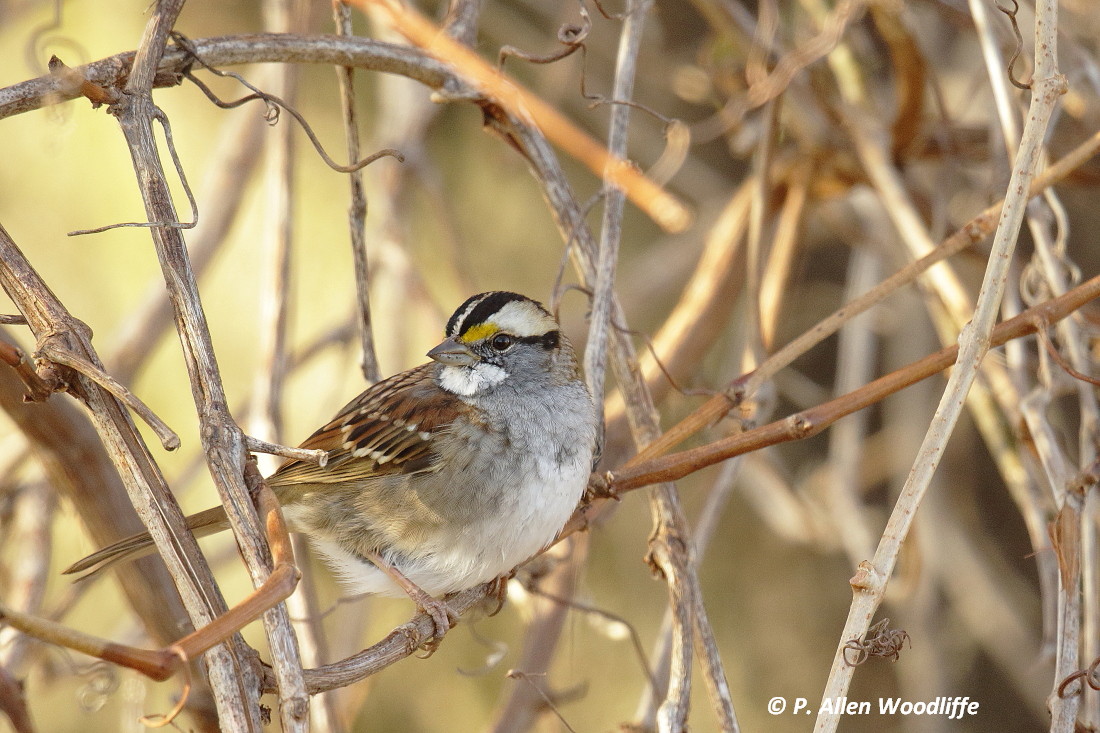
White-throated Sparrow
This trail is also a spot to see White-tailed Deer on occasion. This one was only a short distance away, but reluctant to move off. After a few moments of trying to stare me down, it eventually settled back down.

An occasional Great Blue Heron remains in the area, not surprising given all of the open water. This one was taking shelter along the canal adjacent to Lagoon Road.

With the imminent arrival of colder weather, it will be especially interesting to see how many of these species are recorded on the upcoming CBC!


Sunday, 31 January 2016

Some interesting winter birds

I will get back to my previous theme of Species At Risk on Pelee Island, the complications and an interesting solution to one of the more challenging issues but first, an interlude on some recent winter birding.

Winter birding can be fun, but requires a lot more effort since birds are relatively few and far between compared with the other seasons. Nonetheless, and especially if you are able to find much open water or a well-stocked feeder, the birds are there!

The Rondeau Visitor Centre has had a fair bit of activity, even in this recent mild spell. Hairy Woodpeckers are around.....
Hairy Woodpecker
 ....and Red-bellied Woodpeckers are quite regular.
Red-bellied Woodpecker
 Pine Siskins are quite erratic....they were no where to be found not that long ago, but in the last week or so, at least a few have been there regularly.
Pine Siskin
 Fox Sparrows are not seen very often in winter, but the feeder this year has kept at least one bird well fed.
Fox Sparrow
There are always a few things to be found here and there. A Great Blue Heron has been seen at a creek along Stefina Line from time to time.
Great Blue Heron
 Wild Turkeys are well established.
Wild Turkey
 If you find a berry bush, such as a cluster of Staghorn Sumac, you might find American Robins or sometimes a group of those non-native and noisy European Starlings busily scarfing down the fruit.
European Starling
And birds, beware of the feral cat! Unfortunately one sees a lot of these scattered across the landscape.
Where there is open water, there is often a greater diversity of birds to look through. In the Rondeau Bay area, Erieau and Shrewsbury are the places to be. And that is where I spent some time today. Redheads are not abundant, but scattered around.
Redheads
 There is still the occasional Ruddy Duck.
Ruddy Duck
 Tundra Swans are on the move, although  a few hundred that arrived late last fall, never really left.
 A bonus this year has been the presence of a couple of Trumpeter Swans at Shrewsbury. There is only a handful of records for the Rondeau area. I took this next shot on a very cold day a week or so ago. The pointed feathering at the top of the bill, the large more or less straight bill and the wider black patch just in front of the eye (it is less pinched than for a Tundra Swan), the lack of yellow on the bill, and overall their larger size are all helpful clues as to their identity.
Trumpeter Swans
 Today, the two birds were right close to the dock area, and the light was nice and even. I even heard them give their distinctive nasal honk a few times.
 After a little while, they drifted off to the southwest and then arrived at the edge of the ice 400 metres or so away, but they still stood out due to their size. I also had  a Paul D. Pratt sighting at Shrewsbury who, along with a couple of others, was also out looking for the Trumpeters

At Erieau, was a beautiful male Long-tailed Duck in the marina area. Although they are typically very abundant on Lake Ontario in the winter, they are more of a novelty along the western end of Lake Erie.
Long-tailed Duck
 In the marina by the fish tugs was a lingering Belted Kingfisher. I watched it catch a fish on a couple of occasions, and it seemed healthy and active.
Belted Kingfisher
 American Coot often try and survive at Erieau during most winters. Some birds are more successful than others, as I saw a few dead ones on the shore, but the couple of dozen or so that I saw in the water or pecking at something in the grass all seemed to be okay.
American Coot

 Gulls typically seem to vacate the north shore of Lake Erie in January. I think they spend that time on the south side of the lake, or perhaps much farther away, but this year, since there is open water, there are a few Ring-billed Gulls, Herring Gulls and a smaller number of Great Black-backed Gulls still around.
Ring-billed Gull
The lighthouse at the entrance to Rondeau Bay is not operating these days, although there still is one fishing tug out catching fish. The lake looks bleak and cold, but there isn't much ice on it these days. I spent a bit of time talking to an MNR&F Port Observer at Erieau today, who is based out of Wheatley. He indicated that the brisk westerly winds of a few days ago blew a lot of the ice from the western basin well down the lake towards the east.
Bleak Lake Erie
The sentinel


Friday, 6 November 2015

Ahhh....Indian summer

You gotta love the weather here in southwestern Ontario these last few days. Mostly sunny, light winds, temperatures in the 18-22C range. While this would qualify as Indian summer in most people's books, the Old Farmer's Almanac, which has been passing along its wisdom since 1792 would disagree, however. According to the almanac, to qualify as Indian summer you must have warm--check--dry weather--check--following a decent frost--check--in November--check--with clear chilly nights--check--but it has to occur sometime between Nov 11 and Nov 20! I'm not sure why it has such a restricted time frame. There are some attempts to describe it on their web site, but it doesn't seem to adequately explain why it has to happen in this 10 day stretch. For more information on this, according to the Old Farmer's Almanac, see what they say here. Regardless, I think most people would consider the weather of these past few days as a prime example of Indian summer, when the leaves that remain on the trees are mostly golden.


All that aside, I don't think many people would complain about the weather from Monday-Thursday of this week, other than those who will go unnamed but who have lamented nice weather during the week only to have crappy weather on the weekend :-). However the weekend weather doesn't look all that bad, so we shall see....

I've been able to be out and about several times these last few days, fortunately, and most often to locations in southern Chatham-Kent. I went looking for the Townsend's Solitaire one day, but it turns out that it was a single 'solitairy' occurrence on Nov 1, at least for now. But it is still likely somewhere in the park. The one that showed up back in April of 2011 showed up for one day at the parking lot of the South Point Trail, and then disappeared for about a week when one, and presumably the same one, showed up just a bit north of the Visitor Centre for a day.

There were lots of Cedar Waxwings feeding in the tree where the solitaire had been seen...probably at least 40.....and by the middle of the week, almost all of the berries that had been abundant on the cedar tree were now gone.
There were also lots of American Robins in the area, and on occasion a Red-bellied Woodpecker, which is always nice to see.
Butterflies were fairly common considering the time of year. There were lots of Cabbage Whites and Clouded Sulphurs, an Eastern Comma, a couple of Common Buckeyes and, somewhat surprisingly, 6 Monarchs trying to migrate along the east side of the park. At this point it is highly unlikely that the Monarch will make it to Mexico.
Clouded Sulphur

Eastern Comma
Monarch
On one occasion while I was taking a short snack break and sitting in the car, I noticed a good looking buck venture out from the trail along the south end of the maintenance compound. It didn't seem to mind my presence from a distance, and fortunately I had the telephoto lens right beside me. Notice the swelled neck. That is what happens to bucks during the mating season, with an increased blood flow to the muscles of the neck in preparation for the tugging and pushing of other bucks who are vying for a mate.
I ventured out the Marsh Trail one day, hiking about 10-11 kilometres out to Long Pond and back. It was a bit breezier than I would have liked that day, and it kept the bird sounds and chips covered up. I saw the usual mix of Fox Sparrows, White-crowned and White-throated Sparrows, Rusty Blackbirds, etc. And there was other types of fauna scattered here and there as well, especially herps: Spring (Fall?) Peepers, Leopard and Green Frogs, Eastern Garter Snakes and a single Northern Brown Snake.
Eastern Garter Snake
Northern Brown Snake
And there were many dozens of Autumn (a.k.a. Yellow-legged) Meadowhawks.
Just after turning back from Long Pond, I noticed a couple of Sandhill Cranes standing quietly not too far away in the cattails and Phragmites. I could see that they were not going to stay there long, and so I got prepared for them to take flight. They jumped up in sync and circled around before heading towards the south end of the marsh, yodeling their trumpet like call all the way.


There was a fair bit of Asparagus along the trail, quite obvious with its pale green and feathery leaves and bright red fruit.

I noticed a Red Cedar along the side of the trail with two of its three small trunks lying on the ground. A closer examination of it identified the tell-tale markings of Beaver gnawing.

Beaver don't normally chow down on conifers, but since there aren't many of their choicest items around, including poplar, willow, birch and the like, I guess this animal tried to make do. I'm not sure what his plans were for it, as there wasn't any evidence that it attempted to drag it away to its lodge for consuming.

I also came across this undesirable species of wildlife along the trail. Feral cats, which are not native, of course, have huge impacts on wildlife, especially in natural areas.
Has anyone been out to the observation tower along the Marsh Trail? I hadn't seen it for at least a month, but was concerned when I realized that two of the posts closest to the bay were not looking good.
It was evident that someone, presumably park staff, have stacked up a few sand bags around the posts, but that is a very temporary solution at best. Who knows what the winter storms and moving ice might do to this tower?

I also spent a bit of time along the Erieau Rail Trail and the waterfront. As expected, there is a huge number of waterfowl, especially ducks, in what is locally known for very good reason as Duck Bay. At least 10-15,000 birds are spread out from this southwest corner of the bay all the way to Shrewsbury, and there are still shorebirds using the mudflats and vegetation mats, but one needs a high-powered scope to see them well.

On occasion a few ducks were in the air, and did a reasonably close fly by such as these Gadwall did.


I didn't see the Blue-gray Gnatcatcher that has been seen by others, but I did catch up to the Northern Parula that has been hanging out for several days. It was seen again on Nov 5, which makes it one day later than the previous late date for this species in the Rondeau checklist circle. The bird was in the shade against a bright sky, so it wasn't the easiest to photograph. I had to do more than the usual tweaking on the computer to get it at least recognizable.

So all in all, an excellent few days to be out. I wonder what the change in weather will bring? More northern birds, maybe even a few more Snowy Owls (one was seen from the Erieau trail earlier this week)?

This is the time of year when White-tailed Deer have mating in mind, so be careful when driving the roads!