Showing posts with label muskrat. Show all posts

Friday, 11 March 2022

Nesting begins, waterfowl on the move

 I was going to continue with the series on Birds of Kent County, then and now, but decided to hold off until next time. It is the time of year when as spring slowly arrives, evidence of its arrival involves more than just the weather. It involves birds, of course.

Waterfowl is present in large numbers, although some of the most visible ones have already moved on to a great extent. Tundra Swans were around by the thousands just a short time ago. In this first photo, there are a few mixed in with several other species of waterfowl, mostly geese in this case. Once I got the image on the computer and processed it, a closer look revealed a single Greater White-fronted Goose. If you click on the image it will be visible in a larger format, and if you look closely to the left of one of the closer swans, and just above the 'e' in my name, you may see the white-fronted goose facing this direction.

The swans were on the move, some just to a local field.....
...while others were noticed gaining a much higher altitude than if they were going out to a field, and then heading north. Many swans are now gone.

While I was out enjoying the spectacle of waterfowl, I came across about a dozen Sandhill Cranes. Most were in small loose groups, but some seemed to be paired up already.

The sewage lagoons at Blenheim are completely ice free these days, and there are lots of waterfowl making use of them. There were several hundred ducks there quite recently, most of which were Ring-necked Ducks. Unfortunately for me, the ducks in general were rather skittish. Wherever I went, they seemed to be on the move to the farthest sides of the lagoons, making photography difficult. At least the light was fairly good.

There were a few Redheads.....
...and several Bufflehead, although they were more apt to be on the move rather than sitting still for me.

Canada Geese were paired up. I didn't see any evidence of nests yet, but it won't be long.
There were even a few American Coot.

Red-winged Blackbirds were present, but not in large numbers. It might have something to do with all of the cattail and phragmites trimming that has taken place since last season, leaving them with less suitable habitat.

Muskrats were there in abundance. There were easily three dozen along the edges of all of the lagoon cells, and some were busily digging out a new burrow entrance. Hopefully their activities won't jeopardize the integrity of the berms separating the cells and containing the water.

I've been out to Rondeau a couple of times recently, just to see what is new and to go for some nice long walks. With camera in hand, of course.

I went along the east side of the South Point Trail a few days ago, which I hadn't been to for several weeks. The birds were few and far between, not surprisingly. I did see a couple of adult Bald Eagles soaring over....

....and with the ice now gone and the sometimes brisk southeast winds, the concrete block associated with the old camp office, is now about as exposed as I have ever seen it.
Some explorations in the campground at the north end of the park are often worthwhile, especially before the opening of the camping season in just three weeks from today. House Finches continue to be fairly abundant.
One of the notable activities I came across here was a pair of Carolina Wrens in the business of building a nest. Regular birders roaming the campground may recognize this location, as they are building under the dome of a propane tank. If there is enough propane in it to get through the first few weeks of the camping season, maybe the nest will be successful. If not and the propane suppliers have to gain access to the dome......

Closer to home, just yesterday I noticed three Red-breasted Nuthatches scavenging for tidbits of something in the trees outside the kitchen window. I haven't seen any of this species for at least a couple of months, so it would appear that this species is on the move.

Marie and I have been over to Paxton's Bush a couple of times recently. The Great Horned Owls are back in nesting mode again, and apparently have found this artificial nesting basket satisfactory. At least it is easy to keep an eye on, and at certain angles, one can see through the sides to note a bird, and eventually young, present in it.


If you want to subscribe, or unsubscribe, to Nature Nuggets, send an email to prairietramper@gmail.com


Friday, 31 December 2021

More Christmas Bird Count news, and the ABA Bird of the Year

 The Wallaceburg/Walpole Island Christmas Bird Count was last weekend, and as usual I joined in on the fun. My territory includes a long section of the St. Clair River north of Walpole Island as well as some inland areas. Usually the river is quite productive for waterfowl diversity, although this year wasn't one of those banner years. There was no ice on the river at all, not surprisingly given the warmer than usual weather. Overall there was an average diversity, and some were even close enough to get a few decent photos in spite of the gloomy light conditions. At least there were no harsh shadows caused by the bright sun!

While most ducks are generally well out from any access point, the protected area downstream from the former ferry access at Sombra never disappoints. There are always several dozen ducks to be seen, and are often quite close to shore where one can photograph them from a vehicle, with a little help from a good telephoto lens.

Redheads were one of the more common species to be seen.

Mallards were also in good numbers, as usual.
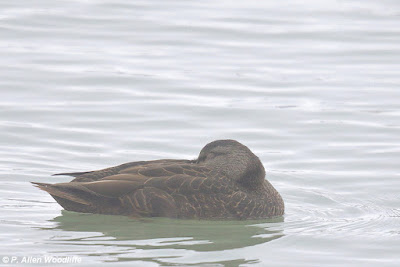
A duck closely related to Mallard is this American Black Duck, shown next. It used to be much more common than Mallard in Ontario, at least at the time of settlement and shortly afterwards. Their preferred breeding habitat is wooded wetlands, which are far less available in the past century or more.
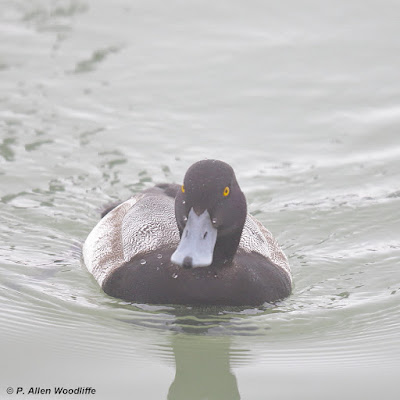
Scaup were in good numbers as well, with the Greater Scaup, shown first, the most plentiful. Even at rest, they are easily separated from the Lesser Scaup by the rounded shape of the head.
Another feature to use, when visible, is the width of the black tip of the bill. This next photo shows the narrower black tip on a Lesser, compared to a black tip almost twice as wide on a Greater.
When the Lesser Scaup is resting, note the more peaked top of the head with a slight notch visible....
...the notch is also visible when the bird is not at rest.
Canada Geese are often quite abundant somewhere in my territory, but not so much this year. I saw a few out in a field, and a few in flight, but not nearly as many as usual.
One of the highlights for me was not so much a rare bird, but an opportunity to watch an adult Red-tailed Hawk in action. Most of the time when a vehicle approaches a hawk on a post, the bird leaves quickly even before the vehicle comes to a stop. I saw this bird on a post and decided to approach slowly to see what would happen. Instead of flying off, the bird dropped to the ground beneath it and proceeded to investigate the grassy ground cover. It was not perturbed enough to leave, and in fact even after I got a bunch of photos, I left and it was still probing the grass with its talons, probably hoping to grasp on to a mouse or vole that it had heard scurrying around.
The road I was on was not busy at all, fortunately, and the bird allowed me to get so close that I had to change my lens down to my 100-400 and even zoom back to about 300mm in order to get these photos. They are hardly cropped at all.
I'm not sure if the hawk was successful or not, as I went on my way after a few minutes and the bird was still hunting.

Photographing birds against the sky was not nearly as successful. I did manage to get a couple of shots of a somewhat wary Northern Flicker, but against the very bland grayish white sky the result was not wonderful. Even after a fair bit of processing, this is the best I could do.

My total for the day was a mere 32 species, quite a bit lower than my usual total of around 40 for this area. But land birds were few and far between and, as mentioned, even the water birds were less abundant than usual. The final total overall was 82 species.

A day or two later I went back out to Keith McLean Conservation Lands, hoping to have a more successful result in looking for the Nelson's Sparrow and Least Sandpiper. The previous two times I was out, the wind was much stronger than I had hoped, and had zero success at finding either of these birds. On this day, while it wasn't totally calm, it was much improved. On the way, I had a couple of Bald Eagles fly over, including this 3rd year bird which at one point almost flew directly overhead.

Again, the type of sky did not make photographing it any easier.
A muskrat was scurrying around at the water's edge before it realized a human was quite close by, causing it to scamper for deeper water.
I finally came across the Least Sandpiper, and it gave me some very good views and photo ops. I'm not sure how it will fare over the next few days with the weather forecast being what it is.

I did not see the Nelson's Sparrow, although there were a lot of sparrows moving through the cattail vegetation and disappearing before I could get a good look. There was the usual mix of American Tree Sparrows, Savannah Sparrows and Swamp Sparrows, but I could not pick out a Nelson's.

Just east of Shrewsbury, I came across a flock of 27 Sandhill Cranes feeding at the edge of a field.


In other news, the American Bird Association has announced its annual choice for Bird Of The Year. Usually it is a species that has more relevance to Ontario than this particular choice, and in the past it has included such species as Green Heron and Cedar Waxwing. However the BOTY for 2022 is Burrowing Owl, an impressive little owl with its piercing eyes, no question.

There has been the occasional record for Ontario, including one back in the late 1970s showing up at McGeachy Pond Conservation Area just outside of Erieau. A few years later one showed up briefly on Pelee Island. I saw the McGeachy Pond one, but did not get any photos. The bird shown here was scanned from a slide I took of one at the Grasslands National Park in Saskatchewan, back in 1986.

Tomorrow, January 1, 2022 is the 43rd St. Clair National Wildlife Area Christmas Bird Count. We've averaged slightly over 82 species over the last decade, with a high of 93 species in 2019. It will be interesting to see how this count fares, but given the deteriorating weather over the course of the day, won't likely set any new overall records. The record for Snowy Owls, currently at 18, may be in jeopardy, however. I was out yesterday and saw 12 different birds in a small, but important part of the count circle. There could easily be twice that many overall, but the question will be, will they be sitting out in a visible location if the forecast rain comes to pass?

Yesterday they were sitting up nicely, with 4 of them on poles or grain bins close to the road, while the others were well out in a field, or beside a post.


Happy New Year!

If you want to subscribe, or unsubscribe, to Nature Nuggets, send an email to prairietramper@gmail.com


Saturday, 3 April 2021

Spring continues to emerge slowly, in spite of the ups and downs of weather

 The spring weather continues with its typical ups and downs. A little bit of sun, a little bit of rain, a little bit of warmth and a little bit of snow! Sounds like a typical spring for southern Ontario. Some warmish sunny days in late March had many folks anticipating a good push of birds arriving, and although some did arrive, not a lot. They are on their own schedule and most have a long way to go to get here. 

On April Fool's Day, we even had some snow that with the wind, created almost whiteout conditions for a little while. This is the view out our kitchen window after the worst had passed through.

But as is often the case, if you don't like the weather, just wait a few minutes!

A day or so earlier, I had been to Rondeau, and while there weren't a lot of birds to see, while scanning the lake for loons and other waterbirds, I noticed this adult Bald Eagle wrestling with something along the water's edge.

It had been picking away at a fish. I don't know whether it was washed up, or whether it caught it floating on the water. After a few minutes, however, it decided to move on with it, and it headed southward more or less towards its nest. Perhaps it was taking it to feed its mate.

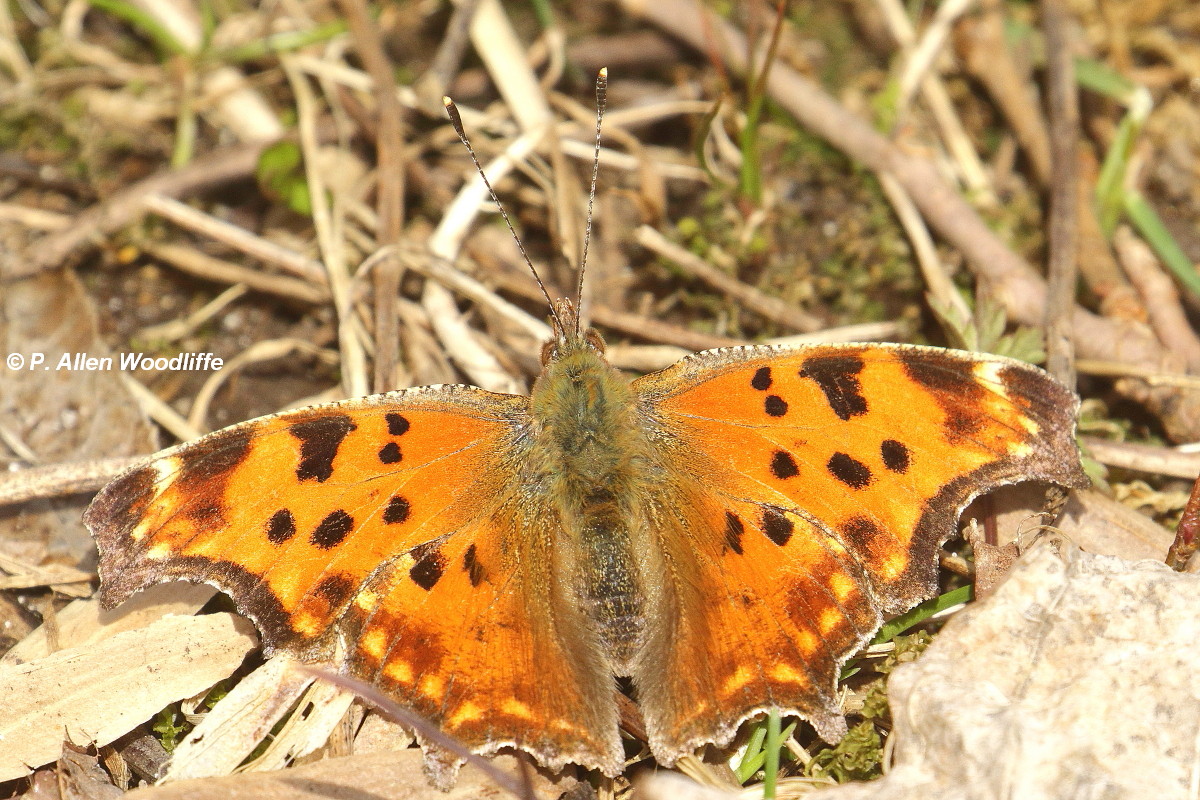
In my travels that day, I also saw the usual early butterflies out sunning in some sheltered spots.

Eastern Comma

Mourning Cloak

A bit later that day I headed to Erieau. There had been lots of Bonaparte's Gulls arrive, and since there were brisk southerly winds, there were 150 or so in the protected marina.


Several Horned Grebes were swimming by, showing some change in their winter garb to look a bit more like their breeding plumage.
While I was standing at the dock, this Common Grackle came almost right up as it was searching for some easy pickings from the water's edge.....
.....and this Muskrat swam right underneath me, oblivious to my presence until a slight movement I made caused it to dive quickly. It surfaced a short distance away and just sat there in the water watching me, trying to assess my threat status. After a few minutes it continued on its way somewhat warily.
At one point as I glanced behind me I saw this Brown Creeper swoop in to the base of a tree a very short distance away. It was quite busy in its search for sustenance, and basically ignored me. I hardly had to crop this image at all.

Yesterday I meandered through parts of the former Dover Twp, northeast of Chatham. There wasn't a lot to see, but I noticed the eagle nest near St. Clair NWA had the pair of adult eagles at or on the nest. And just south of the NWA, I came across this Great Egret standing across the ditch in this field of winter wheat, giving a nice green background. 

Various plants are in growth mode. I saw this Bloodroot in flower at Paxton's Bush.

Before I left home today, I had two, possibly three, Red-breasted Nuthatches stop by and search for tidbits in one of the trees outside the living room window. The light wasn't ideal, but you take what you get. It is always fun to see these in action, and are most often seen on migration in our area.


A bit later, while on route to Keith McLean Conservation Lands (KMCL), I stopped at Sinclair's Bush, and saw this sedge out in flower. It isn't all that showy, as sedges seldom are, but they do have flowers. I believe this is Plantainleaf Sedge, a common species here.....


...and nearby a population of Pawpaw trees were starting to show some bud development. It is a rare species, and at least historically, Chatham-Kent has had the most populations of anywhere in Ontario.

A bit later, I ended up at KMCL. It was quite windy, and most waterbirds were not all that close to photograph. There was the usual mix of waterbirds, as well as Bald Eagle, Great Egret, and such. I did see quite a few Blue-winged Teal, about 18 or more, the most I had seen so far this year.....

...and while on the lookout for either a Greater or Lesser Yellowlegs, shorebirds that had been reported there recently, I saw a smaller shorebird on the far side of the eastern pond. I got a few shots, and managed to get them processed and cropped to be at least identifiable. The camera/lens combination, along with the resulting image being greatly cropped, resulted in this photo at the equivalent of about 130 X, so it isn't great, but shows enough detail to be identified as a Dunlin. It is a bit early, but not totally unlikely.
At present, the shorebird habitat at KMCL isn't nearly as good as it has been the last 2-3 years, but with the forecast rain off and on over the next week or two, maybe that will change. Fingers crossed!

Happy Easter everyone. Here is one of my all-time favourite Easter songs here.