Showing posts with label Baltimore Oriole. Show all posts

Saturday, 2 May 2020

Birds, and other wildlife, of course!

Even without some of the 'best' spots to spend time in these days, there is lots of wildlife to see! I have continued to get out, safely without seeing many other people, so all is well. Certainly one of the highlights so far are the three American Avocets, as shown in my updated header, with a single bird below. It is certainly one of the most striking of shorebirds, especially in its breeding plumage this time of year. The fact that it is large, and fairly rare for this part of Ontario, makes it all the more appealing. The three of them were discovered yesterday at the Keith McLean Conservation Lands, which is looking good again this year for water birds given the high water conditions.
I spent a bit of time just outside of Rondeau, since the park itself is still closed, and there was a nice variety of things, including my first Baltimore Oriole of the year.....
 ...there were at least three Blue-grey Gnatcatchers flitting about, making photography a challenge.
 Brown-headed Cowbirds are typically detested by birders and non-birders alike. I am not a big fan of them, but they are native, and have managed an interested strategy for long-tern survival. This is a female.
 Hermit Thrushes are fairly plentiful these days, with a few of the other thrush species starting to appear.
 House Finches are often in full song.
 Ruby-crowned Kinglets are darting every which way looking for something to eat. I often don't bother trying to photograph them as they are constantly on the move, but occasionally one is a little more cooperative, remaining in one spot for a fraction of a second.
 Tufted Titmice are not often seen, but these days they can be pinpointed more easily since they are in song.

 White-throated Sparrows are fairly common these days as they scrounge amongst the leaf litter looking for something to eat. This particular day, the ones I saw were all back lit, making the photos less vivid.
In other locales, there have been a few other birds to enjoy. While American Robins are quite abundant these last few weeks, I came across this one near Paxton's Bush. The speckled nature is the result of the partial loss of pigment in the feathers. There is a recent article in the Ontario Field Ornithologists publication Ontario Birds, which features a variety of species that have shown this phenomenon.
 Also at Paxton's Bush, I have recently seen Blue-headed Vireos....
 ....and Black-throated Green Warblers.
 A flooded field is always worth checking out. In addition to several Wilson's Snipe on this occasion, I also found three Pectoral Sandpipers.
 All of the expected swallow species have been back for awhile, and Purple Martins are gathering at martin houses. There is an easily accessible martin house at Mitchell's Bay park, where I shot the male and female shown here.

 Turkey Vultures are frequent. I haven't caught up to a Black Vulture yet this year, but I keep looking.
 Yellow-bellied Sapsuckers are quite regular these days.....
 ....and Chipping Sparrows are common on lawns and other short grass sites.
I photographed this Chipping Sparrow while I was waiting to 'shoot' a Red Fox. I had been notified of a fox den on a piece of private property that I had access to. The first evening I was out, I watched and waited for more than two hours, without seeing the fox. I did see more than 20 species of birds while I was standing waiting. But the second time I went out, after an hour and a half, and just as it was getting very dull, the fox showed up briefly. I saw him/her for about 15 seconds and managed three photos. Since it was running through a shrubby area, the focus was thrown off, and so I only got this one photo that was worth keeping.
There are other types of wildlife to shoot at this time of year. Again, while I was waiting for the fox to show, I photographed this cottontail. Clearly it has survived being close by the fox's hangouts, at least for now.
 Eastern Chipmunks are out and about, and often fairly vocal.....
 ...as are their larger relatives.
 On the occasional sunny day, a wetland can have dozens of Painted Turtles out soaking up the sun, necessary for the egg development inside the females so they can lay them in another month.
 The Narrow-headed Marsh Fly is one of the most abundant types of syrphid flies in the spring, and throughout the year for that matter.
 Mourning Cloaks are flitting around or pausing to soak up some sunshine....
 ...as are a few Red Admirals.
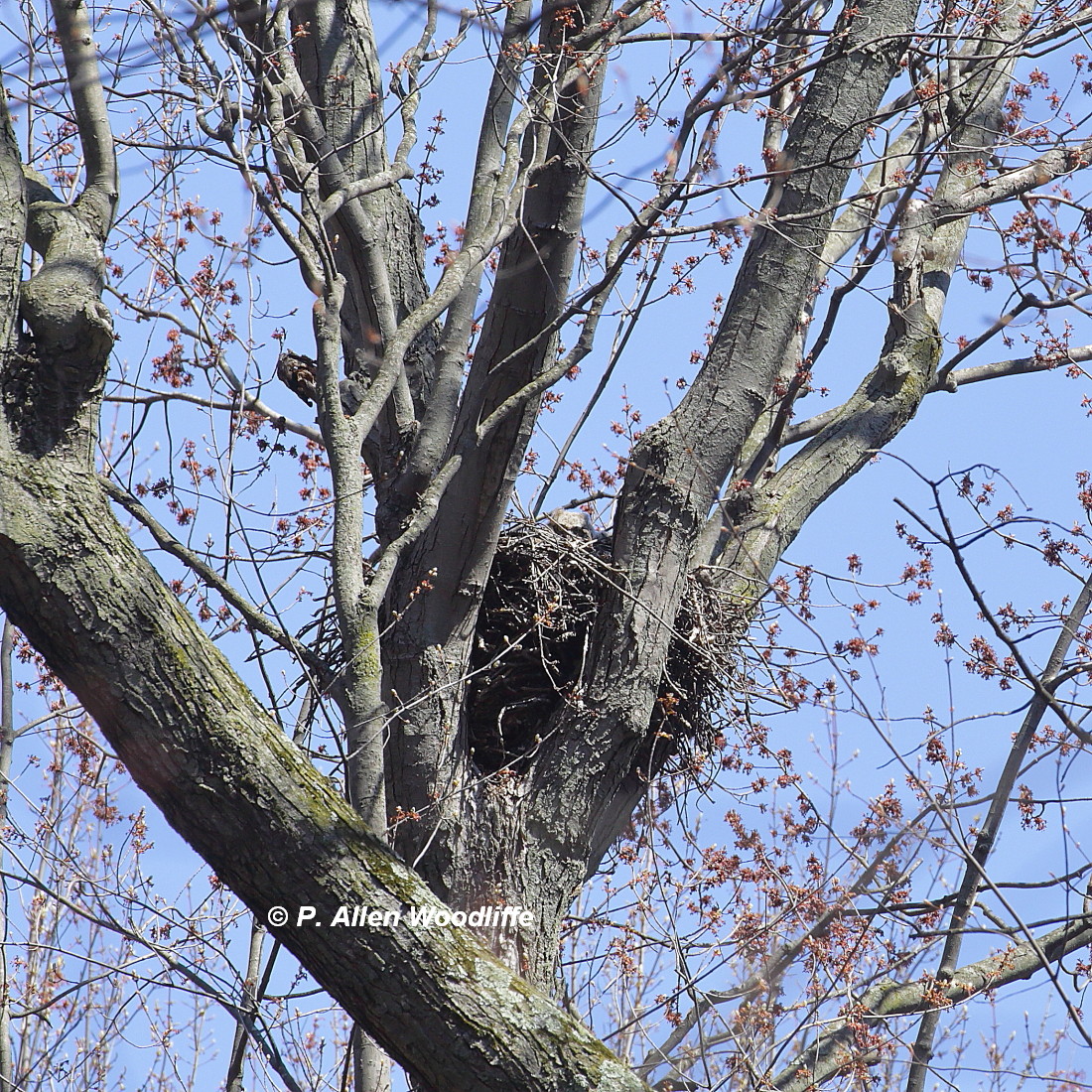
 And a Great Horned Owlet, not the ones at Paxton's Bush, is growing and will soon be leaving this nest. You can just barely see it peering out at me, as I am possibly the first human this owlet had seen.
Ahhh...spring time! So much is happening, and there is so little time to catch up with it all!


Monday, 25 November 2019

Late autumn birds, butterflies and a snake!

The weather has been fairly typical autumn-like, with a hint of winter some days and a reminder of some of the warmth of early autumn on others. And that translates into some birds of winter, as well as some hold-overs of late summer and early autumn.

The snow of a couple of weeks ago was a contrast to what we had been experiencing, and with it came some late autumn and early winter migrants such as American Pipits, which were widely scattered and as abundant as I had seen them in several years.....
 ....as well as good numbers of Fox Sparrows, here seen scratching around in the less snow covered area under some Red Cedar trees.
Ruby-crowned Kinglets were fairly abundant. They are in constant motion, making the attempts at photography challenging indeed. There are usually far more photos slightly blurry or out of focus than there are keepers, and the delete button gets used quite regularly.

 As Ruby-crowns diminish in numbers, their equally active Golden-crowned relatives increase.
 A few hardy thrushes occur, such as Hermit Thrush. On one occasion it seemed like it was a 'thrush' day, as I had about a dozen Hermit Thrushes, about 15 American Robins and an equal number of Eastern Bluebirds, all members of the Thrush family.


Eastern Phoebes, a member of the flycatcher family which seems to be quite adaptable to feeding on non-fly items, such as berries, have been noted regularly in small numbers. On occasion one will still be around for the Christmas Bird Count coming up in mid December.
Shy Phoebe
All through that were a few lingering shorebirds. Dunlin and Killdeer were widely scattered along shorelines, and even in still flooded fields.

 And then a warm-up happened, perhaps the only time we will experience anything like 'Indian Summer' this year. For one day only it was unseasonably pleasant, with bright sun, very little wind, and temperatures reaching 9-10C. And the wildlife responded, however briefly. There were butterflies flitting around at Rondeau, including this Eastern Comma......
 ...and an Eastern Garter Snake was seen stretched out across a sunny spot on a paved road at the park. It seemed hesitant to move, but I encouraged it to move to the side so it wouldn't become a victim of an unobservant (or uncaring) driver.
 I heard, and then saw, this cricket busily 'singing' its song at the base of the Visitor Centre siding.
A few other bird species were a pleasant surprise. Red-headed Woodpeckers used to be quite common during the spring and summer period, but in recent decades are quite unusual. Having one linger this late is even more unusual for this migrant.
 Baltimore Orioles are usually many hundreds of kilometres south of here by now. For some reason this brightly coloured male is content (?) to stick around a well stocked feeder just north of the Visitor Centre. It isn't always easy to find, as it appears out of nowhere and may spend a bit of time in a willow tree, which typically has some leaves remaining. It makes it difficult for the camera to focus.
 But eventually it may come to the feeder, which the owners have stocked with jelly with a few meal worms mixed in. Not the kind of spread I would like on my toast, but the oriole seems to enjoy this source of protein. Last year there was a female Baltimore Oriole that was seen erratically in the Rondeau campground even into January. Maybe this is the year that we will be able to add the species to the Christmas Bird Count.
A couple of weeks ago there was an immature Red Phalarope which showed up at the Blenheim Sewage Lagoons. I got a few photos on that cold, snowy day and included them on a blog post shortly afterwards. Red Phalaropes are quite irregular for this area. We sometimes go for several years without any reports at all. But just this past weekend, an adult in its winter/basic plumage was seen at Erieau. Fortunately it stuck around for both weekend days, giving numerous birders a chance to see it.
It was quite cooperative, and a life bird for some of those that came to view it. Cameras were clicking steadily, and photos have shown up on numerous eBird lists and blogs. Fellow bloggers Dwayne Murphy and Ric McArthur were there at the same time I was, and blogger Blake Mann had been there earlier.

Sandhill Cranes and Tundra Swans are harbingers of mid to late autumn, and they have not disappointed this year. While the cranes used to be a rarity in this area, it is not unusual to see or hear several dozen to several hundred if you are at the right place at the right time. This first photo is part of a group of about 135 I saw today out near St. Clair NWA. I saw about 235 there a few days ago.

Incoming!
Tundra Swans are around by the thousands, mostly in the fields near Lake St. Clair and the NWA. On occasion 3-4000 may be widely scattered in one very large field, but more typically smaller flocks are scattered over various field throughout the western portion of the former Dover Township.


 And almost right on time, the first of the season Snowy Owls have appeared. I had been out several times over the previous couple of weeks checking out their usual haunts, without seeing any. However most of the crops of corn, beans and carrots, etc., are now off, making it more conducive for the owls which like wide open spaces, as well as for those of us looking for them. I photographed this one today in a recently harvested corn field. In recent years it is not all that uncommon to find several in a day during the peak of winter. Who knows how many will appear this year? Regardless, it is always satisfying to see the first one of the season.