Showing posts with label south beach. Show all posts

Monday, 19 December 2022

Another memorable Christmas Bird Count

 The latest Blenheim/Rondeau Christmas Bird Count is now history. It was yesterday, December 18. It has been going since 1939, making it one of the longest running counts in Canada.

The weather in some ways was not too bad. That is unless one was expecting to be out in an unsheltered part of the count circle, as I always am. The south beach of Rondeau Provincial Park is one of my favourite places in Rondeau. It can be a very pleasant outing, especially in warmer seasons. On a Christmas Bird Count, it can really test one's resolve! Such was the case yesterday.

After noting the Eastern Screech Owl that regularly roosts in a cavity of an American Beech tree, I met up with Kevin, Morgan and Finn at the beginning of the west South Point Trail. From there we drove to the end of the trail, at the lake edge. At this point, as shown in the following photo, we got our trusty spotting scopes set up and spent an hour or so scanning for waterfowl or anything that was in sight. 


 Last year I had record numbers of things like Red-throated Loons, and many other species. On this day, however, we didn't see a single loon on the move. There were a few things like two species of scoters as well as numerous scaup, mergansers and such, as well as a sub-adult Bald Eagle.

Since the prospect for loons was not high, we decided to get ready for the next stage of our day. It was walking the south beach all the way to the Erieau channel and back. Except for the first 2-300 metres of this ~8 km trek, we were fully exposed heading face first into the brutal winds, which ranged from about 32-50 km/hour according to local weather stations. Being as exposed as we were along the lakeshore, it might have even been higher. The temperature was just slightly below freezing, and the wind chill was in the -18 to -20C range. Nonetheless, we struck out and went all the way to Erieau and back. After all, there were birds to be seen!

Looking through the 'scopes that we took along, and even looking through binoculars was a challenge to keep steady enough in the wind to get the kind of views we needed for viewing birds at a distance. But there were a few stands of Phragmites that helped give a bit of shelter to make it easier. Even though Phragmites is a highly undesirable invasive species, under these conditions we were glad a bit of it was there.

We had a very good variety of waterfowl, with 19 species observed overall. Even though Mallards and American Black Ducks are typically the most abundant species at this time of year, there were more American Wigeon and Bufflehead than either of those two species, although getting photos of them was not easy. After all, it is the tail end of waterfowl hunting season, and they are used to hunters approaching stealthily or luring them in to get a shot. The birds in the following photo were taking shelter at the edge of Rondeau Bay, but left quickly when they detected our movement through the grasses.

Mute Swans are not used to being shot at, so the few that we saw seemed to care less about our presence.

Ruddy Ducks were numerous as well, numbering about 75 in our territory, but not nearly as abundant as the several thousand reported along the more sheltered east side of the park. This one was injured in some way, as it preferred to rest on the shoreline, and when it decided to get farther away from us, it flopped over and had a difficult time righting itself before swimming away. It always returned to the shoreline as soon as it could. I suspect it will become a source of food for a foraging hawk or eagle before long.

We did see a single Common Loon, but not flying out over the lake. It was swimming in the relatively sheltered water of Rondeau Bay.

With the relative above freezing temperatures of recent weeks, there was a lot of exposed, unfrozen shoreline, with lots of mudflats and seaweed matter along the edges. That meant there was a high probability of finding shorebirds. A few days ago there were both Purple Sandpiper and Wilson's Snipe seen along the south beach, and we were hopeful in seeing one or both of these species. As it turned out, we didn't see either, but overall had something even better!

We saw 10 Killdeer, which were not unexpected. They were skittish, and did not allow for great photos, so we didn't bother. Killdeer are seen regularly on this count. But the other three species were not expected: one each of Spotted Sandpiper, Dunlin and Western Sandpiper! The Spotty was too skittish to get a photo of. Spotted Sandpiper is rather rare for the season, and has only been observed on two previous counts. Fortunately the other two species were quite cooperative.

On the way out, I saw the Dunlin and called over to the others in the group. We noted it could fly fairly well, at least for short distances, and it never seemed to go far. It had a bad leg, and no doubt the ice that encased its foot added to the weight as well as interfered with any streamlining necessary for efficient longer flight. It hopped on one leg and seemed to be able to forage, but I suspect it will not last long under the current weather conditions.

The ice on the foot is a little more evident in this next photo.

As mentioned, we got to the Erieau channel, about 4 km from our starting point. Here are a couple of shots from Erieau, looking east towards the Rondeau forest and our return destination. There is a bit of wooded area right at the channel, and this first photo shows that end of the sandspit looking east with Rondeau Bay on the left. With the lower lake levels for a change, it made getting out to the channel much easier, and is the first time I have been able to get to the channel in at least 3-4 years.

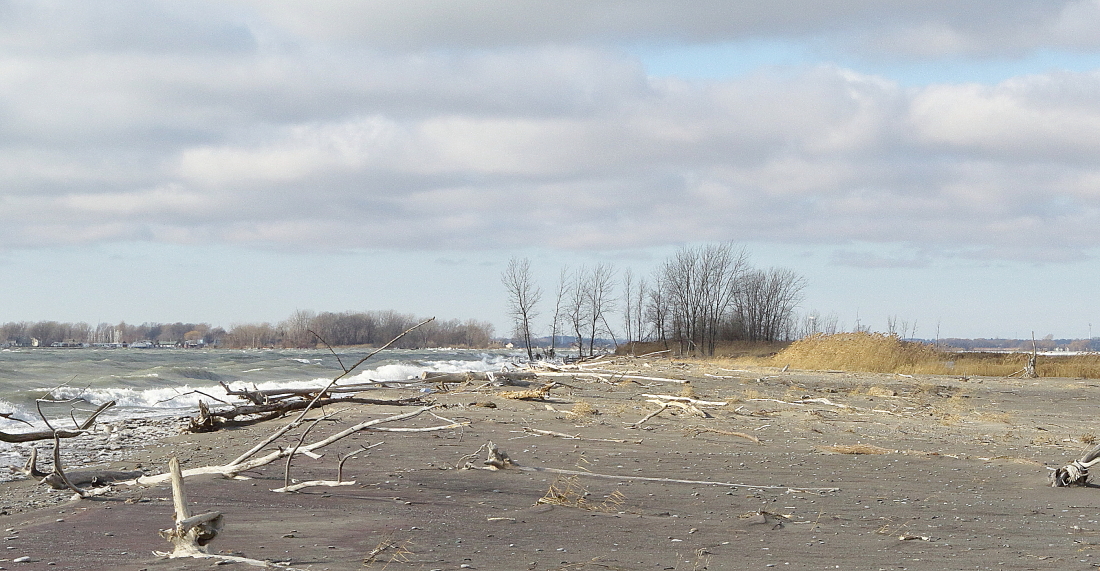
This next photo was taken just at the eastern edge of the wooded area, and shows how open and exposed the majority of the south beach is. The dark line in the distance is the Rondeau forest, about 4 km away.

It was part way along on our way back when a flock of wigeon took flight, and one of our group noticed a small shorebird in flight as well. Fortunately it returned to the edge of the bay, and we were able to relocate it. It didn't take too long to determine it had all the characteristics of a Western Sandpiper! It had only been recorded on this count on one occasion, back in 2001, when I had two at the very south end of the Marsh Trail. But this one wasn't a total surprise, as one had been seen over a several day period back in early December, although it was along the Erieau Marsh Trail. It is likely, although not for certain, that this bird and the one seen at Erieau are one and the same.

We got quite a few photos from a distance, just for the record. The chunky look with no 'neck', the dark bill with a slight droop at the tip, and the bit of dark streaking on the crown all fit the characteristics of Western Sandpiper. But the bird was quite tolerant of us, or at least was more interested in foraging along the shoreline than it felt any threat from us.


Just to show how relatively tolerant of us this bird was, this next photo shows Kevin hunkered down a short distance from the water's edge. Initially the bird was at least 10 metres or more away, but it decided Kevin was not a threat.....
.....and passed by less than 2 metres from him! Way too close to focus the camera on, but at this point, Kevin had an almost face to face look at this bird, which happened to be a lifer for him.

 Kevin, Morgan and Finn had to depart after we got back to our starting point, and our group ended up with 37 species. I kept on for several hours in different parts of the park and I ended up with 57 species for the day. The final number of species had not been determined for the overall count when I checked in with Keith, the compiler, but last evening the number stood at 108 species as reported by about 23 birders spread out over the count circle. There were a couple of more lists to come in, so that number might change. Nevertheless, it is likely to be the highest number for any bird count in Ontario this year, even though it is a far cry from our record of 124 species of last year. We have averaged about 108 species over the last two decades.

 There were a few highlights from other birders on the count in their respective territories, including two or more Golden Eagles (none of the next 4 photos were taken on this count)....

....several thousand American Coot...
...a few Fox Sparrows...
....and at least one Black-crowned Night-Heron. This species is rather unusual having only been seen 9 times over the 80+ years of this count. But it can stay well into the winter, depending on the water conditions. This next photo was taken along a larger creek just north of Erieau back on January 21, 2012.


If you would like to subscribe, or unsubscribe, to Nature Nuggets, send an email to: prairietramper@gmail.com


Wednesday, 11 March 2020

If you 'write' it, will they come? (revised)

First of all, apologies for the way the initial version of this post behaved. I had several people contact me to say that only one of the 15 images would show. I don't know the finer points of how this site works. In more than 460 posts, I have never had this happen before that I am aware of. When I view it on my screen, it seems all is well, but obviously that isn't good enough!

So I will try it again.......


This post will further delay the series on the rare birds of Rondeau. But that is due to the presence of one of those rarities that I featured on one of those posts earlier in the series. Did mentioning it in one of those previous posts have something to do with its current presence? If so, perhaps a few more of those rarities will show up sooner rather than later! Probably not, but one can always hope.

The rare species I am featuring in this post is none other than Purple Sandpiper. It was a couple of days ago, on Sunday, that a report came in from Craig and Katie who had ventured out the South Beach of Rondeau and discovered a Purple Sandpiper feeding along the shore of the south end of the bay/marsh area. Steve and Blake were already in the park and decided to make the trek to look for it. Blake described some of that in his subsequent post, which you can read at this link.

I was not able to get out that day, but yesterday (Monday) looked like a decent day weather wise, and I had the time, so I decided to go. I knew with all of the potential habitat the bird might stick around in the same place or it might not. Such are the risks of birding.

So off I went. I got to the South Beach and the weather confirmed my suspicions: it would be doable, but a challenge. The temperature inland was a balmy 12C or more, but with the quite brisk wind coming off the cold water of the lake at 35-40 km/hr, it was more like 3C. The lake was riled up, so no walking along the firmer sand along the lake side of the beach, just the softer sand a bit inland. There was the usual series of Phragmites stands, shrubby thickets and grape vine tangles to contend with. Fortunately there was wide open space in between these obstacles, and after about three kilometres of these conditions, I arrived at where the bird had been seen on Sunday.

There is a lot of shoreline habitat, but no bird was to be seen. I kept on going towards Erieau hoping the bird was still around, and after awhile, I caught a glimpse of it up ahead. At this point I was probably less than 250 metres from the last wooded part along the South Beach, right across from Erieau and which some folks refer to as Gull Island. It isn't really an island, except for when the lake's wave action breaches and carves out a channel between the lake and the bay.

I got a little closer, and knowing the temperament of the species, I decided to squat down and wait. It started coming my way, probing and feeding on the washed-up vegetation on the more sheltered bay side of the South Beach.


Although it always looked alert, in coming towards me it didn't seem to be the least bit concerned by my presence at all. At one point it came so close, probably no more that about 2 metres of me, that I couldn't get the entire bird in my camera's field of view so I had to reduce the focal length of the zoom lens!

The bird was more than cooperative. It was active all the time, so some of the photos were not as in focus as I would have liked. But of the more than 125 photos I took over the ~35 minutes I spent with this bird, some were definitely keepers. Here are a few:


It was regularly tugging away at a bit of vegetation or something. This next photo shows a stem of some sort, with a couple of small snail shells clinging to it, which was no doubt the reason the bird grabbed on to it.


A question that most of us had was: where did this bird come from? Did it just arrive on spring migration, or was the winter we had, or rather did not have, mild enough and with enough shoreline habitat available to cause it to linger rather than fly off to the southern east coast? I had been out to about this point covering my territory for the Christmas Bird Count last mid-December, and although the habitat was good then, there was no sign of this bird. But there had been an abundance of shoreline and similar habitat around the bay, and most of it was inaccessible, so shorebirds of various species could have been present and just not seen. A Purple Sandpiper had been seen elsewhere around the bay in very early December, so perhaps it just moved out of sight for the next few months. As mentioned in a previous post this past CBC was the first time in about two decades when we did not get any shorebirds at all.

After a delightful time with this relatively rare shorebird, I headed back. That is the western edge of the Rondeau forest way off in the background, about 3 kilometres away.


Thursday, 19 December 2019

Blenheim/Rondeau Christmas Bird Count: my perspective

Bloggers like to tell stories about the exciting things they saw or did recently. Otherwise, why write, right? So when my recent day on the Blenheim/Rondeau Christmas Bird Count was one of my less exciting days on this count, I wrestled with what to say about it. But the more I thought about it, the more I decided there were things that were important to share even if there weren't lots of exciting birds. No White-eyed Vireo or Barred Owl, like last year.

If memory serves me correctly, and as one ages that is less and less likely to happen, I have participated on this particular count for almost exactly 50 years. My first few years were with my dad covering farmland and woodland outside the park, not far from the farm where I grew up. Once my career began with Rondeau in the early 1970s, my territory to cover was park based. And for about the last 35 years or so, it has included some of the most remote parts of the park.

My starting point is at the south end of the South Point Trail, and striking off along the south beach intending to go all the way to the Erieau channel. It is one of my favourite parts of the park, but it can be quite challenging in winter. While this past count day was not the worst conditions I have had to put up with, it was not exactly easy. The temperature wasn't that bad, being just below freezing, but the wind was quite brisk. The trek out was facing straight into the wind which varied between 30-45 km/hr, and the south beach is quite exposed.


Last year I had two friends join me, and they were intending to join me again this year, but on my way out to the park that morning, I got a text stating that due to some health conditions they were not quite over, they would not be making the trek to Rondeau for the count. So I was on my own. That put me at an immediate disadvantage since more eyes are better, and their younger eyes and ears would be very helpful in pin pointing any little bird that was out there. However given the constant noise due to the wind and wave action, I suspect that even their ears wouldn't have been able to hear any birds.

It can be a little risky on the south beach. The first part of the area has very spotty cell service, so if you run into a problem, you are on your own. Cell phones and being able to be in touch with the world at any given moment is a relatively recent phenomenon, of course. It wasn't that long ago that you just ventured out into the wild with no contact and never gave it much thought. How the technological aspects of our times have changed.

At any rate, out I went. I didn't take my camera with me, as I was already loaded down with binoculars, scope, and a few snacks in my heavy winter parka. I scanned the lake regularly with both binoculars and scope, hoping for some goodies such as Red-throated Loon. While that species was seen in much smaller numbers this year compared to last, it seemed that all were along the east beach, and instead of following the shoreline, kept going south and not within my view.

There was an average diversity of waterfowl and gulls, but nothing all that unexpected. The best bird I got was a Green-winged Teal which turned out to be the only one on the count. There were some hunters at the far end of the tip, presumably along the sheltered side of bay/marsh, so I didn't go all the way. I did scope as far as I could see and there weren't any ducks at the end.

One of the stories of anywhere along the lower Great Lakes of late is the high water and the subsequent erosion. Certainly on a sand spit formation such as Rondeau, the effects are fairly significant. This next photo shows what part of the south beach looked like on the bird count exactly 5 years ago.
This is looking towards Erieau. The grasses are predominantly Little Bluestem, a pioneering grass species often found on beach dunes. Fast forward to 2019, and this next photo is what it looks like today, more or less from the same vantage point.
As stated earlier, I didn't have my camera with me on the day of the count, so I decided to go out again today and leave my scope in the vehicle and take my camera instead. It was a bit colder today, and every bit as windy. There was a bit of ice forming along the shoreline, and the bay was totally frozen over. But if I am dressed for the weather and prepared, I really enjoy getting out into the elements to see the forces of nature at work on this dynamic sand spit. Go out regularly and the changes are subtle. But comparing photos over a longer period of time, and it is really evident there are some major changes. This next photo is at the beginning of the break in the south beach that was evident for quite awhile earlier in the year. It was probably the most extensive break in this narrow south beach that I have ever come across in my 50 or so years of exploring this feature. The distance between where I took this photo, and the trees at the far end of the sand spit that locals call "Gull Island" but which really isn't an island, is probably almost a kilometre.
This portion of the south beach has been migrating northward for well over a century. At one point the Erieau part of the peninsula and the Rondeau part of the peninsula were in alignment. The only thing that separated them was the channel at Erieau. Since boat access to Rondeau Bay was important back in the day, a pier was constructed at Erieau in the late 1800s. And that began the changes. The prevailing water currents came from the west, and when they encountered the pier, slowed down and dropped their load of sand, slowly building up the west side which is now known as Laverne Kelly Memorial Park. But when the water currents got around the end of the pier and continued eastward towards the south beach, the resumed velocity caused the currents to pick up sand and move it either along the shoreline, or moved it northward, into Rondeau Bay. It is interesting that a geological consultant in the early 1970s determined that part of the south beach a bit east of Erieau had moved northward ~550 feet from the early 1930s to the early 1970s. With the continued high water level, less ice to protect the shoreline and increase in wave action, it is clear that the south beach has moved quite a bit farther north in the last 40+ years. This next photo was one I took in April, 1989. It shows how even at that time, the Erieau sand spit on the left of the pier had developed so much farther south than the south beach side, on the right. I wish I had taken one just a little farther east, showing how much the south beach curved northward at the time.

While my main intent of today's trip was to capture shots of the south beach to compare it with 5 years ago, I took advantage of some other winter type scenes.

 The ice is really starting to build up on the fallen trees along the shoreline. But with the warmer weather forecast until after Christmas, I expect this new ice will be short lived.

Just to finish up a bit about the bird count. I did see a few Tundra Swans flying over the South Point Trail on my way back.
At the end of the day, I came across a flock of about 350 swans scattered across a field just north of Hwy 3/Talbot Trail.
An Eastern Screech Owl is periodically seen in a cavity of an American Beech tree along Bennett Ave, although it is often only partially visible.
One thing of interest I noted a couple of days before the count was this Northern Brown Snake lying along the north section of Rondeau Road.
It didn't have a mark on it that was noticeable, but it was very dead. Perhaps a bicycle went over it, or perhaps it just succumbed to the cold. It was still there today.

After covering much of the south beach, I checked various other parts of the park that wouldn't have been covered by other bird counters. And then I went to the next major part of my normal territory: the Marsh Trail. In past years, I have driven out to the big parking lot about half way out the Marsh Trail and then walked the rest of the way to the south end, checking out the Long Pond area along the way. However as many readers will know, the Marsh Trail is closed due to being washed away in places, so parts of it are barely passable even on foot at times. The water is down enough to make it more easily accessed on foot, but the trail is officially closed. So instead of driving out, I walked to the parking lot. However with the intensity of the wind, any of the smaller birds that were out there were keeping under cover. Other than a few Bufflehead on the bay and a few Ring-billed and Herring Gulls drifting by overhead, there wasn't much to see. It was a long walk for all I got. I did see this non-birdy thing along the trail, however.
I'm not sure what the intent of this wildlife cam was, but I got a photo of it taking a photo of me, if in fact it was working.
In spite of the overall low numbers of birds, the results were quite satisfying, totalling 102 species at last count. We have only missed hitting the 100 mark three times since 2000, so everyone was pleased with the results. My total for the day was only 34 species, one of the lowest I have ever had, but with the weather being what it was, and the fact that many of the smaller birds left the area with the intense cold spells in the last few weeks, I couldn't complain. But by the end of the day some of my leg muscle were complaining, having walked an estimated 17 kilometres in those conditions and carrying all that gear!

Only three more bird counts to go in the next couple of weeks.


Wednesday, 19 December 2018

Rondeau/Blenheim Christmas Bird Count 2018: a terrific day

The Rondeau/Blenheim Christmas Bird Count is now history. And a bit of history was made. Although we didn't quite set a new record for species observed on the day of the count, at 114 species we missed by one. However we added a new species to the overall count: a Baltimore Oriole which had been seen sporadically prior to the count period, but stayed frustratingly absent until yesterday, which is still within the count week, so it is now added to the overall list of 192 species.

My day started out (not so bright and) early by arriving at Rondeau to try for owls in the pre-dawn. Although the wind was calm, suggesting great conditions for calling and hearing them, the residual wave action from brisk northeast winds the day before interfered quite a bit. I only heard two Eastern Screech Owls although there might have been more that heard me.

I met up with my two birding companions for the day, Josh and Jodi, at the Visitor Centre and off we went, driving the west side of the South Point Trail to the south beach. I was fortunate to have both Josh and Jodi with me for their camaraderie as well as their younger and superior eyes and ears

I always spend a bit of time first thing scanning the lake for waterbirds on the move. Sometimes there isn't much movement, but today was an exception. Aside from the usual mix of scaup and mergansers, we had White-winged Scoters and an amazing 18 Red-throated Loons. The loons were not exactly surprising, as up to a 100 had been seen off the east beach in previous weeks. But since there are only a couple of records of this species for the count (two I had seen back in 1981, and another two last year) it was noteworthy indeed.
From a previous day
Combined with those that others saw in their respective territories, our count total of about 70 red-throat individuals was a terrific start to the day.

The walk out along the south beach was certainly one of the best days in the 30+ years I have been doing this area. Some years it is inaccessible due to snow, ice, howling wind and strong wave action battering the fallen trees lining the lakeshore. Today it was amazingly pleasant being sunny with very light winds, and temperatures nicely above freezing. The south beach is a narrow strip of sand that (usually) separates the marsh and lake, at least when the high water levels haven't breached the sand spit causing a brisk and steady flow of water back and forth. There was very little wave action, making trekking along the beach on either the marsh or lake side very easy, which is always important as we cover the approximately 7-8 kilometer hike to Erieau and back.

Small birds were few and far between, although we did get things like Marsh Wren and Swamp Sparrow. One of the goals of this bit of territory is to see the diversity of waterbirds tucked in at the marsh/bay interface. We ended up with 21 species of waterfowl, including the only Northern Shoveler on the count. Other highlights included two Sandhill Cranes, two Belted Kingfishers, four American Coot, a single Great Blue Heron and a single Snow Bunting.
photo from a previous day
Our return to the start of the beach walk was highlighted by none other than a hatchling Northern Map Turtle, struggling against the waves.
photo courtesy of Josh Pickering
It is possible that some earlier wild wave action dislodged this little fellow from its winter hibernation site buried in the sand somewhere along the beach.

A brief stop at the Visitor Centre at mid-day turned up things like American Goldfinch and White-throated Sparrow.

Our next area to target was the Marsh Trail, and in particular the southern parts. As is sometimes the case, birds were noticeable by their absence, although we did see lots more waterfowl on the open water of the marsh.....
.... and get things like Bald Eagle. We ended up with five eagles for the day.

On the return to the trail entrance, we added a few Red-bellied Woodpeckers and a single Pileated Woodpecker, among other species.
Josh and Jodi tracking down birds
With the main part of our designated territory finished, and being now at the north end of the park, we decided to spend a bit of time searching for things like the White-eyed Vireo and Great Kiskadee. The former had already been seen briefly by others, but the latter species remained absent. Our walk along the southern side of the maintenance yard cedars was initially quiet, and I pointed out where I had seen and photographed the vireo just a few days earlier. And there it was again, in exactly the same spot.

A couple of other birders were nearby looking for it, so we got their attention and the white-eye kept us occupied for several minutes.

After a while, our group dispersed while Josh and I headed to the north side of the maintenance yard where the kiskadee had sometimes been seen in days gone by. A few minutes later we decided to head to the campground where the kiskadee had also been seen from time to time. On the way over, while Josh was facing me in conversation he stopped while looking over my shoulder exclaiming 'there is an owl'. I quickly turned and looked. It was probably only 50 metres away and low in a deciduous tree. It was a large owl, but clearly not a Great Horned. It only took a split second for both of us to conclude it was a Barred Owl! This was totally unexpected, as there are only 4 previous records for the park checklist area, and none since 1981. After getting a few photos, we quickly texted some other birders.
It was late enough in the afternoon that most had already finished their territories, so were able to arrive fairly quickly. The owl was on the move, however, and by the time the ten or so birders showed, it had moved into the campground. And there it was found again, at one point having picked off an Eastern Grey Squirrel which had undoubtedly never had any experience with Barred Owls (and would never have another!).

So although we didn't luck out with the kiskadee, the Barred Owl was certainly a bonus bird even though it was not a new species for this count, having been recorded on one previous occasion.

The Great Kiskadee continues to be absent, not having been seen or heard since December 9. It is interesting to know that one had shown up in recent days in Indiana, so perhaps it has made its move towards a more likely part of its range. Or maybe 'our' kiskadee will reappear somewhere in the Rondeau area, since it has a habit of disappearing for several weeks and then reappearing for a week or two. Time will tell, but for now, I have replaced my header photo of the kiskadee with the latest celebrity, the Barred Owl.
A final note: in addition to the Northern Map Turtle we saw, I heard that others saw Eastern Garter Snakes and Eastern Comma butterflies in at least a couple of different places on this warm and sunny day. Certainly not the kinds of things one expects to find on a Christmas Bird Count, but I guess here in the banana belt, we should expect the unexpected!