Showing posts with label Ruddy Turnstone. Show all posts

Saturday, 10 June 2023

Yellow-crowned Night-Heron, and more birds

 An adult Yellow-crowned Night-Heron was the star of local birding in the last couple of days.

It was seen at the Keith McLean Conservation Lands, at the pond closest to the house. It was quite tolerant of the dozens of birders who came and went over several hours, giving extremely good views.  The parking lot to the property got filled up quickly, and undoubtedly will continue to do so as the weekend has arrived.

There have been a few records for the Rondeau area in the past, but none since 1999, although with the extensive habitat present in the Rondeau vicinity, it is entirely possible that more have come and gone without being recognized. I have seen two, both an adult at a slough along Harrison Trail, and a sub-adult in a slough at the west end of Gardiner Ave, and managed to get photos of both.

Most of the time while I was present, the bird was standing on one leg, as herons often do. It does have both legs, as this next photo shows.

While birding, at least related to migration, has slowed down somewhat, there has been a continuing trickle of migrants. Shorebirds in particular have been around where there is suitable habitat. A few days ago, the Erieau Rail Trail was good to see shorebirds. Black-bellied Plovers are always a highlight to see. There were at least 40 present while I was there, and showed various stages of plumage as the following two photos illustrate.


Dunlin are pretty regular....and were photographed along the beach/lake in the townsite of Erieau...
....as are Sanderling.....
...and Semiplamated Sandpipers. I saw them also along the Rail Trail, but were too far away to get photos like these. Clearly the sandy/gravel beach was not on the mudflat!
Still along the Rail Trail were other birds on the shore, but not 'shorebirds' per se. Three or four Canvasback have been seen regularly. It is hard to know why they are still present, as they should be farther west and busily nesting.
This Mute Swan family also fell into that same 'shorebird' category.
The family of Great Horned Owls continue to be seen, at least from a distance. There are two owlets here, although the one at the lower right of the photo only shows a partial pic.
Other wildlife show up from time to time, including this family of Groundhog while I was photographing the plovers. There were actually two youngsters but the other one had already skedaddled out of the camera frame as this one was in the process of doing.....
...leaving momma to go back and keep an eye on them.

A visit to the Mitchell's Bay area turned up a few things. Black-bellied Plovers again, this time with some out in a field along the North Shore Trail, and a few more on the mudflats between the trail and the lake.


This one-legged Dunlin was able to hop around fairly easily, but I am unsure as to whether it could get enough to feed on to attain the energy required to get it to its northern breeding territory.
A single Ruddy Turnstone in fairly full breeding plumage was there....
...as were three Semipalmated Plovers.
Great Egrets are, of course, quite regular since there is a breeding colony a couple of kilometres away. When they are at the edge of a pond feeding, I find them quite wary and quick to depart.
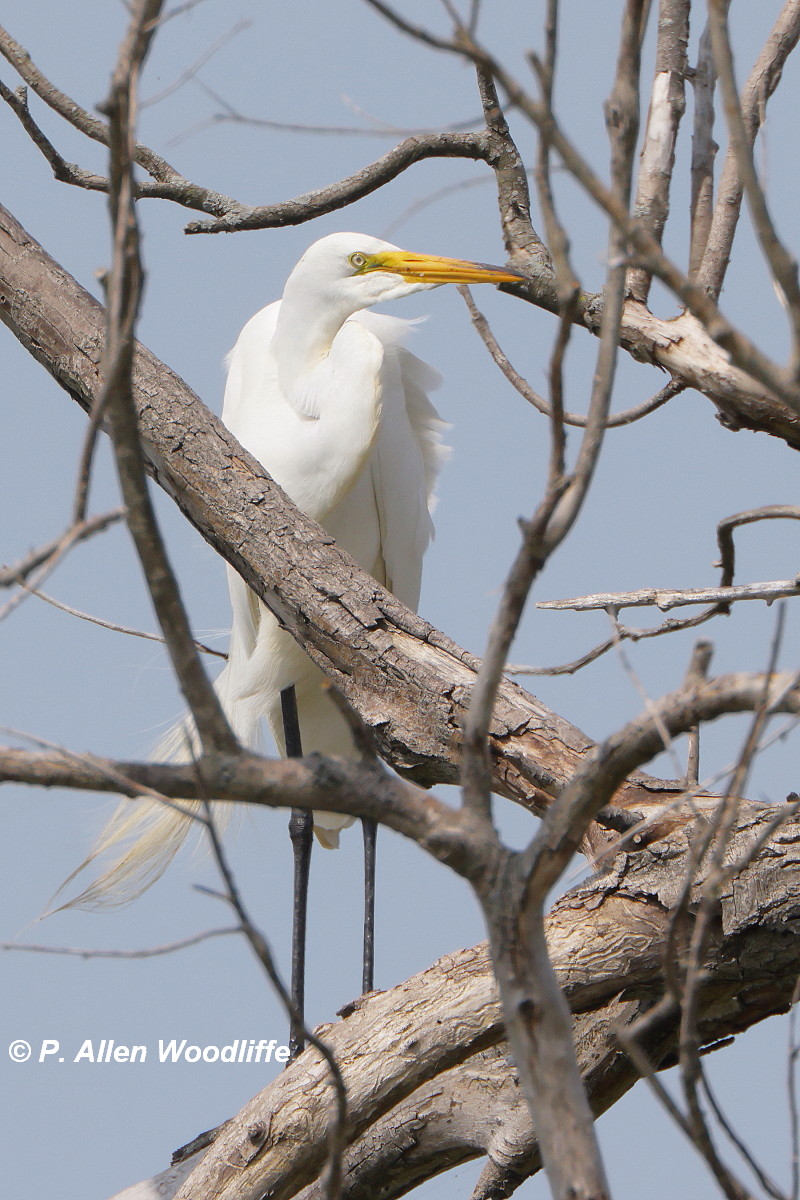
If I come across one in a tree, they seem to feel much safer looking down on me and allow a closer approach without showing much concern.
A pair of Sandhill Cranes flew by. There is often a pair in the area.
And Mute Swans....what can I say. There are usually several dozen within view, although since this one, I thought, was photogenic so I obliged.
An Eastern Kingbird paused briefly for a photo shoot.

On an outing to Rondeau a few days ago, I was concentrating mainly on forest photography. The smoky skies allowed for an evenness in the light, reducing the contrast one will typically encounter on a bright sunny day. More on that in a future post. But I kept an eye and ear open for birds, and came across these along Tuliptree Trail. Most were in the lower canopy, giving some challenging light conditions to work with.

There were at least a dozen Cedar Waxwings....


...and the local, resident Acadian Flycatcher cooperated better than usual.

Hunkered down into some regenerating Green Ash was this Yellow-bellied Flycatcher.

Continuing with a flycatcher theme, in a more open spot with a blue sky, was this Eastern Wood-Pewee.

And a stop at the grassy field area of Clear Creek Forest Prov Park, turned up at least 20 Bobolink claiming territory. Most were males. They didn't get too close to my vantage point, however, other than the occasional one.


If you would like to subscribe, or unsubscribe, to Nature Nuggets, contact me at: prairietramper@gmail.com


Wednesday, 31 August 2022

Waterbirds, and the fastest animal on the planet

 There are lots of waterbirds on the move these days. While I have been out looking at rare orchids and other plants, that will wait for a later post.

I've been to St. Clair NWA recently, as it is not far from home, and if I choose a time or a route where there is no one else, it is extra pleasant for my tastes.

There is an ongoing presence of the aggressive and invasive Phragmites along the trail, which is somewhat unfortunate in that it obscures the view into the extensive wetland. But with the associated more natural vegetation along the way, there is lots of insect activity to be found.

Monarchs were abundant and most of the ones I saw were looking quite fresh.

This similar looking one, a Viceroy, was looking pretty worn.
There were a few crescents. This one is likely a Pearl Crescent, owing to the tip of the antennae not appearing to have any orange.
I thought this colour of a grasshopper was unusual. It might just be the relatively common Carolina Grasshopper.
Not an insect, obviously, but a critter that feeds on insects is this Leopard Frog. They were quite numerous along the trail.

There were quite a few swallows on the wires along the roadway, such as this Barn Swallow, considered a Species At Risk......

...and also along the trail and road entrance were a few Prairie Thistle, another Species At Risk.

One thing the Phragmites and other vegetation along the trail allows, is a closer approach to somewhat open areas in the dense cattails so as to get a relatively close view of the numerous Great Egrets scattered throughout the wetland. This first one was almost too close to focus on. This NWA, and almost any large wetland along Lake St. Clair, is one of the best places in Ontario to see this species. Of course it helps that there are at least a couple of egret colonies within a short flight distance of the NWA.

Once they get startled away from their feeding area, they may take up a spot in a more distant cluster of trees or shrubs, keeping an eye for when the coast is clear.
When they are startled from their feeding spot, they may circle several times affording some great photo opportunities.

Maybe if the water levels are appropriately lower over the next few weeks, there will be quite the spectacle of over-night roosting egrets, like this that occurred for several weeks in September and October of 2012. There were close to 150 birds using this spot. This photo was taken a few minutes before sunrise, using a long exposure. The birds were almost completely motionless. It is one of my many favourite memories of SCNWA, and I had a nice 24" X 8" canvas print made up of this photo.

Other large wading birds offer similar photo ops, but they aren't usually as numerous to begin with.

Great Blue Heron

Sandhill Cranes used to be quite a novelty to be seen in southwestern Ontario other than on migration. Fortunately it is a species that has increased considerably in the last 2-3 decades, and so are a regularly seen species throughout the breeding season.

Sewage lagoons are popular for shorebirds. I've been to the Blenheim lagoons several times lately, as there has been a good variety of shorebirds, including some rarer ones. For example a young Red Knot has been seen periodically. I didn't get any photos of it, but here are the ones I managed to shoot.

 Baird's Sandpiper were one of the rarer ones. It stood out with its wing tips extending beyond the tail. The long, slim wings really stood out when it was in flight.


Least Sandpiper

Greater Yellowlegs
Lesser Yellowlegs greatly outnumbered their larger relatives.
Lesser Yellowlegs

Pectoral Sandpipers were present in small numbers.


This young Ruddy Turnstone was a bit unusual. They are more often found along sandy shorelines of the local lakes.

Semipalmated Plover

Semipalmated Sandpiper

There were lots of these sandpipers, with probably at least 75 or more around the lagoons in variable sized groups.

One of the highlights was not a water bird type at all, but at least one Peregrine Falcon, formerly an endangered species. It would be high in the sky, and then almost out of nowhere, come swooping in and flushing some shorebirds, hoping one would be vulnerable to be picked off. I didn't see it catch anything. Perhaps it was just practicing.
It was hard to keep the focus locked on to the falcon as it sometimes flew low and fast. This species is the fastest animal on the planet, as they have been known to dive at speeds of over 300 km/hr! But of all the shots I took, I managed to get a small number with satisfactory results.

Non-shorebirds were not fazed at all by the falcon. These two Midland Painted Turtles were soaking up some sun.


If you would like to subscribe, or unsubscribe, to Nature Nuggets, send an email to: prairietramper@gmail.com