Showing posts with label Red Phalarope. Show all posts

Friday, 21 February 2020

Rare, Regular Migrant Birds of the Rondeau Area

In my last post I featured quite a few rare types of birds that are known to breed, or have attempted to breed, within the Rondeau Provincial Park Checklist Area.

This post will feature some of the rare but regular migrants that have not yet demonstrated any evidence of breeding. While the previous post required some evidence of breeding to be included, I don't have as clear-cut a definition of rarity. Therefore this list is somewhat subjective.

Generally anything included here will be out of regular breeding range and always an extra highlight to see. Undoubtedly an observation would be posted on a rare bird alert of some type. However they are almost 'expected' rarities, in my opinion, as they occur most years, or at least likely once every 4-5 years. I didn't go into all the Rondeau records to see if a species fits that definition exactly, so take this definition with a grain of salt. If you don't see something on this list that you think should be included, it might be on the next list if I felt it was a bit rarer, or it may be because I don't have a good enough photo yet :-).

They will be featured more or less alphabetically rather than in any checklist order.

First up is American Avocet, a striking large shorebird that shows up briefly every year or so, typically at sewage lagoons, flooded fields, or sometimes along the shoreline.
Next is Cattle Egret, not a species that is considered native to North America, but arrived as a result of major storms bringing a few of them across the Atlantic in the middle of last century. They show up irregularly, and have bred in southwestern Ontario on occasion. The closest places are at Fish Point on Pelee Island back in 1976 where breeding was confirmed (I saw the nest), and another time at Walpole Island in the early 1980s where it was in breeding condition near some appropriate habitat, but never confirmed.
 Eared Grebe is a common nesting species in the innumerable wetlands of the prairie provinces, but only seen in the Rondeau area from time to time on migration.
 Eurasian Wigeon usually appears in the spring and/or fall when huge numbers of puddle and diving ducks show up on places like Rondeau Bay. It can be a challenge picking one out amongst the thousands of ducks at those times of year, especially if there are a lot of Redheads. They often are only well seen through a 'scope. This particular individual was at the Keith McLean Conservation Lands in 2019, on 'Lake McLean'.
 Franklin's Gull is pretty unusual, and I almost put it into the rarer category. However there are enough records over the years to indicate it fits here, at least during those years when masses of the smaller Bonaparte's type gulls are passing through.
 Along with large numbers of geese, one might find the occasional Greater White-fronted Goose. They are seen almost annually, but are sometimes harder to find when mixed in with large numbers of the larger Canada Goose.
 Henslow's Sparrow used to be more regular than it has been. It is an Endangered species in Ontario, and it is doubtful that any nest in the province now.
 Nelson's Sparrow is a regular breeding species in the far north, and when it migrates is very challenging to find. It is a very furtive sparrow and it probably passes through annually in small numbers. It occurs primarily in the fall and may linger, presumably when the urgency to reach their wintering ground isn't quite as strong as it is to head north in the spring.
 Purple Sandpiper is typically a very tolerant shorebird, enabling one to get some good photos. However it doesn't occur all that regularly, and can sometimes go undetected for several years in a row. Usually when it does appear, it may do so for only a very few days.
 Red Phalarope is another shorebird that nests in the far north, and is seen very irregularly in the Rondeau area. Both of these shorebirds definitely get a lot of attention when word gets out that they are around.
 Red-throated Loon was always considered a fairly rare migrant. However in the last few years, they have been documented much more regularly in the fall and early winter on western Lake Erie, and can be seen from good vantage points along the Rondeau shoreline. It was first recorded on a Rondeau Christmas Bird Count back in 1981, and not again until 4 years ago. On the 2018 count we had a huge number flying through conservatively estimated at 70 individuals.

 Ross's Goose was considered a real rarity in eastern North America not that long ago. But the numbers have recovered recently, in part due to the major increase of the similarly looking Snow Goose population in the northeast. It was first recorded on a Rondeau Christmas Bird Count in 2001 and we have had it on 5 other CBCs since then.
 Snowy Egret is a species much more common south of the border, and erratically seen in Ontario. Most often they appear in mid to late summer, when post breeding wanderers may show up and stick around for a few days, depending on the weather and the feeding opportunities.

Trumpeter Swans aren't really a migratory species in the sense that most of the rest of the birds on this post are. They have never nested in the Rondeau area that we know of, and it is only in the last couple of decades where they are seen somewhat erratically.
 Western Kingbird shows up periodically, which follows a general pattern that some members of the flycatcher family are known for. You will hear more about that in the next post or two. There are a few records for the Rondeau area, but several years can go by in between records, and they don't stay long.
 Worm-eating Warbler is one of those southern warblers that gets a lot of attention when one is reported. They appear most often in early May when the weather conditions are such that a strong warm front comes up from south of the border. In the last few years, however, it seems that one of the dominant wind directions in early to mid May is from the east or north east, which holds back good movements of the more southern specialties like this warbler.

That is it for this post......come on back for a future one which will feature what I consider to be much rarer migrant species, with another post featuring mega rarities at some point after that.

Monday, 25 November 2019

Late autumn birds, butterflies and a snake!

The weather has been fairly typical autumn-like, with a hint of winter some days and a reminder of some of the warmth of early autumn on others. And that translates into some birds of winter, as well as some hold-overs of late summer and early autumn.

The snow of a couple of weeks ago was a contrast to what we had been experiencing, and with it came some late autumn and early winter migrants such as American Pipits, which were widely scattered and as abundant as I had seen them in several years.....
 ....as well as good numbers of Fox Sparrows, here seen scratching around in the less snow covered area under some Red Cedar trees.
Ruby-crowned Kinglets were fairly abundant. They are in constant motion, making the attempts at photography challenging indeed. There are usually far more photos slightly blurry or out of focus than there are keepers, and the delete button gets used quite regularly.

 As Ruby-crowns diminish in numbers, their equally active Golden-crowned relatives increase.
 A few hardy thrushes occur, such as Hermit Thrush. On one occasion it seemed like it was a 'thrush' day, as I had about a dozen Hermit Thrushes, about 15 American Robins and an equal number of Eastern Bluebirds, all members of the Thrush family.


Eastern Phoebes, a member of the flycatcher family which seems to be quite adaptable to feeding on non-fly items, such as berries, have been noted regularly in small numbers. On occasion one will still be around for the Christmas Bird Count coming up in mid December.
Shy Phoebe
All through that were a few lingering shorebirds. Dunlin and Killdeer were widely scattered along shorelines, and even in still flooded fields.

 And then a warm-up happened, perhaps the only time we will experience anything like 'Indian Summer' this year. For one day only it was unseasonably pleasant, with bright sun, very little wind, and temperatures reaching 9-10C. And the wildlife responded, however briefly. There were butterflies flitting around at Rondeau, including this Eastern Comma......
 ...and an Eastern Garter Snake was seen stretched out across a sunny spot on a paved road at the park. It seemed hesitant to move, but I encouraged it to move to the side so it wouldn't become a victim of an unobservant (or uncaring) driver.
 I heard, and then saw, this cricket busily 'singing' its song at the base of the Visitor Centre siding.
A few other bird species were a pleasant surprise. Red-headed Woodpeckers used to be quite common during the spring and summer period, but in recent decades are quite unusual. Having one linger this late is even more unusual for this migrant.
 Baltimore Orioles are usually many hundreds of kilometres south of here by now. For some reason this brightly coloured male is content (?) to stick around a well stocked feeder just north of the Visitor Centre. It isn't always easy to find, as it appears out of nowhere and may spend a bit of time in a willow tree, which typically has some leaves remaining. It makes it difficult for the camera to focus.
 But eventually it may come to the feeder, which the owners have stocked with jelly with a few meal worms mixed in. Not the kind of spread I would like on my toast, but the oriole seems to enjoy this source of protein. Last year there was a female Baltimore Oriole that was seen erratically in the Rondeau campground even into January. Maybe this is the year that we will be able to add the species to the Christmas Bird Count.
A couple of weeks ago there was an immature Red Phalarope which showed up at the Blenheim Sewage Lagoons. I got a few photos on that cold, snowy day and included them on a blog post shortly afterwards. Red Phalaropes are quite irregular for this area. We sometimes go for several years without any reports at all. But just this past weekend, an adult in its winter/basic plumage was seen at Erieau. Fortunately it stuck around for both weekend days, giving numerous birders a chance to see it.
It was quite cooperative, and a life bird for some of those that came to view it. Cameras were clicking steadily, and photos have shown up on numerous eBird lists and blogs. Fellow bloggers Dwayne Murphy and Ric McArthur were there at the same time I was, and blogger Blake Mann had been there earlier.

Sandhill Cranes and Tundra Swans are harbingers of mid to late autumn, and they have not disappointed this year. While the cranes used to be a rarity in this area, it is not unusual to see or hear several dozen to several hundred if you are at the right place at the right time. This first photo is part of a group of about 135 I saw today out near St. Clair NWA. I saw about 235 there a few days ago.

Incoming!
Tundra Swans are around by the thousands, mostly in the fields near Lake St. Clair and the NWA. On occasion 3-4000 may be widely scattered in one very large field, but more typically smaller flocks are scattered over various field throughout the western portion of the former Dover Township.


 And almost right on time, the first of the season Snowy Owls have appeared. I had been out several times over the previous couple of weeks checking out their usual haunts, without seeing any. However most of the crops of corn, beans and carrots, etc., are now off, making it more conducive for the owls which like wide open spaces, as well as for those of us looking for them. I photographed this one today in a recently harvested corn field. In recent years it is not all that uncommon to find several in a day during the peak of winter. Who knows how many will appear this year? Regardless, it is always satisfying to see the first one of the season.


Monday, 11 November 2019

'Winter' shorebirding

Yesterday I spent a bit of time checking out parts of the former Dover Twp, looking for waterfowl and hoping to find the first of season Snowy Owl.

As is typical of this time of year, Tundra Swans are fairly abundant. I noted at least 5000 birds scattered about in various locations.

There were a few Great Blue Herons in the fields, and likely a lot more in the wetlands.
 A flock of Wild Turkeys were out in a recently harvest field.

 Towards the north end of my route, I came across 5 Sandhill Cranes, three of which I got in this next photo.
I did not see any Snowy Owls. Perhaps that isn't surprising, as there have only been one or two reported so far in Ontario this fall.

But what a difference a day makes. The snowy forecast for today did indeed occur. And this is what it looked like outside our kitchen window this morning. Maybe this burst of wintry conditions will encourage Snowy Owls to move a little farther south into Ontario!

But some shorebirds either didn't get the memo for this change, or could have cared less. A bird alert in the early afternoon from Steve C indicated that the Blenheim Sewage Lagoons still had a surprising number and diversity of shorebirds, the most unusual being a juvenile Red Phalarope. This species is quite uncommon in Chatham-Kent, and along the lower Great Lakes in general. So in spite of the crummy driving conditions (I'm always reluctant to go very far during the first snowfall, since many drivers aren't driving according to the conditions!), I ventured out to the sewage lagoons. One other birder was just leaving, with a satisfied look on his face, and as I was leaving, two other birders arrived with anticipation on their faces.

The gloomy conditions and steady snowfall was anything but ideal for viewing, let alone photography. Looking through melted snow flakes on the binoculars, in addition to those unmelted ones that provided a steady white curtain across the viewing area, just wasn't what one likes to contend with. But it was either that or likely miss this bird. There were at least nine species of shorebirds, numbering almost 50 individuals that one could see. With the far pond being partly vegetated, it is likely there were even more taking shelter.

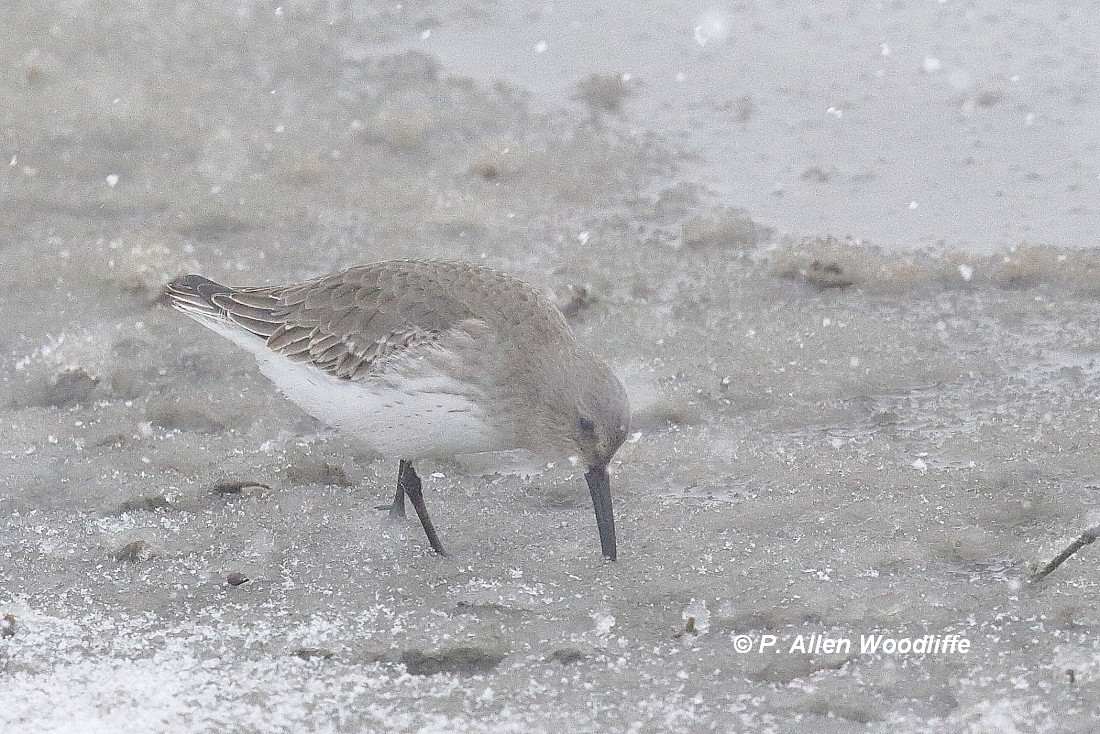
I didn't try photographing all species, but I did manage to get records shots of the following: (and note that the first three species shown are walking through slush, hoping to find some little morsel to keep up their energy.)
Dunlin
Pectoral Sandpiper
Wilson's Snipe
 And the main target species: Red Phalarope. It was actively moving around one or more of the sewage ponds, so it wasn't easy to get many photos. I found the most successful method was to hunker down along the edge, behind some vegetation and wait for the bird to swim closer. It wasn't always easy to get the best focus as it darted this way and that, but some turned out reasonably well considering the circumstances. With snow flakes landing in my camera's eyepiece, it was sometimes hard to look through and get the camera aimed at the right spot let alone locking into the proper focus.
 There were other shorebirds, including Least Sandpiper, White-rumped Sandpiper, Long-billed Dowitcher and Greater Yellowlegs, all of which I photographed here just a few days ago and featured in my previous post. There were a few other things that came along, so I dutifully captured their likeness on my camera as well.
Bonaparte's Gull
 There were at least two or three dozen American Pipits feeding along the edges, and this one flew almost right at me before landing.
American Pipit