Showing posts with label Boogie Woogie Aphid. Show all posts

Saturday, 29 October 2016

Sun worshippers at the beach and mid-autumn stuff

It has been that kind of week.....some days being quite cool and others much warmer than usual. With the abundance of Turkey Vultures passing through, some have been noted enjoying the sun while resting on the beach. They aren't the normal sun worshippers, but about the only ones out there this time of year.

Beach dunes are good places to find other animal life. While checking the east beach of Rondeau recently to see if any rare geese were mingling with the hundreds of Canadas resting along the water's edge (there wasn't), I came across a life-and-death struggle. A large Chinese Mantid had found a Woolly Bear caterpillar and was proceeding to chow down on it.


Normally the mantid would not allow me to get this close with my macro lens (I was a mere 8 cm away for a couple of these shots), but she was more interested in the meal than escaping me. It was interesting that the caterpillar was still attempting to escape even though the mantid had a very firm grasp, but this is one Woolly Bear that will not have to wait to see what the winter might bring.

While I was on the sand photographing this mantid in action, a type of Ground-hunting Spider came by.

There wasn't much bird activity at the beach that day, so I ventured into the woods. There weren't many birds there either, so I guess it is clear that the fall migration has passed.

Even though the birds weren't very plentiful, there were other things to see and photograph. Earlier this year I had posted about the Boogie Woogie Aphids which are found on American Beech trees. There are still some around doing their thing.


The change in leaf colour is delayed this year compared with most years. According to visitors to central Ontario, even there the leaves are not as far along as they normally are. These next few shots are images taken at Rondeau in the last day or two. While it appears that there are lots of leaves already on the ground, the predominantly green of the trees indicates that the vast majority of them are still holding on quite successfully.
Bennett Ave
Bennett Ave
Rondeau Road
Spicebush Trail

Spicebush Trail


Amidst the leaves on one of the paths of the Spicebush Trail was this large female Eastern Garter Snake. It was in the shade and the ground was cool. The only thing that moved was its tongue as it flicked it in and out trying to determine if I was a threat or not.

Did you see it? Maybe this next photo will make it a bit more obvious.


A year ago, on October 26, some of the same vantage points looked like this:
Bennett Ave
Rondeau Road

This Hawaiian Beet Webworm moth was spotted on my van's door which was parked at the head of one of the trails. It is apparently an uncommon migrant to this area, the northern part of its range.
 
Autumn is a great time for seeing the fruiting bodies of fungi on the decomposing logs and stumps.
Pholiota sp.


Turkey Tail

A stop at one of the local sewage lagoons can add to the day's interest, and one time I stopped at the Ridgetown lagoons. As expected there were several hundred Canada Geese, and after a careful examination, I came across these two blue phase Snow Geese on the water.

They weren't on the water when I first saw them, but at one point something stirred up many of the geese. It turns out that this young Bald Eagle was drifting along right over head, and not all that high up, putting the geese in a bit of a panic. I presume that the geese thought it was safer in the water, so that in case the eagle swooped down, the geese could try and escape by diving under.

There were a few other ducks around, including a couple of dozen Northern Shovelers, most of which which were going through their moult and looking a bit drab.


Friday, 26 August 2016

Endangered orchid, Boogie Woogie Aphid, shorebirds and more

Late August is normally prime time for one of Canada's rarest orchids. The endangered Nodding Pogonia (Triphora trianthophora) only occurs in Canada at Rondeau Provincial Park. The numbers have fluctuated considerably, so annual monitoring is beneficial to understand how the population is doing. I have had a study plot in place since 1985, and have monitored the population there almost every year since.


Nodding Pogonia

It is a small, but very attractive little orchid. I posted a fairly extensive blog about it previously, so will not repeat myself here. If you want to know a bit more about this endangered species, check out this blog post. 

A couple of days ago I met with park staff to visit the study area to see what this year might have in store. I was concerned about the excessive dryness in June and July, as moisture to keep the delicate tuber type root healthy just below the diminishing leaf litter is critical for the species survival.

We parked along the road and headed into the forest, crossing ridges and sloughs to get to the study area. Once there, we checked out the places where this species had been known to flower in previous years. After awhile, it was very evident that it was not a good year for Nodding Pogonia. We saw a grand total of three plants, one of which had grown well but been affected by a blight of some kind. The other two plants had flowered briefly a few days earlier, and had one or two developing buds that, if conditions are favourable, may yet flower.

On the next ridge over, also occasionally good for this orchid, we saw another three plants, none of which had flowered yet but had developing buds. Some years have had over 1000 plants in this general study area. It looks like this year will be less than a dozen. The species is known to fluctuate from year to year, but with the diminishing leaf litter and very dry conditions, perhaps the delicate tubers will not survive dormancy to try another year....time will tell.


While searching for the orchid, my survey colleague called me over as she had noted something quite unusual....it was a branch of an American Beech tree covered with fuzzy white things.
When the branch was bumped, the little fuzzy white things would raise up their hind ends and wave a filament up in the air to make it look like it was dancing!

This is the Beech Blight Aphid, a.k.a. the Boogie Woogie Aphid due to its hilarious behaviour of a branch full of fuzzy white things waving back and forth in unison!

A closer look:


These aphids suck out a lot of sap from a beech tree. After sucking the sap, they excrete copious amounts of a honey dew type of liquid. Since the aphids are concentrated on branches and sometimes even leaves, the honey dew may drip down on a lower branch in considerable concentration. This resulting concentration of honey dew supports the mould Scorious spongiosa, which is especially evident after the leaves have fallen, and may last well into the next summer.
This process seldom does any real or long-term harm to the tree, although sometimes individual branches may die.

Another interesting observation on our orchid search was discovering a small caterpillar that initially looks like a bird dropping. Such mimicry is part of its defense. It also has large eyespots, presumably to appear more fearsome to a would-be predator.
This is the very young larva of a Spicebush Swallowtail butterfly. After it goes through a few growth spurts, it will be a bright green with large eyespots, before going into the pupal stage and eventually emerging as an adult butterfly. I wonder how many times I have passed by such imitation bird droppings without giving them a second glance?

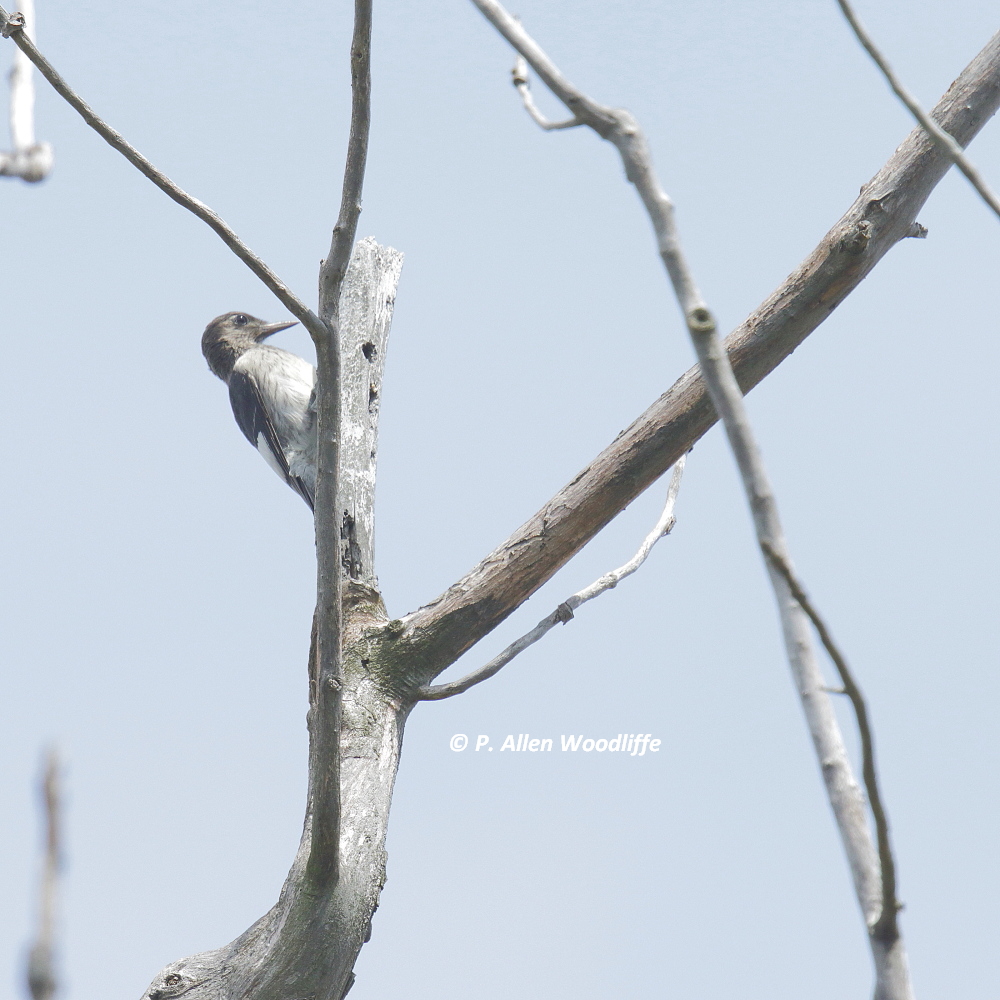
I had heard from the McArthur's that Red-headed Woodpeckers were hanging out in the vicinity of their cottage. We had hoped earlier in the season that a pair of adults would nest in a partially dead cottonwood tree, but that didn't happen. They must have found a location more to their liking. Regardless, both adults and young were now showing up. Although they remained quite high in a dead cottonwood while I was there, I managed to get a few shots, which I had to crop considerably.
Adult Red-headed Woodpecker

Young of the year Red-headed Woodpecker

After leaving the park, I decided to check out the Blenheim Sewage Lagoons. I must admit that I was hoping for a Common Ringed Plover, so I wouldn't be tempted to travel to Toronto to see one (Note: I haven't gone to Toronto, and likely won't). Not surprisingly, I didn't see one here. In fact I didn't even see its look alike relative, the Semipalmated Plover, on this visit. But it was still worthwhile, with half a dozen or so species of shorebirds. Sometimes they are very skittish and getting photos is difficult. I find that if there are a lot of Killdeer, the other shorebirds are more skittish, responding to the startling cries of the Killdeer. When Killdeer are fewer, the other shorebirds are more tolerant of birders.

There were the usual species.

Least Sandpiper

Semipalmated Sandpiper
Lesser Yellowlegs
And there were some less common species including this next one which is my first of the year,
Baird's Sandpiper
Stilt Sandpipers are relatively uncommon in the spring, but more common in the fall as juveniles show up.
Stilt Sandpiper
Although it was windy, I walked along one of the more sheltered paths to see what butterflies were there. I got some very nice shots of the rare Common Checkered Skipper on an earlier visit, and I saw at least 11 individuals on this one. However I only had my camera gear that was the equivalent of a 22X binocular, which could only focus at about 3 metres, so I was pleased to get even one shot that turned out half decent. It blends in quite well on the top of this Wild Carrot.