Showing posts with label nesting. Show all posts

Thursday, 28 September 2023

A bird with the aerial view decides to nest

 Nesting Mourning Doves in southern Ontario aren't uncommon at all. But the timing for this one, the chance to photograph it from start to finish, and from the comfort of air conditioning over the course of those mostly hot and humid days of August, gave the opportunity to create this post.

 This pair didn't even start to build their nest, as sparse and flimsy as it was, until early August of this year. The vast majority of bird species have finished their nesting cycle weeks earlier, and some have even begun their southward migration. But for a year-round resident species, the lateness of the summer isn't all that much of a problem.

A pair of Mourning Doves (MODO) have attempted to nest at this spot in the past. On one occasion, they were at least partially successful. Building a nest of their style does not lend itself well to this particular location. The branches of the White Pine tree are quite smooth and getting a bit of nesting material to stay long enough to construct the next stages is next to impossible, especially if there is any wind. Nonetheless this pair persisted, and eventually they had what they thought would do the job.

In spite of the visibility of this nest location, photographing it was not without its challenges. If there was any kind of wind from a northerly direction, some pine branches got in the way at just the wrong time. And for any morning photos, which was generally the most active period, the nest was backlit. Overcast days were generally better for morning photos, but that put the ISO of the camera higher than I would have preferred. The mirrorless R7, which I used almost entirely for these photos, handled the increased ISO much better than my other DSLR cameras,

 They were well along at this stage, but still had some finishing touches to complete.

It was interesting to see some aspects of the nest building process. The male comes in with a bit of nesting material.....


...and then typically climbs onto the back of the female, which is sitting in the partially constructed nest, passes the material over and she decides where it is needed.

This next photo was taken on Aug 8 the first day of incubation of what presumably were two eggs, the typical number for this species.

Day 1 of incubation

I took a few photos over the next several days, but there wasn't a whole lot of difference to show. It was on Day 14, that the hatching began. Nothing really to see in this photo, but the adult's general actions indicated something was happening underneath. The adult kept getting up and looking at the eggs it was sitting on....

Day 14 after incubation begins

...and by Day 16, activity increased to the point where it was clear hatching had begun.

It was around this time that I was reminded of a well-known bird observer from many decades ago, who made numerous astute and detailed observations of a common nesting species, the Song Sparrow: it was Margaret Morse Nice, and you can find a bit of information on her at this link. She didn't have high quality optics and camera equipment available, but used her exceptional ability to observe detail, and record that. She was definitely ahead of her time, and contributed observations of bird behaviour for several decades.

I am not putting myself at the same level of observing and interpreting bird behaviour as she was, but I thought at least I had the optical and camera equipment available to document some things that I could. While MODO is a commonly breeding species, they don't often nest in such a location that has an accessible view.

During the first few days after hatching, there wasn't much to observe. I took a few photos, but by Day 21, 5 days after hatching the two young were much more visible. They grow quickly!
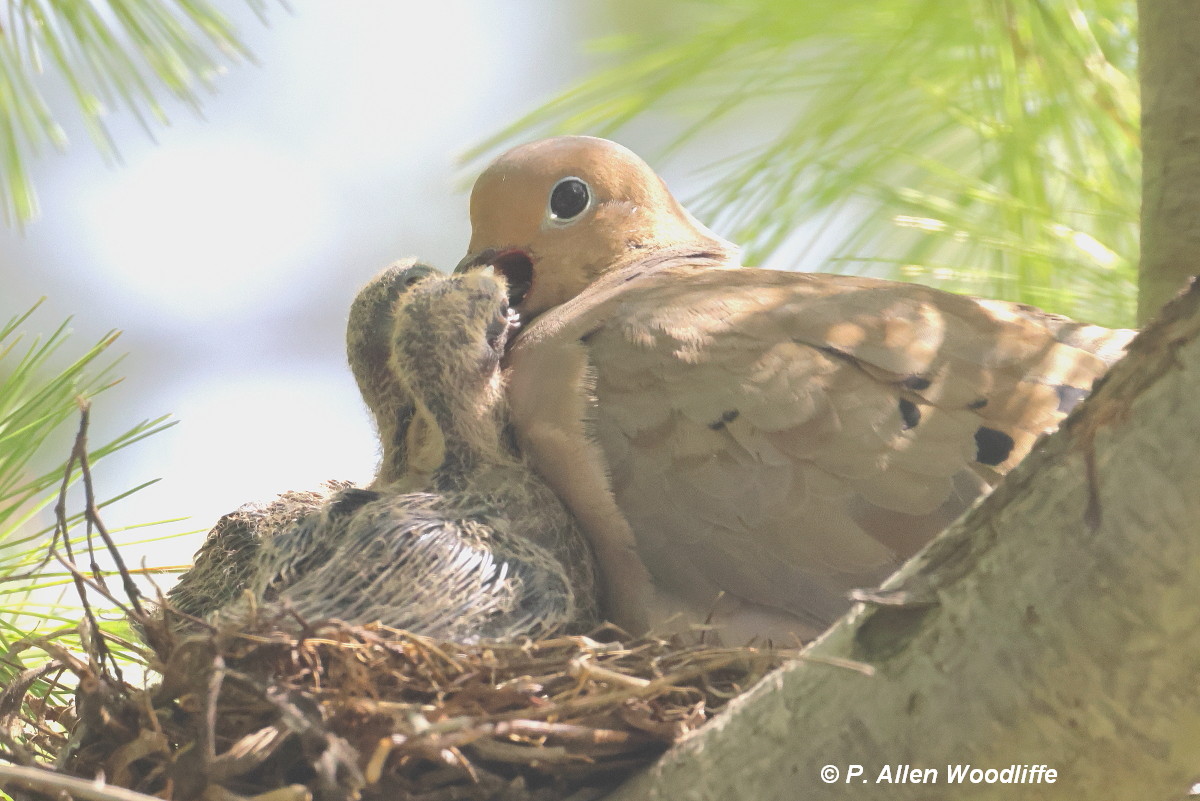
The MODO does not feed its young in quite the same way most other species do. The adults ingest their normal diet of seeds and then proceed to create 'pigeon milk' in their crop. The young, as shown in the photo above, then 'dig in' to the adult's mouth and either get to where the pigeon milk is waiting, or sometimes cause the adult to regurgitate some of the pigeon milk to a more accessible part of its mouth. This goes on during the entirety of the nesting period, and continues for even a couple of weeks after they have left the nest. Then they will eventually switch over to the normal MODO diet of seeds.

Most of the first few days the young, when not feeding, are content to sit low in the nest, barely visible. It seems the adults were getting a bit restless from time to time, probably to stretch to compensate for the long periods of just sitting.

Day 22

By Day 26, when the young were about 11 days old, they were much more visible and active in their own way.


By Day 29, they were getting quite large, and a crowded nest was more and more the case. When one tried to move around at the edge of the nest, it might have even lost its balance a bit. At least this caused it to develop its wing muscles in preparation for future air borne mobility.

I should mention that the vicinity of the nest seemed to have been kept clean. In many songbird groups, the adults remove the white fecal sac from the nest and immediate area so that predators have less to go on when looking for something to prey upon. I never saw the removal of white fecal sacs with the MODO. However I did frequently observe the adult poking around in the nest, and coming up with and even eating small dark things which I expect was what the young had eliminated from their digestive system.

The young were increasingly observed just by themselves at the nest. It was definitely getting more crowded.

Day 30

The next morning, on Day 31 and about 15 days after hatching, there was only one bird in the nest. It seemed a little more restless and it was observed moving around on the supporting branches beyond the nest itself.

Day 31
It spent a lot of time on the edge of the nest, looking for where its sibling had moved on to.....
---and discovered it was sitting at the edge of the garden, all by itself unless an adult came in to feed it.

Later that same day, the presumably younger bird had decided it was time to get out, and by mid-afternoon it too, had vacated its home and re-joined its sibling.

They were seen in or near the garden on a regular basis for several days afterwards, always on the ground, but with decreasing frequency.
By Day 38, they were seldom seen at all, and on occasion clearly had developed their flying capability to get to above ground locations. At this stage, they were looking more and more like the adults.

MODOs are still around the neighbourhood, and will be for the remainder of the year and beyond. But it is next to impossible to determine which are the youngsters that came from this nest.


If you would like to subscribe, or unsubscribe, to Nature Nuggets, send an email to: prairietramper@gmail.com


Saturday, 6 March 2021

Early migration continues, nesting begins

 Spring is teasing us, and bringing back more birds, as well. A recent visit to St. Clair NWA didn't turn up a lot of migrants, as most of the wetland is still frozen. However there were lots of Red-winged Blackbirds scattered throughout. They were in the trees....

....and spread out amongst the remnant cattails. All were males, trying to establish their territory for when the females return in a few days.

I made a trip out to the mouth of the Thames River. The river is almost entirely open in the lower reaches, but when it enters Lake St. Clair, there is still lots of ice. I figured there would be lots of gulls, and I wasn't disappointed. There were easily 4-5000, but most were too far out at the edge of the ice. I had hoped for some of the rarer species, but all I saw were the more expected ones. However the ones that were in close are always an interesting study. There are numerous 'battles' over a dead fish. Given the number of dead fish lying on the ice, one would think there was enough for all, but most had been picked over. These Herring Gulls were by far the most common and close enough for photos.


Some seemed content to just stand and watch. Maybe they were trying to look inconspicuous, waiting for an opportunity to swoop in and catch another gull looking the wrong way.
Others were squawking about something or other.
This next one was taken at a different time, but illustrates the type of feistiness that gulls can display.
Ring-billed Gulls were not nearly as common.
One of my all-time favourites was taken a few years ago, showing these two Ring-bills definitely having a difference of opinion. I liken it to a mated pair, and one is definitely 'hen/gull-pecked.' Regardless, these adult gulls are at their most impressive appearance, with the feathers looking crisp and clean, and the bare skin parts looking quite vibrant. I especially like the bright red mouth.

A recent trip to Rondeau was good for a nice long walk, but not for seeing many birds. This Red-tailed Hawk was the only bird I was able to photograph successfully.

After being at Rondeau, I swung by Shrewsbury, and amidst a large group of Canada Geese, I spied this Cackling Goose. They are often hard to get a photo of, as they are so much smaller and often at least partially hidden behind the larger Canada. But this one came out into the open enough to get a clear view. The size difference of the body and the bill is pretty obvious.

Yesterday there were two Greater White-fronted Geese at the Ridgetown lagoons. Since I was heading that way anyway, it was an obvious reason to stop and check them out. Unfortunately at that particular time, they had gone into hiding. I met the Sadler brothers, so I hoped that more eyes would give a better chance to locate them, but it didn't work out that way. They weren't visible in the north lagoons or the south pond. There were hundreds of Tundra Swans, and a mix of other geese and various ducks, but no white-fronts. I even drove around to the west side of the south lagoon and stood on the cover on the back of the truck to see over the berm, but still no white-fronts to be seen. There is a fairly extensive stand of tall shrubs in the water along one part of the lagoon, and it is possible they were out of sight there. At any rate, some other birders who stopped by an hour or more later did report seeing them. While we didn't see the white-fronts, we did see a small group of Snow Geese drop in. But once they got mixed in with the swans, their much smaller white bodies were harder to pick out. The first photo shows at least parts of 4 of the Snow Geese......

.....and this one stands out a bit better.

Tundra Swans were coming and going regularly.

And in other news, there are now more local eagle nests showing evidence of nesting. This first one is just east of Thamesville, seen from Longwoods Road, and an adult seems to be in an incubating posture.
This next photo is of the nest at the north end of Scane Road. It shows two adults right on the nest, but with them both standing on or in the nest, they may not have any eggs in it quite yet. But I'm sure there will be eggs soon, and a few weeks later, the eaglets will be peering over the edge.


Wednesday, 9 March 2016

Eagles, eagles and more eagles

Yesterday (Tuesday) was a great day to be outside. Although at one point the temperature inland reached 18C, it barely got to 8C out at Rondeau once one was exposed to the wind coming off the ice of Rondeau Bay......there was still a fair bit of ice, and the water wouldn't have been much warmer.

I wanted to get out to the south end of the Marsh Trail at Rondeau to see what the eagles were up to. I had suspected that the nest that the one pair had been using for the last few years was no longer there. This is the very distinctive nest tree within about 200 metres of the Marsh Trail.
photo of 2014
In checking more closely yesterday, this nest tree is indeed gone. Presumably it got blown over in one of the fierce wind storms of last fall. Of course it is an ill wind that doesn't blow in something good, and those storms resulted in some memorable birds such as the invasion of Franklin's Gulls, the Sabine's Gulls, etc.

But for the eagles, it presented a problem. Fortunately they decided to move to a nearby White Pine tree that they deemed suitable and built the nest....perhaps this tree is not quite as sturdy as the previous one, but it may work. At least it doesn't have as much foliage at the top to catch the wind, so maybe it will last. Yesterday, one adult eagle was on it for awhile, with the other adult perched in a dead tree not far away.

photo of new nest, 2016
I decided to hike out to Long Pond and then to the very south end of the trail, a total hiking distance of about 8 kilometres. There were thousands of waterfowl out on Rondeau Bay, with the usual mix of divers and puddle ducks, but also including a single male Eurasian Wigeon. A wigeon with a brick red head is nice to see, but was too far away to photograph, unfortunately, so a 'scope view was all I was able to get.

A couple of Sandhill Cranes emerged from the marsh, giving their trumpet tremolo.

Land birds were beginning to build. There were several hundred Red-winged Blackbirds, not surprisingly, and all males.
A few American Robins were around....I saw probably at least 50 in the park, but only a small number on the Marsh Trail which isn't there prime habitat.
There were a few Swamp Sparrows lurking furtively in the lower cattail vegetation, but none cooperated for the camera. Same for several Song Sparrows. But the good number of American Tree Sparrows did not let me down.
A year or so ago, it seemed that a second pair of Bald Eagles had established a territory in the expanse of the Rondeau Marsh, right near the south beach at the edge of the forest. At first I wasn't certain if it was just a second nest by the known pair, as sometimes they will build one or more other nests. This may happen when one of the adults dies and a new one enters into the pair. But yesterday I saw a pair of adults in a tree within 100 metres of the nest tree at the south end, so it is apparently a separate pair. The birds are about 1.5 km from where I took this shot, so with the thermal shimmer, distance and heavy cropping, it isn't all that sharp.

Much to my surprise, I came across a third pair! I saw an adult perched in a tree at the Rondeau marsh/bay edge, where the cormorants have recently taken up nesting. While watching the one adult, another adult flew into view, went to the water's edge, then to the edge of the marsh where it picked up a stick, and flew up to a small tree and proceeded to work away with it in the largest nest structure of that tree cluster!
This image shows the two adults, at quite a distance, and if you look closely at the right hand side of the image, there is a white arrow that points to the largest nest structure. Clearly this is not the kind of tree that I would expect a pair of eagles to build a nest in, but who knows? It may just be an early attempt that will be for naught. Or they may attempt to occupy this nest and raise young. Or eventually move to a better tree before wasting too much time with this flimsy structure. I expect that the presence of the other nests in the trees, made by cormorants, may have stimulated the eagles to try it out. At any rate, it will be interesting to see if anything comes out of this apparent nesting effort.

It was during the first half of the previous century that there were typically two pairs of Bald Eagles nesting at Rondeau. That dropped to one pair by mid-century, and didn't increase back to two pairs again until likely 2014. Now it seems that a third pair is trying to get in on using this large marsh/bay complex, which would be precedent setting as far as I am aware. It certainly seems that with the increase in the area's Bald Eagle population which I described a couple of posts ago, it may not be all that surprising that a third pair is around. It would seem that there is adequate territory, as the nests are all at least two kilometres from each other. All of the pairs stuck pretty much to their nest area during the entire 4+ hours I was out there.

It is also interesting that a 7th eagle, a sub-adult, was around yesterday, too, but well away from any of the three nesting pairs.

Another reason I wanted to get to the south end of the trail was to see how the controlled burn for Phragmites turned out. I mentioned this event a couple of posts ago.
I was impressed! I haven't seen this swampy ridge this clear of vegetation ever, and hopefully the nasty Phragmites that used to be here will be less of a problem for a few years. Maybe it will give park staff a chance to attack the many other areas in the interim where Phragmites is dominant.

After leaving the park, I decided to swing around by the Ridgetown Sewage Lagoon. There was a good variety of ducks, and several hundred Canada Geese, but only a couple of dozen Tundra Swans. However at least 5 Greater White-fronted Geese were still around.


Friday, 26 February 2016

Quest for the nest.....

Bald Eagles aren't the novelty they used to be, but they still are a highlight to see.


At one point in the first half of the last century, eagle advocates determined that there was on average an active Bald Eagle nest for every mile of Lake Erie shoreline between Long Point and Point Pelee. But by the early 1970s, there was only one. That was at Rondeau Provincial Park, where historically there had been two active nests. When the first Ontario Endangered Species Act came into effect in 1973, the Bald Eagle was listed along with 11 other species.

The culprit for the decline? Primarily it was the liberal use of DDT, which caused egg shells to become so thin that they broke when the adults attempted to incubate them. There were also deformities in beaks appearing in birds that had hatched, resulting in young birds not being able to fledge.

Even the nesting pair at Rondeau, at least for a few years, did not produce any young, or at least not every year. When young were raised, it was often only a single eaglet.

Of course in many respects, it has been a good news story since that time. DDT was banned, at least in Canada and the US. DDT was still used in developing countries of Latin America and elsewhere, but since eagles didn't migrate to those locales, and the fish they were feeding on here weren't affected by DDT, the plight of the eagle improved considerably.
Adult eagle with fish in its talons
There have been other issues that eagles have faced, including loss of habitat as well as persecution in areas where they weren't protected by legislation due to the perception that they were killing young livestock. In recent years there have been effects by power lines, wind turbines and such. As unfortunate as those incidents are, the Bald Eagle population has continued to climb in numbers.

For example in the early years of the Blenheim/Rondeau Christmas Bird Count (which began in 1939), it was common to get anywhere from 1-11 Bald Eagles on the count. By the late 1950s through the mid 1980s, it was rare to get more than 2-3, and some years none were counted. Since 2000, it has been unusual to get fewer than 10 eagles, with a high of 17 recorded one year.


On the St. Clair NWA Christmas Bird Count (CBC), which started in 1981, Bald Eagles were only counted about half the time for the first few years and only one or two if any. Since 2002, that count has averaged 10 eagles, with more than 20 counted on two of those years. The all-time high of 27 was on the most recent count.

The Wallaceburg/Walpole CBC, which began in 1986, did not have a single Bald Eagle for the first 10 years but in the last decade has only missed them once. The most recent count recorded 8 birds, an all time high for that count.

A new CBC has been started in the Skunk's Misery area, which includes parts of Chatham-Kent, Elgin, Middlesex and Lambton. In only its second year, in early January, 2016, there were 27 Bald Eagles tallied.
 Of course some of the count results have been weather related, but in general, this last decade and a half has seen a continual increase in Bald Eagle numbers throughout southwestern Ontario. And it was about a decade ago when the species was re-evaluated and taken off the provincial Endangered Species list. It is currently ranked as Special Concern, a much lower level of significance.

When I was working at Rondeau in the 1970s and 1980s, it was always a highlight to go out to the nest and band the young birds. The adults liked their privacy as well as having good access to the extensive marsh, so getting to their nest was not easy. The next few shots have all been scanned from old slides.
Approaching the nest tree, where the nest is in the upper left hand corner
We had to cross several sloughs, and even with chest waders, it was not always easy to get to the nest without getting wet. Fighting our way through the gnarly buttonbush while carrying equipment made it an additional challenge. During the first few years, a researcher associated with the University of Wisconsin was the lead bander, as he had been keeping tab on all the eagle nests around the lower Great Lakes. Of course there were very few nests to keep track of in those days. On occasion someone from a TV station would join us, to document this newsworthy event. Even though they were told they would need chest waders, they didn't always come prepared. But at least they kept the camera equipment dry.

Once we got to the nest tree, one person would climb the tree, using climbing spurs and ropes (although one time an energetic young fellow just had climbing spurs, and no other equipment. He did it free hand.......That wouldn't happen in today's world, with emphasis on health and safety.....)

The climber would get into the nest, and if we calculated the bird's age closely enough, the birds would stay put. Then each one would be carefully put into a burlap bag and lowered to the ground, where the awaiting crew would take measurements and a blood sample, and then an aluminum band was placed on the leg. Ideally we would band the bird when it was about 5-6 weeks of age. A younger bird might have smaller legs, and the band would be too big for the leg. If the bird was older, it might attempt to jump out of the nest, fledging prematurely.

On one occasion we got a 'jumper' and the eaglet, with wings outspread, floated down to the adjacent marsh. I managed to catch up to it, grasping its lower legs to keep the talons from doing any damage, and took it to the rest of the crew where the banding process was completed. It was returned to the nest in the bag, and it did not attempt to jump again.

Measuring the femur
Putting on the band
Measuring the beak
On occasion, there were even three birds in the nest, certainly an indication of improved health in the adults. Two is the norm, so three birds were a major highlight.

But the main reason for this post is not to present this bit of history....most readers will likely know a good part of it. No, this post is to try and generate interest in finding active nests in 2016, especially in the Chatham-Kent area.

The local Bald Eagles have been in their early stages of courtship and nesting behaviour for a little while now. In fact some may have been busy repairing old nests or beginning new ones, even late last autumn. But now that spring is not all that far off (we hope!) serious nesting activity is near. Egg dates for this latitude around the lower Great Lakes, typically starts in mid-March. The farther south one goes, the earlier the nesting season starts, not surprisingly. For example in Florida, the egg-laying season usually starts in mid-November.

Nests are most visible right now, and until the trees leaf out in May. Active nests will have one or more adults nearby, confirming their active state.

I am aware of up to 18 nests in Chatham-Kent or immediate vicinity.
  • two at Rondeau, one visible from the Marsh Trail and the second only visible from a small section along the south beach.
Rondeau nest
  • one in the immediate vicinity of Clear Creek Forest Provincial Park
  • another one along the Lake Erie shoreline east of Morpeth
  • one along the Thames River, east of Thamesville. It occurs along an oxbow on the north side of the river, and is visible from Hwy 2/Longwoods Road.
Along oxbow, east of Thamesville

  •  one along the Thames River on the south side and closer to the Delaware of the Thames First Nation
  • one at the north end of the Scane Sideroad, on the south side of the Thames River
  • one that used to be adjacent to a small gravel pit northeast of Thamesville, although it may not still be usable, and that pair might now occupy one of the other nest territories not far away
  • one on the south side of the Thames River, in a tree line south of the Maple City Golf Club
  • one along the Snye Channel (a.k.a. Chenal Ecarte)
  • one, or possibly two, along the Lake St. Clair shoreline south of SCNWA
  • one on the south side of Lighthouse Cove. Technically it is in Essex Co, but it is associated with the Thames River and the river mouth
    Lighthouse Cove nest
  • one in a woodlot east-northeast of Wheatley, although I haven't seen that nest for a few years and it may not still be active
  • one in a small woodlot north of Talbot Trail, just west of Dillon Road
  • one in a larger woodlot complex north of Dealtown. It is possible this pair and the one along Dillon Road may be the same, as eagles sometimes have nests that they rotate to.
  • one along the Sydenham River, east of Dawn Mills.
There is a possible nest in a small woodlot north of Shrewsbury. It is a recently constructed nest, although it is not very large.....yet. To add to the uncertainty, in the last few weeks some of us have seen and photographed Bald Eagles perched on the nest or in nearby trees, and we have also seen and photographed Red-tailed Hawks doing the same thing! It will be interesting to see who eventually makes use of this one. Or since Great Horned Owls typically begin nesting before either eagles or  hawks, maybe this one will be used by a Great Horned Owl! Stay tuned....

These are the ones that I am aware of. Not all are necessarily active this year, and likely there are others. Given that Bald Eagles feed on fish a lot, or other creatures of wetlands, nests are typically found within one to two kilometres of a large water body or river.

If you are cruising the countryside in the vicinity of Lake Erie, Lake St. Clair, the Thames River or the Sydenham River, keep an eye open for Bald Eagles or a large cluster of sticks that could be their nest. And if you find something that fits, please let me know, either through a comment on this blog, or via email: prairietramper@gmail.com
Immature Bald Eagle