Showing posts with label Common Merganser. Show all posts

Wednesday, 18 February 2026

More birds, less winter??

 It has been nice to see the intensive wintry conditions subside, at least a bit. So I have managed to get out to a few local places to see what is around. 

 A recent visit to St. Clair NWA wasn't terribly productive, but the combination of a nice walk and a few birds made it worthwhile. American Tree Sparrows are often around, scrounging on the now exposed grassy trail and retreating to the adjacent cattails when a hiker disturbs them.

A few Canada Geese are going to and fro, but not stopping in the still frozen NWA.
Views of the frozen NWA, taken from the observation tower, follow. It won't be many weeks until there is lots of open water, and hopefully lots of water birds!

Rock Pigeons are here and there, and on a really cold day they seldom fly, but as the weather warms up a bit they become less tolerant of a stopped vehicle with something pointed out at them. These three were part of a group that was a little more tolerant. 

I decided to make another trip up along the St. Clair River. There is still lots of ice floating around, making it difficult to get close enough to many of the waterfowl. I was hoping to catch up to a couple of Trumpeter Swans that are here and there, and although I did see them, I didn't get any photos of them. This next photo is of two I saw a few years ago.

A few other, much more common species of waterfowl, were more available for my photographic attempts. This first one features a male Ring-necked Duck in the foreground, and a male Redhead in the background.
 

male Common Merganser

male Canvasback
On another outing, I headed a bit east, into southeastern Lambton County, where it seems that eagles tend to over winter. I have seen and photographed Golden Eagles here in the past. However on this occasion I only saw one Bald Eagle, but didn't get an acceptable photo. I did manage a few other things, such as a fair number of Horned Larks in scattered locations, so I spent a bit of time capturing a few photos of them as they hung out in the fields adjacent to the road. They blend in quite well when in the corn stubble.


Horned Larks are fun to watch, and photograph. It is the the Bird of the Year for the American Birding Association.
A Red-tailed Hawk hung out on a tree quite a way from the road, but enabled me to get this heavily cropped photo.
Closer to home, I spent a bit of time hiking some of the less snowy/slushy roads and trails at Rondeau. I got a good hike or two in, but didn't photograph many birds. This male Pileated Woodpecker was the most successful of my efforts, and didn't seem to mind my camera pointed at him for several minutes.


I came across this workings of this Poplar Vagabond Aphid. I hadn't paid much attention to them in the past but they are more abundant than I thought. It looks quite a bit different in the mid-summer, and will try and get photos of it later this year.

Even closer to home, I checked out the water treatment plant outlet just downstream from Chatham. The open area is not large, but there are a few dozen ducks making use of it. Amongst the mostly Mallards, were a couple of others, such as this female Common Goldeneye, shown first...

...and this female Common Merganser. A Green-winged Teal was also there but I didn't get any photos of it.

 And even closer to home, were some American Crows, not surprisingly, and I took this through the kitchen window. Doesn't get any closer than that!


If you would like to subscribe to Nature Nuggets, send an email to me at: prairietramper@gmail.com 

Friday, 6 February 2026

Wintry landscapes, lots of ice, and a few birds

 I managed to get out to the southern part of Chatham-Kent a couple of times, but the birds were not all that plentiful. There was virtually no open water along the east beach, although small open spots well out had a few waterfowl. The ice formations were attractive, however.


 The east beach was attractive to a few Bald Eagles. I think I have seen at least 2-3 on every time I made it out.


 There were some scenic parts of the woodland, even though the birds were almost non-existent.


However at a couple of feeders at the north end of the park, there were often at least some bird activity. A Carolina Wren isn't very common in the winter, but on occasion they can be found visiting a feeder under the current wintry conditions.

Here a Black-capped Chickadee and Downy Woodpecker were putting up with each other on opposite sides of the feeder.

I went over to Erieau, hoping there were two or three open spots in the Lake's ice to appeal to at least a few ducks, but it wasn't to be, at least unless a change in the wind caused some openings.


For something different, I went up along the St. Clair River as there is usually enough movement in the river to create some openings.


There was a small group of swans well out on the ice, and resting so it was hard to tell what species they were. I had some Mute Swans elsewhere. The bit of gray on some of the plumages suggest they were likely Tundra Swans, which isn't surprising, although a few Trumpeter Swans have also been seen. However getting a look at their beak would have been really helpful

One of many Redheads was constantly diving for something. I didn't see that it caught anything for its efforts.
Others seemed to be content to mostly just swim around.
These are a few Mute Swans, easily identified by their bill.
A few Common Mergansers were in the area....
...as were Common Goldeneye...
...and Canvasback.

I also spent a bit of time roaming around the former Dover Twp. There was no shortage of American Crows.

At St. Clair NWA, now that it is open to hikers again, there were a couple of dozen American Tree Sparrow feeding on the open grassier sections of the trail.
This Beaver lodge is, I think, new. I don't recall seeing it along the usual stretch of trail I hike along, but with the NWA being closed from October to the end of December, there was time for them to build one.
 The view of the NWA from the observation tower is rather bleak. Not much interest there for birds at the moment, but come spring....I will be there regularly!

 At a usual spot that has several Wood Duck nesting boxes, Eastern Screech Owls will take up one as a wintering residence, peaking out to capture some of the sun's warming rays.
This next item is what is probably the result of a Poplar Vagabond Aphid causing some deformation on the outer buds of a Poplar tree.
Where there is a bit of open area in a field, you can sometimes find a few Wild Turkeys. There were at least 40 birds gathered in this open space.


 If you would like to subscribe to Nature Nuggets, send an email to me at: prairietramper@gmail.com

Wednesday, 15 January 2025

Early January (mostly) birding

 Certainly one of the most sought after local birds over the last couple of weeks is the Harris's Sparrow. It is a species that shows up quite irregularly in this area, so as this one has been predictably popular, there have been many dozens of birders out to see it. On one occasion there were so many vehicles lined up, it was hard for local travelers to pass through.


It hasn't always been easy to photograph. On my first attempt, it was a sunny day, which isn't necessarily a bad thing, but the bird was almost always along the fence row at the side of the road, and behind grasses that were in a constant state of movement due to the wind. Therefore the camera's focus as well as the backlit conditions made it almost impossible, and this next photo was the best I could get.

Fortunately on another day, it was cloudy bright, and the sparrow sat up on a rail for long enough to get the first couple of unobstructed photos.

It was accompanied by a good mix of other winter time sparrows, including White-crowned Sparrows and others.

Before it got too snowy and cold, I managed to capture a few other things, such as one of four American Robins I saw on an outing at Rondeau....

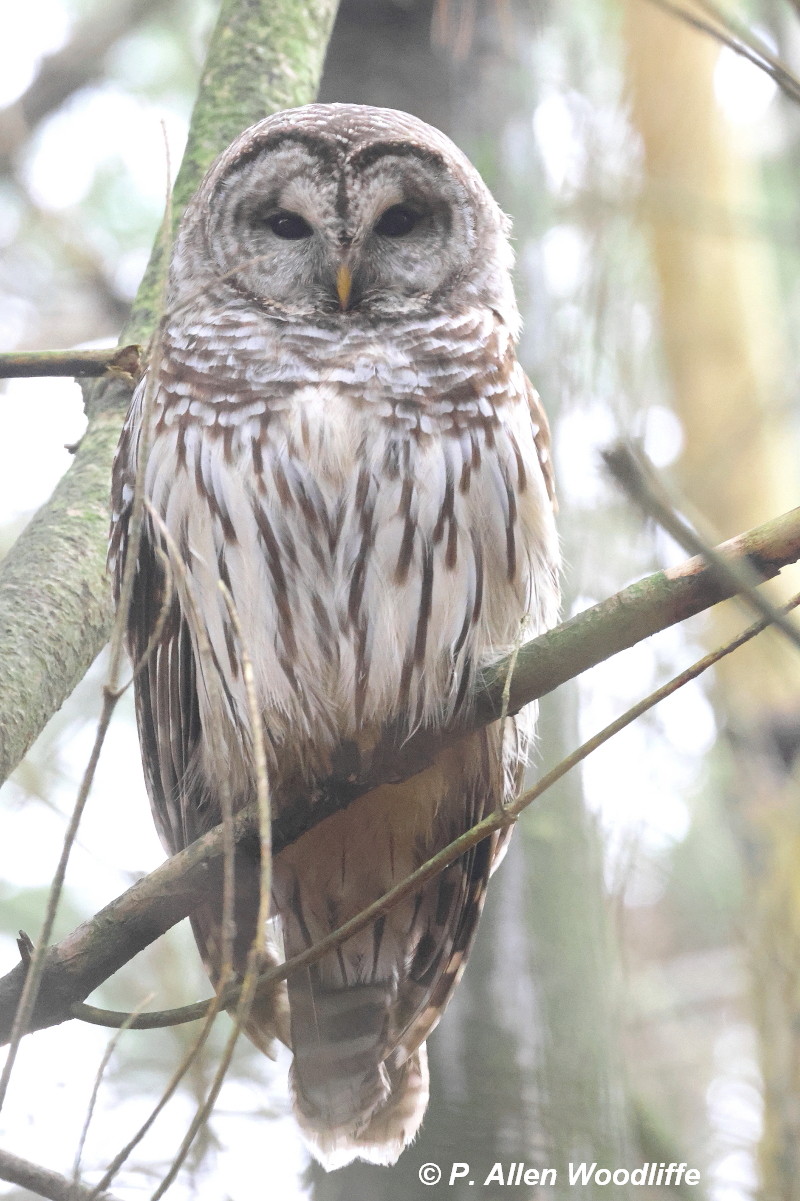
....the Barred Owl at a nearby conservation area, which has been there for several weeks but roosts unpredictably and is often not found by the searchers.....
...from 1-6 Killdeer hanging out at a small unfrozen area at the Keith McLean Conservation Lands....
....a few Sandhill Cranes...

....and a Snow Goose. All nice things to add for the season.

As is usual for the time of year, in spite of the colder than average temperatures, a bit of the water in the Erieau vicinity remains open. Lingering waterfowl continue to hang out, at least for now. At first the birds are well out in the open water, as they are undoubtedly still cautious in being too close to human activity due to the continuing waterfowl hunting season. This first photo shows a mix of typical ducks, including Ring-necks, Scaup sp, Redhead and a good number of American Coot, the latter of which technically is not a duck.

Mostly American Coot
As the cold continues, waterfowl are forced to be closer to shore, much to the delight of viewers and photographers.
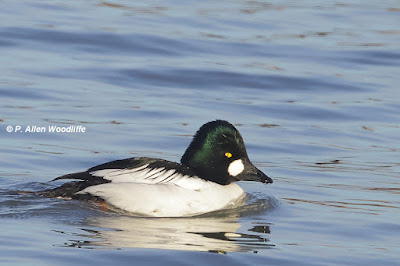
Common Goldeneye

Common Merganser

Greater Scaup
Certainly one of the primary ducks to look for in the Erieau area in the last week or so has been not one, but three Harlequin Ducks. Finding them is no easy task, as they are often across the channel and sometimes tucked in with the rocks out of view. These three are females, so not nearly as colourful as the males, but still a great species to find and photograph. I had been out looking on a couple of different occasions, including one time when there were hunters set up across the channel amongst the rocks, and the only 'ducks' I could see were decoys. The other real ducks were widely scattered and the Harlequins were not visible. However on my most recent attempt, I managed to see all three close together where the marina joins the main channel.

Among other species were Redhead....
...and Ruddy Ducks.

While out looking for Short-eared Owls, I found one or two, but was not able to get a photo. But I did manage to get a distant photo of this Rough-legged Hawk busily hunting in the same area....

....and some Wild Turkeys were feeding in a field near the Ridge Landfill. Backlit a bit, but salvageable.

I will finish up with some odds and ends. For anyone who is a regular hiker at Rondeau, you will notice that the Tulip Tree Trail has been partially closed for several weeks. The park staff have been busy making some much needed repairs in some sections. But now as one approaches the trail, parts of it look like this:

And a closer look:
For anyone interested, the American Birding Association has selected what species will be its 'Bird of the Year.' It is the Common Loon, a species well-known to Canadians!

If you would like to subscribe, or unsubscribe, to Nature Nuggets, send an email to: prairietramper@gmail.com