Showing posts with label Western Sandpiper. Show all posts

Monday, 19 December 2022

Another memorable Christmas Bird Count

 The latest Blenheim/Rondeau Christmas Bird Count is now history. It was yesterday, December 18. It has been going since 1939, making it one of the longest running counts in Canada.

The weather in some ways was not too bad. That is unless one was expecting to be out in an unsheltered part of the count circle, as I always am. The south beach of Rondeau Provincial Park is one of my favourite places in Rondeau. It can be a very pleasant outing, especially in warmer seasons. On a Christmas Bird Count, it can really test one's resolve! Such was the case yesterday.

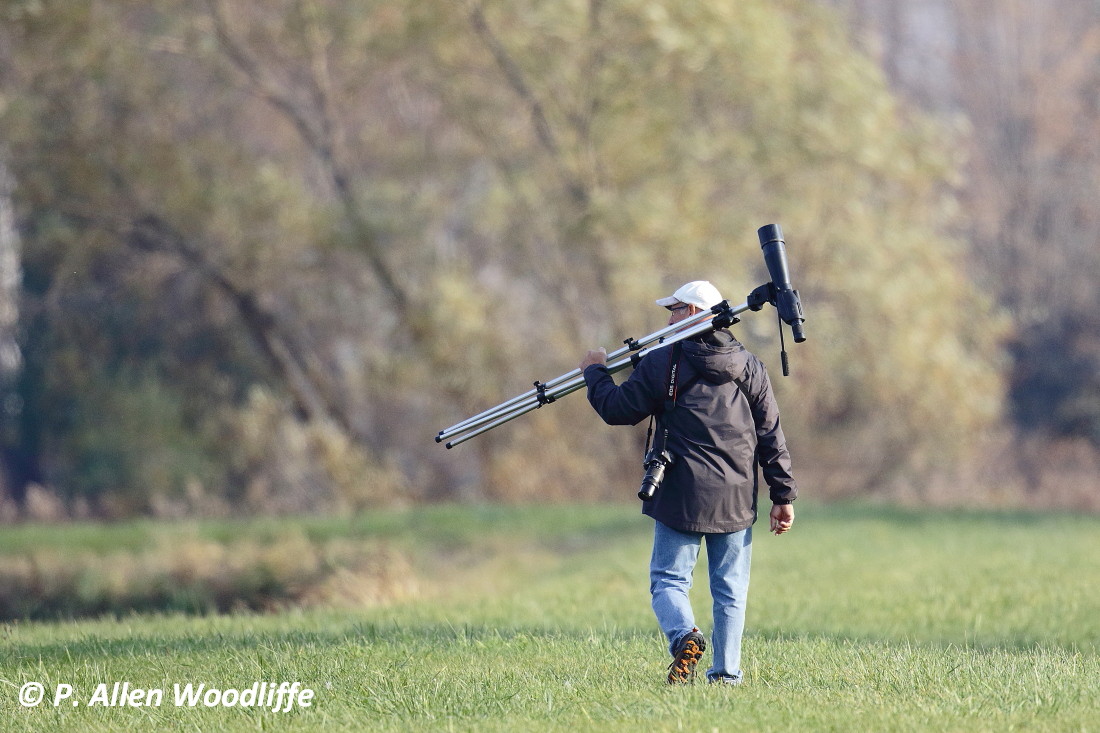
After noting the Eastern Screech Owl that regularly roosts in a cavity of an American Beech tree, I met up with Kevin, Morgan and Finn at the beginning of the west South Point Trail. From there we drove to the end of the trail, at the lake edge. At this point, as shown in the following photo, we got our trusty spotting scopes set up and spent an hour or so scanning for waterfowl or anything that was in sight. 


 Last year I had record numbers of things like Red-throated Loons, and many other species. On this day, however, we didn't see a single loon on the move. There were a few things like two species of scoters as well as numerous scaup, mergansers and such, as well as a sub-adult Bald Eagle.

Since the prospect for loons was not high, we decided to get ready for the next stage of our day. It was walking the south beach all the way to the Erieau channel and back. Except for the first 2-300 metres of this ~8 km trek, we were fully exposed heading face first into the brutal winds, which ranged from about 32-50 km/hour according to local weather stations. Being as exposed as we were along the lakeshore, it might have even been higher. The temperature was just slightly below freezing, and the wind chill was in the -18 to -20C range. Nonetheless, we struck out and went all the way to Erieau and back. After all, there were birds to be seen!

Looking through the 'scopes that we took along, and even looking through binoculars was a challenge to keep steady enough in the wind to get the kind of views we needed for viewing birds at a distance. But there were a few stands of Phragmites that helped give a bit of shelter to make it easier. Even though Phragmites is a highly undesirable invasive species, under these conditions we were glad a bit of it was there.

We had a very good variety of waterfowl, with 19 species observed overall. Even though Mallards and American Black Ducks are typically the most abundant species at this time of year, there were more American Wigeon and Bufflehead than either of those two species, although getting photos of them was not easy. After all, it is the tail end of waterfowl hunting season, and they are used to hunters approaching stealthily or luring them in to get a shot. The birds in the following photo were taking shelter at the edge of Rondeau Bay, but left quickly when they detected our movement through the grasses.

Mute Swans are not used to being shot at, so the few that we saw seemed to care less about our presence.

Ruddy Ducks were numerous as well, numbering about 75 in our territory, but not nearly as abundant as the several thousand reported along the more sheltered east side of the park. This one was injured in some way, as it preferred to rest on the shoreline, and when it decided to get farther away from us, it flopped over and had a difficult time righting itself before swimming away. It always returned to the shoreline as soon as it could. I suspect it will become a source of food for a foraging hawk or eagle before long.

We did see a single Common Loon, but not flying out over the lake. It was swimming in the relatively sheltered water of Rondeau Bay.

With the relative above freezing temperatures of recent weeks, there was a lot of exposed, unfrozen shoreline, with lots of mudflats and seaweed matter along the edges. That meant there was a high probability of finding shorebirds. A few days ago there were both Purple Sandpiper and Wilson's Snipe seen along the south beach, and we were hopeful in seeing one or both of these species. As it turned out, we didn't see either, but overall had something even better!

We saw 10 Killdeer, which were not unexpected. They were skittish, and did not allow for great photos, so we didn't bother. Killdeer are seen regularly on this count. But the other three species were not expected: one each of Spotted Sandpiper, Dunlin and Western Sandpiper! The Spotty was too skittish to get a photo of. Spotted Sandpiper is rather rare for the season, and has only been observed on two previous counts. Fortunately the other two species were quite cooperative.

On the way out, I saw the Dunlin and called over to the others in the group. We noted it could fly fairly well, at least for short distances, and it never seemed to go far. It had a bad leg, and no doubt the ice that encased its foot added to the weight as well as interfered with any streamlining necessary for efficient longer flight. It hopped on one leg and seemed to be able to forage, but I suspect it will not last long under the current weather conditions.

The ice on the foot is a little more evident in this next photo.

As mentioned, we got to the Erieau channel, about 4 km from our starting point. Here are a couple of shots from Erieau, looking east towards the Rondeau forest and our return destination. There is a bit of wooded area right at the channel, and this first photo shows that end of the sandspit looking east with Rondeau Bay on the left. With the lower lake levels for a change, it made getting out to the channel much easier, and is the first time I have been able to get to the channel in at least 3-4 years.

This next photo was taken just at the eastern edge of the wooded area, and shows how open and exposed the majority of the south beach is. The dark line in the distance is the Rondeau forest, about 4 km away.

It was part way along on our way back when a flock of wigeon took flight, and one of our group noticed a small shorebird in flight as well. Fortunately it returned to the edge of the bay, and we were able to relocate it. It didn't take too long to determine it had all the characteristics of a Western Sandpiper! It had only been recorded on this count on one occasion, back in 2001, when I had two at the very south end of the Marsh Trail. But this one wasn't a total surprise, as one had been seen over a several day period back in early December, although it was along the Erieau Marsh Trail. It is likely, although not for certain, that this bird and the one seen at Erieau are one and the same.

We got quite a few photos from a distance, just for the record. The chunky look with no 'neck', the dark bill with a slight droop at the tip, and the bit of dark streaking on the crown all fit the characteristics of Western Sandpiper. But the bird was quite tolerant of us, or at least was more interested in foraging along the shoreline than it felt any threat from us.


Just to show how relatively tolerant of us this bird was, this next photo shows Kevin hunkered down a short distance from the water's edge. Initially the bird was at least 10 metres or more away, but it decided Kevin was not a threat.....
.....and passed by less than 2 metres from him! Way too close to focus the camera on, but at this point, Kevin had an almost face to face look at this bird, which happened to be a lifer for him.

 Kevin, Morgan and Finn had to depart after we got back to our starting point, and our group ended up with 37 species. I kept on for several hours in different parts of the park and I ended up with 57 species for the day. The final number of species had not been determined for the overall count when I checked in with Keith, the compiler, but last evening the number stood at 108 species as reported by about 23 birders spread out over the count circle. There were a couple of more lists to come in, so that number might change. Nevertheless, it is likely to be the highest number for any bird count in Ontario this year, even though it is a far cry from our record of 124 species of last year. We have averaged about 108 species over the last two decades.

 There were a few highlights from other birders on the count in their respective territories, including two or more Golden Eagles (none of the next 4 photos were taken on this count)....

....several thousand American Coot...
...a few Fox Sparrows...
....and at least one Black-crowned Night-Heron. This species is rather unusual having only been seen 9 times over the 80+ years of this count. But it can stay well into the winter, depending on the water conditions. This next photo was taken along a larger creek just north of Erieau back on January 21, 2012.


If you would like to subscribe, or unsubscribe, to Nature Nuggets, send an email to: prairietramper@gmail.com


Wednesday, 7 December 2022

Western Sandpiper and other waterbirds

 Shorebirds are something you don't expect to find very often once December and sometimes freezing temperatures are the norm. But in the last week or so, a few species continue, and certainly a highlight was that of a Western Sandpiper.

The place to see this rarity, and others, was along the Erieau Marsh Trail. Unfortunately the trail wasn't always easy to access, as a large tree limb had come down on one of the windy days that occurred recently. I took note of it, along with this photo, and sent it to my municipal Chatham-Kent Trails staff contact. She indicated it would be cleared as soon as yesterday (Tuesday) afternoon, so hopefully by the time this post is sent out, the trail is clear for any hikers and cyclists who wish to use the trail.

The obstruction on the trail wasn't impossible to get through, although a bit of agility made it easier for hikers. For cyclists, that was another matter.

At any rate, getting past the fallen limb to the muddy edges of the wetland near the observation deck, was worth the effort. The shorebirds were not always in sight, as evidenced by various eBird posts indicating the shorebirds were not seen. But patience paid off, as it often does when birding, and after an hour or so, the shorebirds came into view along the more distant shore. A bit more patience paid off, as they eventually came a lot closer to the edge of a small channel that meandered through the mud flats. Even at that, a good telephoto lens and some significant cropping was required to get these.

Some observers may have initially thought of this bird as none other than a Semipalmated Sandpiper (SESA), and indeed, it does look similar. However a SESA is unheard of almost anywhere in North America at this late date, as they are far, far away on their wintering grounds. Western Sandpiper (WESA) is not common by any means, but there are a few records this late in the season even here in Ontario. I have seen them twice before, including on one of the local Christmas Bird Counts, where I had one at the south end of the Rondeau Marsh Trail even in later December!

A closer look at this individual shows some subtle, but definite, differences between SESA and WESA, as can be noted in the three photos shown here. In this individual, (a) the bill is a bit stouter, with a slight droop at the tip, (b) the bird seems a bit stockier, with almost no neck, and (c) a look at the crown shows some slight streaking. All of those features, as well as the lateness of the season, point quite strongly to WESA, and photos that were sent to shorebirds specialists for assistance agreed with this identification.


The WESA was often in accompaniment with 5-6 Dunlin, a slightly larger shorebird that is one of the most likely species to occur this late in the season. It also has a noticeable droop to the tip of the bill, but is overall quite a bit larger, and differs in its plumage pattern.
Dunlin
There were also several Killdeer with it, or at least not far away. This group of 5 Killdeer, shown next, did not come as close, so this photo is very heavily cropped as the birds were right out at the shoreline of Rondeau Bay. As many as 26 Killdeer were noted overall.

Another shorebird species, a Lesser Yellowlegs, was seen near Shrewsbury this same day, but was gone by the time I passed by that spot.

With lots of water spots still at least partially open due to the slightly warming temperatures, other water birds remain in good numbers. I saw more than 30 Sandhill Cranes while on a drive through parts of the former Dover Twp. Some were at St. Clair NWA, as shown here, while others were at a wetland farther north.

During a slow drive by some fields, some dark spots that looked out of place way out in the corner of a field caught my eye. Upon checking it more closely, and capturing a couple of photos, I noted about 14 Great Blue Herons at the far corner of the field, taking some refuge behind some shrubbery from the strong windy conditions. Also, it was a waterfowl hunting day, so they probably didn't feel quite as content in their usual wetland haunts. Seeing two White-tailed Deer very close by was a bonus, although the one had moved a little farther away when I took this photo.

Tundra Swans are pretty regular in parts of Chatham-Kent these days, especially if there are recently harvested corn fields with the stubble remaining. There are large flocks scattered in various fields near SCNWA, but even larger flocks are in fields north of Ridgetown. I believe it is partly because of the presence of the sewage lagoons where they sometimes rest for the night, but mainly because there are far more untilled fields with corn stubble still available for feeding. In Dover Twp, most harvested corn fields are already worked up, or at least have had the stalks cut smaller and have been baled to then be used as a covering for some vegetable crop to protect it from harsher winter weather.

A couple of days ago while driving north of Ridgetown, I came across several fields with swans, totaling well over 3000 birds. Along one quiet gravel road, the swans were quite close to the road. But as soon as I slowed up, the birds showed an immediate concern and at least started to head farther inland.

Once I stopped with the camera lens showing out the window, most of the birds took flight to points farther inland.
For some reason this first year bird, as evident by its continuing grayish neck and the pinkish bill, gleaning corn or whatever from the edge closest to the road, showed no concern. I was able to get several photos that were hardly cropped at all.

Sticking with a water bird theme, sort of, here is a photo of one of a couple of dozen American Tree Sparrows which, along with some Dark-eyed Juncos, a couple of Fox Sparrows and an American Goldfinch, was enjoying some of the puddles along Harrison Trail at Rondeau. Certainly not a true water bird, but...

Carolina Wrens pop up once in awhile, still singing to proclaim their territory.
The Eastern Screech Owl still shows up from time to time, peeking out of its cavity in the American Beech along Bennett Ave.
The woods are certainly quiet these days, an excellent time to enjoy the tranquility of the world of nature!

If you want to subscribe, or unsubscribe, to Nature Nuggets, send an email to: prairietramper@gmail.com


Thursday, 24 November 2016

Peep conundrum and other late autumn shorebirds

Birders will be aware of the recent conundrum surrounding a small peep seen at the Blenheim Sewage Lagoons in the last couple of weeks. Peeps, for the benefit of non-birders, are those smaller shorebirds of the genus Calidris, and are sometimes difficult to identify to species due to their general similarity as well as their various stages of moult which seem to overlap.

Peeps are fairly rare as the autumn progresses. Certainly by late October and early November, any peep is quite rare in southern Ontario. Indeed, the majority of them have made their way to South America! So the presence of a peep at the sewage lagoon, mixed in with larger, more distinct shorebirds known as Dunlin, was out-of-the-ordinary to say the least.

One of my first shots of this peep, between two Dunlin
Two of the 40+ Dunlin present Nov 18, 2016

Steve Charbonneau was one of the first to notice this peep at the lagoons during his almost daily visits there.
Steve C on the prowl for birds at the Blenheim lagoons

There are a number of useful birding references that we used to attempt to sort out this bird:
-Sibley Guide to Birds (Sibley)
-Advanced Birding (Kaufman)
-The Shorebird Guide (O'Brien, Crossley and Karlson)
-Shorebirds: An Identification Guide (Hayman, Marchant and Prater)

In addition to using these references, other birders got photos of various angles and in various light. Some of these photos were sent off to other birders, most of whom had more experience with these peeps than Steve and I had.

What follows does in no way attempt to consolidate all the detailed information found in these references pertaining to these two species!

Given the subtle differences, and decent but perhaps less than ideal views, it was first called a Semipalmated Sandpiper (SESA). SESA are some of the most abundant smaller shorebirds in eastern North America. Now had some of us, myself included, clued in to the fact that SESA are almost unheard of anywhere on the North American continent this late in the season, we might have given it a bit more careful scrutiny. We certainly had entertained the thought of it being a Western Sandpiper (WESA), which is one the most abundant smaller shorebirds in western North America, but not seen very often in the east. But in spite of our considering WESA, some of the features didn't seem quite right.

For example, WESAs have a longer, finer tipped bill than the shorter, somewhat chunkier bill of a SESA. In addition, the bill tip of a SESA is often slightly enlarged, not finely tipped, and the bill of a WESA usually has a slight droop to the tip.

Peep on the right has a slightly bigger tip?
bill doesn't have much of a drooping tip, if any
Complicating this 'bill' issue is that the bills of females are typically somewhat longer than that of a male, and there is some overlap even between the species. Even at that, the comparative length differences is a matter of millimetres. So using the bill characteristics is not all that reliable.

The shape of the head is marginally different, with some field guides suggesting that a SESA is more rounded compared to a slightly more squarish look to the head of a WESA.

WESA is slightly slimmer and longer looking than a slightly chunkier looking SESA. Of course given the time of year and the relative cold temperatures (it got below freezing on more than one occasion, and ice had formed around the edge of the cells), perhaps the bird was cold and has fluffed up its feathers, given the appearance of being a bit more chunky looking.

Since WESA have slightly longer legs, they are more often found feeding in deeper water, often belly deep, compared to SESA which is more likely to be found in shallower water and closer to the edge. There is some variability, of course. This bird seemed to stay in shallower water than the larger Dunlin, however.


What might have been especially helpful is having one of each species side by side, since the differences are somewhat relative, and this bird was only in the vicinity of the much larger Dunlin.

Dunlin and presumptive WESA
Moult is important to consider. The young WESA apparently begin their moult as early as August, even when they are on their breeding ground before they head south, whereas young SESA often do not moult much until they get to their wintering ground in the southern hemisphere.

SESA August 24, 2016
SESA, Sept 4, 2016
And that leads us to the feature that perhaps was the deciding factor in the consensus of this bird being a WESA. Under certain light conditions, especially in close-up views, there is a slight but distinctive rufous colour on their scapular feathering. SESA does not have this rufous colouring this late in the season.
A bit of rufous on the scapulars
So given all of the above, it seems the collective opinion of this bird is that it is a WESA. Some field guides state that distinguishing a winter WESA from a winter SESA is one of the more difficult birding challenges, and that certainly was the case with this bird.

Check out Blake's blog for some additional details as well as some of the November and December records of WESA in Ontario.

When trying to ID this bird, I even spent a bit of time trying to determine if it was one of the other even rarer small Calidrids that are Asiatic in range, but have been recorded in North America on extremely rare occasions. The two closest in appearance would be the Red-necked Stint and the Little Stint. One of the most distinct differences, if it is visible, is that the two latter species do not have any webbing between their toes, whereas WESA and SESA both have some webbing. I noted that one of my photos showed the feet and webbing, so I could not make this into a Calidrid from Asia!


Other shorebird species can linger or even turn up in November. As mentioned earlier, Dunlin are around, and more than 40 were seen accompanying the WESA a few days ago. The colder weather in the last couple of days seems to have encouraged them to move on, as only half a dozen or so were seen earlier today.

One rare but regular shorebird that always attracts attention is the Purple Sandpiper. It is a medium-sized, dark and chunky shorebird that shows up in late fall. I had been looking for them at Erieau on Tuesday of this week, but was not successful in finding any. Yesterday morning, I got word from Jim Burk that one was seen at the pier at Erieau. Unfortunately I had to go off to Burlington and would not have a chance to look for it yesterday. When I got home in the evening, I discovered that several birders were able to get some excellent close photos of this species, and in at least one case, actually captured two of them in one image.

Check these out:
Garry Sadler's ebird list and image here.

Steve Charbonneau's ebird list and images here.


Today, Thursday, I made a point of heading to Erieau. Unfortunately the first couple of hours were unsuccessful in finding this species. There were several other birders in the area looking as well, and we did console ourselves with decent looks through the 'scope of the bright male Harlequin Duck that has been around the rocks on the far side of the breakwall for a few days. The other birders eventually left, but since I didn't have anything pressing, I drove over to where the fish tugs often are moored, as it gives a better angle of view to the rocks on the east side of the breakwall across the main channel. I scanned back and forth for awhile through the 'scope, and all of a sudden a Purple Sandpiper hopped up on a rock in excellent view but only for about three seconds before dropping down, not to be seen again. So no photos this day. This next photo is a scan of a slide that I was able to get of a very cooperative Purple Sandpiper back in my film days. It was taken on the main pier heading out into the lake.


With the relatively mild weather continuing, it is only a matter of time to see if any of these shorebirds are around for the Blenheim/Rondeau Christmas Bird Count less than a month away. Over the years, I have had about 10 species of shorebird in my area, so I am hoping for some shorebird activity!