Showing posts with label Eastern Fox Snake. Show all posts

Saturday, 24 August 2024

An endangered orchid, and lots of odes

 Sometimes the days go slowly, and other times the days go more quickly. Some of it is weather dependent, and at other times, it is in dealing with some of the other major issues in the aftermath of Marie's passing. I have been out roaming around locally as time, weather and energy permits.

One of the priorities in the world of nature during August, is to do some monitoring of an endangered orchid, and specifically the Nodding Pogonia (Triphora trianthophoros), which is only known in Canada to occur at Rondeau. Its location is for the most part, being kept a secret by park staff due to its small nature and endangered status.

 I have been following this special orchid for about 50 years. Given that the individual flowers only remain open for a day, there have been some good days this year, and other days not so good. I expect to devote an entire blog post about this species and my 2024 experience with it, so keep an eye out for it.

This is also a good time to try and track down various species of odonates or odes (damselflies and dragonflies), and I have had some moderate success in this. They are best found near water, of course, and my 'go to' places include a few spots along both the Thames River and Sydenham River, as well as Clear Creek Forest Provincial Park, St. Clair NWA and Rondeau.

On one occasion as I was heading to Clear Creek Forest, I came across an unfortunate scene.

This large adult Eastern Fox Snake, which is a Species At Risk and with its main population primarily limited in Canada to southwestern Ontario, had been crossing Talbot Trail when a vehicle ran over it.

At Clear Creek Forest, things were a bit more positive, and I have been there on more than one occasion to photograph odes and a few other things that provided an opportunity.

Blue Dasher

Blue Dasher

Calico Pennant

Double-striped Bluet

Eastern Amberwing

Eastern Pondhawk female

Eastern Pondhawk male

Variable Dancer

Widow Skimmer

None of the aforementioned odes are particularly unusual, although the Double-striped Bluet is probably the most uncommon of the ones shown. I particularly liked the Variable Dancer, the only damselfly where the male is an obvious pink/purple colour. I did see the rarer Comet Darner on a couple of occasions, but very briefly and there was no opportunity for a photo.

There are typically a few other invertebrates that get my attention here, such as:

Bronzed Tiger Beetle

Great Spangled Fritillary

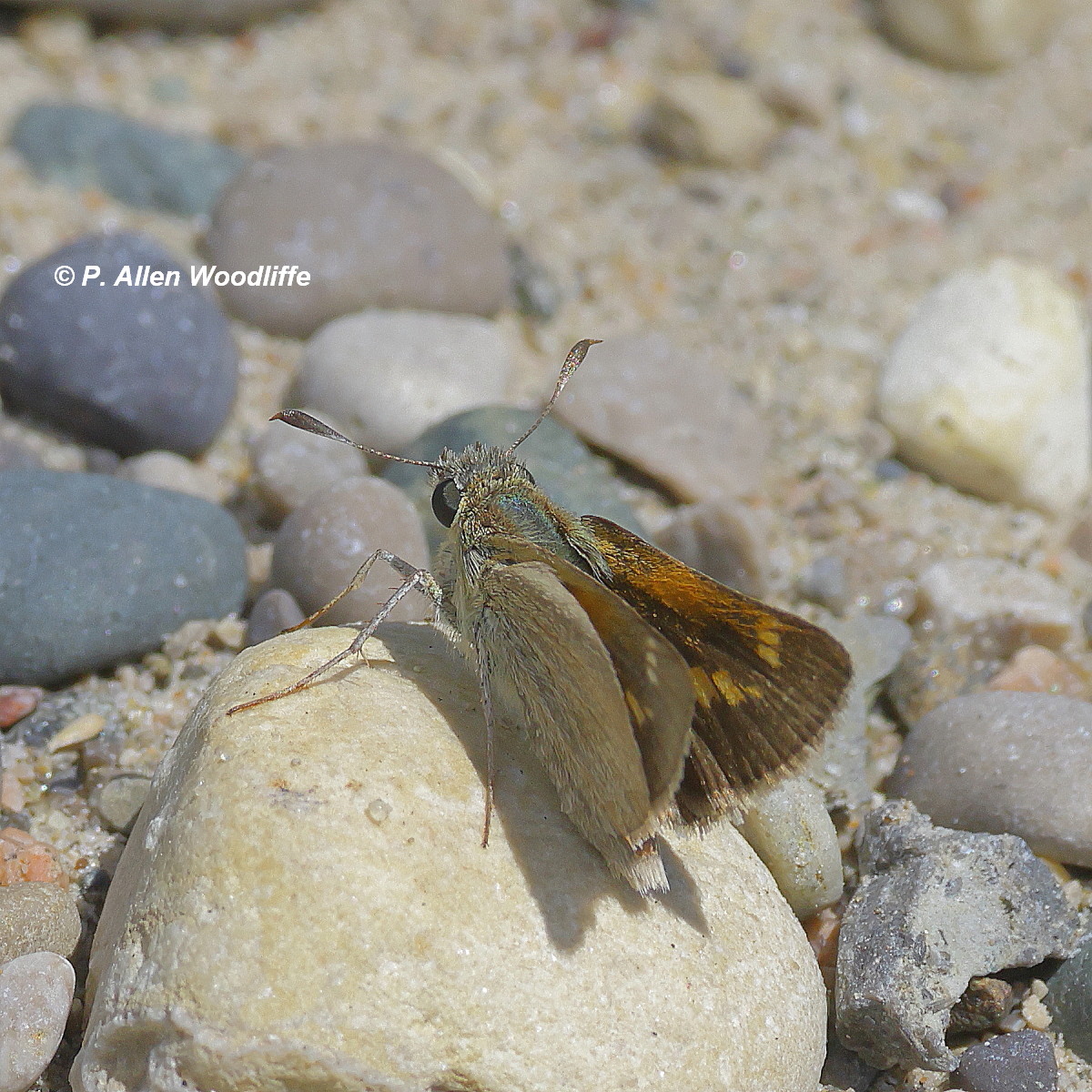
Tawny-edged Skipper

Viceroy

The local rivers are definitely worth checking out, as they feature some of the more challenging damselflies to see and photograph. With all of the rain over these past several months in their overall watersheds, however, the water levels continue to be a bit high, and the banks are a bit muddy and therefore slippery. Caution to gain access to even the limited places must be adhered to! Nonetheless, with care and a bit of time, there are a few that make it worthwhile. These include:

American Rubyspot

Blue-fronted Dancer

Ebony Jewelwing female
This next one is very rare, even considered endangered in Canada. It is the Smoky Rubyspot and for the most part, is very limited to the rivers of southwestern Ontario.

While on the prowl for odes, I came across this American Snout butterfly busily feeding on some goldenrod. It is not a common species, and I hadn't seen one for quite awhile so was glad to get a few photos.

At other places, such as Rondeau and SCNWA, there are various odes as well, although none that I came across were particularly uncommon.

Halloween Pennant
There were lots of Ruby Meadowhawks, shown next, flitting around.
I only got a frontal photo of this one, and it is likely a Ruby Meadowhawk as well, although there are at least a couple of others that look similar and a careful look at some more obscure feature is required to make definite call on it.

While I was busily focussing on the meadowhawks, I saw this caterpillar roaming around. It is the larval form of the American Dagger Moth.

And on various milkweed pods, I came across clusters of the Large Milkweed Bug.

Monday, 31 May 2021

Rare birds and herps

 I've been fortunate to have encountered quite a few rare, threatened or endangered bird and reptile species lately. Of course in the part of the province, the chance of encountering such creatures is higher than many other parts of Ontario. Some are permanent residents, while other are regular breeding species. Still others are just passing through, or way off their usual migration route.

I've also been fortunate to have encountered them with some very good photographic conditions. A prime example is the Acadian Flycatcher, currently featured at the head of my blog and in a previous post. It continues to cooperate, and I have gotten some additional good photos while showing it to a park staff person.


On another occasion, I specifically went out to see if one of the breeding Prothonotary Warblers would be cooperative. I had photographed it on a couple of earlier occasions this month, but always from a distance. On this day, as I approached its breeding territory on the boardwalk, several other folks were trying to photograph something almost right over the boardwalk. As I cautiously approached, it was clear that a female Prothonotary was busily poking through some spider web material. After a few moments of this, it headed directly to the nest box about 25 metres away. Although the light wasn't ideal, I shot it anyway. It is slightly less brilliantly coloured than its male counterpart.

That was the only time she was out in our area, but the male flew in very close on several occasions. At times the light wasn't great, but at other times is was about as good as one could hope for. These next two examples of several photos I took are some of the best ones I think I have ever gotten! They were taken with the full frame 5D3 and the 500mm lens, and not cropped very much.

I was quite pleased with the photographic efforts so far, as I should be. Yet while I was arriving home, I got a text message from Steve that two Glossy Ibis had been reported at the end of Angler Line, a bit south of Mitchell's Bay, along Lake St. Clair. My plans to arrive home were delayed a bit, as I headed towards the spot.

None were visible at first, and even after Steve arrived we saw no sign of them. As we were pondering what to do next in our search, one flew up from behind some cattail vegetation, then another and then a third! They didn't land in a good spot for photography, but they moved around a bit more and eventually landed out on the open side of the cattails. It turned out there were four of them. They were still a bit farther away than we would have liked (a typical birder/photographer lament :-) but eventually we got some fairly good record shots. These are heavily cropped.


I still hadn't been at the right place at the right time to see any Whimbrel, in spite of spending the equivalent of several hours over several days looking out at the lake. The south beach was a likely spot, so Kevin and I headed out to check on whatever we could find out there. The south beach has always been one of my favourite spots in Rondeau, due to the sometimes wild weather conditions as well as the wide open view of the lake, bay and marsh. The narrow sandspit is a draw for birds. So off we went. We saw many of the more common shorebirds, including Ruddy Turnstone, Semipalmated Plover, Semipalmated Sandpiper, Sanderling, etc. And eventually we came across 28 Whimbrel, which at first were not giving us any good photo ops, but eventually they did.


There were hundreds of gulls, most of which were Ring-billed and Herring, but we also saw a Lesser Black-backed Gull, and a single Little Gull which we saw clearly but were not able to photograph until it headed out over the lake. This is a poor record shot.

We also had a very cooperative Eastern Tiger Swallowtail stop by to sip something from a small area of wet sand.

On the herp/reptile side of things, some of them are becoming more visible in the warmer and sunnier weather. Unfortunately this first one, an Eastern Hog-nose Snake, will not be with us any more. It is, quite sadly, quite dead. Some folks had seen it writhing around, and at first thought it may have just been going through some of its defensive antics the species is know for. It will wriggle and writhe, and play dead when it feels threatened and any escape route is not available. However this one was fighting for its life and breathing its last. It was disgorging two American Toads, the largest one is shown below. But after a few minutes it stopped moving. I was told about it (thanks, Mike!), and after I came off the trail I had been hiking, went to the spot and found it quite dead. The second photo shows a close-up of its upturned snout, from which it gets its name. There was some speculation that the snake had bitten off more than it could chew, and was choking on the two toads. It didn't make a lot of sense, since even though toads will inflate themselves when threatened to appear much too big for a snake to consume, this snake species has a couple of teeth towards the back of its mouth specifically designed to puncture a toad, deflate it and make it manageable. So I was interested to hear from Kevin that when he checked it out, he could tell that there were several parts of its rib cage and vertebrae that had been crushed. While there was no outward injury visible, which would have been the case had it been run over by a car, it is most likely that the snake was run over by a bicycle and did enough damage to effectively kill it. So sad, when you consider that it is a species at risk in Ontario, and quite a rare find at Rondeau since it occupies the pine-oak forest community and edges, which are some of the most developed parts of the park. And this one was a very mature individual which had the potential to add to its population for a few years yet.


A much more positive encounter was one I had with this Eastern Fox Snake, a species at risk, seen on Harrison Trail. I had just come back from birding, and noticed it quite motionless. I suspect it was hoping its pattern might make it less noticeable and that I would pass it by. After getting a few shots with my camera I did, and when I came back a few minutes later with a different lens combination hoping for some better photos, it had moved on.

Ontario's only lizard, the Five-lined Skink, is another species at risk, and occurs in various spots at Rondeau. While I was hiking along Tuliptree Trail, I noticed at least three of them meandering around a large fallen tree.
On another occasion, I came across an Eastern Ribbon Snake basking on the same tree trunk. It is also an official species at risk.
It looks very much like the much more common Eastern Garter Snake, but has a more defined black and yellow striping, as well as a small white spot in front of its eye.
So much to see and photograph!


Wednesday, 19 May 2021

Bluebells and birds

 It is the time of year when I try and get out to see the fabulous displays of Virginia Bluebells. It isn't a species that is very common at all, but where it occurs, can cover some extensive parts of the forest floor. Some readers may remember a post I made about a year ago, which among other photos, featured these two:


I particularly liked the first one, right along the river, and hoped to get to the same spot this year to improve on that photo, using a tilt\shift lens to get an even closer view of some of the flowers while showing the river in the background.

A few days ago I went to the Sydenham River Nature Reserve, where those two photos were taken. While there were lots of the bluebells, the flowers had continued to develop even in the cool, wet and overcast conditions so that by the time the sunny skies occurred, almost all of them were past their best. The overall photos turned out sort of okay, but even after looking over hundreds of plants, I only found one that didn't either have at least some brown on the blue petals, or entire petals had fallen off. I didn't attempt to get to the spot along the river where the first photo was taken. It would have been a lengthy trek, carrying lots of camera gear, with the bluebells past their best. Nonetheless, it was still an exhilarating time, enjoying the peaceful atmosphere while feasting my eyes on the blue and green spectacle, and listening to things like Yellow-bellies Sapsuckers giving their characteristic drumming. 

Here are some of the better ones I got this year:


This is the only one that was still early enough in its development to not show any senescence.

On that particular outing, I also stopped for a few moments to view the Bald Eagle nest right along the highway. A single young bird was busily jumping up and down at the edge of the nest, flapping its wings to develop its muscles so that it would be prepared to fledge from the nest in the very near future.

While watching the young eaglet, hoping for a less obscured photo, one of the adults arrived to sit above it, keeping an eye on its youngster.
I also came across a new spot for Eastern Flowering Dogwood, a legislated Species At Risk, right along the road.

On the birding front, it has been fairly steady, but one has to cover a lot of area to see many species unless you happen to bump in to a nice flock. The Erieau Rail Trail can be fairly productive, although with the birds busily feeding, they are often hard to photograph. A short time ago I was there and had more success seeing birds than photographing them.

 American Redstarts are becoming quite common, and some will remain to nest in nearby woodlands.

This Barn Swallow, another Species At Risk, took a moment out of its ongoing swooping for insects, for a rest.
Bay-breasted Warblers are not an early migrant warbler, but are building in numbers as they continue on to their northern breeding grounds.
Magnolia Warblers, another more northern breeding species, are quite common.
Gray Catbirds are fairly abundant.
Creatures that were motionless and easy to photograph included this Eastern Fox Snake, my first of the year. This one was half in the rock rubble, so perhaps had just emerged on this relatively warmish day.
 Midland Painted Turtles continue to be abundant, sunning to increase their internal metabolic activity so the developing eggs inside will be ready for laying in the next few weeks.

So many things to see at this time of year!