A busy time of year, and I am behind in my photography. But I thought it important to at least provide an update regarding the Piping Plovers.
This endangered species used to breed at Rondeau and area. Like about 80 years ago. According to the A. A. Wood unpublished manuscript Birds of Kent County, Ontario, it was cited as "numerous between Erieau and Erie Beach. Nest not found but young observed." Specifically at Rondeau, it was found regularly as recently as the 1930s, with two nests found in 1937 and another in 1938. Undoubtedly there were other nests and pairs which went undocumented due to the extensive habitat and general lack of observers. So officially, the last nest recorded at Rondeau was 84 years ago.

And it looks like the wait will continue. One or more of this pair that showed up in May was observed over a period of about 8 days. There were indications of one creating a scrape for a potential nest site, and certainly they were somewhat vocal. However eventually the male seemed to have disappeared, and even the female tended to wander farther than what a normal territory would seem to be, and then she disappeared as well. There have been no observations since about the first of June.
It is uncertain exactly what happened. They were exhibiting territorial behaviour at a time when they would normally be establishing a territory and even beginning to lay eggs. The fact that they also stayed for several days indicated that they had a definite interest in the south beach of Rondeau. Factors that could have played a part in their abandoning this site include the number of people illegally enjoying the south beach, with campfires, picnics, kids and dogs running around and such. It wasn't just one or two events. On a nice day especially on a weekend, there can be dozens of people scattered across the beach area. Since this part of the park is rarely if ever patrolled by park staff, some of the general public treat it like a free beach for such activities, and even camping short term. It is difficult for park enforcement staff to access it, but for the beach goers from Erieau, it is quite easily accessible. Or it could have been that there were quite a few predatory type gulls spending time on the beach, although on occasion the plovers were observed chasing potential predators of this type. Regardless, the results were not what was hoped for.
Maybe next year....
I was out a couple of times. On one occasion Steve C and I went out, right at the end of May, to see what we could find. This first photo shows what part of the south beach looks like, with the forested end (locally referred to as Gull Island, but it isn't an island at all) and Erieau off in the background.
We saw an Osprey perched, scanning for a meal no doubt, but it wasn't easy with Red-winged Blackbirds dive-bombing it.
There were shorebirds, such as Ruddy Turnstones.....
....Sanderlings.....
...and a few Whimbrel. And gulls, of course. This first one is a Herring Gull, which has been banded. I sent the band information away, and found out that it was banded at Port Clinton, Ohio, slightly less than a year ago.
A Lesser Black-backed Gull, next, has been around for awhile.
There were at least two Little Gulls, both non-breeding youngsters, in the area. On occasion three birds have been seen either along the south beach or from Erieau.
The marshy areas are becoming rather colourful, with Bullhead Lily scattered across the quiet water...
....and Southern Blue Flag popping up in various places.
I've been to a few other places, and one of the highlights was to see this American White Pelican along the Erieau Rail Trail.
It was present for several days, fortunately.

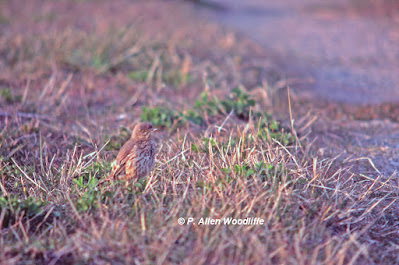
A day or so later, there was a Tricolored Heron that showed up in the same place. I didn't get to track it down, and it was only there for a briefer period. It would have been nice to see, but I have seen that species before. Interestingly my first observation of this southern heron, which at the time was called a Louisiana Heron, was back in late April of 1981. I had seen one fly southward along the east beach of the park. I thought it would probably end up spending some time in the ~1000 acre marsh, so the next day I headed out looking. But before I saw the heron, I got distracted by another bird which I could not identify. Even after getting two or three highly experienced birders to join me and take a look, it took a little while before we decided on it being a Sage Thrasher! That was Rondeau's first, and at the time was one of the few Ontario records ever. Fortunately the bird stuck around for almost three weeks of the spring birding season, allowing many hundreds of birders the opportunity to get out towards the south half of the marsh trail and see this bird. This was, of course, well before the digital era, and my photo equipment wasn't the greatest back then. But here is one of the photos I got of that bird.
An occasional stop at the Keith McLean Conservation Lands has resulted in a few shorebirds, including
 |
| Dunlin |
 |
Semipalmated Sandpiper
|
 |
White-rumped Sandpiper
|
I spent a bit of time at a private wetland complex in the Mitchell's Bay area and had some good photo experiences, shooting
 |
Black-crowned Night-Heron
|
 |
Great Egret
|
An Osprey flew by with a Bullhead in its talons. I didn't see it take it to a nest site, so it was probably just looking for a spot to eat in peace and quiet and away from being harassed by things such as this Eastern Kingbird.
A real treat was to get a quick look and photo of this Eastern Spiny Softshell Turtle, up on a bank basking. They are very fast moving turtles, and it scampered back in to the canal. It is an endangered species.
The light for this wasn't the greatest, so I got a better vantage point and waited, hoping for its return. It didn't but I had a few Northern Map Turtles come by for a bit of sun. They are definitely more common than the softshell turtle, but still considered a Species At Risk.
Just north of Mitchell's Bay, along the north shore trail, I had the usual couple of Sandhill Cranes feeding on a berm.
And this Caspian Tern remained on this mud flat long enough for me to get a photo.
So all in all, it was a good few days, but the results of the Piping Plover were not so satisfying.
If you want to subscribe, or unsubscribe, to Nature Nuggets, send an email to: prairietramper@gmail.com


